- 320 pages
- English
- ePUB (mobile friendly)
- Available on iOS & Android
eBook - ePub
About this book
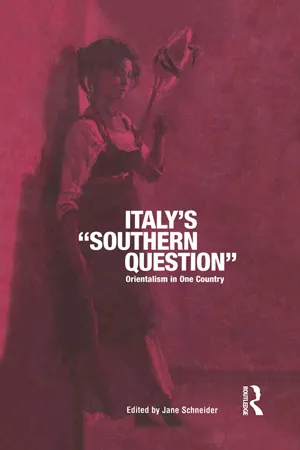
The 'Southern Question' has been a major topic in Italian political, economic and cultural life for a century and more. During the Cold War, it was the justification for heavy government intervention. In contemporary Italy, a major part of the appeal of the Lombard League has been its promise to dissociate the South from the North, even to the point of secession. The South also remains a resonant theme in Italian literature. This interdisciplinary book endeavours to answer the following: - When did people begin to think of the South as a problem? - Who - intellectuals, statisticians, criminologists, political exiles, novelists (among them some important southerners) - contributed to the discourse about the South and why? - Did their view of the South correspond to any sort of reality? - What was glossed over or ignored in the generalized vision of the South as problematic? - What consequences has the 'Question' had in controlling the imaginations and actions of intellectuals and those with political and other forms of power? - What alternative formulations might people create and live by if they were able to escape from the control of the 'Question' and to imagine the political, economic and cultural differences within Italy in some other way? This timely book reveals how Southern Italians have been affected by distorted versions of a complex reality similar to the discourse of 'Orientalism'. In situating the devaluation of Southern Italian culture in relation to the recent emergence of 'anti-mafia' ideology in the South and the threat posed to national unity by the Lombard League, it also illuminates the world's stiff inter-regional competition for investment capital.
Information
Part I
The Genesis of the Question
1
Before the Southern Question: "Native" Ideas on Backwardness and Remedies in the Kingdom of Two Sicilies, 1815–1849
Marta Petrusewicz
Recently, a historian wrote that "the Southern Question was not born with the political unification of Italy; it had its roots in the history of the Mezzogiorno" (De Rosa 1993: v). But this is an unusual position. For most scholars today, the "Question," understood as a global representation of the Mezzogiorno's people and heritage, was born after 1860, in the wake of the Risorgimento. The arguments are mainly about what there was in the process of Unification that caused the "Question" to crystallize as a discourse. Some scholars, following the well-known thesis of Emilio Sereni (1974), claim that, by broadening the market, unification simply exposed what was already there — namely the structural "backwardness" of the southern economy. Others, in the Gramscian tradition, see Unification and its aftermath as having provided an opportunity for southern agrarian conservative interests to strike a mutually advantageous alliance with northern industrialists; this so-called "historical bloc" in turn caused the economic dualism that condemned the South to the role of a permanent periphery. Yet others, influenced by the dependency school, interpret unification as straightforward colonization. In one, economically-oriented, version of this scenario, northern colonizers forcibly destroyed the existing industries of the South in order to turn the Mezzogiorno into an outlet for northern commodities and a source of cheap and compliant labor. In a second, more political version, the emphasis is placed on the "conquest of the South," the conqueror overthrowing, manu militari, a legitimate southern dynasty and pillaging the territory that was defeated.
It is not only that scholars have generally located the origins of the "Southern Question" in the Risorgimento. Until recently, its dominant representation has been composed of economic, social and political elements measured against broad Enlightenment-inspired criteria of progress or development. The result was a series of narratives, at times romantic, at times merely condescending, of failure: the failure or betrayal of the intellectuals; the failure of the popular classes to understand the terms, forms, and directions of collective action; the failure of developmental institutions, from the late-eighteenth-century Cassa Sacra to the Cassa per il Mezzogiorno after the Second World War; the failure of self-government and autonomy. From the beginning of the 1980s, however, in the political climate generated in part by the Northern League movement of Umberto Bossi, the Southern Question has been rephrased as a cultural and emotional one. It has become the Question of the North as much as of the South - an issue that seems to produce more anxiety in the North than in the South.
Meanwhile, southern historians and social scientists — the "new meridionalists" — have begun to challenge this frozen image, questioning the very concept of the "South." Numerous studies have shown that there was not one South, nor even two, as in Manlio Rossi Doria's famous "l'osso e la polpa," but many. And, whereas earlier the issue of poverty loomed large among the southern problems that scholars felt compelled to address, today other concerns have taken over, namely uncertainties surrounding law, and the rights, duties, and obligations of citizens. At the same time, social and intellectual historians and literary critics have studied the very idea of the South as a social construction.1
In this chapter, I propose to contribute to the current debate in the following ways. First, I explore the cultural climate prevalent in the Neapolitan Kingdom of the Two Sicilies, also called the Kingdom of Naples or the Neapolitan Kingdom, before the "Southern Question" was articulated, and in particular the southern perception of this country's backwardness and possible remedies. Second, I reexamine the chronology of the Question, proposing the year 1848 as the critical moment in its emergence. Third, I suggest that Southerners themselves played a leading role in constructing the South as a Question. The discussion focuses on the ideas that were prevalent among intellectuals and in what we might call public opinion in the Kingdom, and on the social practices that helped to disseminate these ideas internally before 1848, and in exile afterwards. I concern myself here only with the discourses of the broadly defined southern intelligentsia, and shall not discuss their implementation. Nor shall I examine 'popular' representations of the country's condition.
The culture of the southern intelligentsia had its roots in the 1700s. Some aspects of the Neapolitan Kingdom's eighteenth-century history help to clarify this background. Unlike many other political entities of the Italian peninsula, the Kingdom of Naples was a sovereign state, having achieved independence from Spain in 1734. No longer a vice-royalty, it was governed stably by one dynasty, which rapidly became "neapolitanized." The passage from vice-kingdom to kingdom meant the possibility of pursuing an autonomous foreign policy, of exploring and expanding new commercial opportunities, and of dealing with the Papacy from a position of strength. On the domestic front independence meant a lessening of burdensome fiscal pressures and the possibility of breaking with the Spanish court tradition, in which corruption, violence, and intrigue were integral aspects of rule. Although the new Kingdom remained within the Spanish sphere of influence, its independence gave considerable impetus to administrative and economic reforms.
Many attitudes and innovations of the new age had been anticipated by the Spanish and Neapolitan reformers of the seventeenth century, but had received scant attention in their day. Now, in the climate of a remarkable recovery and a widespread effort to improve the material conditions of the country, royal councilors and men of letters read their predecessors' works assiduously, had them republished, and experimented with putting their ideas into effect. The minister Bernardo Tanucci's attempts at reform, with all their limitations, were remarkably coherent, aimed at restricting feudal privilege, restructuring public finance and taxation, reorganizing the prison system, and reducing the wealth and power of the Church. He successfully carried out the formation of a modern cadastre, reorganized the annona system, negotiated a Concordat with the Papacy, and expelled the Jesuits. In European eyes, Naples, although still believed to be surrounded by a countryside of exotic barbarie, was one of the more important cultural capitals. The splendid San Carlo theater was built in this period, art and music flourished, and the first archaeological excavations at Herculaneum and the discovery of Paestum took place. And what was of particular significance was that intellectuals began meeting and conversing in salons.
The young king Ferdinand, who reigned from 1759 (through Tanucci) to 1825, was eager to build up the strength of his state and make a name for himself. Although personally not well educated, he saw himself as a member of that vigorous cohort of "enlightened despots" that included his own father, Charles I II of Spain, Frederick II of Prussia, and Joseph II of Austria. Like those monarchs, Ferdinand was at once a political conservative and a committed modernizer. Unwilling to concede a constitution, he nevertheless sought to improve the economic and social conditions of the kingdom. He encouraged industry, commerce and innovation, and attempted a fiscal reform. The Cassa Sacra, created after the huge earthquake in Calabria in 1783 to expropriate and sell ecclesiastical lands, was an attempt at a quite radical land reform that involved the redistribution of the Church's wealth and the curtailing of baronial privileges. In the end, though, the Cassa Sacra was a deceptive façade, like the contemporary villages of Potiomkin, behind which the old regime remained intact. By 1789 the French Revolution and the attendant regicide had generated the "great fear" that afflicted monarchies everywhere, and Ferdinand's program of reforms was abandoned and even reversed. Enlightened despotism, as Benedetto Croce once said, threw off the cloak of the enlightenment and remained just despotic.
And yet, while his reforming spirit lasted, Ferdinand sought the opinions of scholars, courted their approval, and tolerated critical writings so long as they did not question the institution of dynastic monarchy. And the intelligentsia responded enthusiastically. For example, poets and scholars acclaimed the San Leucio royal manufacturing complex, an experimentation in "harmonious," almost Utopian, industrialization; the poet Eleonora Fonseca Pimentel even wrote an "Ode" to it. Meanwhile, the University of Naples was revamped, creating the first chair of political economy in continental Europe, which went to the noted economist, Antonio Genovesi. It was a period of intellectual giants whose writings made the Neapolitan Enlightenment famous in Europe.
One of the main questions pondered by these "public intellectuals" was the backwardness of the Neapolitan Kingdom. Despite their different theoretical and political perspectives, there emerged a common catalog of evils that were argued to be hampering the country's progress. Its main points were widely publicized. First, the feudal institutions of primogeniture and entailment, and the ecclesiastical institution of mainmorte, were faulted for immobilizing huge tracts of land, preventing the formation of a land market. Second, the iniquity of the fiscal system burdened and stifled the entrepreneurial and laborious classes while favoring parasites. Third, baronial jurisdiction, never just, was made even more unfair and arbitrary by the indifference of its absentee administrators. Fourth, the ambiguity of the land tenure system, and in particular, the absence of clearly defined private property in land, made agricultural improvement impractical. Fifth, the poverty, ignorance and superstition of the peasants hampered social and economic "improvement".
Thus articulated, the catalog was not, however, a specifically southern question, but a question of "normal backwardness," common to most of Europe, its various elements applying, mutatis mutandis, to many other countries. Moreover, the Neapolitan intellectuals who drew up the list relied upon the same pool of references that enlightened reformers were turning to everywhere. Throughout eighteenth-century Europe, reformers attributed social and economic evils to one structural cause, feudalism, and argued that, if progress were to occur, feudalism would have to be abolished.
These eighteenth-century ideas, and the actions they inspired, constituted the collective cultural memory of the Neapolitan intelligentsia of the century to follow. But the younger generation was drastically separated from its enlightened maîtres à penser by the experiences of the period 1799-1815: revolution, civil war, foreign rule, and more than one defeat. The year 1799 had been a revolutionary year in Naples, and numerous students of the great masters — for example Vincenzo Cuoco, who was to author a rich essay on the Neapolitan Revolution of 1799, an invaluable source for future scholars (Cuoco 1913 [1800]) - participated in both the revolutionary activity and the Parthenopean Republic that overthrew the monarchy. This group directly experienced the collapse of national institutions, the flight of the monarch, the misinterpretation of their Republic's goals, the terrible "God and King" popular crusade against the Republic, and the eventual massacre of the "Jacobins" at the hands of the Neapolitan lazzari. Victims of the mob's rage, they lived through or witnessed cruel and semi-legal trials, mass executions, prison, and exile. In 1806, after the French kings, Joseph and then Murat, had been installed in Naples by Napoleon's troops, the survivors returned, committed to supporting the alien monarch in his modernizing effort. There followed the "happy decade," at the end of which the Bourbon Kingdom of Naples was restored, forcing this intelligentsia into exile yet again. The result was a decimated generation, wounded and humiliated, its members burdened with a sense of responsibility for having been witnesses and accomplices to the surrender of Neapolitan sovereignty before the generals of foreign armies. The burden was heavy even when the invader represented Reason. Considering themselves "patriots," they had, after all, given in to French demands. According to one of the most interesting of them, Cuoco, they had thereby rendered their revolution "passive." Furthermore, they had to endure a restoration as passive as the revolution.
From those experiences came a new way of thinking, which flourished during the Restoration. The post-Napoleonic intelligentsia did not reject the problematique of the cohort of the revolution, but did challenge many of their founding ideas, methods, and political choices. Their main attack was directed at the universalism of the Enlightenment, the idea of the blind application of foreign recipes, contempt for native customs and institutions, and remoteness from popular sentiment.2 Yet another generation, influenced by romanticism like its contemporaries in other parts of Europe, searched for local traditions, spirits of the local territory. Rediscovering their own national past, they found inspiration in their Neapolitan forebear, Gianbatista Vico, who had held the chair of rhetoric at the University of Naples in the early 1700s. Vico's Scienza Nuova was prescient in arguing for an approach to historical studies that took different societies on their own terms, rather than in terms of universalizing categories like "human nature." The new "romantic generation," if we can refer to them thus, initiated programs of local action, making use of new regional forms of sociability and communication such as associations and journals. Their emphasis on "localism" made them influential in the provinces. All told, the new way of feeling, thinking, and relating helped, as it spread, to form a middle-class "opinion," increasingly focused on organizing and inhabiting what might be called a "civic" space.
The period 1799-1815 changed not only the Weltanschauung of the intelligentsia but also of the country. "Murat fell in 1815; but the laws, usages, opinions, and hopes which had been impressed on the popolo for ten years, did not fall with him" — thus wrote Pietro Colletta (1967 [1834] book VIII: 701), himself a protagonist of the "decade." Most importantly, feudalism had been abolished. Although the Bourbons returned to the throne in 1815, they did not, and could not, restore feudal institutions. On the contrary, bound by treaties and advised by common sense, Ferdinand maintained as much of the administrative and institutional structure, and as many of the appointments, of the "decade" as possible. The fact that he made no attempt to reinstate feudalism, which had for so long been considered the primary obstacle to any successful reform, conferred upon the Restoration regime a character of its own, different from that of the Ancien Régime. This second restoration was also less radical and less vengeful than the first, the absolutism of the years 1815—1848 being considered generally mild. For example, freedom of the press and of expression was broad, even if punctuated by periods of aggressive censorship. Moreover, although secret societies were banned by law, this stricture on free association was more effective against the reactionary Calderari than against the better-organized progressive or radical Carbonari. Similarly, Ferdinand signed a new Concordat with Rome; but its most restrictive stipulations (such as the power to censor or suppress any books or journals deemed heretical) were not enforced. The King was a reactionary, but not a fanatic. More like Louis XVIII than Charles X, he favored at least some form of modernization.
The main bone of contention between the throne and the intelligentsia was the question of the constitution and of representative government. Between 1815 and 1848 there unfolded a succession of promises and negotiations, another revolution, concessions, abrogations, repression and forgiveness. In 1815 the intelligent...
Table of contents
- Cover
- Half Title
- Title Page
- Copyright Page
- Contents
- Acknowledgments
- Introduction: The Dynamics of Neo-orientalism in Italy (1848–1995)
- Part I The Genesis of the Question
- Part II Critical Theory from the South
- Part III Alternative Representations and Realities
- Part IV Conclusions
- Notes on Contributors
- Index
Trusted by 375,005 students
Access to over 1.5 million titles for a fair monthly price.
Study more efficiently using our study tools.
Frequently asked questions
Yes, you can cancel anytime from the Subscription tab in your account settings on the Perlego website. Your subscription will stay active until the end of your current billing period. Learn how to cancel your subscription
No, books cannot be downloaded as external files, such as PDFs, for use outside of Perlego. However, you can download books within the Perlego app for offline reading on mobile or tablet. Learn how to download books offline
Perlego offers two plans: Essential and Complete
- Essential is ideal for learners and professionals who enjoy exploring a wide range of subjects. Access the Essential Library with 800,000+ trusted titles and best-sellers across business, personal growth, and the humanities. Includes unlimited reading time and Standard Read Aloud voice.
- Complete: Perfect for advanced learners and researchers needing full, unrestricted access. Unlock 1.5M+ books across hundreds of subjects, including academic and specialized titles. The Complete Plan also includes advanced features like Premium Read Aloud and Research Assistant.
We are an online textbook subscription service, where you can get access to an entire online library for less than the price of a single book per month. With over 1.5 million books across 990+ topics, we’ve got you covered! Learn about our mission
Look out for the read-aloud symbol on your next book to see if you can listen to it. The read-aloud tool reads text aloud for you, highlighting the text as it is being read. You can pause it, speed it up and slow it down. Learn more about Read Aloud
Yes! You can use the Perlego app on both iOS and Android devices to read anytime, anywhere — even offline. Perfect for commutes or when you’re on the go.
Please note we cannot support devices running on iOS 13 and Android 7 or earlier. Learn more about using the app
Please note we cannot support devices running on iOS 13 and Android 7 or earlier. Learn more about using the app
Yes, you can access Italy's 'Southern Question' by Jane Schneider in PDF and/or ePUB format, as well as other popular books in Social Sciences & Economic History. We have over 1.5 million books available in our catalogue for you to explore.