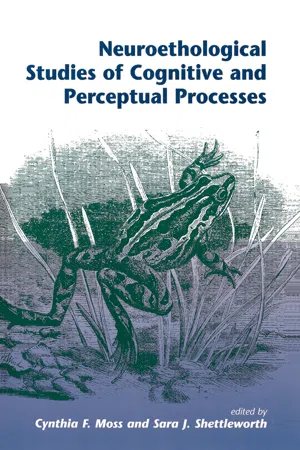
eBook - ePub
Neuroethological Studies Of Cognitive And Perceptual Processes
- 336 pages
- English
- ePUB (mobile friendly)
- Available on iOS & Android
eBook - ePub
Neuroethological Studies Of Cognitive And Perceptual Processes
About this book
How do bats catch insects in the dark? How do bees learn which flowers to visit? How do food-storing birds remember where their hoards are? Questions like these are addressed by neuroethology, the branch of behavioral neuroscience concerned with analyzing the neural bases of naturally occurring behaviors. This book brings together thirteen chapters presenting findings on perceptual and cognitive processes in some of the most active areas of neuroethological research, including auditory localization by bats and owls, song perception and learning in birds, pitch processing by frogs and toads, imprinting in birds, spatial memory in birds, learning in bees and in Aplysia, and electroreception in fish. A variety of approaches are represented, such as field studies, psychophysical tests, electrophysiological experiments, lesion studies, comparative neuroanatomy, and studies of development. Each chapter gives an up-to-date overview of a particular author's research and places it within the broader context of issues about animal perception and cognition. The book as a whole exemplifies how studying species and their particular specializations can inform general issues in psychology, ethology, and neuro-science.
Information
1
Introduction: Neuroethology, Perception, and Cognition
Abstract
Neuroethology is the branch of behavioral neuroscience concerned with analyzing the neural circuitry of naturally occurring behaviors. Perhaps uniquely among the specialized subfields that have grozon out of ethology, neuroethology retains a commitment to an integrated approach to behavior, combining Tinbergen’s (1963) four questions, about causation, function, evolution, and development. Inherent in the neuroethological research program is a tension between studying ethologically meaningful behaviors and using artificial situations to dissect them. The chapters in this book illustrate a range of ways to resolve this tension. Some of them provide evidence that the causal factors important in the field can remain surprisingly relevant in very artificial contexts. A second potential tension is that generated by studying the impressive specializations of particular species while searching for scientific generalities. Several chapters illustrate hozo choosing species with particular specializations provides a means to address general issues about perception and cognition.
Introduction
Neuroethology is firmly grounded in Tinbergen’s (1963) “four whys” of ethology: the “whys” of immediate causation, development in the individual, evolution, and current function. While trying to answer the causal “why” question in the most complete and detailed sense possible, by tracing the neural circuitry of ethologically meaningful behaviors, neuroethologists also have in mind the other three why s. As the chapters in this book illustrate, this means that neuroethological research takes place in a context of information about the natural history, evolution, and development of the species under study.
Much neuroethological research analyzes the causation of particular behaviors in particular animals. How do bats catch insects in the dark? How do birds learn to sing? How do frogs hear potential mates and fish see potential rivals? Questions like these are distinctively different from those in the rest of behavioral neuroscience which commonly concern general issues about structures and neural function: What does the hippocampus do? What synaptic changes underlie learning? Many such questions, like the one about hippocampal function, are most relevant to mammals, and they are most often studied in convenient laboratory species like rats, mice, and monkeys. In contrast, a hallmark of neuroethology is its eclectic choice of species. Bats, frogs, owls, and bees, all are candidates for a neuroethological analysis. Solving a functionally important problem like catching prey or finding mates in a striking and unusual way sometimes seems to be one of the chief qualifications for the study of particular species.
This book contains a sample of current research on the neuroethology of cognitive and perceptual processes. A more general book on neuroethology might also have included research on motor systems and motivation. Research on a wide range of species and information-processing problems is represented here, including learning about flowers in bees (Gould, Chapter 2), classical conditioning in invertebrates (Colwill, Chapter 3), song learning, neighbor recognition, imprinting, food-storing and migrating in birds (Chapters by Cynx, Weary, Bolhuis, and Healy), processing of calls by frogs (A. Simmons and Buxbaum, Chapter 9), and processing of visual signals by fish (Fernald, Chapter 10). One whole section of the book (Chapters 11–13) describes mechanisms for auditory localization of prey in two now-classic cases, bats and owls. The chapters vary in their relative emphasis on neuro and ethology. Some chapters that are almost entirely about behavioral work emphasize how a thorough understanding of phenomena at that level is a necessary underpinning to sound analyses of neural mechanisms. For instance, Colwill (Chapter 3) prescribes some previously under-emphasized criteria for choosing appropriate preparations in neural analyses of associative learning. Dooling et al. (Chapter 6) describe behavioral methods for detecting species-specific processing of vocal signals, methods that could be used to select stimuli for later neural analyses of possible specialized perceptual mechanisms. A wide range of methods from neuroscience is also represented, including lesions, electrophysiology, hormonal manipulations, neuroanatomy and, in Healy’s chapter, the comparative evolutionary approach.
Bats, bees, and songbirds inhabit a very different world from ours (Boden, 1988). Each of these worlds poses its own challenges to the person attempting to understand it. Nevertheless, the research unraveling the diverse animals’ specialized cognitive and perceptual abilities that is represented in this book does have common themes. Some of these arise out of two sorts of tensions inherent in the neuroethological research program. One is that between keeping the focus of research on behavior as it takes place in its natural context and using artificial situations to dissect it. The other tension is that between fascination with the remarkable specializations of individual species and science’s equally compelling search for generalities. Ways in which these apparent conflicts are productively resolved can be seen throughout the book.
The Field and the Lab
The most obvious way to avoid the potential conflict between dissecting behavior and keeping it “natural” is to do one’s experiments in the field. Gould’s chapter on flower learning by honey bees exemplifies this approach. Using von Frisch’s time-honored technique, Gould entices foraging bees to artificial flowers and then manipulates the flowers’ characteristics to discover what the bees are responding to. It is but a small step from here to teaching a hungry forager how to find food in the laboratory, as described in the chapters by Moss and Simmons and by Haresign et al. on audition in bats. It seems reasonable to assume that these animals are using their abilities to the fullest whether they are sitting on a platform locating phantom targets for a reward of mealworms or flying around outside catching real insects.
Students of bird song face a more difficult task than people wishing to analyze the sensory and neural control of foraging, because singing takes place in a more limited context than foraging. Someone like Weary (Chapter 7), wishing to understand how a male songbird’s territorial defense reflects his ability to recognize his neighbors will have as background the results of experiments in which birds have been induced to respond to recorded songs in the field. However, as Weary points out, recognition cannot be separated from response in the field. If a subject responds to two songs in the same way, this may not mean he does not recognize them as coming from two different individuals. Moreover, because the females’ responses to song are often difficult to observe, whole realms of questions about song recognition are impossible to answer in the field. And, unlike the case with the fish described in Fernald’s chapter, the questions that can be asked about captive birds are limited by the unwillingness of many species to breed in captivity. (Notice that the willingness of budgerigars to carry out their whole life cycle in the laboratory is one feature making them attractive subjects for the studies described by Dooling et al. in Chapter 6.)
Until recently, most behavioral work on song learning was based on analyzing the songs of adults that had been exposed to different early experiences (see review in Chapter 4). As in field studies of song recognition, with this method performance (here, singing a given song) is equated with learning. However, the three chapters in this book on bird song describe experiments in which evidence of learning and discrimination has been obtained independently of singing and territorial behavior by training hungry birds to work for food with songs as discriminative stimuli. But when the animal’s primary motivation as well as its environment have been changed, how can we be sure of what we are measuring? Cynx (Chapter 4), Dooling et al. (Chapter 6), and Weary (Chapter 7) all meet this question head on, and all answer, in effect, that “the proof of the pudding is in the eating.” In other words, performing a food-rewarded auditory discrimination can validly be used to study the song system if the operant behavior is sensitive to the same variables that affect singing or response to song. And food-rewarded operant behavior is surprisingly sensitive to such variables.
Cynx (Chapter 4) directly addresses this issue in his experiments on song discrimination learning in zebra finches. For instance, he shows that the speed with which these birds learn a discrimination between two zebra finch songs depends on the subjects’ gender and the season. The latter is a surprising result because zebra finches had been thought to be opportunistic breeders, not influenced by seasonal cues such as day length. As Cynx describes, his findings have stimulated a re-examination of the factors that control readiness to breed in this species. Further, the fact that zebra finches’ discrimination between zebra finch songs is influenced by hormone levels, whereas their discrimination between canary songs is not, suggests that the neural system for acquisition and production of species-specific song is somehow involved in song discrimination learning in adult zebra finches. The fact that a subject’s own song is especially salient in food-rewarded operant song discriminations also supports this conclusion.
Accepting that food-rewarded responding in a laboratory is controlled by the same variables that influence behavior in functionally meaningful situations in the wild opens up for the researcher a whole kit of well-established tools for analyzing cognitive and perceptual processes. The cognitive mechanisms used in mate choice or territorial defense become amenable to the same methods applied to “general” cognitive processes in humans and other species. Dooling et al. (Chapter 6) provide one of the more sophisticated examples. Using a clever behavioral test, they have gathered data suitable for multidimensional scaling to reveal how birds categorize the vocalizations and faces of their own and other species. Work of this kind will likely be used more and more to address issues in behavioral ecology concerning how the forms of animal signals are perceived by their receivers and how they may have evolved (cf. Guilford & Dawkins, 1991).
Specializations and Generalities
Nearly every chapter in this book contains examples of animals’ biases to learn best about or respond best to species-relevant events. Gould (Chapter 2) describes honey bees’ bias to learn about the best cues to nectar. Dooling et al. (Chapter 6) describe how budgerigars, canaries, and zebra finches each discriminate better among calls of their own species than among songs of the other two species. A perceptual specialization for processing species-specific sounds is also evident in the frogs discussed by A. M Simmons and Buxbaum (Chapter 9), though its neural and developmental basis may be different. Moss and Simmons (Chapter 11), Haresign et al. (Chapter 12), and Moiseff et al. (Chapter 13) describe the auditory specializations of bats and owls for nocturnal foraging. As Moiseff et al. discuss, these are necessarily somewhat different because echolocating bats themselves are generating the sounds they use for localization whereas owls must listen for sounds made by the prey.
In his chapter, Gould refers to both biases and specializations. By a bias, Gould means a tendency to selectively respond to or learn about some features of flowers. Any perceptual system has biases, in that it does not respond equally to all stimuli. But, as Gould points out, learning theorists in psychology have traditionally assumed that learning is without bias. Whatever the animal could perceive it could learn about, more or less indifferently. Gould reviews developments within the last 20 years that have led to modification of this belief and acceptance by many psychologists that learning, like perception, is fine-tuned to the requirements of each species’ ecology (for further discussion see Rozin & Schull, 1988). Attempts to document this fine-tuning, however, are fraught with difficulties. For the implication is that the observed biases are adaptive specializations (Rozin & Kalat, 1971). Supporting this conclusion is as difficult as supporting any hypothesis about adaptation in evolutionary biology (see Williams, 1966). It may appear self-evident that the fit between the details of some behavioral mechanism and the animal’s natural history is too intricate to have arisen by chance. Ideally such arguments for adaptation can be taken further with comparative studies involving large numbers of species, as Healy’s chapter illustrates. However, in behavioral work at least, comparisons can also be done within a species to test assertions about the specialization of a given system to do a particular job.
It is obvious, for example, that the visual system is specialized for processing light and the auditory system, for sound. The eyes simply don’t respond to sound nor the ears to light. However, it is less obvious that there are specialized systems for learning and cognitive processing. Suggestions that such specializations exist have occasioned much debate among those concerned with both animal and human cognition. Just as in perception, however, learning and cognition can pose a number of different functionally incompatible requirements, and these would be expected to lead to the evolution of separate, adaptively specialized, memory systems within the same animal (Sherry & Schacter, 1987; Shettleworth, 1993). In their development of this idea, Sherry and Schacter (1987) cite as an example the different requirements of song learning and food-storing in some passerine species. In song learning in many species, passive exposure to song at a restricted period early in life results in learning which is retained for many months, if not the bird’s lifetime. In food-storing, at least in some species, the locations of a constantly changing inventory of food caches must be remembered for a few days or weeks and then forgotten. Similar functional incompatibilities can be identified among candidates for separable memory systems in people. Healy (Chapter 5) discusses anatomical evidence for separable song and spatial memory systems in birds and how evolution has fine-tuned them for the requirements of each species.
To these specialized memory systems in birds can be added the recognition system involved in imprinting, as discussed by Bolhuis (Chapter 8). He describes a particularly well worked out example of a species-specific bias or predisposition. Young chicks will become filially attached to a wide variety of artificial stimuli in the laboratory. However, they show filial behavior most readily to a stuffed hen of the Burmese junglefowl, the ancestral form of modern domestic chickens. This does not mean, though, that they learn most quickly about junglefowl. Rather, a predisposition to respond to junglefowl hens combines with a learned preference for a familiar imprinting object. As Bolhuis shows, this species-specific predisposition itself depends in subtle ways on age and experience.
Once it is accepted that cognitive and perceptual processes are the products of evolution (and ethologists have always accepted this; Fernald’s chapter can be consulted for a fine example), it becomes obvious that the same forces producing specializations and differences among species are also responsible for generalities. This point is made forcefully by Weary (Chapter 7) in his discussion of the types of stimuli birds use to recognize their own species’ songs. He suggests that both similarities and differences can be understood in ...
Table of contents
- Cover
- Half Title
- Title
- Copyright
- Contents
- 1 Introduction: Neuroethology, Perception, and Cognition
- PART ONE Specializations in Learning
- PART TWO Specializations for Perception of Biologically Relevant Stimuli
- PART THREE Specializations for Spatial Perception and Orientation
- List of Contributors
- Index
- About the Book and Editors
Trusted by 375,005 students
Access to over 1.5 million titles for a fair monthly price.
Study more efficiently using our study tools.
Frequently asked questions
Yes, you can cancel anytime from the Subscription tab in your account settings on the Perlego website. Your subscription will stay active until the end of your current billing period. Learn how to cancel your subscription
No, books cannot be downloaded as external files, such as PDFs, for use outside of Perlego. However, you can download books within the Perlego app for offline reading on mobile or tablet. Learn how to download books offline
Perlego offers two plans: Essential and Complete
- Essential is ideal for learners and professionals who enjoy exploring a wide range of subjects. Access the Essential Library with 800,000+ trusted titles and best-sellers across business, personal growth, and the humanities. Includes unlimited reading time and Standard Read Aloud voice.
- Complete: Perfect for advanced learners and researchers needing full, unrestricted access. Unlock 1.5M+ books across hundreds of subjects, including academic and specialized titles. The Complete Plan also includes advanced features like Premium Read Aloud and Research Assistant.
We are an online textbook subscription service, where you can get access to an entire online library for less than the price of a single book per month. With over 1.5 million books across 990+ topics, we’ve got you covered! Learn about our mission
Look out for the read-aloud symbol on your next book to see if you can listen to it. The read-aloud tool reads text aloud for you, highlighting the text as it is being read. You can pause it, speed it up and slow it down. Learn more about Read Aloud
Yes! You can use the Perlego app on both iOS and Android devices to read anytime, anywhere — even offline. Perfect for commutes or when you’re on the go.
Please note we cannot support devices running on iOS 13 and Android 7 or earlier. Learn more about using the app
Please note we cannot support devices running on iOS 13 and Android 7 or earlier. Learn more about using the app
Yes, you can access Neuroethological Studies Of Cognitive And Perceptual Processes by Cynthia Moss,Sara J Shettleworth in PDF and/or ePUB format, as well as other popular books in Biological Sciences & History & Theory in Psychology. We have over 1.5 million books available in our catalogue for you to explore.