- 228 pages
- English
- ePUB (mobile friendly)
- Available on iOS & Android
eBook - ePub
About this book
Celluloid Mushroom Clouds is a historical account of how the movie industry responded to specific economic and political forces over the postwar years. Joyce Evans investigates the transformation of the imagery associated with atomic technology found in Hollywood films produced and distributed between 1947 and 1964. Incorporating qualitative and quantitative research methods, over 90 are analyzed in terms of their historical context and the context of film production and distribution.
Information
1
Hollywood After the Bomb, 1946–1953
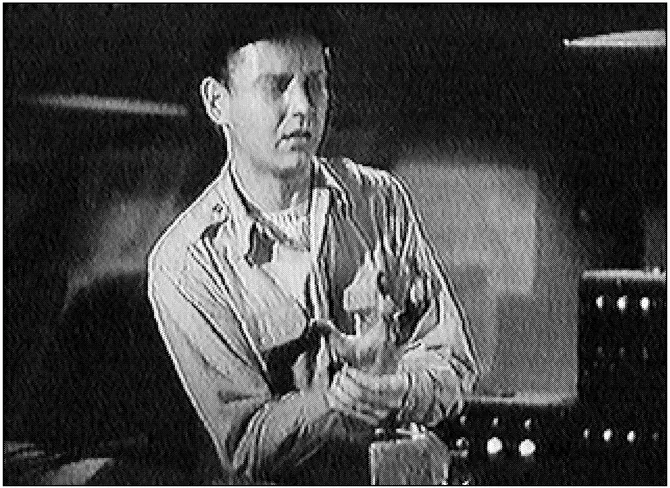
Fictitious scientist Matt receives a fatal dose of radiation while working on the A-bomb in The Beginning or the End? (1947)
BY 1946, ONLY ONE YEAR AFTER THE ATOMIC BOMBS had been dropped on Japan, Hollywood studios were anxious to capitalize upon the public interest in what Life magazine called the "biggest event since the birth of Christ."1 In the aftermath of the military use of this new technology, an urgent public discussion arose via newspapers, magazines, and radio broadcasts. Rhetoric postulating upon the potential danger of atomic power pervaded American culture at this time. For example, dialogue from a 1946 public-affairs program from the University of Denver explained: "A time bomb is under your home. It is ticking slowly away. Even while I talk, even while you listen, time is running out. America must act, if we are to choose the road of atomic peace rather than atomic war."2
The American media began devoting massive and direct attention to atomic issues; over three hundred articles on the topic of the atomic bomb were published in major popular periodicals such as Time, Life, and Reader's Digest in 1946 alone.3 American society at this time was certainly relieved by the war's end, but with the euphoria brought about by Japan's surrender came a gradually growing anxiety and uneasiness about the atomic future.
Commercial entertainment films produced during this period provide insight into Hollywood's initial attempts to frame and present atomic topics while still realizing their main goal in film production—profit. The antitrust measures, economic troubles, and direct government pressure on film content had not yet taken full effect, and Hollywood studios felt some freedom of experimentation with genre and style in exploiting nuclear themes. Although pressure from exhibitors exerted a fundamentally conservative influence that encouraged the production of standard formulaic fare imbued with the country's dominant ideological stance, topics that overtly questioned the government's atomic weapons policy and atomic testing program did appear to a limited extent in Hollywood products.
Such experimentation took the form of various science fiction and dramatic fare presenting paradoxical and contradictory representations of atomic development and use. Early films that portrayed attempts to justify the bomb's recent use (The Beginning or the End? 1947) were mixed with comic portrayals of atomic tests (The Atomic Kid, 1954). A variety of science fiction scenarios were developed in this new Hollywood genre, including narratives presenting the use of atomic power as weaponry (Sombra, the Spider Woman, 1947; The Flying Missile, 1950) and survival adventures in postholocaust environments, both on Earth and on other planets (Red Planet Mars, 1952; Rocketship XM, 1950). Such products allowed the studios to cater to public tastes and direct government scrutiny, while questioning the ethical implications of nuclear development in ways unheard of later in the 1950s. A few independently produced films promoted a view of atomic technology that was overtly against atomic proliferation and the official government nuclear agenda (Five, 1951; The Day the Earth Stood Still, 1951).
Initially, most Hollywood films that addressed atomic issues merely incorporated the new public interest in all things atomic into scripts already under production, or as a plot element in a formulaic spy thriller. Immediately after the bomb's military use, an atomic element was added in postproduction to the plot of The House on 92nd Street (1945). First Yank in Tokyo (1945) worked military footage of the devastation in Hiroshima into its low-budget production in an attempt to be the first to capitalize upon the recent event. Noted directors such as Alfred Hitchcock, Orson Welles, and Fritz Lang didn't hesitate to hint at atomic substances and secret atomic plans in their otherwise standard dramatic mysteries in films such as Cloak and Dagger (1946), Lady from Shanghai (1948), and Notorious (1946).
In their attempts to reap profit from public interest in atomic technology, Hollywood producers devoted much film time to describing and presenting mysterious atomic substances, military technologies, and depictions of atomic explosions. Films like White Heat (1948) and The Beginning or the End? (1947) are exemplary in their emphasis upon the image of the explosion. The initial fascination with these relatively realistic images gradually waned as they became a common, familiar film image; the explosions were replaced by more bizarre and imaginative technological creations in the science fiction films of the 1950s.4
Hollywood Production Contexts: 1945–1953
What type of film was actually made, and how atomic-related content was selected and constructed, depended to a large extent on the specific context of production. Although 1949 marked the time when the old style of production was slowly being undermined by government antitrust cases, this traditional Hollywood mode of production, developed in the early years of the industry, remained for the moment unchanged. During this period, five major film companies dominated the screen in the United States. The largest was Warner Brothers, followed by Metro-Goldwyn-Mayer (MGM), Paramount, RKO, and Twentieth Century Fox. With stables of in-house stars, writers, directors, producers, and technicians, each of the majors produced from forty to sixty films per year. In 1945, these majors owned most aspects of production, distribution, and exhibition, enjoying almost complete vertical integration of the industry.
These studios produced practically all the class-A features, the films that were played in the best theaters and generated the most revenue. However, a large market existed for "B" class movies as well, produced for release in the second segment of a double-feature program. This tradition of presenting two-for-one double bills was originally created to lure back shrinking movie audiences in the 1930s. The practice of block-booking marketing, in which a distributor was forced to purchase an entire package of pictures, both A and B class, ensured a financial return on any product a studio produced. B movies, which were produced inexpensively and quickly, were often a testing ground for new writers, directors, and producers, and for experimentation with new topics. The amount of money spent on a given picture was presumably related to the anticipated drawing power of its combination of talent and production values.5
Until the early 1950s, most Hollywood film production was characterized by the "studio system" developed during the initial development of the feature film. The major studios were organized by hierarchical departments, with work allocated to centrally organized departments, all under the control of the studio head. For example, MGM boasted a workforce of six thousand, who were distributed into twenty-six departments involving all aspects of filmmaking. The studio head was primarily concerned with business affairs, negotiating contracts with stars and ensuring that the studio operated efficiently. After the story idea, or property, was selected, it was then assigned to an associate producer, who saw the project through to completion. MGM employed one head of production and ten subordinate associate producers, each specializing in a particular genre of film such as action, comedy, or western.
The relationships within a major studio among the various departments handling production, distribution, and exhibition were most important in respect to determining the type of film made. Enjoying the most advantageous positions by virtue of the division of labor in the industry, film distributors and exhibitors were more closely in touch with the moviegoing public than were the in-house producers. They helped determine the genre of picture to be made, the number of pictures in each cost class, and the type of story. Generally, the studio's head of distribution announced the number of films desired for the upcoming season based upon an estimate of what could be profitably sold, and the chief executive announced the amount of money available for the season's production schedule.6
Therefore, company executives and exhibitors, together with sales estimates, determined the total amount of money to be spent, how funds would be distributed among various classes of pictures, and the deadlines for completion and distribution. The exhibitor group controlled the purse strings and accounted for more than nine-tenths of the studio's invested capital and two-thirds of the industry's income. Distributors also exerted a conservative influence upon film content, tending to promote previously profitable formulas over the experimental or untried. In the early 1950s, the government mandated the breakup of the studio oligopoly, and the subsequent rise of independent production and exhibition industries eventually altered film content.
Most films with nuclear themes were B movies, produced on a low budget tor exhibition on the back end of a double feature; they were not meant to showcase stars or directors. Because of the low priority and limited investment the studio allotted to these products, more experimentation was allowed in testing new ideas for film formulas. The monopoly that the major studios enjoyed over film production and distribution, which ensured a market for any studio product, also contributed to the flexibility that in-house producers were allowed in experimenting with nuclear images. However, by the early 1950s, the effects of the economic restructuring of the film industry, the changing government agenda, and the developing Cold War ideology would drastically inhibit the portrayal of this specific issue in film content.
The differences in the presentation and emphasis of atomic issues in Hollywood film between the late 1940s and early 1950s can be illustrated by comparing two major motion pictures produced in the docudrama genre by one of the largest film studios, MGM. The variations between the two docudramas embody the political concerns of the American public and the economic pressures on the Hollywood industry at the time of each film's production. Produced immediately after the war, The Beginning or the End? (1947) typifies the view of the atomic bombing of Japan presented to the American public immediately after World War II by the media and official government channels.7 The film captures the ambivalence and contradictory nature of the moral implications of the atomic bomb that was then being expressed in public dialogue. Its narrative overtly questions the ethical nature of the bomb's development while adopting official government rhetoric to justify its recent use. The film's producer also appropriated residual cultural elements to link the atomic discovery to contradictory metaphors of its destructive and constructive potential.
In comparison, Above and Beyond, produced only five years later in 1952, illustrates how the themes and images concerning the development and use of the atomic bomb evolved from the seminal depictions that expressed the controversial and contradictory nature of atomic technology to more Hollywoodesque presentations embodying Cold War ideology and promoting government interests. Both films deal with the same historical period and the same sequence of factual material, that of the Manhattan Project and the bombing of Hiroshima and Nagasaki, but each selectively emphasizes different historical aspects of those facts. It is these differences that reveal the changing historical context—the evolving transformations of the film industry and their influence upon the appropriation and construction of nuclear themes.
MGM and the Atomic Bomb: The Beginning or the End? (1947)
The people of our century unleashed the power which might, for all we know, destroy human life on this Earth. . . . We know the beginning, only you of tomorrow, if there is a tomorrow, know the end.
(The Beginning or the End?)
Louis B. Mayer, chief executive of the second-largest Hollywood film studio, Metro-Goldwyn-Mayer, was anxious to produce the first film documenting the development of the atomic bomb. He was interested in capitalizing upon the anticipated prestige the studio would attain in explaining the history of atomic development to curious audiences, while placing itself at the forefront of the public debate concerning the potential future use of the technology.
After buying the story from Hal Wallis of Paramount, who owned the rights, the studio jumped into the production of a fabricated account of the Manhattan Project, proposing to create an in-depth presentation of the implications of the bombing of Hiroshima and Nagasaki.8 Titled The Beginning or the End? the film took its name from a quotation by President Truman about nuclear development. The script consisted of a fictional framework presented in a pseudodocumentary style, it went on to become a seminal example of the docudrama genre. The story of the development of the atomic bomb was presented against a romantic subplot involving a fictitious young scientist, Matt, and his bride.
MGM planned to adapt the atomic bomb issue to the previously successful documentary-style format. Norman Taurog was selected to direct the film, largely because of the success of his past work, particularly the documentary film Young Tom Edison (1940). The producer, Sam Marx, hoped The Beginning or the End? could be made in a similar style and tone and garner the same box-office success. Unfortunately for MGM, however, the ethical implications and the competing ideological interests surrounding the atomic issue were not as easy to manipulate into a simple entertainment format, as the more hygienic scientific discovery of electricity had been. The potential benefits to humanity of the atomic bomb were dubious, and although the dominant consensus embraced the idea that the use of the weapon had helped shorten the war and save thousands of American lives, a myriad of unanswered questions as to the morality and future direction of atomic technology were being debated within American society.
MGM promoters focused upon the controversial nature of the subject as a viable selling point. Offered as adult entertainment that questioned the morality of the bomb and provided justification for its use, The Beginning or the End? was advertised as a film of "unique value to all humanity." Since many facts concerning the bomb's development had yet to be publicized, the producer sought to capture a large audience by emphasizing that the film would reveal new information. Publicity posters promised to present the "true story of the A-bomb, the story of the most Hush-hush secret of all time."9 This strategy of presenting in a docudrama format a transparent document of historical fact is evident in the film's opening sequence. In the first few scenes, the audience is presented with an explanation of the film's intended purpose. It was produced, according to the narration, for the sole purpose of being placed in a time capsule, not to be opened for five hundred years. Canisters of film, supposedly copies of the film the audience is about to see, are shown being buried in a grove of California redwoods. Replicating common newsreel style, the voice-over proclaims: "A message to future generations! Come what may, our civilization will have left an enduring record behind it. Ours will be no lost race."
Sam Marx ambitiously intended to present the facts concerning the entire course of the development of the atomic bomb in entertaining fashion. In doing so, the film narrative selectively emphasizes historical aspects deemed "entertaining," from Enrico Fermi's initial Chicago experiments to the destruction of Hiroshima, while providing a simplified explanation of atomic fission and the history of atomic research.
The conception of a Hollywood film that would ponder a serious threat to the continuance of American society, a threat born out of the government's own weapons research program, posed a message that was potentially oppositional to Washington's official nuclear policy. Early film scenes present Hume Cronyn portraying J. Robert Oppenheimer gravely questioning whether the birth of the "atomic age" represents "the beginning or the end" of civilization and "life, as we know it." Hence, the very title of the film conveyed the controversial and contradictory images involv...
Table of contents
- Cover
- Half Title
- Title
- Copyright
- Dedication
- Contents
- Acknowledgments
- Introduction: Hollywood and the Atomic Bomb
- 1 Hollywood After the Bomb, 1946–1953
- 2 MGM and the Cold War: Above and Beyond (1952)
- 3 Experimentation with Atomic Themes
- 4 Hollywood Science Fiction, 1954–1959
- 5 Radiation-Produced Monsters: Them! (1954)
- 6 Alien Invaders and Atomic Espionage
- 7 Postnuclear Scenarios
- 8 The Nuclear Future, 1960–1964
- 9 Questioning Authority
- 10 From Mutually Assured Destruction to Mutant Ninja Turtles
- Appendix
- Notes
- References
- Index
Trusted by 375,005 students
Access to over 1.5 million titles for a fair monthly price.
Study more efficiently using our study tools.
Frequently asked questions
Yes, you can cancel anytime from the Subscription tab in your account settings on the Perlego website. Your subscription will stay active until the end of your current billing period. Learn how to cancel your subscription
No, books cannot be downloaded as external files, such as PDFs, for use outside of Perlego. However, you can download books within the Perlego app for offline reading on mobile or tablet. Learn how to download books offline
Perlego offers two plans: Essential and Complete
- Essential is ideal for learners and professionals who enjoy exploring a wide range of subjects. Access the Essential Library with 800,000+ trusted titles and best-sellers across business, personal growth, and the humanities. Includes unlimited reading time and Standard Read Aloud voice.
- Complete: Perfect for advanced learners and researchers needing full, unrestricted access. Unlock 1.5M+ books across hundreds of subjects, including academic and specialized titles. The Complete Plan also includes advanced features like Premium Read Aloud and Research Assistant.
We are an online textbook subscription service, where you can get access to an entire online library for less than the price of a single book per month. With over 1.5 million books across 990+ topics, we’ve got you covered! Learn about our mission
Look out for the read-aloud symbol on your next book to see if you can listen to it. The read-aloud tool reads text aloud for you, highlighting the text as it is being read. You can pause it, speed it up and slow it down. Learn more about Read Aloud
Yes! You can use the Perlego app on both iOS and Android devices to read anytime, anywhere — even offline. Perfect for commutes or when you’re on the go.
Please note we cannot support devices running on iOS 13 and Android 7 or earlier. Learn more about using the app
Please note we cannot support devices running on iOS 13 and Android 7 or earlier. Learn more about using the app
Yes, you can access Celluloid Mushroom Clouds by Joyce Evans in PDF and/or ePUB format, as well as other popular books in Media & Performing Arts & Film History & Criticism. We have over 1.5 million books available in our catalogue for you to explore.