- 302 pages
- English
- ePUB (mobile friendly)
- Available on iOS & Android
eBook - ePub
About this book
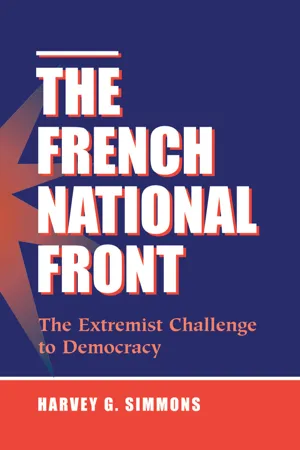
Over the past few decades, extreme-right political parties have won increasing support throughout Europe. The largest and most sophisticated of these is the French National Front. Led by the charismatic Jean-Marie Le Pen, the Front is now the third most important political force in France after the mainstream right and the socialists.This clear and comprehensive book explores the antecedents for the meteoric rise of the National Front. Beginning with a political history of the extreme right from 1945 to 1995, Harvey Simmons traces links between Le Pen and French neo-fascist and extreme-right organizations of the 1950s and 1960s, and concludes with analyses of the Front's antisemitism, racism, organization, ideology, language, electorate, and views on women. Simmons argues that the Front is not a party like any other, but a major threat to French democracy.
Information
Part 1
History
1
Out of the Ashes: Postwar Fascism in France
Rare are those who, these days, dare to say publicly that they are fascists. And almost as rare are those who in the depths of their soul recognize themselves as such.
—André Fontaine, in Le Monde, April 2, 1949
Jean-Marie Le Pen was born on June 28, 1928, in La Trinité-sur-Mer in the Department of Morbihan in Brittany, the far northwestern area of France, where agriculture and fishing have been traditional activities for centuries.1 Le Pen's mother came from a farming family, and his father owned a fishing boat. In 1942, when Le Pen was fourteen, his father drowned after his fishing boat struck a mine. Soon thereafter the young Jean-Marie Le Pen left home to work as a fisherman with his maternal grandfather. In 1984 Le Pen claimed that as a fifteen-year-old, in June 1944 he had tried to join a Resistance group but had been turned back by members of the Free French forces in the area. Yet there are a number of inconsistencies in his story, and except for one witness who later joined the National Front (NF) and claims to have seen Le Pen and a friend in the area, no one else remembers Le Pen.2 In high school after the war, Le Pen proved to have all the qualities of a born leader: He was amusing, articulate, and always in trouble. According to one classmate, Le Pen was "an agitator, an agitator at any price, he waited and always looked for some kind of occasion to use."3 Big and strongly built, Le Pen also became a brawler who enjoyed provoking arguments and fistfights. At the age of nineteen, after being graduated from a Jesuit school in Brittany, he enrolled in the Paris Law Faculty, traditionally a hotbed of extreme right-wing agitation.
In Les Français d'abord (The French first), Le Pen wrote that on arriving in Paris, he was "apolitical, areligious, but on the right."4 Shortly afterward he traveled to East Berlin, then the capital of the Communist German Democratic Republic. Nearly four decades later, he recalled: "I was over-whelmed. . . . The story of the taking of Berlin by the Red Army; the rapes, pillage and massacres, inspired me with revolt and revulsion. . . . I am afflicted with this vision . . . that the Communists . . . are an implacable force of repression and tyranny."5
After he enrolled in the Law Faculty in 1947, Le Pen's debating skills, energy, and bravado helped him become vice president and then president of the Corpo de Droit (Law Student Corporation), a right-wing faction of the Union National d'Étudiants Français (National Union of French Students, or UNEF). Le Pen spent much of his time propagandizing for the UNEF, debating and quarreling with fellow right-wing students, and brawling in demonstrations and street battles against the left.6 His activities in the UNEF soon brought him to the attention of the ex-Vichyites who frequented extreme right circles in the late 1940s and early 1950s. In 1951, at the age of twenty-three and at the height of the cold war, Le Pen was asked to direct the security service of Jacques Isorni, leader of the extreme right Union Nationale des Indépendants Républicains (National Union of Independent Republicans, or UNIR), who was then contesting a seat in the legislative elections. Isorni was a leading right-wing lawyer and a former advocate for Vichy leader Marshal Pétain and pro-Nazi intellectual Robert Brassilach during their treason trials. In the 1960s Isorni was to support the extreme right terrorist Organisation de l'Armée Secrète (Secret Army Organization, or OAS), which tried on three occasions to assassinate President Charles de Gaulle. However, in 1951 the UNIR was obsessed with rehabilitating the memory of Vichy and the honor of Marshal Pétain, who had died in July 1951 shortly after being released from prison.7
Le Pen eagerly joined Isorni's campaign—after all, Marshal Pétain was one of Le Pen's heroes. "Until 1945, I kept a photo of Marshal Pétain and retained my admiration for him. Nor did I renounce the authors of my youth just because they were in prison like Maurras, or among the executed, like Robert Brasillach."8 However, the UNIR received only 280,000 votes in the 1951 election and sent only four deputies to the National Assembly. A few years later, wracked by personal quarrels and fatally undermined by Isorni's ambition to join one of the major political parties, the UNIR disappeared.9 Although it failed to become the political spearhead of the extreme right, the party provided the young Le Pen with valuable experience in political organizing.
By 1953, having failed to complete his degree and too impatient to continue as a student, Le Pen enlisted in the famous Third Paratroop Regiment of the Foreign Legion.10 At this time the French were fighting a bitter rearguard action against the communist army of Ho Chi Minh in a doomed attempt to keep Indochina in the French Union, and the legion was in the forefront of the battle.
As was to be the case in the United States more than two decades later, the Indochina War created deep divisions in French society. The Communists, the Socialists, and the moderate center advocated a French withdrawal from Indochina, while the mainstream and extreme right supported nothing less than a military victory over the communist National Liberation Front. Each side saw the Indochina War through the lens of its own ideology. For the Communists, the war was being fought in the interests of French capital. For the Socialists, the war was the last gasp of an out-moded colonialism. For the right, the war was a battle between the forces of democracy and freedom, represented by France, and the forces of brutality and totalitarianism, represented by Ho Chi Minh. Le Pen saw Indochina as a battle in the war against communism.
Luckily for Le Pen, he arrived in Indochina just in time to miss a paratroop drop on Dien Bien Phu, the ill-fated valley fortress that had been subjected to a murderous artillery bombardment by the Vietminh army led by the legendary General Vo Nguyen Giap. Unable to withstand the assault, the legionnaires defending Dien Bien Phu were forced to surrender in spring 1954. The defeat drove home to the French government the futility of any further military action and led Premier Pierre Mendes-France to declare a cease-fire and sign the 1954 Geneva Accords, which divided the peninsula into a communist North and a noncommunist South Vietnam. According to Le Pen's biographer, Roger Mauge, the farseeing Le Pen realized as early as 1954 that the battle for Indochina was the first phase of a two-stage campaign by the communists to deprive France of its colonies. During a battalion meal, seated amid legionnaires from all over Europe, including former members of the German Wehrmacht, the young Le Pen had the temerity to proclaim that the next war would be in Algeria. After a brief silence, one of the legionnaires said: "In Algeria? Why not in Paris? Lieutenant, in case you don't know it, Algeria is France. And if there is a rising in Algeria, it will be crushed."11 After some argument from the tenacious Le Pen, his commander told him to "shut up." Le Pen kept his peace, but his predictions were borne out when, on November 1, 1954, the Algerian National Liberation Front (FLN) attacked a number of police posts in Algeria, signaling the beginning of a colonial war that was to last for eight years.
In addition to sharpening his geopolitical skills in Indochina, Le Pen saw enough to confirm him in his visceral hatred of communism. Watching the starved and abused legionnaires who had been prisoners of the Vietminh march by, and witnessing the way in which, after the armistice, the victorious communists exacted revenge on those who had supported the French, Le Pen observed: "I returned from Indochina with a concrete revelation about the Communist enemy, its terrible methods, the pitiless manner of liquidating its adversaries, its technique of psychological warfare, its destruction of man from within. . . . The Indochina humiliation and the first murderous encounters in the Algerian War decided my political engagement."12
While completing his tour of duty in Indochina, Le Pen heard about a rising young right-wing politician named Pierre Poujade and speculated about the influence Poujade might have on the politics of the Fourth Republic. "We have been betrayed here in Indochina by governments which have been accomplices of the enemy. Entire populations helped us, but Paris delivered them to a dictatorship which reduced them to slavery. It is in Paris that it is necessary to fight."13 According to Mauge, Le Pen devoted an issue of the Foreign Legion magazine Caravelle, which he edited, to the rise of Poujadism and confided to a friend that he was going to enter politics "like Poujade."14 Le Pen's political career was about to begin.
The Fascist International
While Le Pen was studying in Paris and serving in Indochina, a skeletal fascist organization was kept alive by small groups of die-hard adherents in a myriad of clandestine organizations scattered across Europe. Among these organizations was the Odessa group organized by Otto Skorzeny, leader of the German commando unit that had rescued Benito Mussolini from the partisans during World War II and briefly installed him as the head of the fascist "Salo Republic" at the end of the war. Around Odessa floated an array of Nazis, fascists, and French ex-collaborators nostalgic for the heady days of Adolf Hitler and Mussolini and hurling imprecations against "international capitalism served by the Jew and Stalin."15 Although the fascists kept a low political profile after 1945, the coming of the cold war and mounting anticommunism led fascist leaders, including Oswald Mosley from Great Britain, Georges Albertini (the former aide-de-camp to the French fascist Marcel Déat), and Guy Lemonnier, to organize a preparatory conference for a fascist international in Rome. In October 1950 a youth congress was organized and a European committee was formed.16 Finally, in May 1951 the first full congress of the so-called Mouvement Social Européen (European Social Movement, or MSE) took place in Malmö, Sweden, attended by sixty delegates from Western Europe. The MSE enunciated the familiar themes of wartime fascism: the need for a strong central government based on plebiscites, emphasis on physical strength and spiritual regeneration, and reorganization of the economy along corporatist or organic lines.17 The congress also proposed establishing an education system that would "make strong men and women" and would "spiritually regenerate man, society and the state."18
Like the Trotskyists who argued that it was impossible to build socialism in one country, the postwar fascists maintained that fascism had to be international, or it would be nothing at all. After all, Alfred Fabre-Luce asked, why should internationalism be the exclusive monopoly of the left when it equally well could be adopted by fascists?19 The Nazis had been wrong to propose uniting Europe under the German heel; international fascism should henceforth base itself on the principal of equality among nations. Europe should form an intermediary power bloc between the two wartime superpowers, the United States and the Soviet Union, carving out what the congress called a "European empire," excluding Great Britain. Obviously, the North Atlantic Treaty Organization and military integration with the United States were rejected.20
Beyond redrawing die map of Europe, die postwar fascists had grandiose plans to rebuild the foundation...
Table of contents
- Cover
- Half Title
- Title
- Copyright
- Contents
- Preface
- Introduction
- Part One History
- Part Two Analysis
- Conclusion
- Postscript
- Appendix A: The National Front at the Polls
- Bibliography
- About the Book and Author
- Index
Trusted by 375,005 students
Access to over 1.5 million titles for a fair monthly price.
Study more efficiently using our study tools.
Frequently asked questions
Yes, you can cancel anytime from the Subscription tab in your account settings on the Perlego website. Your subscription will stay active until the end of your current billing period. Learn how to cancel your subscription
No, books cannot be downloaded as external files, such as PDFs, for use outside of Perlego. However, you can download books within the Perlego app for offline reading on mobile or tablet. Learn how to download books offline
Perlego offers two plans: Essential and Complete
- Essential is ideal for learners and professionals who enjoy exploring a wide range of subjects. Access the Essential Library with 800,000+ trusted titles and best-sellers across business, personal growth, and the humanities. Includes unlimited reading time and Standard Read Aloud voice.
- Complete: Perfect for advanced learners and researchers needing full, unrestricted access. Unlock 1.5M+ books across hundreds of subjects, including academic and specialized titles. The Complete Plan also includes advanced features like Premium Read Aloud and Research Assistant.
We are an online textbook subscription service, where you can get access to an entire online library for less than the price of a single book per month. With over 1.5 million books across 990+ topics, we’ve got you covered! Learn about our mission
Look out for the read-aloud symbol on your next book to see if you can listen to it. The read-aloud tool reads text aloud for you, highlighting the text as it is being read. You can pause it, speed it up and slow it down. Learn more about Read Aloud
Yes! You can use the Perlego app on both iOS and Android devices to read anytime, anywhere — even offline. Perfect for commutes or when you’re on the go.
Please note we cannot support devices running on iOS 13 and Android 7 or earlier. Learn more about using the app
Please note we cannot support devices running on iOS 13 and Android 7 or earlier. Learn more about using the app
Yes, you can access The French National Front by Harvey G Simmons in PDF and/or ePUB format, as well as other popular books in Politics & International Relations & European Politics. We have over 1.5 million books available in our catalogue for you to explore.