- 352 pages
- English
- ePUB (mobile friendly)
- Available on iOS & Android
eBook - ePub
About this book
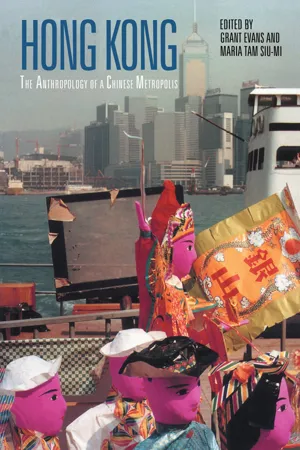
Hong Kong has become a by-word for all that is modern and sparkling in Asia today.
Yet tourist brochures still play with the old cliche of Hong Kong as a place where 'East meets West'. Images of so-called 'traditional' China, junks sailing Victoria Harbour or old women praying to gods in smoky temples, mingle with those portraying Hong Kong as a consumer and business paradise.
This collection of essays attempts to transcend the old polarities. It looks at modern Hong Kong in all its splendour and diversity in the run-up to its re-absorption into Greater China in mid-97, through the mediums of film, food, architecture, rumours and slang.
It explores the question of a distinct, modern Chinese identity in Hong Kong, and even when it explores the traditional stamping ground of the older anthropology in the New Territories it finds a dramatically changed context, in particular for women.
This collection presents an intriguing insight into the process of transition from 'tradition' to 'modernity' in this Modern Chinese Metropolis.
Information
1
Introduction
The Anthropology of Contemporary Hong Kong
When anthropologist Barbara Ward arrived in Hong Kong in 1950 she remarked that in ‘the harbour itself, all the local craft were under sail; in the New Territories every particle of flat or terraced land was under rice …’. Indeed, rural rhythms still pulsated faintly through the city: ‘Street life was also marked by seasonal changes of colour, for most men wore Chinese suits – black in summer and soft bluish grey with wide white turned back cuffs in autumn and winter’ (1985:ix). Ward came to Hong Kong firmly convinced that a central tenet of anthropology is the cross-cultural study of meaning, the attempt to see ‘through other eyes’. She herself did this by studying a group marginal to mainstream of Cantonese society, the ‘Tanka’ or boat people. Like many anthropologists of her day she travelled out of the city to carry out her main fieldwork. In the academic division of labour which had developed in both Europe and America anthropologists were allocated tribal peoples and peasants as well as exotic (to some people ‘irrational’) belief systems, while sociologists studied industrial societies, cities and ‘rationality’.
But world politics also dictated where, when and how anthropological fieldwork was done. Prior to 1950 few anthropological studies had been written about China; the work by Fei Hsiao Tung and Frances Hsu was exceptional. After the communist revolution in China anthropology was vilified as an ‘imperialist’ discipline and disappeared from the mainland until its recent revival (Guldin 1994). Thus, if anthropologists wished to study ‘China’ they were confined to Hong Kong and Taiwan, so when anthropologists came to Hong Kong in the 1950s and 1960s they invariably headed off to the still rural villages of the New Territories to study what was left of ‘traditional China’. The influential work on Chinese lineages by Maurice Freedman was partly based on fieldwork there, as were many other studies. Anthropologists came to Hong Kong to investigate ‘traditional China’, not the rapidly growing modern city of Hong Kong.
There were some exceptions to this rule however, including an insightful study of a small factory’s organization written by Barbara Ward in the mid-1960s where she tried ‘to discern what, if anything, was specifically ‘Chinese’ about the socio-economic relationships involved’ (1985:140). Culture came into play ‘only in those areas where the demands of technology itself were not overriding’ (1985:140), and she found a sum of ‘intangibles’ (1985:169) which added up to something like a ‘Chinese style for running economic institutions’ (1985:169), or at least a perceived difference in style. In the context of recent mythologising about the ‘uniqueness’ of the Chinese firm (trenchantly critiqued by Greenhalgh 1994), Ward’s study stands out as a sober and careful piece of research. Perhaps it is also the first real anthropological study of modern Hong Kong. While others did some research in urban locations what they documented there was the persistence of ‘tradition’. Only in the early 1970s did urban anthropological research consciously begin with the work of Fred Blake, Greg Guldin, John Meyers and Eugene Cooper. However, this work soon stalled, and when the ‘real China’ opened up in the 1980s anthropologists flowed across the borders.
Institutional factors also influenced the anthropological study of Hong Kong. When an anthropology department was established at the Chinese University of Hong Kong in 1980 following a division from the sociology department, the emphasis of its staff was on the study on Chinese minorities and Chinese ‘traditional’ culture. At the University of Hong Kong anthropology, for various reasons, remained a minor stream within the sociology department. In general, it was sociologists who taught about and studied urban industrial Hong Kong.
Only recently have anthropologists begun to focus on modern Hong Kong society. This corresponds to a global shift in anthropological interest which has broken the straightjacket of the old academic division of labour and allowed the anthropological gaze to roam over the whole of human action. Furthermore, in China itself anthropology has revived and it is no longer confined to the ethnology of minorities, but also focuses on the Han and urban anthropological research (Guldin and Southall 1993). In Hong Kong these re-orientations have also been spurred on throughout the 1980s and 1990s by the prospects of reunification with China in 1997 and an ever intensifying cultural debate about ‘Hong Kong Identity’.
Culture & Identity
It was the closure of the border with China following the communist revolution in 1949 that gave Hong Kong a heightened sense of distinctiveness. Prior to then it was primarily seen as a place of transit. The migrants who flooded into Hong Kong after the revolution maintained this mood for a while in the 1950s, but soon it became apparent that most of them were here for good. Indeed, the British Colonial Government initially thought there would be a reflux of refugees when conditions stabilised on the mainland. The realisation that the thousands of refugees in their squatter settlements were here to stay brought into existence the massive public housing programme which has gone on ever since. Many of these migrants were from urban China, and fortuitously combined with migrant capital from Shanghai they provided the essential ingredients for the rapid transformation of Hong Kong into a modern industrial society. By 1984, when the Joint Declaration was signed between London and Beijing for the return of Hong Kong to China, a whole new generation had been bom and bred in Hong Kong and a unique cultural formation had established itself in the colony. Writing in the China Quarterly in 1984 Hugh Baker declared ‘The Emergence of Hong Kong Man’:
He is go-getting and highly competitive, tough for survival, quick-thinking and flexible. He wears western clothes, speaks English or expects his children to do so, drinks western alcohol, has sophisticated tastes in cars and household gadgetry, and expects life to provide a constant stream of excitement and new opening. But he is not British or western (merely Westernized). At the same time he is not Chinese in the same way that citizens of the People’s Republic of China are Chinese. … Hong Kong Man is sui generis and the problems of the territory’s future are more difficult to resolve because of it.
(1984:478–9)
One might remark that not only is Baker’s ‘Hong Kong Man’ close to journalistic cliché, but also very middle class and male. A few years later Wong Siu-lun argued: ‘The Hong Kong Chinese may be described as Westernized only in a superficial sense. They have adopted a number of western folkways [unspecified], but a substantial number of them still adhere to traditional Chinese mores on various aspects of social living’ (Wong 1986:307). In 1988 Lau Siu-Kai and Kuan Hsin-Chi published the most comprehensive exploration of the ‘mentality’ of Hong Kong in their The Ethos of the Hong Kong Chinese. They wrote: ‘In our 1985 survey, an astonishingly large proportion of respondents (59.5 percent) identified themselves as ‘Hongkongese’ (HPung Góng yàhri) when they were asked to choose between it and ‘Chinese’. This Hong Kong identity, though not implying a rejection of China or the Chinese people, necessarily takes China or the Chinese people as the reference group and marks out the Hong Kong Chinese as a distinctive group of Chinese’ (1988:2). The Hong Kong ethos, they say, ‘represents a mixture of traditional Chinese culture and modern cultural traits …’ (1988:2). Since then the debate over Hong Kong ‘identity’ has sharpened. The following book is a product of that debate and is a concerted attempt by anthropologists and people engaged in cultural studies to examine the nature of contemporary Hong Kong culture and society.
As is immediately apparent from the few statements reproduced above, the discourse on Hong Kong culture among academics often echoes the terms found in tourist brochures: Hong Kong is a place where ‘East meets West’, but where ‘Chinese tradition’ still holds sway. The common sense appeal of these categories to both gwáilóu (foreigner) and Chinese academics, advertising copywriters, journalists and the person in the street who has been brought up on a diet of this rhetoric is itself intriguing. It is an idea which has both a history and a theory of culture embedded within it.
The history of the idea is intimately bound up with Hong Kong’s colonial history which until relatively recently saw a radical social and cultural separation between the British colonial officials and expatriate population and their Chinese subjects. For a long time ‘East’ met ‘West’ in a kind of cultural stand-off. Of course all colonial powers need to develop a local elite that respects the achievements of the dominant power and who is able to act as ‘cultural translators’ between the foreigners and the local population. Such a group of ‘Anglophiles’ did emerge in Hong Kong. We await a full social history of British Colonialism in Hong Kong which hopefully will tease out the culturally enigmatic lives of this ‘Anglophile’ elite, for they were in the vanguard of the creation of an identifiably modern Chinese culture in Hong Kong. On the other hand, colonialism everywhere also produces its own experts on the colonised peoples, many of whom engage in an extended romance with the dominated culture. We can see this clearly among the French, for example, in Indochina. In Hong Kong, as a counterpoint to the indigenous ‘Anglophiles’ a group of expatriate ‘Sinophiles’ emerged. The speciality of the latter was the documentation of ‘Chinese tradition’, and anthropologists were often found in their ranks. Indeed, in the recent political row over ‘traditional’ indigenous land rights in the New Territories and alleged discrimination against women (see the chapters below by Selina Chan and Eliza Chan) ‘tradition’ found some of its strongest supporters among this expatriate group. This colonial history established a powerfid discourse of ‘East meets West’, and the ‘modern world meets Chinese tradition’. There was, of course, for a long time a strong ‘racial’ discourse as well, with the British seeing themselves as representatives of ‘civilisation’ and Chinese customs as ‘barbarian’; while for their part the Chinese held a mirror image of the gwáilóu (foreigner). But this discourse has not survived, although academic and political debates in Hong Kong often disturbingly echo these faded sentiments.
What are the attractions of this ‘East meets West’ ideological discourse?
First and foremost, it is extremely simple. Its binary structure allows it to accommodate an infinite variety of situations, and better still, it works for both local Hong Kong Chinese and for expatriates. Hong Kong Chinese, when they encounter mainlanders, are able to explain their differences from them by their ‘Westemess’, when they encounter expatriates they can explain their differences from them by their ‘Chineseness’. Expatriates on the other hand quickly recognise Hong Kong’s modernity as a familiar ‘Westemess’, while all differences can somehow be accounted for perhaps by ‘traditional Chineseness’. And so on. What is most bewildering about the situation is the rapid codeswitching that goes on within it.
But let’s look a bit more closely at the structure of this discourse and at the contradictory valuations of ‘Western’ on the one hand and ‘traditional Chinese/Confucianist’ on the other.
Westernisation: positive valuation.
– liberalism, freedom of thought, rationality
– egalitarianism, generally and of gender
– industrialization, affluence, science and modern education
– individualism, choice of values in relation to sexuality
– fashion and popular culture
Westernisation: negative valuation.
– family ‘breakdown’ and divorce
– sexual immorality
– disrespect for authority and liberalism
– advocacy of change and future orientation
– general problems of the modern world
Chineseness (‘Confucianism’): positive valuation
– familism
– respect for elders
– social order
– scholasticism
– sexual morality
– hard work
– ‘China’s glorious past’
Chineseness (‘Confucianism’): negative evaluation
– conservative morality
– chauvinistic attitude to women
– authoritarianism
– opposed to change
This list could no doubt be extended and refined, but what is immediately apparent from it is its contradictoriness, how an idea valued in one context is not valued in another. In reality individuals hold a mixture of all of these views and in different proportions, and, depending on context, they rapidly code-switch from one point to the other, often being only vaguely aware of the inconsistency. The coexistence of all these views is partly related to the rapidity of social change in Hong Kong, and the mixture of codes within individuals is different between generations who for obvious reasons have experienced different aspects of this rapid social change – we return to the complexities of cultural change below.
The idea of Westernization as an explanation for social and cultural change is perhaps much stronger in Hong Kong than elsewhere in Asia because of the continuation of colonial rule, the predominance of a foreign language in the education and governmental system, and initially the high profile of rich foreign hohng (business houses). The process of modernization of Hong Kong society was, therefore, inevitably conceptualised as alien. People everywhere feel powerless in the face of rapid social change and they feel disoriented. Europe itself (‘the West’) during the massive transformation from feudalism to capitalism experienced similar disquiet, with massive traditionalist messianic movements (unsuccessfully) mobilised against the change. In Hong Kong this feeling could be partly managed by conceptualising this as a force from the outside – colonialism, Westernisation, and so on, and indeed all the problems which come with industrialisation can in this way also be blamed on ‘the West’. Rapid social change also produces a certain nostalgia for an idealised stable past and the idea of ‘Chineseness’ is important here. Yet attempts to articulate a ‘traditional Chinese’ way, or a ‘Confucian’ way, in a modern industrial society encounters fundamental obstacles – which, of course, does not mean that people will not continue to try.
Barbara Ward in her studies of the ‘boat people’ here in Hong Kong developed a theory of ‘conscious models’ in order to understand ‘Tanka’ ideas of Chineseness. Often when she asked the people in the village of Kau Sai why they follow a particular custom they answered: ‘Because we are Chinese’. This she says was their conscious model of the social system which they carried in their minds in order to explain, predict or justify their behaviour as ‘Chinese’. The problem begins, however, upon the investigator’s realization that people in different locations of China have different ideas about what it means to be ‘Chinese’. There are, therefore, a variety of conscious models ‘a number of different Chinese ideal patterns varying in time and space with varying historical development and the demands of particular occupations and environments’ (1985:42). The overarching model is a rather idealised version of Chineseness promoted by the traditional literati. This ideal, always incompletely known by ordinary Chinese, was what they aspired to but fell short of. Yet each group believed that the way they lived more closely approximated the ideal than any other neighbouring group which they observed. They constructed an observer’s model of these other groups as distinct from the model they had of their own way of doing things which Ward called their immediate model. Thus they carried in their minds an ideal or ideological model of Chineseness, their observer models of other Chinese groups, and their immediate model of themselves which may vary considerably from other groups and from the ideal model. ‘Strictly speaking,’ writes Ward, ‘the only people who can observe differences between immediate models are outsiders (or social scientists); what a Chinese layman compares is his own immediate model of his own social arrangements with his own “observer’s” model of the other fellow’s’ (1985:51).
Following from these ideas of Ward what we are suggesting is that the framework elaborated earlier constitutes some of the elements of the conscious model held by people living in modern Hong Kong. It allows them too to construe some people as more Chinese than others, or less (as with ‘ABC’s’, American Bom Chinese, as explored in Greg Guldin’s chapter below). The important thing to bear in mind about conscious models is that, as Levi-Strauss who stimulated Ward’s work remarks: ‘conscious models are … by definition very poor ones, since they are not intended to explain the phenomena but to perpetuate them’ (1968:281).
The coherence of Ward’s model hinged on the reality of an ideal Chineseness, one modelled on the literati of the Ching Dynasty. The collapse of the old structure left a hole at the centre of the Chinese system, and so throughout the Twentieth Century Chinese intellectuals and others have endlessly debated what it means to be ‘Chinese’. Nationalism has been the main overarching ideology to step into the vacuum, although different nationalists have disagreed on what is ‘essentially’ Chinese. For example, the victorious communist nationalists for a long time attacked Chinese ‘feudal’ beliefs and practices, as had the Guomindang in its early days. The latter however became a defender of Chinese tradition from its base in Taiwan after 1949, and only recently has Beijing supported a re-exploration of Confucianism. In other words, the cultural content of Chinese nationalism has been under continuous renegotiation.
In a recent essay on culture and identity in Hong Kong by Chan Hoiman a recurring theme is Hong Kong’s lack of ‘a unifying cultural foundation’ (1994:447). Thus Hong Kong would appear to epitomise the century long crisis of Chinese identity. He writes, Hong Kong ‘identity can only be defined in relation to its vacuous centre’ (1994:460). This ‘vacuous centre’ in Hong Kong is filled by popular culture, which however can only paint over the fragmentary nature of the colony’s culture. Nevertheless, it acts as ‘the key dynamic’ because ‘popular culture is d...
Table of contents
- Cover
- Half Title
- Title Page
- Copyright Page
- Table of Contents
- List of Illustrations
- 1. Introduction: The Anthropology of Contemporary Hong Kong
- Identity
- Cultural Studies
- Gender and Kinship
- Religion and Beliefs
- Language
- Glossary
- Contributors
Trusted by 375,005 students
Access to over 1.5 million titles for a fair monthly price.
Study more efficiently using our study tools.
Frequently asked questions
Yes, you can cancel anytime from the Subscription tab in your account settings on the Perlego website. Your subscription will stay active until the end of your current billing period. Learn how to cancel your subscription
No, books cannot be downloaded as external files, such as PDFs, for use outside of Perlego. However, you can download books within the Perlego app for offline reading on mobile or tablet. Learn how to download books offline
Perlego offers two plans: Essential and Complete
- Essential is ideal for learners and professionals who enjoy exploring a wide range of subjects. Access the Essential Library with 800,000+ trusted titles and best-sellers across business, personal growth, and the humanities. Includes unlimited reading time and Standard Read Aloud voice.
- Complete: Perfect for advanced learners and researchers needing full, unrestricted access. Unlock 1.5M+ books across hundreds of subjects, including academic and specialized titles. The Complete Plan also includes advanced features like Premium Read Aloud and Research Assistant.
We are an online textbook subscription service, where you can get access to an entire online library for less than the price of a single book per month. With over 1.5 million books across 990+ topics, we’ve got you covered! Learn about our mission
Look out for the read-aloud symbol on your next book to see if you can listen to it. The read-aloud tool reads text aloud for you, highlighting the text as it is being read. You can pause it, speed it up and slow it down. Learn more about Read Aloud
Yes! You can use the Perlego app on both iOS and Android devices to read anytime, anywhere — even offline. Perfect for commutes or when you’re on the go.
Please note we cannot support devices running on iOS 13 and Android 7 or earlier. Learn more about using the app
Please note we cannot support devices running on iOS 13 and Android 7 or earlier. Learn more about using the app
Yes, you can access Hong Kong by Grant Evans,Maria Tam in PDF and/or ePUB format, as well as other popular books in Social Sciences & Cultural & Social Anthropology. We have over 1.5 million books available in our catalogue for you to explore.