Senior investigators internationally have here collaborated to produce an international reference work. Each contributor provides critical and thought provoking concepts and ideas based on the latest developments in their field. The result is a must read and timely reference work for investigators who are interested in how spermatogenesis is currently understood and which are the most promising avenues for future research; an Introduction sets the context for the chapter and points out the relevance of the research for basic research scientists and clinicians.
- 278 pages
- English
- ePUB (mobile friendly)
- Available on iOS & Android
eBook - ePub
1Golgi apparatus regulation of differentiationA case study for male germ cells of the rat testis
Louis Hermo, Regiana L. Oliveira, Charles E. Smith, Catherine E. Au, and John J. M. Bergeron
Introduction
The Golgi apparatus is found in each of the estimated more than 200 different cell types that make up the human body.1 Golgi apparatus structure visualized by standard thin sectioning techniques at the electron microscope (EM) level, which reached its apogee in the latter part of the last century, can identify solely and unambiguously any of the differentiated cell types in a given species. Remarkably, its structure is strictly conserved with the number and size of cisternae in Golgi stacks and overall size of the Golgi apparatus under strict control for each of the many differentiated cell types of a given organ of the human body. This conjecture has been illustrated here for the Golgi apparatus using the well-described differentiation of male germ cells in the adult rat testis.
Spermatogenesis: A discovery based on the Golgi apparatus
In the mid-1950s, detailed light microscope (LM) observations elucidated the complexity of the differentiation pathway of male germ cells in seminiferous tubules of the testis, a process referred to as spermatogenesis. The periodic acid Schiff (PAS) technique2 was the breakthrough that enabled both the steps of germ cell differentiation to be uncovered as well as the discovery of stem cells (Figure 1.1).
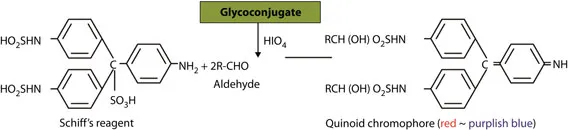
Figure 1.1Chemical ingredients for the Schiff reaction. (Reproduced with permission from Wako Chemicals USA.)
The PAS stain is specific to vicinyl hydroxyls and when applied to the testis reveals staining of the Golgi apparatus and Golgi derived acrosome of germ cells.3 The reaction due to carbohydrate modifications on glycoproteins is modulated by Golgi localized glycosyltransferases. This method provides a precise mapping of how germ cells associate with each other in cross sections of seminiferous tubules of the testis, as first described by Leblond and Clermont3 (Figure 1.2).
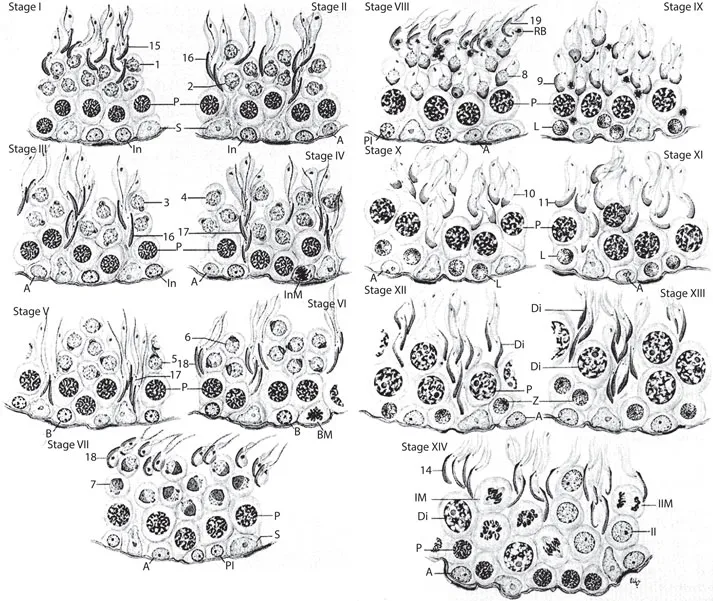
Figure 1.2Schematic drawings of portions of seminiferous tubules, each representing one of the 14 well-defined stages of the cycle of the seminiferous epithelium as revealed from PAS-hematoxylin stained preparations. Stages are represented by roman numerals. Spermatogonia: type A, intermediate (In) and B; InM and BM, mitosis of In and B spermatogonia; preleptotene (Pl), leptotene (L), zygotene (Z), pachytene (P), diplotene/diakinesis (Di) spermatocytes and secondary spermatocytes (II). IM and IIM, first and second meiotic divisions. Arabic numbers represent the 19 steps of differentiation of spermatids undergoing spermiogenesis. RB, residual body. (Reproduced with permission from American Physiological Society. Clermont, Y. Physiol Rev. 1972;52(1):198–236.)
In the seminiferous epithelium, germ cells at different steps of differentiation associate with each other to form specific cellular associations referred to as stages of the cycle of the seminiferous epithelium. The PAS method was the first test in defining the significance of the Golgi apparatus in understanding the differentiation process of any organ undergoing renewal. Even more important was the first identification of stem cells identified as a constantly replenished population undergoing ...
Table of contents
- Cover
- Half Title Page
- Title Page
- Copyright Page
- Dedication
- Contents
- Preface
- Contributors
- Chapter 1 Golgi apparatus regulation of differentiationA case study for male germ cells of the rat testis
- Chapter 2 Androgen regulation of spermatogenesis
- Chapter 3 Testicular immunoregulationThe role of Tyro3, Axl, and Mer receptor tyrosine kinases and pattern recognition receptors
- Chapter 4 Inflammation and spermatogenesis
- Chapter 5 Junctional adhesion molecule (JAM) familyRecent findings and their role and regulation in spermatogenesis
- Chapter 6 Sertoli cell immune regulation within the testis
- Chapter 7 The mitotic phase of spermatogenesisRecent advances and perspectives
- Chapter 8 Genetics of mammalian meiosis
- Chapter 9 Roles of membrane and nuclear estrogen receptors in spermatogenesis
- Chapter 10 Regulation of fertility and infertility in humans
- Chapter 11 Male infertilityEvaluation and treatment
- Chapter 12 Effects of chemical pollutants on spermatogenesis and implications in male infertility
- Chapter 13 Advances in our understanding of human spermatogenesis
- Chapter 14 A look into the testis as a reservoir for HIV and ZIKV—A reproductive biologist’s perspective
- Chapter 15 Cytoskeletons (F-actin) and spermatogenesis
- Chapter 16 Roles of mTOR signaling in spermatogenesis
- Chapter 17 Does planar cell polarity matter during spermatogenesis?
- Chapter 18 Computational characterization and integrative analysis of proteins involved in spermatogenesis
- Chapter 19 Effects of chemical exposures on testis cell-cell interactions and endocrine function
- Chapter 20 Environmental toxicants on Leydig cell function
- Index
Trusted by 375,005 students
Access to over 1.5 million titles for a fair monthly price.
Study more efficiently using our study tools.
Frequently asked questions
Yes, you can cancel anytime from the Subscription tab in your account settings on the Perlego website. Your subscription will stay active until the end of your current billing period. Learn how to cancel your subscription
No, books cannot be downloaded as external files, such as PDFs, for use outside of Perlego. However, you can download books within the Perlego app for offline reading on mobile or tablet. Learn how to download books offline
Perlego offers two plans: Essential and Complete
- Essential is ideal for learners and professionals who enjoy exploring a wide range of subjects. Access the Essential Library with 800,000+ trusted titles and best-sellers across business, personal growth, and the humanities. Includes unlimited reading time and Standard Read Aloud voice.
- Complete: Perfect for advanced learners and researchers needing full, unrestricted access. Unlock 1.5M+ books across hundreds of subjects, including academic and specialized titles. The Complete Plan also includes advanced features like Premium Read Aloud and Research Assistant.
We are an online textbook subscription service, where you can get access to an entire online library for less than the price of a single book per month. With over 1.5 million books across 990+ topics, we’ve got you covered! Learn about our mission
Look out for the read-aloud symbol on your next book to see if you can listen to it. The read-aloud tool reads text aloud for you, highlighting the text as it is being read. You can pause it, speed it up and slow it down. Learn more about Read Aloud
Yes! You can use the Perlego app on both iOS and Android devices to read anytime, anywhere — even offline. Perfect for commutes or when you’re on the go.
Please note we cannot support devices running on iOS 13 and Android 7 or earlier. Learn more about using the app
Please note we cannot support devices running on iOS 13 and Android 7 or earlier. Learn more about using the app
Yes, you can access Spermatogenesis by C. Yan Cheng in PDF and/or ePUB format, as well as other popular books in Medicine & Anatomy. We have over 1.5 million books available in our catalogue for you to explore.