Revisits and updates the centrality of the social construction of sexuality, especially in the age of Viagra, FSD (female sexual dysfunction) and the media saturation of sex. Leonore Tiefer is one of the foremost sexologists working in the United States today; she is a well-known and respected scholar who writes engagingly and humorously about a wide array of topics in sexuality to appeal to both students and general readers. Revised and updated with new pieces on the medicalization of sex, FSD (female sexual dysfunction) and the politics of sex, as well as classic pieces found in the original edition, such as "Am I Normal?: The Question of Sex."

- 324 pages
- English
- ePUB (mobile friendly)
- Available on iOS & Android
eBook - ePub
Sex Is Not A Natural Act & Other Essays
About this book
Information
part one
Sex is not a Natural Act: Theme and Variations
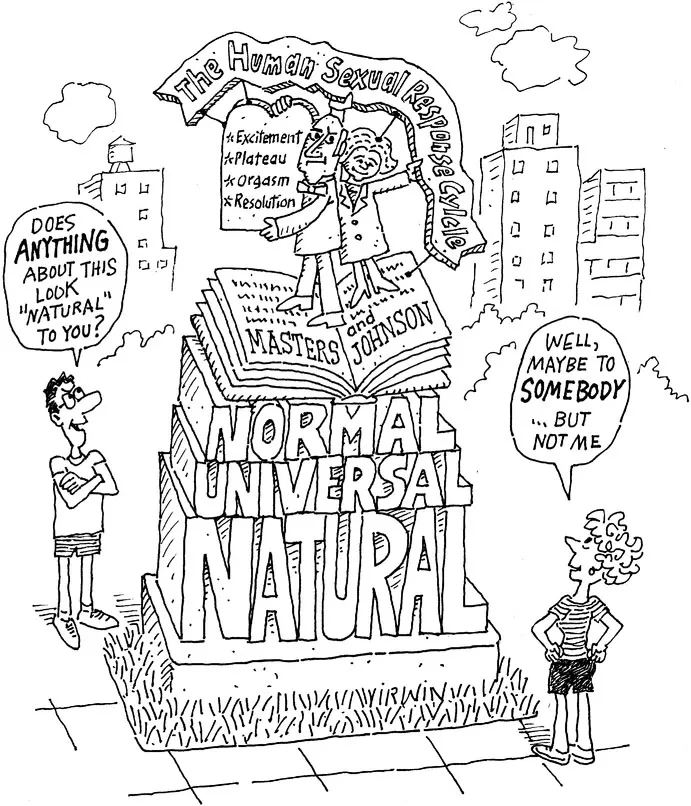
My mother is a professional musician, and the metaphor of music has helped me explain sexuality to numerous audiences. Open a textbook on human sexuality, and nine times out of ten it will begin with a chapter on anatomy and physiology. This opening sets the stage for the assumption that "the biological bedrock," as it is often called, must be understood before we can look at anything else, such as what people want, what they experience, how they get their ideas about what sex ought to be, and so on. Furthermore, the biology presented in these texts always dwells on the anatomy and physiology of the genital organs, never of the tactile receptors of the cheek or lips or the physiology of aroma preferences. You'll find the physiology of arousal but not of pleasure, of performance but not of fantasy. So, it's not just biology that is being portrayed as fundamental, but a certain kind of biology.
Open a textbook of music, in contrast, and you will not find chapters on the bones, nerves, blood vessels, and muscles of the fingers (for playing the piano), the hands (to play cymbals or cello), or even the mouth or throat (for flute or singing). And what about the physiology of hearing or of the sense of rhythm? Why don't music texts start with biology? Isn't biology as fundamental to music as it is to sexuality?
It is, and it isn't. It depends on what you mean by fundamental. If you mean that music requires human physiology to produce and experience, of course this is largely true. But if you mean that the physiological aspect is the most human, the most complex, the most interesting, or the most important thing about experiencing music, well, then, we are going to have an argument! By privileging biology within the discourse of sexuality, and often by reducing sexuality to the biological, I think we've got the cart before the horse, as the musical analogy suggests. And by privileging genital physiology over any other aspect of bodily experience, sexology research and writing make further choices and, I think, further mistakes. Much of this collection examines these choices and their causes and implications.
But the rhetoric of sexuality as "natural" is not just about biology; it also relates to the expanding discussion of sexuality and health. As some of these writings will show, I worry a lot about the consequences of locating sexuality within the conceptual model and the material institutions of health and the health industry. I think the already-accomplished medicalization of male sexuality shows that sexuality is diminished and human interest only incompletely served by the medical model, at least at the present time. Maintaining that "sex is a natural act" identifies as experts those social actors who know a lot about body mechanics rather than those who understand learning, culture, and imagination.
Human sexuality is not a biological given and cannot be explained in terms of reproductive biology or instinct. All human actions need a body, but only part of human sexuality has to do with actions, and even that part only requires a body in the way that playing the piano does. What is done, when, where, by whom, with whom, with what, and why—these things have almost nothing to do with biology. Giving biology priority in our talking and theorizing about sexuality is called essentialism after the mistaken assumption that once you "strip away" all the cultural and historical trappings, the essence of sexuality that is left is biology. This type of thinking used to be called biological determinism, a perfectly good term.
So, if sex is not a natural act, a biological given, a human universal, what is it? I would say it's a concept, first of all—a concept with shifting but deeply felt definitions. Conceptualizing sex is a way of corralling and discussing certain human potentials for consciousness, behavior, and expression that are available to be developed by social forces, that is, available to be produced, changed, modified, organized, and defined. Like Jell-O, sexuality has no shape without a container, in this case a sociohistorical container of meaning and regulation. And, like Jell-O, once it is formed it appears quite fixed and difficult to re-form.
A kiss is not a kiss; in this perspective, your orgasm is not the same as George Washington's, premarital sex in Peru is not premarital sex in Peoria, abortion in Rome at the time of Caesar is not abortion in Rome at the time of John Paul II, and rape is neither an act of sex nor an act of violence—all of these actions remain to be defined by individual experience within one's period and place.
In Part One I attempt to articulate this antinaturalism perspective further. In these chapters I explain more about the naturalism perspective, where it comes from, how it tyrannizes, what the social constructionist alternative looks like, and how the new approach fits into current theory and research.
chapter 1
"Am I Normal?" The Question of Sex
Three times in my career I have written regular columns on sexuality for the public—a weekly column for six months for the New York Daily News in 1980-1981 and monthly columns for two national magazines, Play girl Advisor and Playgirl, for a year and for four months, respectively. In each case I received stacks of letters from readers. The ones below, taken from the newspaper job in 1981, are representative:
My name is Arlene. I am eighteen years of age I have a friend [and] we have become very committed to each other in a friendship way, but he thinks that because we have developed this friendly relationship we ought to have a sexual relationship, too. But I am a bit confused [as] to what to do. first before I have a sexual relationship with him. 1 am not sure if I really love him enough. What I am really afraid of is that once I get involved with him, all he will want to do is just have sex, and not be friends anymore.
I am forty-nine years old and my husband is fifty-Eve years: old. My problem is that we have had sex twice in fourteen months. When I bring the matter up, which I have done twice in this period of time, my husband insists that there is nothing wrong, not in any way, physically or mentally. He says that he is more tired lately, or that our twenty-four-year-old daughter may come in. . . . Two years ago I had a hysterectomy and we both joked about freedom from contraceptives and how we could look forward to "really enjoying it." But, to the contrary, our sex life is almost nil. I miss those intimate moments, preliminary caresses, and the feeling of being desired.
I am a divorced woman who, in addition to a ten-year marriage, also has had two other sexually satisfying relationships. So I know I don't have a problem. In the past year, however, I have met several seemingly nice men who just don't make love very nicely, and it has created anxieties in me which were never there before. How common are things like this, for example?
- Food, which I believe belongs in the kitchen, not on the body. (This man thought I was unimaginative and unenlightened.)
- Such a preference for oral and manual sex that I felt like a masturbating machine, not a lover.
- The weirdo who refused to ejaculate inside me, even with rubbers1 "for the first two or three months until we know each other better." All he could say was, "Look, I've always done it this way. It frustrates me as much as it frustrates you, but I prefer not to just yet."
I know all about "consenting adults," but are these men normal?
God forbids all sex outside marriage—but you encourage it! Which leads to promiscuity and all sorts of trouble. Are you proud of yourself? Someday God will judge you. He will hold you accountable for everything.
There are three things to notice about these letters. First, they don't reveal that the writers themselves have any problems; rather, the partners have problems (2 and 3), the writer has a problem only because of her partner (1), or I, the expert, have a problem (4). This pattern also holds true in questions I've received during radio and TV shows. In part, people are understandably defensive and don't like to admit something is wrong with them. But, also, people who write are not just asking for help; they want to make a statement about how badly they're being dealt with and how they deserve some sympathy.
Second, notice that the question-writers want me to tell them things about their partners—people I've never laid eyes on! These women have been unable to get these men to give them straight answers, have not gotten any answers at all from them, or perhaps have not even been able to ask the men directly about the problem. The average person might not believe how many complex sexual problems are solved "merely" with improved communication, but anyone with any experience in long relationships probably realizes how difficult it is to change the communication patterns a couple has established.
Finally, note that in these letters the emphasis is not on performance (sexual "function") or pleasure so much as on psychological gratifications related to sex. The first woman wants to maintain her self-esteem and does not want to feel betrayed. The second woman misses intimacy, closeness, the feeling of being desired. The third woman wants her expectations met and wants to feel respected. The fourth writer wants me to subscribe to his or her moral vision of sexuality. Far more than is popularly realized, sexual activity is the means to gain or maintain important psychological feelings, and a challenge to one's sexuality is often a personal threat. Self-esteem, closeness, feelings of competence and well-being—these are the feelings sought from sex during modern times.
What Is Normal?
Why do people write letters like the ones above to medical sexuality "experts"? Why are radio phone-in shows on sexuality so immensely popular, night after night, coast to coast? The easy answer is that questions on sexuality have always existed in people's minds, but only recently has there been the opportunity to discuss such matters openly. Dramatic changes in broadcasting and publishing rules about explicit sexual language and imagery, this argument goes, have opened the door to public discussion of issues that have been on people's minds forever.
Another popular hypothesis to explain the explosion of public discussion about sex is that people are less willing nowadays to put up with sexual disappointment and sexual problems and less: embarrassed to try and make things better.
Although I agree that as long as there have been human beings there have been questions about sex, I believe that the current deluge reflects less eternal inquisitiveness than a modern epidemic of insecurity and worry generated by a new social construction: the idea that sexual functioning is a central, if not the central, aspect of a relationship. Such an emphasis naturally leads to tremendous concern about sex and a greater need for advice, education, support, and a variety of repair services.
The new importance given to sexuality and emotional intimacy in relationships is one result of large social changes in how we view marriage and life:
- The purpose of marriage has shifted from economic necessity to companionship, resulting in dramatic changes in obligations and expectations.
- There has been a shift in how we measure a person's "success" to include physical vitality and life enjoyment along with material achievements.
- Divorce and "serial monogamy" have become increasingly acceptable, making people anxious about maintaining relationships.
- Changes in social attitudes and improvements in contraception have allowed women to view sexuality as separate from reproduction and as an avenue for self-expression and pleasure.
- People are relying on personal relationships to provide a sense of worth they lack in the public sphere due to increased technology, mobility, and bureaucracy.
These social changes provide the backdrop for reconstructing sexuality in modern life. But most people are not prepared for the increased importance of sex for relationships and personal identity. Sex, for the most part, is still a private and secret matter. The majority of people have never seen any genital sex acts but their own.2 Most people do not talk honestly about sexual activity, and until recently there was no formal education in public schools about sex.
Imagine how you would feel if playing gin rummy, and playing it well, were considered a major component of happiness and a major sign of maturity, but no one told you how to play, you never saw anyone else play, and everything you ever read implied that normal and healthy people just somehow "know" how to play and really enjoy playing the very first time they try! It is a very strange situation.
Norms for sexual activity until recently came from religious authorities primarily concerned, about moral boundaries. Sexual activities were governed by a right/wrong mentality, with homosexuality, masturbation, and having many partners among the wrongs and marital coitus, female sexual modesty, and a complete absence of self-disclosure between parents and children among the rights. During the nineteenth and twentieth centuries, religious authority over everyday activities has gradually eroded and the authority of science and science-based medicine to set norms has grown. Various forms of disapproved and deviant behavior (e.g., chronic lying, drinking, disobedience, and sexual "wrongs" of various sorts) came to be seen less as violations of God's law and more as the products of sick minds. The authority for interpreting deviations of behavior shifted almost imperceptibly, category by category, from the domain of sin and evil to that of disorder and abnormality.3
Five Meanings of Normal
Well, what is sexual normalcy? There are at least five ways to answer this question:
- Subjective: According to this definition, I am normal, and so is anyone who is the same as me. Secretly, most of us use this definition a lot, but publicly, few will admit it.
- Statistical: According to this definition, whatever behaviors are most common are normal; less frequent ones are abnormal. If you conduct a survey and ask people how many lies they have told, how often they have drunk alcohol, or what kinds of sexual activities they have engaged in over the past five years and graph the results on a curve, the most frequent responses will be those in the middle, with extreme highs and lows at the ends. The idea of normalcy as something that is not too high and not too low is based on the statistical viewpoint. In the United States today, "too little sex" has joined "too much sex" as: cause for worry.
- Idealistic: From this viewpoint, normal means perfect, an ideal to be striven for. Those who model their behavior on Christ or Gandhi, for example, are taking an ideal for their norm, against which they measure all deviations.
- Cultural: Without realizing it, this is probably the standard most of us use most of the time. This measure explains why our notions of normalcy do not always agree with those of people from other countries, regions, cultures, religions, and historical periods. Bare breasts or men kissing in public is normal in one place but abnormal in another. It is common for deviant behavior to be perceived as dangerous and frightening in a culture that rejects it, although die same behavior may be as common and harmless as chicken soup a few tribes or national boundaries away. Mouth-to-mouth kissing is a good example. In much of Oceania, mouth-to-mouth kissing was long regarded as dirty and disgusting, and yet in Europe and North America its a major source of intimacy and arousal.
- Clinical: All the above definitions seem arbitrary, that is, they seem to depend on individual or group opinion rather than on "objective" evidence. The clinical standard, by contrast, uses scientific data about health and illness to make judgments. A particular blood pressure or diet or activity is considered clinically abnormal when research shows that it is related to disease or disability. It shouldn't matter to the clinical definition whether we are talking about the twentieth century or the tenth, about industrial Europe or rural Africa.
Using the clinical standard with regard to psychology is more difficult than using it for physiological matters because it is harder to prove psychological disease, deterioration, or disability. Who's to say, for example, that absence of interest in sex is abnormal according to the clinical definition? What sickness befalls the person who avoids sex? What disability? Clearly, such a person misses a life experience that some people value very highly and most value at least somewhat, but is avoiding sex "unhealthy" in the same way that avoiding protein is? Avoiding sex seems more akin to avoiding travel or avoiding swimming or avoiding investments in anything riskier than savings accounts—it's not trendy, but it's not sick, is it?
Are clinical standards that have been established for sexuality in fact based on valid and demonstrable standards of health and illness, or are they based on cultural and class opinion dressed up in scientific language? Sexual habits and preferences that do not conform to a procreative model for sex are the ones considered abnormal in medicine and clinical psychology. From lack of erection and orgasm to preference for masturbation and oral sex over intercourse to involvement of pain or items of clothing in sexual scripts— everything that is listed in contemporary psychiatric classification texts as abnormal refers to sexual practice that deviates from a preference for heterosexual coitus as the standard fare. Homosexual activities and affections would also still be included, except that...
Table of contents
- Cover
- Title
- Copyright
- Contents
- Acknowledgments
- Credits
- Introduction to the Second Edition: Good News and Bad News
- Part One: Sex Is Not a Natural Act: Theme and Variations
- Part Two: Popular Writings on the Theme
- Part Three: Feminism and Sexuality
- Part Four: The Medicalization of Sexuality
- Part Five: The Creation of FSD
- References
- Index
Trusted by 375,005 students
Access to over 1.5 million titles for a fair monthly price.
Study more efficiently using our study tools.
Frequently asked questions
Yes, you can cancel anytime from the Subscription tab in your account settings on the Perlego website. Your subscription will stay active until the end of your current billing period. Learn how to cancel your subscription
No, books cannot be downloaded as external files, such as PDFs, for use outside of Perlego. However, you can download books within the Perlego app for offline reading on mobile or tablet. Learn how to download books offline
Perlego offers two plans: Essential and Complete
- Essential is ideal for learners and professionals who enjoy exploring a wide range of subjects. Access the Essential Library with 800,000+ trusted titles and best-sellers across business, personal growth, and the humanities. Includes unlimited reading time and Standard Read Aloud voice.
- Complete: Perfect for advanced learners and researchers needing full, unrestricted access. Unlock 1.5M+ books across hundreds of subjects, including academic and specialized titles. The Complete Plan also includes advanced features like Premium Read Aloud and Research Assistant.
We are an online textbook subscription service, where you can get access to an entire online library for less than the price of a single book per month. With over 1.5 million books across 990+ topics, we’ve got you covered! Learn about our mission
Look out for the read-aloud symbol on your next book to see if you can listen to it. The read-aloud tool reads text aloud for you, highlighting the text as it is being read. You can pause it, speed it up and slow it down. Learn more about Read Aloud
Yes! You can use the Perlego app on both iOS and Android devices to read anytime, anywhere — even offline. Perfect for commutes or when you’re on the go.
Please note we cannot support devices running on iOS 13 and Android 7 or earlier. Learn more about using the app
Please note we cannot support devices running on iOS 13 and Android 7 or earlier. Learn more about using the app
Yes, you can access Sex Is Not A Natural Act & Other Essays by Leonore Tiefer in PDF and/or ePUB format, as well as other popular books in Scienze sociali & Studi di genere. We have over 1.5 million books available in our catalogue for you to explore.