eBook - ePub
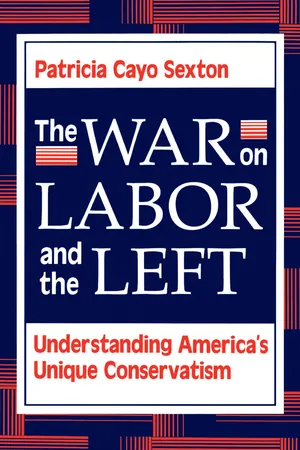
The War On Labor And The Left
Understanding America's Unique Conservatism
- 335 pages
- English
- ePUB (mobile friendly)
- Available on iOS & Android
eBook - ePub
About this book
In all countries, labour has war stories" to tell, but none are so violent as those of American labour. Since the 1870s at least 700 workers have been killed and thousands seriously injured in labour disputes. Nowhere but in this country have employers so actively fought back against strikes through the use of scabs," surveillance, and mercenary armies.Although much of the violence occurred decades ago, author Patricia Sexton contends that this rich history sheds light on questions that still plague observers of the American political system: Why has the United States been more conservative in its domestic policies than other Western democracies? Why is it almost alone among them in lacking a mass labour or democratic socialist party,or the kind of social policies favoured by such parties? And why has American labour unionism been in serious decline in recent decades?The most familiar answers to these questions involve consensus explanations of what has come to be known as American exceptionalism. America is conservative, observers say, because its citizens have loved" capitalism and supported its political policies wholeheartedly or because the nation's open frontier and early voting rights reduced dissent and class consciousness. Other explanations focus on various internal constraints said to be unique to the American working class or its organizations, such as conflict among diverse immigrants, the sectarianism and blunders of leftist groups, and the conservatism or incompetence of labour union leadership. All of these are said to have prevented labour from carrying out successful conflicts with employers and economic leaders.According to Sexton, these arguments ignore the remarkable record in American history of labour-left struggles: the violent suppression of industrial unionism prior to the 1930s, legal and forceful repression of trade unionism, and destruction by various means of left-leaning unions and political organizations. Her book explores instead a neglected explanation of American conservatism,that of a literal war on labour, waged by unusually powerful economic entities using repressive strategies, often backed by police and sometimes by federal forces.The details of this violent history, familiar to labour historians, are recounted here in a new perspective emphasizing the impact on workers of conflict sustained over many years. But the book is much more than a reinterpretation of this history. Patricia Sexton shows how the use of power and repression has played out as well in our institutions of law and government, in economic policies, and in the media. Making these links and showing how America's conservatism is unique among other Western democracies is the contribution of this ambitious book. For only by coming to terms with this history of repression and its legacy can we fully understand America's conservatism today.
Part One
Conservatism and Union Decline
1
Conservatism and the War on Labor
THE WAR ON THE LABOR-LEFT has been waged with relentless vigor for well over a century. The New Deal era did transform and empower labor for a time, but starting in the mid-1950s and accelerating rapidly in the 1970s and 1980s, the war drove labor into retreat and even turned its sights on the most conservative trade unions and their moderate politics. The calculated result of this effort has been a steady decline in union "density" (the unionized share of the work force) and a parallel loss of labor's political influence and bargaining power.
In the mid-1950s, union members were some 36 percent of the labor force; by 1989, that figure had dropped to about 16 percent, the lowest density of any developed democracy with the possible exception of France. But even at its peak in the 1950s, union density was lower in the United States than in almost all comparable countries. By the 1990s, it was much lower, about 16 percent compared with over 95 percent in Sweden and Denmark, 85 percent in Finland, over 60 percent in Norway and Austria, over 50 percent in Australia, Ireland, and the United Kingdom, and over 40 percent in West Germany and Italy. Unions almost everywhere were on the defensive, but only U.S. union density had declined sharply in the 1970s and 1980s. In 1987, U.S. union density was 37 points below the average of seventeen countries surveyed, down from 17 points below average in 1970, and it was less than half the Canadian density, down from rough equality in 1970.1 During the same period, density declined in only three other countries: in Austria by 3 percent, Japan 7 percent, and the Netherlands 4 percent. In the United States, it declined by 14 percent.
Density losses have been greatest in the most unionized sectors of the economy—in manufacturing, down from 42 percent in 1953 to 25 percent in the late 1980s; in transportation, from 80 percent to 37 percent; in mining, from 65 percent to 15 percent; and in construction, from 84 percent to 22 percent.2 Losses in the private sector (42 percent) greatly exceeded those in the public sector (10 percent) from 1971 to 1985.3 The U.S. private sector loss of 42 percent was significantly greater than in other developed democracies: 2 percent in Canada, 3 percent in Norway, 6 percent in West Germany, 7 percent in Switzerland, 9 percent in Austria, 14 percent in the United Kingdom, 15 percent in Italy—and zero in Sweden. U.S. unions were disadvantaged by the relatively small size of U.S. public sector employment—only 16 percent of total employment (public and private), compared with 33 percent in Sweden, 30 percent in Canada, 27 percent in the United Kingdom and Germany— and by the lower degree of U.S. union penetration of the public sector.
The war's escalation contrasts with the experiences of other developed democracies, where labor has also been subjected to considerable repression but nowhere on so massive a scale as in the United States. Aside from Britain, in other developed democracies neither employers nor the state has joined in equivalent hostilities to labor, despite more serious economic problems in some cases. Even British employers have generally abstained from heightened hostilities to unions, despite antiunion campaigns and legislation sponsored by the Thatcher government.4
Causes of Union Decline
Explaining contemporary union decline (historical declines are dealt with later) is complicated by the need to consider not only why U.S. unionism has declined but also, for our purposes here, why it has declined so much more than unionism in other countries—or its "relative decline." Among the most popular explanations of the decline are public disapproval of unions and the behavior of the unions themselves.
Public approval of unions, however, explains nothing about the U.S. union decline, since approval has actually improved over the period of the decline. Between 1981 and 1988, for instance, public approval of U.S. unions climbed 6 percentage points, with 61 percent of Americans approving of unions in 1988, 25 percent disapproving, and 14 percent having no opinion—approval being lowest among those aged thirty-five to forty-four.5 Moreover, polls show little difference in public "confidence" in unions between nations with declining density and those with stable or rising density: 33 percent confidence in the United States, 26 percent in Britain, 32 percent in Italy, 36 percent in Germany and France, and a less favorable attitude in Canada, where unions have grown.6
As for union behavior, some critics claim that "sellouts" by union leaders have been the major cause of union decline. They blame contract concessions on union bureaucrats and "business unionism" and urge strikes against the give-backs demanded by employers. Yet almost all concession strikes in the 1980s ended in defeat, and in some cases the unions themselves were broken. In a context of weakened unions, reduced political influence, the use of replacement workers, and employer threats to close plants, the success rates of strikes and other union tactics have plunged.
Other observers claim that U.S. unions excite employer hostility by their bargaining tactics and by making too many wage demands. Although the allure of cheaper labor may be greatly responsible for U.S. employer responses and union decline, high wages do not explain the relative decline of U.S. unions. In 1987, average hourly labor costs as measured in U.S. dollars were, in fact, higher in eight Western European countries than in the United States: the United States $13.44, Norway $17.39, Switzerland $17.14, West Germany $16.87, Netherlands $15.46, Sweden $15.12, Belgium $15.02, Denmark $14.56, Finland $13,52,7 Private sector unions in almost all those countries had declined somewhat between 1971 and 1985, but none so sharply as in the United States.8
Employers, Government, Repression
Almost all theories of the contemporary U.S. union decline fall finally under the rubric "repression," typically originated by employers and sustained by government. I deal briefly with only four of the theories: those based on (1) the "wage gap"; (2) public sector penetration; (3) closings and cutbacks; and (4) labor relations and labor law.
The Wage Gap. The decline of U.S. union density is explained by economists David Blanchflower and Richard Freeman largely in terms of the gap between union and nonunion wages, which is greater in the United States than in comparable countries. This gap, they say, stimulates employers to oppose unions in order to hire cheaper nonunion labor.
Yet in Canada, despite a union/nonunion wage gap second only to that in the United States, and an equal stress by unions on wage demands, union density has nonetheless risen. This deviation is attributed to the fact that labor law in Canada seriously limits the antiunion activity of employers.9 In the end, then, union decline is caused, not by excessive wage demands, but by employer efforts to repress unionism and employer-inspired labor laws that allow them to do so.
Public Sector Penetration. According to comparisons of U.S. and Canadian unionism made by economist Leo Troy, the size and union penetration of the public sector, rather than employer opposition, account for the stronger position of Canadian unions. The Canadian public sector is proportionately much larger than the U.S. sector, and Canadian unions grew rapidly in that sector, to a density of 66 percent by 1985, when U.S. unions had a density in a smaller public sector of only 36 percent.10 In the final analysis, however, the U.S. public sector and union penetration of it are small compared to Canada because the growth of both have been far more vigorously opposed by American than by Canadian economic elites and more vigorously supported by Canada's labor party.
Closings and Cutbacks. Deindustrialization and the closings and cutbacks of unionized plants account for much of contemporary U.S. union decline, some economists say more than 70 percent. According to an International Labor Office (ILO) study of seven countries, laws sharply restricted such closings during the 1980s in Japan. West Germany, France, the United Kingdom, and Italy, but in the United States and Canada, employers could generally cut back the work force without notice, in the absence of contrary agreements.11 Again, employer opposition to laws restricting closings and the political power to enforce such opposition account for much of U.S. job and union density loss.
In Japan, for example, workers through their union sued their American employer, Proctor and Gamble, when it closed the plant where they worked, even though all workers were offered job transfers to a nearby Proctor and Gamble plant and jobs elsewhere were in plentiful supply. Other U.S. employers, because of habits permitted by U.S. law, have run into similar problems in Japan with layoffs and closings. Japanese law permits such suits, and tradition encourages them. Japanese plants rarely close or even lay off workers permanently; deeply troubled companies are usually taken over by affiliates, or workers are transferred to other companies.12
Labor Relations and Labor Law. Richard Freeman's study shows that management opposition to unions in the workplace best explains the relative decline of U.S. unions.13 U.S. labor relations, he says, exemplify what aggressive management can do to unionism. In the 1970s and 1980s, U.S. management "turned against unions and collective bargaining to a degree not seen anywhere else in the free world." Almost all U.S. firms facing union elections conducted "expensive aggressive campaigns to persuade/pressure workers to reject unions," unfair labor practices rose to five and six times the rates of earlier decades and included the firing of more than 1,000 union activists in a year, and some 45 percent of the relatively moderate members of the Conference Board's Personnel Forum (a prestigious business group) claimed in 1983 that their main labor goal was to be union free. Even when workers voted to unionize, management refused a first contract in a third of the cases.14
Freeman says that a militant, market-oriented ideology has developed that excuses almost all antiunion activities on the grounds that they give management more flexibility. Because Canadian laws prohibit most such activities, many of the same employers who have fought U.S. unions have accepted them in Canada. If present trends continue, Freeman concludes, nations will be divided between those with strong unions functioning in a neocorporatist setting, such as in Scandinavia, and those with ghetto unions restricted to a small segment of the work force, as is happening in the United States.15
Political Contexts
Canadian and U.S. Law
Comparisons of American and Canadian unions are instructive. The union structures are similar, and in some cases unions in both countries can even be part of the same "international" union, but one twin, the Canadian, has grown to a density almost twice that of the American. The difference is not in the unions but in the nature of the "class forces" they confront, the laws and their enforcement, and the general political context of unionism.16
The main source of divergence between the twins has been that Canadian laws (federal and provincial) encourage public sector unionism and seriously limit the antiunion practices of employers. In 1967, the Canadian Parliament passed a law that gave almost all federal employees the right to organize, bargain, and strike, and most provinces promptly passed similar laws. Moreover, the Canadian government, especially in the major provinces of Ontario and Quebec, prohibits the kind of warfare waged on labor by U.S. employers.17 Ontario provides for first-contract arbitration; U.S. employers are free to refuse a contract even when employees vote for a union. In British Columbia, when a first contract cannot be agreed on, one is imposed by law. In Quebec, where union density has risen most, the provincial Ministry of Labor extends contracts negotiated by unions in a given industry to the whole of the industry. Other provincial laws regulate strikebreaking, union membership for some professions, and other matters.
Most important, under Canadian law, unions usually only need to submit membership cards signed by a majority of employees in order to be considered a certified bargaining agent. Such a provision is a far cry from the costly and prolonged election procedures to which American unions seeking National Labor Relations Board (NLRB) certification are subjected. Because of such laws, the union certification rate in highly industrialized Ontario was 76 percent in 1982, for example, compared with less than 50 percent in the United States. Canadian law is more hospitable to unions because the political system has facilitated the rise of a potent labor party, the New Democratic Party, which in 1991 came to power in Canada's most populated and industrialized province, Ontario.
Neocorporatism and Tripartitism
Even before the enactment of prolabor laws, union growth and influence were stronger in Canada than in the United States. This fact can be attributed to Canada's history of having tripartite boards (labor, employers, government) to deal with labor disputes, greater government involvement in economic life, a parliamentary rather than a congressional system of government, and the participation of democratic socialist parties in both provincial and state elections.
In most developed democracies, unions function in neocorporatist settings characterized by strong labor parties and strong unions, in which bargaining tends to be more centralized and more attention is paid to reducing wage inequalities for comparable work and adjusting wages in keeping with national income policies. Richard Freeman concludes that unions fare best in these neocorporatist settings.18
After World War II, tripartite boards in many developed democracies formulated policy on a broad range of issues, including economic policy, the framework for collective bargaining, minimum wages, occupational health and safety, and equal opportunity. In some cases, unions became disenchanted when the boards ignored their views, but the union position generally remained strong because the unions themselves and their parties remained strong. As a result, public policy was likely to support favorable labor laws, include unions in the delivery of social services, and provide a climate for union stability or growth. In many countries, unions also won seats on governing boards of corporations and pension funds, though in some cases the resistance of conservative governments and employers during the 1980s slowed this trend.19
In West Germany, a neocorporatist state and the leading European economy of the postwar era, union density has risen in recent decades. Work hours in the metal industry have declined, shift work has disappeared, union codetermination has grown, manipulative labor relations programs have declined, and unions have made few wage or other concessions. Few plant closings or takeovers have occurred, and laws limit worker layoffs and restrain deregulation of industry. Such improvements are largely attributable to the fact that West Germany has had relatively strong unions, a strong Social Democratic Party, codetermination in industry, and an economic elite that is not all that hostile to labor.
U.S. labor, on the other hand, has lacked the essential political influence to enter as a full partner into such arrangements, so tripartitism has not fared well in the United States. Even joint labor-management efforts to define policy have often failed. In 1978, as an example, Douglas Fraser, then president of the United Automobile Workers (UAW), resigned from the high-level Labor-Management Group formed to reduce workplace conflict, charging that business leaders, with few exceptions, had discarded the unwritten contract of coexistence and had chosen to "wage a one-sided class war in this country—a war against working people, the unemployed, the poor, the minorities, the very young and the very old, and even many in the middle class of our society." Moreover, he said, the two major partie...
Table of contents
- Cover
- Half Title
- Title
- Copyright
- dedication
- Contents
- Acknowledgments
- Introduction
- Part I Conservatism and Union Decline
- Part II Unionism: Strategies of Repression
- Part III Labor-left Politics: Strategies of Repression
- Part IV Strategies of Economic Manipulation and Violence
- Part V The Power to Repress
- Notes
- About the Book and Author
- Index
Trusted by 375,005 students
Access to over 1.5 million titles for a fair monthly price.
Study more efficiently using our study tools.
Frequently asked questions
Yes, you can cancel anytime from the Subscription tab in your account settings on the Perlego website. Your subscription will stay active until the end of your current billing period. Learn how to cancel your subscription
No, books cannot be downloaded as external files, such as PDFs, for use outside of Perlego. However, you can download books within the Perlego app for offline reading on mobile or tablet. Learn how to download books offline
Perlego offers two plans: Essential and Complete
- Essential is ideal for learners and professionals who enjoy exploring a wide range of subjects. Access the Essential Library with 800,000+ trusted titles and best-sellers across business, personal growth, and the humanities. Includes unlimited reading time and Standard Read Aloud voice.
- Complete: Perfect for advanced learners and researchers needing full, unrestricted access. Unlock 1.5M+ books across hundreds of subjects, including academic and specialized titles. The Complete Plan also includes advanced features like Premium Read Aloud and Research Assistant.
We are an online textbook subscription service, where you can get access to an entire online library for less than the price of a single book per month. With over 1.5 million books across 990+ topics, we’ve got you covered! Learn about our mission
Look out for the read-aloud symbol on your next book to see if you can listen to it. The read-aloud tool reads text aloud for you, highlighting the text as it is being read. You can pause it, speed it up and slow it down. Learn more about Read Aloud
Yes! You can use the Perlego app on both iOS and Android devices to read anytime, anywhere — even offline. Perfect for commutes or when you’re on the go.
Please note we cannot support devices running on iOS 13 and Android 7 or earlier. Learn more about using the app
Please note we cannot support devices running on iOS 13 and Android 7 or earlier. Learn more about using the app
Yes, you can access The War On Labor And The Left by Patricia Cayo Sexton in PDF and/or ePUB format, as well as other popular books in History & North American History. We have over 1.5 million books available in our catalogue for you to explore.