- 320 pages
- English
- ePUB (mobile friendly)
- Available on iOS & Android
eBook - ePub
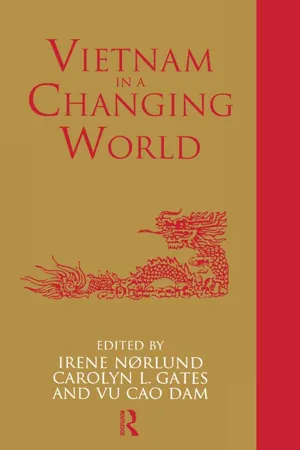
Vietnam in a Changing World
About this book
The last two decades saw Vietnam largely isolated in the world, but during this time economic reform and development slowly gathered pace. Recent events have led to Vietnams rapid re-emergence into the world and an escalation of economic changes. A unique insight into these changes.
CHAPTER TWO
State and Market in Vietnam
Some Issues for an Economy in Transition
To judge from a number of key macroeconomic variables, the last few years have been extraordinarily successful for the Vietnamese economy. According to preliminary estimates, gross domestic product (GDP) increased by over eight per cent per year in real terms in the period 1992-94, reflecting a healthy growth in all major economic sectors. Underpinning the dynamic development has also been a spectacular increase in exports, averaging close to 25 per cent per year.
The rapid growth in 1992-94 has been accompanied by a drastic decline in inflation. While consumer prices increased by 67 per cent in 1991, corresponding figures for 1992 and 1993 were 17 and 5 per cent, respectively. In 1994, a slight upsurge in inflation was registered but the projected figure of some 14 per cent is still far lower than those of a few years ago, when a three-digit rate of inflation was the order of the day.
To the great surprise of many Vietnamese and foreign observers, the Vietnamese dong has turned out to be one of the strongest currencies in the world in recent years. Supported by rapid growth of exports, and by a sizeable surplus on the capital account, the dong appreciated by some 25 per cent against the US dollar between late 1991 and early 1993, and has remained stable since then.
Imports rise even more rapidly than exports, however, and the current account deficit may soon become a source of concern. The rate of exchange has, according to many observers, become slightly overvalued and, if present trends continue, the strong dong – in itself a sign of confidence in the future prospects of the economy – may jeopardize the internationalcompetitiveness of Vietnamese exports and import-competing sectors.
There is a danger that the great achievements in 1992-94 may lead to a certain complacency. 1989, a highly successful year for the Vietnamese economy, was followed by a period of higher inflation, a slowdown of economic growth and, in particular, by a deceleration of the pace of economic reform, including policy reversals in key areas such as monetary policies. A similar development in the future cannot be ruled out; to judge from past experience in Vietnam, successful economic policies often lead to setbacks, while crises make the reform process accelerate.
The objective of this article is not, however, to discuss the current performance of the Vietnamese economy. The main purpose is to make a tentative assessment of the present state of the process of economic reform, with particular emphasis on the interaction between the state and the market. The focus is on institutional change rather than macro-economic developments.
The article is divided into three sections, which partly overlap. The first part is a brief presentation of the role of the state in the old development model, today largely abandoned, and the Vietnamese reform process compared to other countries undertaking reform, now often referred to as structural adjustment. In part two, the emergence of a market economy in Vietnam is discussed against the particular background of the old centralized planning system. The emphasis is on the interplay between state intervention and market forces in a transitional period, and on the extent of, and limits to, a continued ‘marketization’ of the Vietnamese economy.
One conclusion from this discussion is that, although Doi Moi is an irreversible process, there is at present a danger that the reform process may lose momentum, as the comparatively ‘easy’ phase of economic transition has largely been accomplished already. The next phase may in some respects prove to be more difficult, as it will require measures which go against the short-term interests of the driving forces behind the initial reforms, in particular within the state enterprise sector. The dynamics of the reform process may also lead to profound political and social changes – at present resisted by the Vietnamese leadership – including a thorough democratization of the political system, the separation of the state from the party, and the establishment of an independent judiciary and press. Political tensions may therefore be accentuated in the future.
The last part of the paper is a very brief assessment of recent macro-economic trends, with particular attention paid to the issue of macro-economic stability as a prerequisite for a successful consolidation and continuation of the process of economic reform.
Background
The DRV model and the early reform process
Vietnam was divided at the Geneva Conference in 1954, with the present government only extending its rule over the entire country after its victory over the United States in 1975. The development model adopted in North Vietnam, the Democratic Republic of Vietnam (DRV), from the late 1950s is referred to as the ‘DRV model’. This development model was also applied, unsuccessfully, in reunited Vietnam after 1976.
Vietnam’s per capita income grew well below potential between 1975 and 1989. This poor rate of growth is today almost universally blamed on erroneous development policies in the past. A country rich in natural resources, possessing a reasonably literate population and situated in the midst of the world’s economically most dynamic region cannot lay the blame anywhere else. The main problem must lie in the policies applied.
The essence of the old model was Soviet-style central planning aimed at rapid industrialization, plus collectivization of agriculture and a strong central control of the entire economy. The state sector, fuelled by subsidized inputs and forced to obey orders from the higher planning authorities, was the ‘engine of growth’. There would be virtually no room for small-scale, private production in the socialist economy. The system was based on a state monopoly in the allocation of resources to both industry and agriculture, and industrial enterprises and agricultural cooperatives were given quantitative targets for their compulsory deliveries to the state.
In Vietnam, this development strategy was soon characterized by increasing sectoral imbalances and inefficiency. As a result, social and economic resources in Vietnam today are underutilized, or used in inefficient activities; there is considerable ‘slack’, in the sense that higher output is possible through using existing resources more efficiently, and without additional material and labour inputs.
Experience with partial reforms in the 1980s showed that better economic organization was able to take up some of this economic slack in certain sectors. Substantial short-term gains were experienced in response to such changes. However, the ineffectiveness of the DRV model still affects present-day Vietnamese society in many respects, and weakens the basis for the implementation of market-oriented reforms. The country does not possess, for example, such basic institutional foundations as an effectively functioning legal system or an adequate statistical basis for the collection of economic data relevant for the smooth functioning of a market economy.
The DRV model came under increasing strain during the late 1970s when bad harvests, in combination with the military intervention in Kampuchea and the political and economic isolation of Vietnam from most of the outside world, triggered off a serious crisis as the capacity of the state to supply the economic system with inputs, and the people with food, declined drastically.
The failure of the central-planning system to maintain control over resources forced the economic agents – individuals as well as agricultural cooperatives and state enterprises – to engage in a reform process ‘from below’. ‘Fence-breaking’, to use a translation of a Vietnamese expression describing this phenomenon, became increasingly common, and the authorities tacitly had to admit that the old development model had become unimplementable. The spontaneous reform process was accompanied by piecemeal economic reforms ‘from above’ – retail trade was liberalized and the introduction in 1981 of the so-called output contract system in agriculture and the Three Plan system in industry1 can be interpreted as the beginning of the official process of reform.
The reforms could also, however, be interpreted as tactical retreats with the aim of preserving the basic tenets of the DRV model through concessions to a spontaneous process which could not be controlled. This interpretation can be supported by the fact that the authorities, when the economic situation had improved after the crisis of 1979-80, broke off economic liberalization in an attempt at recentralization, as witnessed by, among other things, the clamp-down on the free market in Ho Chi Minh City (formerly Saigon) and by the campaign to resuscitate agricultural collectivization in the Mekong Delta in the south.
Irrespective of the motives behind the reforms, it can be said that the combination of ‘fence-breaking’ and cautious reforms gradually weakened the inner logic of the DRV model. Prices, costs and markets began to play a larger role, and the economic agents became used to thinking in more market-oriented terms. The ‘rules of the game’ were extremely unclear – and varied, in fact, from place to place – but people’s perceptions of what was possible to do were changing. If the basis for action in the 1970s had been that everything that was not explicitly permitted was forbidden, the tendency as from the early 1980s was to assume that even a wide range of forbidden activities were in actual practice tolerated, and sometimes even encouraged, by the authorities.
The official confirmation of the Vietnamese leaders’ commitment to the abandoning of the DRV model process can be dated to December 1986, when accelerated economic reform – Doi Moi, or ‘renovation’ – was approved by the Sixth Communist Party Congress. Since then, the reforms have not been regarded as mere tactical retreats due to difficult but temporary circumstances but as new strategic concepts, although there still exist different opinions within the leadership about the desired pace of the reforms.
The reform process has accelerated during the last few years, and in particular as from 1989, which witnessed a remarkably forceful attack upon the very foundations of the old, central-planning system, including a price reform which effectively put an end to the former ‘two-price system’ by allowing virtually all prices to be market-determined. The primary foreign source of inspiration was not the development in the former Soviet Union but rather the spectacular economic development experienced in the newly industrialized countries in the Southeast Asia region.
The Vietnamese reforms have been more economic than political in character. In other words, perestroika rather than glasnost. Despite some political liberalization during the 1980s, Vietnam retains its authoritarian, one-party system. And the Vietnamese (and, certainly, Chinese) leaders’ lesson from the downfall of communism in the old Soviet bloc, and the economic crisis affecting these countries at present, appears to be straightforward: more perestroika, if the economic collapse of Russia and other ex-USSR nations is to be avoided, and less glasnost, if the collapse of the hegemonic role of the communist party is to be avoided.
Doi Moi and Third World structural adjustment: similarities and differences
When comparing the Vietnamese experience with other socialist and non-socialist Third World countries undergoing a process of structural change it may be observed that there are a number of models for the reform process. Still, they tend to have certain features in common. Thus, a ‘typical’ structural adjustment programme that would attract support from the International Monetary Fund (IMF) and the World Bank would contain several of the following ingredients:
• a reduction of state expenditures – including real wages in the public sector – and of the fiscal deficit;
• tax reform;
• curtailment of state subsidies to public enterprises and a dismantling of certain state monopolies, such as parastatals responsible for the supply of inp...
Table of contents
- Cover
- Half Title
- Title Page
- Copyright Page
- Table of Contents
- Foreword
- Introduction
- Economic Policy Reforms: An Introductory Overview
- State and Market in Vietnam: Some Issues for an Economy in Transition
- Monetary Stabilization: The Vietnamese Experience
- Development Strategy and Trade and Investment Policies for Structural Change
- Agricultural Reforms in Vietnam in the 1980s
- Vietnamese Industry in Transition: Changes in the Textile Sector
- Vietnam’s Private Economy in the Process of Renovation
- The Role of the Enterprise Unions in the Shift from Central Planning to Market Orientation.
- Labour and Employment in Transition to a Market Economy in the 1990s
- Gender Issues in Vietnam’s Development
- Women’s Labour and Socio-Economic Status in a Market-Oriented Economy
- Demolishing the Ivory Tower: Science, Technology and Economic Development
- Vietnam’s Science and Technology Policy in the Market Economy Reforms: A Political Perspective
- From Market Reforms to Sustainable Development: The Cultural Dimension of Science and Technology Policy in Vietnam and China
- List of Contributors
Trusted by 375,005 students
Access to over 1.5 million titles for a fair monthly price.
Study more efficiently using our study tools.
Frequently asked questions
Yes, you can cancel anytime from the Subscription tab in your account settings on the Perlego website. Your subscription will stay active until the end of your current billing period. Learn how to cancel your subscription
No, books cannot be downloaded as external files, such as PDFs, for use outside of Perlego. However, you can download books within the Perlego app for offline reading on mobile or tablet. Learn how to download books offline
Perlego offers two plans: Essential and Complete
- Essential is ideal for learners and professionals who enjoy exploring a wide range of subjects. Access the Essential Library with 800,000+ trusted titles and best-sellers across business, personal growth, and the humanities. Includes unlimited reading time and Standard Read Aloud voice.
- Complete: Perfect for advanced learners and researchers needing full, unrestricted access. Unlock 1.5M+ books across hundreds of subjects, including academic and specialized titles. The Complete Plan also includes advanced features like Premium Read Aloud and Research Assistant.
We are an online textbook subscription service, where you can get access to an entire online library for less than the price of a single book per month. With over 1.5 million books across 990+ topics, we’ve got you covered! Learn about our mission
Look out for the read-aloud symbol on your next book to see if you can listen to it. The read-aloud tool reads text aloud for you, highlighting the text as it is being read. You can pause it, speed it up and slow it down. Learn more about Read Aloud
Yes! You can use the Perlego app on both iOS and Android devices to read anytime, anywhere — even offline. Perfect for commutes or when you’re on the go.
Please note we cannot support devices running on iOS 13 and Android 7 or earlier. Learn more about using the app
Please note we cannot support devices running on iOS 13 and Android 7 or earlier. Learn more about using the app
Yes, you can access Vietnam in a Changing World by Carolyn Gates,Irene Noerlund,Vu Cao Dam Vu in PDF and/or ePUB format, as well as other popular books in Economics & Development Economics. We have over 1.5 million books available in our catalogue for you to explore.