![]()
Part I
Guiding Principles
Each organization presents a value proposition to current and prospective employees and enters into an economic and psychological, if not legal, contractual relationship with employees. The talent utilized may consist of employees and outsiders who offer their knowledge and skills in varying ways. The terms of the contract with people doing the organization’s work will include a philosophy about how performance is defined, managed and rewarded. If the terms are mutually understood there is less chance of misunderstanding and conflict, which can lead to poor performance or unwanted turnover.
The principles that determine how the employer manages performance and rewards will play a critical role in guiding the formulation of strategies and programs. And in order to be effective the performance and rewards strategies must be well integrated with the staffing, development and employee relations strategies, to produce a human resource strategy that is effective and appropriate to the context.
Part I explores how organizations can develop human resource management strategies that are a good fit to their context (Chapter 1). It then addresses the process of formulating performance and rewards management principles that will support the effective execution of the human resource strategy (Chapters 2 and 3). The importance of choosing guiding principles to guide the development of strategies and programs is a central theme. Lacking guiding principles, an organization can develop local strategies and programs that are not integrated with the business strategy and with each other, potentially creating inconsistencies and conflicting interests across the organization.
![]()
Chapter 1
Human Resource Management Strategy
Performance and rewards management strategies and programs must fit the context within which they will operate. What works is what fits. They must be consistent with and supportive of the human resource management strategy, which in turn must be consistent with and supportive of the organizational strategy. Prior to discussing the principles of sound performance and rewards management, it is therefore necessary to describe how an organization develops an effective and appropriate human resource management strategy. The HR strategy will guide the development of appropriate and effective performance and rewards management strategies, as well as integrating those strategies with the staffing, development and employee relations strategies adopted by the organization.
The human resource management strategy utilized by any organization must first and foremost produce the desired results at the individual, group and organization-wide levels. In order to accomplish this it must drive the effective creation and application of the required intellectual capital by:
• defining, evaluating and shaping a culture that is appropriate;
• designing an organization structure and employee roles that fit the context;
• formulating staffing and development strategies that produce the workforce required;
• formulating performance and rewards management strategies that motivate that workforce to work towards organizational objectives;
• integrating all strategies and programs that impact workforce management in a manner that is fair, competitive and acceptable to employees.
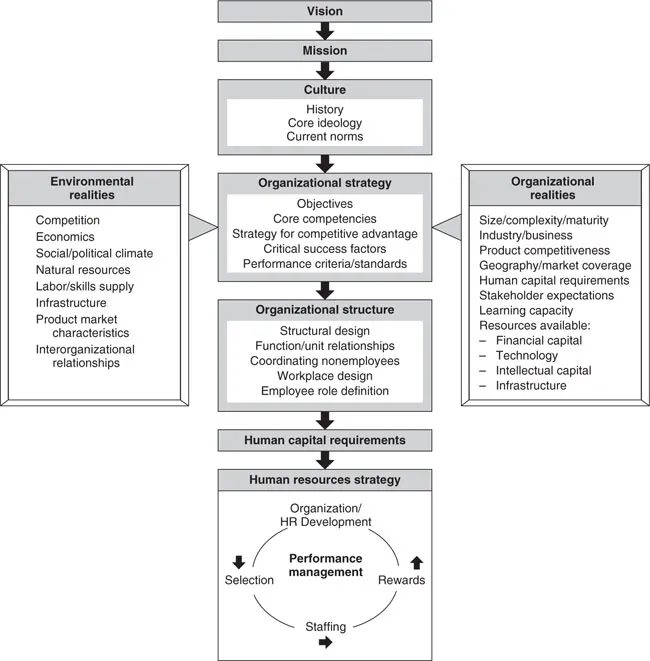
Figure 1.1 provides a model for formulating an HR strategy that will produce a good fit with an organization’s context. This model can guide the design of a human resource management strategy and can also be used to evaluate the current effectiveness and appropriateness of an existing strategy. Once an effective strategy has been formulated it can then be used to evaluate how well policies and programs support the strategy. The model must be dynamic. If any of the contextual characteristics change, the HR strategy should be reassessed. The degree to which the HR strategy is made specific will also depend on contextual characteristics. During stable periods it may be well defined. In times of uncertainty and/or rapid change it may be in the form of a general direction, to be in sharp focus only when a direction is clear and new objectives defined. This demands a dynamic strategy that is administered by continuously assessing the environmental and internal realities and by reallocating resources in a manner that keeps the organization on its desired course.
Formulating an HR Strategy That Fits the Organizational Context
To ensure alignment with the context, several key characteristics of that context must be defined.
Vision/Mission
The vision of an organization defines the organization’s desired future: the desired end state it is focused on producing. The mission of the organization defines the role it intends to play in producing that end state. The example below from the utilities division of a major city illustrates how the vision and mission might be defined:
Vision: (Our City) with reliable power and safe, clean water available to the entire population, contributing to a healthy, high-quality standard of living.
Mission: To generate and distribute power and to purify and distribute water to the entire population, reliably and in a cost-efficient manner.
The vision statement serves as a “magnetic north” that can guide the organization. It can provide a purpose for its existence and define what it needs to accomplish in order to be successful. The mission statement defines the role of the organization in making the vision come true. An often heard mission statement is “to maximize shareholder value.” This unidimensional definition of performance may be defensible for private sector, for-profit organizations, and it is likely to be viewed as appropriate by the party at interest that is being served by this approach. On the other hand, if it results in short-term maximization of resource utilization it can jeopardize the long-term viability of the entity. Or, if it results in low pay and lack of job security for employees, the organization may be unable to attract and retain the workforce required to produce financial success. Therefore, it is critical to integrate how an organization defines performance with its mission.
The CEO of a publicly traded organization must pay attention to the external constituencies that have an interest in the well-being of an organization and in how it conducts business. Conflicting views on the part of these constituencies can make the mission difficult to reconcile. For example, Sam’s Club has been criticized by the public and (more silently) by the government, for low pay and for not providing benefits to many of its employees. The organization is seen as too focused on shareholder return, at the expense of the employees. Its direct competitor Costco has been criticized by Wall Street analysts and shareholders, for pay levels that are too high and benefits that are too generous, which lower shareholder return. Dilemmas such as this are common for executive management when attempting to align HR strategies with business strategies.1 The Sam’s Club–Costco example demonstrates equifinality – that there are numerous feasible paths to success.
Culture
The culture of an organization defines how its members see the world; it is a function of their beliefs, values and priorities. Edgar Schein defined culture as how an organization resolves problems of external adaptation and internal integration.2 Organizational culture impacts how members of an organization behave. The culture of the workforce is also critical in shaping employee behavior. A formal articulation of the desired organizational culture can help to align all constituencies. Below is an example of how key elements of the aforementioned utility’s culture could be defined:
Culture: Reliability in serving customers and executing processes is the primary goal of all employees and organizational units. All employees will be expected to perform well as individuals, while contributing to the effectiveness of those they work with and to the effective functioning of their unit. Safe, reliable and affordable services are the primary measures of effectiveness. Rewards and career progression will be based on competence and performance. Long service will be rewarded through recognition programs and company loyalty to the employee, assuming that they continue to perform and that they maintain the skills and knowledge required. Ingenuity and creativity are valued, as long as they are consistent with safety, reliability and cost-effectiveness standards. Individual contributions to the effectiveness of their unit and of the organization are valued and will be rewarded.
This summary leaves a lot unsaid about how an employee should behave when presented with a particular set of circumstances. But it establishes the importance of safety and reliability and commits everyone to valuing both service and performance, as well as committing the organization to adhering to established principles and values. It provides information about how performance is defined, how it will be measured and what will be rewarded. It sends the message that a “performance culture” is going to be pursued.
It is important for each organization to define and evaluate its culture to determine if it is optimal given the vision/mission and the realities it operates within, as well as the nature of the culture(s) of its workforce. Appendix 2 provides a process that enables an organization to define and evaluate its culture. It also addresses issues associated with the workforce culture, specifically occupational mix and generational mix.
Environmental Realities
The environmental realities faced by an organization at a given point in time should be considered when formulating its strategy. The economic, market, social/political, legal and competitive conditions will play a major part in determining the feasible approaches to accomplishing organizational objectives. For example, organizations attempting to use contingent incentive compensation awards to motivate employees worldwide may find that in some places the approach is not accepted, or even legal. And the condition of the infrastructure needed to support operations may render an otherwise attractive strategy impossible to execute. Failure to perform regular environmental scans and to consider their impact on the organizational and human resources strategies can be a recipe for disaster, particularly if operations are dispersed globally.
The environmental realities must be identified and their impact assessed. An example of a summary of environmental realities for the aforementioned utility might be:
A summary of environmental forces identifies the critical realities faced by the organization and assesses their impact both on strategy and on how operations are conducted. It is important to ensure that how an organization defines, measures and rewards performance is reasonable when externalities are considered. Setting performance objectives that require being first or second in every business may work for General Electric, but would not be believable for a minor player in an industry, which lacks the resources to achieve the average performance level of competitors. Obviously unattainable performance standards would not motivate the workforce, instead promoting a sense of futility.
Another environmental reality that has become critical for many organizations over the last decade is the availability of critical skills. As technology races forward in areas like data analytics, cyber security, artificial intelligence and machine learning a severe shortage in data scientists and other related occupations has been created. Much like the desperate shortage of network IT personnel in the late 1990s, due to Y2K, organizations have had to “rent” skills rather than buy. This has created a new challenge . . . how to deconstruct work into manageable modules that can be contracted out to people who are not employees. Talent platforms have come on the scene (UpWork, Top Coder and the like) that offer to find the needed skills and to connect talent to organizations to perform short-term projects. In order to compete for the best contractors an organization must brand itself as a desirable entity to do business with, much the same as it does when attracting employees. Contracts must be designed that will attract talent and offer them rewards that are viewed as fair, competitive and appropriate. This is a much different challenge than employing talent on a longer-term basis. And yet another challenge involves integrating what is done by employees and contractors, to ensure the units are compatible and work together to produce the desired result.
Organizational Realities
The organizational realities existing at a given point in time will also have a critical impact on what the strategy can be, how it can be executed and what performance levels are achievable. The characteristics of the organization and its business(es) will be dynamic, as will the resources it has available. As organizations grow it becomes increasingly critical to formulate policies and systems that will enable the growth to be controlled. The human capital requirements are particularly relevant to the human resource management strategy. It does little good to build a state-of-the-art microchip plant if the available workforce does not have the knowledge, skills and abilities to operate it effectively.
The SWOT model addresses organizational realities by identifying strengths and weaknesses, providing the guidance to ensure the strategy employed builds on strengths and minimizes the impact of weaknesses. Using the aforementioned utility as an example again, a summary of internal realities might be as follows: