eBook - ePub
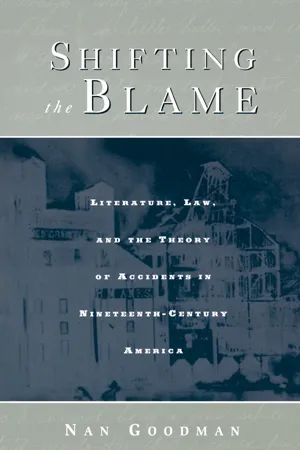
Shifting the Blame
Literature, Law, and the Theory of Accidents in Nineteenth Century America
- 214 pages
- English
- ePUB (mobile friendly)
- Available on iOS & Android
eBook - ePub
Shifting the Blame
Literature, Law, and the Theory of Accidents in Nineteenth Century America
About this book
When someone gets hurt in an accident we reflexively ask a set of questions which ultimately comes down to who was blameworthy? Yet early nineteenth-century Americans were entirely, and to the modern reader, astonishingly, uninterested in this line of reasoning. Their concern was whether an accident had happened and not why. Nan Goodman takes this transformation in legal and popular thought about the nature of accidents as a starting point for a broad inquiry into changing conceptions of individual agency-and ultimately of self-in industrializing America. Goodman looks to both conventional historical sources and the literary depiction of accidents in the work of Mark Twain, Stephen Crane, Charles Chesnutt, and others to explain the new ways that Americans began to make sense of the unplanned.
CHAPTER ONE
Introduction
And if one man’s ox hurt another’s, that he die; then they shall sell the live ox, and divide the money of it; and the dead ox also they shall divide. Or if it be known that the ox hath used to push in time past, and his owner hath not kept him in; he shall surely pay ox for ox; and the dead shall be his own.
(Exodus 21:35–36)
THE PRINCIPAL ARCHITECT of American railroad law,1 Chief Justice Lemuel Shaw (1781–1861), of the Supreme Judicial Court of Massachusetts,2 was known for handing down landmark decisions. The case of Brown v. Kendall,3 however, decided by Shaw in 1850, did not, at first glance, appear to be among them. In fact, far from providing him with an opportunity to review public policy and to forge new legal doctrine, it called attention to an unambiguously private dispute between two dog owners. In trying to part the fighting dogs by beating them with a stick, one dog owner accidentally hit the other in the eye and in this caused an actionable injury. In deciding the case, Shaw was called upon to rule on the question of liability, which until that time had not been a controversial area of the law. Indeed, it was a tribute to Shaw’s ingenuity as a jurist that from facts as seemingly dull and incontrovertible as these, he was able to articulate the influential and revolutionary new doctrine of negligence that altered the legal resolution and the literary representation of accidents in nineteenth-century America.
An emphasis on blameworthiness was at the heart of the new doctrine. “[F]or if the injury was unavoidable,” Shaw wrote, “and the conduct of the defendant [Kendall] was free from blame, he will not be liable.”4 Of course, to readers and litigants in our own time, Shaw’s formulation may seem almost commonplace, for it is now customary to associate legal liability for injury with certain standards of care and blameworthiness. But in the first half of the nineteenth century, this connection was far from obvious. Under the doctrine of strict liability which had prevailed in accident cases for centuries, the law imposed liability even on perpetrators whose conduct was unblameworthy. This outcome, jurists and legal scholars believed, furthered the “dominant idea of Anglo-Saxon law … that man acts at his peril,”5 and thus must suffer the consequences that issue from his acts. For Shaw, however, the fact that the accident in Brown v. Kendall was “such as the defendant could not have avoided by the use of the kind and degree of care necessary to the exigency, and in the circumstances” greatly problematized the inquiry into liability. For if the defendant was in fact “using the kind and degree of care that prudent and cautious men use,” Shaw wrote, there was no logical basis on which to assign liability to him. Rather, for Shaw and his colleagues, the appropriate standard for adjudicating accidents involved an inquiry into fault, where “fault” was construed as the failure to use “ordinary care.” Thus, fault was defined as a form of carelessness or negligence, making negligence the comprehensive standard by which all future accident cases were to be judged.
Although by no means immediate, the implications of the transformation ushered in by the doctrine of negligence were enormous. As a legal doctrine, negligence was undoubtedly most transformative for the litigants who went to court to get compensation for their injuries. In addition to the changes wrought by negligence in the law were the changes it precipitated for industrialization and for America’s understanding of individual agency6 and responsibility for risk as a whole. In fact, so pervasive was the impact of negligence that virtually no aspect of nineteenth-century culture escaped its influence. Shifting the Blame, however, focuses on one particular aspect of that cultural reformation—the narrative manifestations and implications of accidents that emerged not in scientific tables and charts that correlated risk with other variables or even in the histories of industrial risk and danger, but in the literary telling and retelling of accidents. In turning my attention to literature, moreover, I conclude that nowhere was the significance of the new doctrine of accidents more visible than in the pages of the accident narratives that began in this period (a period that roughly coincides with the heyday of American industrialization) to permeate the literary marketplace. For in these stories of accidents, the features of accidental risk that might otherwise escape our attention—the suddenness of impact, the encounter between strangers, and most important, the changing nature of liability and human agency under negligence—were painstakingly reconstructed, taking a particular, and culturally significant, shape.
THE ORIGINS OF NEGLIGENCE
The modern doctrine of negligence is crucial to an understanding of the nineteenth century because it altered the story that the culture told itself about blame and responsibility. Specifically, the doctrine altered the story of blame that was associated with the legal doctrine of strict liability for accidents—the doctrine that had prevailed in Anglo-American culture for centuries before modern negligence took hold. Under strict liability—the general principle governing cases that came under the heading of torts or “wrongs” not arising from contract—responsibility for compensating someone for an accident fell absolutely or strictly to the individual who caused the injury. There was no inquiry under the doctrine of strict liability into whether the agent who had caused the injury had done so in a blameworthy manner. As one legal theorist put it: “The early law asked simply, ‘Did the defendant do the physical act which damaged the plaintiff?’”7
Indeed, in some instances in early accident law, the law inquired only into the status relations between the injurer and injured party, thus making an inquiry into the physical act itself superfluous. Liability, that is, was often attributed on the theory that those in certain status relations with others, like that of parent and child or master and servant, should assume responsibility for those less capable of doing so. In the early stages of industrial organization, when factories were small and employees were few, relationships in the workplace were likened to those in a family where there had always been a basic presumption of compensation: family members were in the habit of taking care of each other in time of injury. On this theory, the law typically held masters liable for their servants’ actions. A similar argument, based on status, applied to the liability of parents for their children and employers for their employees, extending even to the liability of doctors and lawyers for their patients and clients.8
Curiously, in many of these status cases the courts spoke of the “action” involved as negligent. But this early use of the term had little or nothing to do with the concept as we now know it. In fact, in these cases, without exception, negligence did not signify a careless performance but rather the failure to perform a task that had been assigned. In all of these cases, in short, negligence was tied to the absence to specify a preexisting duty or to the breach of a duty imposed by contract, statute, or by clearly defined status relations. This understanding of negligence, then, diverged only slightly from the concept of strict liability that attributed liability on the basis of causation alone, without inquiry into fault or carelessness. Thus, in a typical invocation of negligence in an escape case dating from 1795, the court attributed liability to a sheriff on the basis of this older, stricter notion of liability even in the face of evidence that the “escape was occasioned by circumstances not to be foreseen, and which could not be prevented by even more than ordinary exertions and caution.”9 For, as the court reasoned, “every escape not happening by the act of God, or the public enemies was, in the eye of the law, considered a negligent escape. The law admits no other excuse.”10
As events became more complex, however, the strict causal emphasis of strict liability as well as the status orientation of early “negligence” became increasingly irrelevant. Indeed, in America as early as the late eighteenth century,11 in certain accidents,12 a new defense emerged that absolved the defendant of liability where the accident itself appeared to be inevitable, the result, for instance, not of the defendant’s act directly but of a natural disaster. A very common confusion, for example, arose in cases where a sea captain allowed his ship to become disabled when a storm then forced it to collide with and cause damage to another, for in these instances it was never clear whether the accident would have occurred even in the absence of the captain’s contribution.13 In these cases, defendants often argued that not only was the accident unavoidable but that their action was lawful or unblameworthy, at the very least the result of the best efforts that could have been taken at the time and in the circumstances. Thus, in the place of strict liability, a new standard of ordinary care began to creep into the standard for adjudicating accidents long before Shaw wrote his landmark decision which was based upon it.14 Indeed, Brown v. Kendall echoed an emphasis that had been placed as early as the first quarter of the nineteenth century by a small number of judges in Massachusetts and elsewhere15 on the unavoidable and unblameworthy nature of certain injuries.
Distinguishing between blameworthy and unblameworthy behavior on the basis of the kind of care taken during the act that resulted in injury introduced a much broader notion of responsibility. It assumed, in fact, that a certain level of care was owed to each and every individual, not just to specific individuals in specific status relations. And once the notion of ordinary care replaced status and causation as an arbiter of liability, liability depended on a definition of duties which, having been violated, would lead to a finding of fault. Indeed, in larger factories, and in more densely populated urban centers that were made possible in large part by steamship and railroad travel (which were themselves prime sources of accidental injury), accidents increasingly took place between people who had never met before and between whom there was no preexisting sense of obligation. In this new, highly industrialized and technologized climate, where the causes of accidents were uncertain, and the perpetrators and victims of accidents unknown, decisions about liability for accidental injury required both a new theory of liability, and a new calculus for distinguishing between a primary cause and a potential host of others.
The concept of duty—the duty to exercise ordinary care when engaged in potentially hazardous activity—proved a paradox. Insofar as it assumed a duty that was in Oliver Wendell Holmes’s words, “of all the world to all the world,”16 it turned liability from a standard that applied to certain individuals because of their status either as actors or in certain occupations into a concept that applied to everyone indiscriminately. In short, liability went from being a specific designation for certain acts or actors to a universal standard, a shift that in America coincided with a turn from status-based notions of government to more democratic ones. Under negligence, for the first time, liability for accidents was based not on the status of the victim and perpetrator or on the fact of injury alone but on the question of fault or blameworthiness. Thus, we recall from Shaw’s decision, negligence was defined as the absence of “ordinary care,” or the “kind of care prudent and cautious men would use … in the circumstances.” But if the concept of ordinary care and the invocation of the average, prudent, and cautious man paralleled a rise in democratic social relations, it did so in part by imposing a model of universal liability. In the early nineteenth century, universal liability was especially problematic for it threatened to put an end to the taking of risks necessary to an expanding industry.
The paradox of universal liability, then, was that it led to a limited liability. Indeed, almost as soon as the universal duty of taking ordinary care was introduced in America, it was curtailed by four important legal doctrines. The first and most important of these was the doctrine of negligence under which the courts defined fault and assigned liability only in the absence of ordinary care which was, generally speaking, construed quite loosely in favor of the risk-taking entrepreneur. The second of these doctrines was known as the fellow-servant rule.17 The brainchild of Lemuel Shaw, whose influence on the negligence doctrine has already been noted, the fellow-servant rule paved the way for employer dereliction of all kinds. Under this rule, the courts explicitly reversed the earlier, status-based presumption in favor of employer liability by forbidding workers to sue their employers for injuries inflicted by their fellow employees. Because few injuries were inflicted by employers themselves, although many were the product of their negligence, this rule seriously limited suits for work-related accidents. Hand in hand with the fellow-servant rule was the third restrictive legal doctrine, the doctrine of the assumption of risk which absolved the employer of responsibility for risks the employee had assumed voluntarily. (A variation on this theme emerged in the doctrine of the scope of the employment which held all acts that endangered the employee to be, quite literally “outside the scope of employment,” and thus nonactionable under the law.) Thus, employees who, in Holmes’s words, “appreciated the danger”18 of their jobs—an attribute no employee could afford to be without—had no legal right to sue employers for injuries that arose in the course of their employment.19 The fourth and last of these doctrines had to do with limiting the liability not of capitalists but of spectators, yet it reflected the general climate of the new restrictions on liability for all. Under the doctrine of the good Samaritan, as it came ironically to be known, the law defined the duties of all to all as negative ones and thus did not expect and even actively prohibited bystanders from acting affirmatively as good Samaritans unless a relation of status required them to do so.
Central to all of these limitations on liability were assumptions about how liability and responsibility should work. But perhaps the most important of these assumptions was a theory of causation that was drastically different from the one that underwrote the doctrine of strict liability. As Morton Horwitz has observed, the theory of causation relied on two metaphors: a chain of causation and the distinction between remote and proximate cause.20 Thus, someone could be held responsible for causing harm to another only when a chain of proximate rather than remote causes could be established from that person’s act to the effect of damage on the other. These metaphors helped to construct a narrative of very limited liability, of very limited duties that all owed to all.
Horwitz locates these metaphors in an instrumentalist view of the rise of negligence. In his view the legal doctrine of negligence was the inevitable result of the changes in economic conditions that accompanied industrialization. In keeping with his instrumentalist conception of the law, Horwitz argues that negligence was primarily a result of the law’s interest in promoting policies of industrial expansion. Specifically, he points to a series of influential court decisions in the middle of the nineteenth century in which negligence became a tool designed specifically for encouraging entrepreneurial risk. By altering the already vague and variable standard of care central to the negligence calculus, the courts were able almost imperceptibly to remove certain barriers to the capitalist risk-taking they saw as necessary to the well-being of society. In short, a pattern of practice emerged in which the courts increasingly found the behavior of industrialists—factory, steamship, and railroad owners, primarily—to be within the parameters of “ordinary care,” even when the facts clearly suggested an absence of care or an adequate attention to safety. While my own view benefits tremendously from that of Horwitz, it has a different emphasis. That is, while I too point to the influence of economic conditions on the rise of negligence, I do not argue for the exclusivity or inevitability of their effect. Rather, in turning my attention to the many literary narratives of accidents, narratives that compete with each other and that tell multiple and varied tales, I hope to identify the contingencies rather than the exigencies of legal history—the possibility, in short, that legal history in general, and the notion of liability under negligence in particular, need not have taken the path it did.
LITERATURE, LAW: A MODEL
In comparing and contrasting legal and literary narratives, Shifting the Blame both builds on and diverges from the general trend in legal and literary studies. Insofar as it assumes literary and legal texts to be equally rich and illuminating, for example, it is indebted to many of the assumptions made by some of the earliest and most influential of law and literature scholars. In particular, it draws upon the insights of James Boyd White who has emphasized the extent to which both law and literature are narrative and interpretive institutions comprised largely if not exclusively of what he refers to as “compositional activities.”21 In White’s terms, both kinds of texts interpret, legitimate, and even regulate empirical data through narrative descriptions—in the one case a novel or a poem, in the other, a trial transcript or a judicial opinion. Similarly, in investigating the constructedness of both law and li...
Table of contents
- Cover
- Title Page
- Copyright Page
- Dedication
- Table of Contents
- Acknowledgments
- Chapter One Introduction
- Chapter Two A Clear Showing: The Problem of Fault in James Fenimore Cooper’s The Pioneers
- Chapter Three Negligence before the Mast: Ship Collisions and the Nautical Literature of the Mid-Nineteenth Century
- Chapter Four “Nobody to Blame”: Steamboat Accidents and Responsibility in Twain
- Chapter Five The Law of the Good Samaritan: Cross-Racial Rescue in Stephen Crane and Charles Chesnutt
- Chapter Six Stop, Look, and Listen: The Signs and Signals of the Railroad Accident
- Chapter Seven Epilogue
- Notes
- Index
Trusted by 375,005 students
Access to over 1.5 million titles for a fair monthly price.
Study more efficiently using our study tools.
Frequently asked questions
Yes, you can cancel anytime from the Subscription tab in your account settings on the Perlego website. Your subscription will stay active until the end of your current billing period. Learn how to cancel your subscription
No, books cannot be downloaded as external files, such as PDFs, for use outside of Perlego. However, you can download books within the Perlego app for offline reading on mobile or tablet. Learn how to download books offline
Perlego offers two plans: Essential and Complete
- Essential is ideal for learners and professionals who enjoy exploring a wide range of subjects. Access the Essential Library with 800,000+ trusted titles and best-sellers across business, personal growth, and the humanities. Includes unlimited reading time and Standard Read Aloud voice.
- Complete: Perfect for advanced learners and researchers needing full, unrestricted access. Unlock 1.5M+ books across hundreds of subjects, including academic and specialized titles. The Complete Plan also includes advanced features like Premium Read Aloud and Research Assistant.
We are an online textbook subscription service, where you can get access to an entire online library for less than the price of a single book per month. With over 1.5 million books across 990+ topics, we’ve got you covered! Learn about our mission
Look out for the read-aloud symbol on your next book to see if you can listen to it. The read-aloud tool reads text aloud for you, highlighting the text as it is being read. You can pause it, speed it up and slow it down. Learn more about Read Aloud
Yes! You can use the Perlego app on both iOS and Android devices to read anytime, anywhere — even offline. Perfect for commutes or when you’re on the go.
Please note we cannot support devices running on iOS 13 and Android 7 or earlier. Learn more about using the app
Please note we cannot support devices running on iOS 13 and Android 7 or earlier. Learn more about using the app
Yes, you can access Shifting the Blame by Nan Goodman in PDF and/or ePUB format, as well as other popular books in Law & 19th Century History. We have over 1.5 million books available in our catalogue for you to explore.