- 80 pages
- English
- ePUB (mobile friendly)
- Available on iOS & Android
eBook - ePub
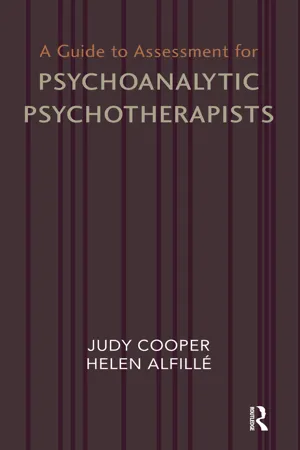
A Guide to Assessment for Psychoanalytic Psychotherapists
About this book
Psychoanalytic psychotherapists and psychoanalysts inevitably find themselves doing assessment in their work, both in private practice and in a clinical setting such as the NHS. The authors felt a need for a book that covers this vital aspect of their work, which would be of benefit both to students in training and to practitioners. Amongst subjects covered are the nature of assessments, the setting, consultation, contraindications, and clinical examples. This title contains the distilled wisdom of over twenty years experience in the field.
Information
Chapter One
Overview of assessment
The assessor and his role
Assessment for psychotherapy forms a large part of the clinical work of a consultant psychotherapist, but it raises more uncertainty and anxiety than any other subject in psychoanalytic psychotherapy. [Garelick, 1994]
Given that Garelick talks in terms of the assessor being a consultant, we find it somewhat perturbing that many people expected to do assessments in various settings frequently have very little therapeutic experience. For a therapist, meeting a new patient evokes feelings of suspense, excitement, and anxiety. He is aware of potential dangers in getting in touch with the unconscious in both himself and the patient. He needs to be able to identify with the patient and, at the same time, maintain his analytic role. Within this role, if assessing to refer on to a colleague, he needs to be prudent in what he expects from the patient, aware that an imminent ending is there from the beginning. He needs to put his narcissism aside and leave the centre of the stage. The role of the assessor has broadened over time from being purely a matter of deciding whether a person was suitable for psychoanalytic work to one where the assessor may recommend another form of treatment. Advising a patient in this way could be seen as being in conflict with the aims of psychoanalysis, one of which is to open up choices for a patient and give him control over his own life. Because of this, some therapists consider that asessment is a clinical skill in its own right, with its own technique. It is an introduction to a very different way of relating, both formal yet intimate. In any event, increasingly it is being recognized that clinicians need a considerable amount of experience and expertise in order to develop their individual style and focus in conducting an assessment consultation.
What is an assessment?
In this book, we are talking primarily about assessment for psychoanalytic work in private practice. From our experience, we feel that a minimum of one and a half hours is necessary for an assessment, if the assessment is restricted to one session only.
However, we have come to the conclusion over the years that in order to really understand how a patient uses the setting, at least two consultations are more helpful. Although we are, in general, referring to private practice, it is important to mention that clinicians in other settings may work with other models; for instance, with extended assessment, as was sometimes practised at the Anna Freud Centre, or where an organization pays for a limited number of sessions, it may be more helpful to think of these in terms of an extended assessment rather than ongoing psychotherapy. As Bolognini (2006) says, assessment consultations should be “aimed at clarifying the patient’s suffering, needs, ways and levels of functioning, difficulties, fears, motivations, expectations and real possibilities for change” (p. 25). An assessment consultation can be seen as an unequal meeting between two strangers, where one person is troubled and seeking help and the other is informed and trained to listen in a very particular way.
It is not a social chat. One must bear in mind that fantasies have developed the moment a person obtains the name of an assessor, or even before, when someone becomes aware that he wants help.
Some people carry around a piece of paper with the name and number of the assessor for a considerable time, which can be seen as a talisman or transitional object, before making contact. The voice on the telephone both increases fantasies and also gives a modicum of reality to the situation.
Perhaps it is worth remembering that this first unseen, aural contact between patient and assessor on the telephone is a repetition evocative of one of the earliest prenatal links between infant and mother. This experience may be replicated in future therapy with a patient on the couch. As can be seen, the transference and countertransference is intrinsic to the situation and the therapist will be aware of this and use the nuances in the consultation. A patient, having spoken to the assessor on the telephone, on subsequently meeting her said, “Oh, but you sounded so young on the phone.” Her transference response of surprise and disappointment was taken up by the assessor. A strong countertransference response to a patient’s angry, aggressive, initial phone call alerted the therapist to what might emerge in the consultation. She made sure that there would be someone else in the vicinity should there be any acting out by the patient. An assessment should reflect a microcosm of a patient’s life and inner world. It also gives the patient an experience of the analytic setting. It is to be hoped that the containment of the therapeutic setting will allow us to get as full a picture as possible, so that we can begin to assess a patient’s capacity to use psychoanalytic work, with its emphasis on the unconscious. The kind of things we need to cover are: what has brought the patient for help now, current problems and relationships, and his memories and experiences of early family life and growing up. We will note if there is some evidence of a good primary object. A young woman seeking psychotherapy had been abused by her father from a very early age. The mother denied it until the girl was fourteen, when there was a court case and the father was sent to prison. There were no grandparents and no evidence of a good object, reflected in desperate and empty adult relationships, posing questions in the assessor’s mind as to her capacity to enter into a psychoanalytic relationship. We explore loss and the patient’s capacity to mourn, any addictions, suicidal attempts or thoughts, somatizing, fantasies, and dreams. We try to cover these themes, but, of course, it is impossible to achieve all this in one session.
What can an assessment offer?
We do not offer a magical cure. We hope that improvement will occur as part of the exploration. Tyson and Sandler (1971) felt that the psychoanalyst was in the difficult situation of seeing a cure as a desirable by-product of the process of analysis but not necessarily the main aim. Freud felt that one of the main aims of analytic work was to enable the patient’s unconscious drives to become conscious, so that he might have more choice and control over his actions. “Where id was ego shall be.” There are many today who feel psychoanalysis is passé, with its painstaking techniques of reflection and exploration. But, in fact, the theoretical concepts are the basis for many of the myriad therapies being offered today that seem to suggest a rapid solution even to complex problems, which seems to us more in keeping with the somewhat unrealistic demands and expectations of today’s culture.
A patient’s fantasies of what therapy may offer also need to be explored in an assessment. Not everybody is as clear as Fairbairn’s patient was when he said that he was not interested in the analyst’s interpretations; he was there in search of a father. Many patients are not as clear as to what they are searching for, though “the fact that the patient has chosen to consult a psychoanalyst suggests that probably he is already unconsciously inclined to proceed further along the psychoanalytic route” (Quinodoz, 2003, p. 119). She goes on to note that there may be a latent request for a deeper exploration behind the manifest one. In any event, the patient needs to become aware of the existence of the unconscious and their own internal world. In fact, psychoanalytic psychotherapy offers an opportunity to mature and to integrate. Putting confused feelings into words in an assessment can help to put them into better perspective. The consultation can provide a safe space where patients can be heard. Sometimes, the initial session can prove to be sufficient help in itself, and the patient can move on without a referral: it is as if he needed to tell his story, feel heard and understood, which enabled his perspectives to shift. “Whew, that was such a load off my mind,” said one such patient.
The setting
In an assessment, the setting is of paramount importance, as in all psychoanalytic work. After the auditory impact mentioned before, the first visual impression of the psychotherapist in the consulting room is crucial. A young woman who felt physically and emotionally messy and unacceptable saw an analyst whose room was chaotically untidy, reflecting her own experience of chaos. This proved to be unbearable, and she found another analyst where she felt more contained.
Sometimes, patients having therapy in an institution form an attachment to the place, to a “brick mother” rather than the person of the therapist, and even in private practice, a severely deprived patient may form an immediate transference attachment to the setting, as it feels safer. For example, one young man commented, “I like you, but I really love your room.” It is of paramount importance that the assessor should be absolutely clear about the parameters of this first setting that the patient encounters. The physical space of the consultation, as well as the appearance and manner of the psychotherapist, will be intensely observed and used by the patient. How they register the place and person of the therapist will be influenced by their fantasies, which, in turn, will affect the material that emerges.
Having had a previous assessment, one woman observed that although she had liked the therapist, she felt more secure and safe with the “solid furniture” of the present assessor’s room.
The analytic position
In an assessment, just as in long-term psychotherapy, we have to be aware of our analytic position at all times, which is so different from normal social exchange: “What is distinctive about psychotherapy is the therapist’s prohibition upon himself from enacting either the promptings of his own inner world or those of his patient . . .” (Temperley, 1984, p. 102). If we did respond to the promptings of the patient, we may play a part in an enactment, thus distorting our therapeutic role and function of analysing the transference. Much of our training helps us to learn to hold back and not respond to a patient’s wishes.
Who comes?
Patients are referred from many different sources. They may make a self-referral, or be referred by GPs, ex-patients, psychiatrists, psychologists, social workers, family, or friends.
Not all these referrers are knowledgeable about what exactly psychoanalytic psychotherapy has to offer. Since Freud, the type of presenting problem has changed dramatically and the basis on which people are referred has broadened considerably. The scope has increased to include not only the “good neurotic”, but also narcissistic and borderline patients, often with severe problems in functioning. One also sees many patients with personality disorders who are notably difficult to treat. There is also a group of patients who seek therapy not because of incapacitating symptoms, but because of a wish to explore conflictual issues in a search for personal growth, which may also help their professional development. Distinct from these are those patients who feel they come into therapy only for training purposes, who can be a very defensive and unsatisfactory group to treat. Care is needed in making such a referral, as the ...
Table of contents
- Cover
- Half Title
- Title
- Copyright
- Contents
- ABOUT THE AUTHORS
- FOREWORD
- PREFACE
- CHAPTER ONE Overview of assessment
- CHAPTER TWO Are we looking for a diagnosis?
- CHAPTER THREE The consultation
- CHAPTER FOUR Transference and countertransference in the assessment consultation
- CHAPTER FIVE Contraindications
- CHAPTER SIX People who come to us for assessment
- AFTERWORD
- REFERENCES
- INDEX
Trusted by 375,005 students
Access to over 1.5 million titles for a fair monthly price.
Study more efficiently using our study tools.
Frequently asked questions
Yes, you can cancel anytime from the Subscription tab in your account settings on the Perlego website. Your subscription will stay active until the end of your current billing period. Learn how to cancel your subscription
No, books cannot be downloaded as external files, such as PDFs, for use outside of Perlego. However, you can download books within the Perlego app for offline reading on mobile or tablet. Learn how to download books offline
Perlego offers two plans: Essential and Complete
- Essential is ideal for learners and professionals who enjoy exploring a wide range of subjects. Access the Essential Library with 800,000+ trusted titles and best-sellers across business, personal growth, and the humanities. Includes unlimited reading time and Standard Read Aloud voice.
- Complete: Perfect for advanced learners and researchers needing full, unrestricted access. Unlock 1.5M+ books across hundreds of subjects, including academic and specialized titles. The Complete Plan also includes advanced features like Premium Read Aloud and Research Assistant.
We are an online textbook subscription service, where you can get access to an entire online library for less than the price of a single book per month. With over 1.5 million books across 990+ topics, we’ve got you covered! Learn about our mission
Look out for the read-aloud symbol on your next book to see if you can listen to it. The read-aloud tool reads text aloud for you, highlighting the text as it is being read. You can pause it, speed it up and slow it down. Learn more about Read Aloud
Yes! You can use the Perlego app on both iOS and Android devices to read anytime, anywhere — even offline. Perfect for commutes or when you’re on the go.
Please note we cannot support devices running on iOS 13 and Android 7 or earlier. Learn more about using the app
Please note we cannot support devices running on iOS 13 and Android 7 or earlier. Learn more about using the app
Yes, you can access A Guide to Assessment for Psychoanalytic Psychotherapists by Helen Alfille,Judy Cooper in PDF and/or ePUB format, as well as other popular books in Psychology & History & Theory in Psychology. We have over 1.5 million books available in our catalogue for you to explore.