- 352 pages
- English
- ePUB (mobile friendly)
- Available on iOS & Android
eBook - ePub
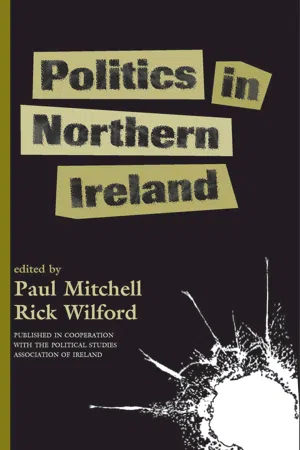
Politics In Northern Ireland
About this book
Despite the staggering number of books related to the Northern Ireland political arena, most of the literature concentrates on only a few dimensions of ?the conflict? and especially on constitutional policy and the on-going search for a resolution of the antagonisms. This original textbook, the first of its kind, serves as a comprehensive examination of the subject by exploring these topics and other important dimensions of politics which have been overlooked and undervalued.Politics in Northern Ireland is written by a team of distinguished academics, drawn from both within and outside Northern Ireland. It adopts the analytic tools of political science and brings a comparative perspective to bear on the politics of Northern Ireland. Early chapters examine the historic sources of conflict, analyze the period since the outbreak of the modern troubles, and discuss the differences between the communities. The book then examines the nature of parties, elections, and elective assemblies, before focusing on policy matters, such as fair employment, policing, and gender. In the concluding chapter, contributors consider relations with the Republic of Ireland and discuss events as current as today's headlines, including the historic breakthrough in negotiations, the referendums, and the Assembly elections. The result is a well-rounded core text designed for the classroom, as well as for those interested in learning more about different facets of politics in Northern Ireland.
Information
1
The Past in the Present
FEARGAL COCHRANE
It was once wryly observed that Irish history was something Irishmen should never remember and Englishmen should never forget. In reality, the obverse has normally been the case, as Britain has sought to minimise the intrusion of Ireland into its domestic politics whereas the rival political groupings in Ireland have engaged in a selective recollection of their shared history. Unlike the Republic of Ireland or other countries that have emerged from violent beginnings (such as the United States of America), historical memory plays an important role in contemporary political behaviour within Northern Ireland— where questions over ethnicity, territoriality, power, and national identity, which determined the region's historical development, have not yet been resolved. Consequently, history (or, more precisely, historical myth) is invested with an importance that is not reflected in more stable societies. The central focus of this chapter, therefore, is to illustrate how the past structures the present—specifically, how the political development of Northern Ireland, leading in 1969 to the outbreak of the present civil conflict, is a product of that history.
Background to Partition
After the joint launching by the British and Irish governments of the Framework Documents in February 1995, Prime Minister John Major prepared to be interviewed by a local television journalist in Belfast. Just before transmission, Major asked, "Okay, Ken, where do you want me to start?" Feigning seriousness the reporter replied, "1690, Prime Minister!" Deciding where to begin any account of Irish history is a matter of discretion and, to some degree, a political statement in itself. However, to understand the dynamics that led to the partition of Ireland, we must know something of the political forces that, by this time, had coalesced into the rival ideologies of unionism and nationalism.
Home Rule
The inability of Britain to successfully integrate Ireland politically or culturally into a viable model of common citizenship throughout the nineteenth century led eventually to calls for some degree of political autonomy. There were two views as to the extent this local autonomy should assume: complete independence, on the one hand, or some ambiguous form of devolution, on the other. There was also disagreement about the methods that should be used to achieve these ends. One group took the view that revolutionary nationalism was the only means available to attain the goal of independence. The lineage of this group can be traced through the Irish Republican Brotherhood and the emergence of Sinn Féin to the physical-force tradition of Irish republicanism that remains in Ireland today. The other strand within the emerging Irish nationalist movement was less ambitious in its goals and consequently more pragmatic in its political strategy. Once again, a line can be drawn from the reformist leadership of Charles Stewart Parnell and Isaac Butt to John Redmond and the "constitutional nationalism" practised today by the Social Democratic and Labour Party (SDLP) in Northern Ireland and by the main parties in the Republic of Ireland.
The most important point to note is that the home rule movement was neither revolutionary nor separatist. The initial principles of the Home Government Association were federalist, with separate legislatures being planned for England, Scotland, Wales, and Ireland, which would derive their authority from the United Kingdom parliament. The home rule movement became a political party in 1873; then, after the Westminster general election of January 1874 (when 59 out of the 100 Irish MPs were returned), it became the Irish Parliamentary Party (IPP) under the leadership of Butt and Parnell. The advocates of home rule were influenced by international events such as the northern victory in the American Civil War and the establishment in 1867 of Canada, where federalism had become de rigueur amongst political theorists.
This demand for limited self-government within the United Kingdom was opposed by British Conservatives who feared it could damage British authority in other parts of the empire. When Liberal leader William Gladstone announced his support for the cause of home rule, the Conservatives accused him of treason, while Randolph Churchill would later declare, "Ulster will fight and Ulster will be right."
For many years the home rule issue was a hostage to Westminster arithmetic, as the influence of the Irish Parliamentary Party on the government depended upon the party's maintenance of the balance of power in the House of Commons. It was only in 1911, when the Liberal Party needed IPP support to reform the House of Lords, that the necessary legislation was pushed through. The Third Home Rule Bill was introduced by the Liberal government in 1912 (the previous two had failed in 1886 and 1893) and was opposed by the Conservatives and Unionists. In Ulster the unionist leader Sir Edward Carson, a Dublin-born lawyer, formed a private army called the Ulster Volunteer Force, and a "Solemn League and Covenant" was entered into by more than 400,000 unionists, many of whom signed their names in their own blood. This example of "public banding" is a key facet of Protestant political culture. The same phenomenon was seen more recently after the signing of the Anglo-Irish Agreement on 15 November 1985, albeit with less success. In this case, radical unionists formed "Ulster Clubs," as Edward Carson had done at the beginning of the century. As Alan Wright, the leader of this group, remarked in 1986: "It's a case of history repeating itself. In 1893 when the first home rule bill was presented to parliament, the unionists got together and formed a Unionist Club. So we decided that we needed a structure that everyone could come together under" (Fortnight, February 1986: 4).
In September 1914 the Government of Ireland Act became law, with two important qualifications: First, its operation would be suspended until after the ending of World War I and, secondly, a special opt-out would have to be provided for Ulster. Although the war had delayed the implementation of home rule, and perhaps forestalled the outbreak of civil war in Ulster, a mechanism still had to be found that would satisfy the unionists in the North of Ireland. In 1920, the British government introduced the Government of Ireland Act. This act became the basis for partition and established the region's political geography, which remains today. In particular, it proposed two subordinate legislatures in Ireland under the authority of Westminster: one for "Northern Ireland," incorporating six of Ulster's nine counties, and the other for Southern Ireland, with jurisdiction over the remaining twenty-six counties. Following the war of independence and subsequent negotiations between the British government and Sinn Féin, the Anglo-Irish Treaty was signed, enshrining the new territorial boundaries. Ironically, although six counties of Ulster were allowed to remain within the Union, their method of doing so was a form of home rule.
Political Cultures in the New State
The first prime minister of Northern Ireland was Sir James Craig, a man who claimed not to welcome the new state but who would go to his grave "ashamed if I did not go down with the ship too" (Buckland 1980: 50). Craig faced the unenviable task of creating a viable administration in the face of latent antagonism from the British government and open aggression from Southern nationalists and Catholics within the North, who felt that they had been corralled within an illegitimate regime and abandoned to the mercy of their unionist enemies. The political culture in the early years of the new state was therefore dominated by fear and uncertainty. This condition remains a feature of the unionist psyche today, and insecurity about their political surroundings is a central dynamic of contemporary unionists' political behaviour.
In 1920 unionists were aware that they had succeeded in obtaining a regional administration only by forming a paramilitary army, the Ulster Volunteer Force (UVF), and threatening to rebel against the British state. Fears about the tenuous nature of their position were heightened by the civil war that raged in the Free State from June 1922 until May 1923. The picture is clearer now, in retrospect; at the time, however, it was not obvious as to who would emerge victorious from this struggle: Had the anti-treaty republicans, led by Eamon de Valera, triumphed over the pro-treaty government, the future of Northern Ireland would have been seriously jeopardised. Unionist political culture during the early years of the Northern Ireland state was therefore one besieged by hostile forces. This situation translated into a desire for political domination and electoral cohesion, as it was feared that a loss of control to the nationalist community would have imperiled the very existence of the state itself. Many Protestants believed that if Northern Ireland were to disintegrate and they were subsumed politically into some sort of pan-nationalist Ireland, their cultural and religious freedom would also evaporate under the unyielding dogma of conservative Catholicism. Although such fears were debilitating, they also became an essential element of electoral cohesion. The unionist political leadership soon learned that the most successful electoral strategy lay in exacerbating these twin fears of "Rome rule" and "Catholic disloyalty," inasmuch as this could be relied upon to elicit the Pavlovian response among Protestants of voting for the Unionist Party (see Chapter 5).
The political culture among the nationalists was, conversely, one trapped in a state to which they held no allegiance, increasingly beset by the feeling that they were second-class citizens under the law. These feelings were heightened in 1925 after the report of the Boundary Commission, which had been a condition of the Anglo-Irish Treaty. In theory, this was given a remit to revise the border in line with local wishes. It was expected within nationalist circles that in border counties where nationalists formed a majority, such as parts of Fermanagh, Armagh, and Derry/Londonderry, they would be allowed a local opt-out from Northern Ireland into the Free State. The fear that this outcome might indeed ensue fueled the insecurity and uncertainty endemic within unionist politics. The Northern Ireland administration, mindful that the British government might take the opportunity to chip away at the geography of the state to the point that it became an untenable regime, made strenuous efforts to influence both the composition of the Boundary Commission and its eventual findings. The minister for home affairs, Dawson Bates, was the least subtle in this respect, drafting a memo that listed the military capability of the Northern Ireland government should a confrontation with the British state become necessary (Bardon 1992: 506). The commission's declaration that the boundaries should remain as they were confirmed the worst fears of the Northern nationalist community and strengthened its antipathy toward the Stormont regime.
Although "constitutional" (i.e., nonviolent) nationalists quickly established a dominance over Sinn Féin, they, too, adopted an ambivalent attitude toward the new regime, refusing to assume the role of official opposition, which would have conferred legitimacy upon the system. The degree of discrimination against nationalists between 1920 and 1972 is a matter of some debate. Abuses undoubtedly occurred (see Farrell 1980; Wilson 1989), but they were often haphazard and localised rather than systematic. Of course, the point could be made that electoral malpractice, together with partiality in housing and employment provision, occurred only when demographic circumstances demanded. Subsequently, however, nationalists have exaggerated the mistreatment in the same way that unionists have denied or downplayed it (see Whyte 1990: 61-64, for an outline of this debate). The effects on the political culture within Northern Ireland were certainly real enough. Many Protestants were living in conditions as bad as, if not worse than, those experienced by the Catholic community; influenced by the sectarian stereotypes provided by their leaders, they believed Catholics to be "enemies within" whose economic misfortunes were entirely self-inflicted.
Nationalists in Northern Ireland, meanwhile, were effectively leaderless, at least until the beginning of the civil rights movement in the late 1960s. Sinn Féin operated a policy of abstentionism and was of little practical use to the Catholic community, whereas the Nationalist Party, which did take its seats in the Stormont parliament, was excluded from power, becoming merely a decorative addendum to the political system. As a consequence of the party's disempowerment, "constitutional" nationalism became withdrawn and complacent, its conservative Catholic middle-class leadership "going through the motions" of opposition rather than taking up the political cudgels to fight for the grievances of those whom they purported to represent. For much of the period from 1920 to 1972, nationalist politics were in disarray, both philosophically and organisationally, functioning as little more than the political wing of the Catholic Church hierarchy: "Its basic unit of organisation was not the electoral ward but the parish, . . . Nationalist candidates were not selected, they were anointed" (Eamonn McCann, cited in Arthur 1984: 56). It was not unusual for seats to go uncontested due to the predictability of the electoral results, as demonstrated by the fact that between 1929 and 1969, 37.5 percent of all seats were unopposed and in a 52-seat lower chamber, unionists never held fewer than 32 seats (Arthur and Jeffrey 1988: 33).
Northern nationalism became alienated from the state, creating a constituency which believed that unconstitutional action and physical force was a legitimate means of political redress. Unionism, on the other hand, having originally been antipathetic to the notion of a devolved parliament for six counties of Ulster, soon became mesmerised by its potential. The preservation of the political regime (i.e., Unionist Party rule) became the modus operandi of successive administrations, whose political fixation lay neither with ideas nor ideologies but with the numbers game. A negative equation was quickly established— namely, that the loss of political control by the Unionist Party would lead to the immediate destruction of the state by "disloyal" nationalists; hence the necessity to do everything possible to reinforce unionist political hegemony and electoral cohesion. Eventually, owing in part to British government ambivalence and lack of interest, unionists made the fatal mistake of believing that Stormont was an autonomous entity, rather than simply a region of the United Kingdom that had been given a measure of self-government. Prime Minister Edward Heath was to disabuse unionists of this assumption in March 1972 by proroguing Stormont and introducing direct rule.
The Politics of Blood Sacrifice
The leader of the Irish Parliamentary Party, John Redmond, supported the British cause during World War I, confident that the long struggle for self-government was over. The unionists also cooperated, and although their leader, Edward Carson, did not personally care for British War Secretary Lord Kitchener, he offered the latter 35,000 men on condition that they would be retained in a single division. Although the unionists got their 36th (Ulster) Division, Irish nationalist support for the war quickly dimmed, due mainly to the continued postponement of home rule and the human costs of the conflict. Vast numbers of people disillusioned with the IPP's support for the war transferred their allegiance to Sinn Féin (formed by Arthur Griffith in 1906), which was overtly abstentionist and committed to political, economic, and cultural independence. On Easter Monday 1916, a small band of republicans staged an uprising in Dublin. The central figure behind the Easter Rising was Patrick Pearse, a cultural nationalist committed to the romantic ideal of a historic Gaelic race. Catholicism was tied into this philosophy, with blood sacrifice seen as a form of religious martyrdom—that is, as a reenactment of Christ's crucifixion that would ultimately lead to Ireland's resurrection. It was no accident, of course, that the episode took place at Easter. Shortly before the Rising, Pearse commented rather chillingly: "[W]e may make mistakes in the beginning and shoot the wrong people; but bloodshed is a cleansing and sanctifying thing" (Foster 1988: 477). Other nationalist leaders who took part in the Rising, such as James Connolly, were, until the very last moment, sceptical of this fatalistic vision. Mocking a Pearseian metaphor, he declared: "We do not think that the old heart of the earth needs to be warmed with the red wine of millions of lives. We think anyone who does is a blithering idiot" (Foster 1988: 478-479). Republicans seized government buildings at the centre of Dublin and engaged in a week of street fighting with the British army, at the end of which more than 450 people had been killed. The leaders signed a declaration of independence and proclaimed Ireland to be an independent Republic. Support for the Rising was minimal at the beginning and assumed such historical importance only because of the draconian British response: Fifteen rebel leaders were executed one by one over the period of a fortnight, martial law was imposed, and large numbers of innocent people were arbitrarily imprisoned.
A reorganised militant Sinn Féin took advantage of the public mood and routed the Irish Parliamentary Party in the 1918 Westminster election, winning 73 seats to the IPP's 6. By 1919 extreme republicans had formed the Irish Republican Army and had gone to war with Britain, a conflict that lasted until the 1921 truce and the eventual signing of the Anglo-Irish Treaty. Ironically then, Pearse had his blood sacrifice; it became the driving force that eventually led to the birth of an independent Ireland. His comment at the funeral oration of republican leader O'Donovan Rossa in 1915 turned out to be correct, but only because a foolhardy British government played the part that he had written for it: "Life springs from death, and from the graves of patriotic men and women spring living nations." The caveat should be added that Britain was at war and fighting for its own survival in 1916 at a time when life was cheap. Therefore, although the executions should be judged in their historical context rather than with the benefit of hindsight, the political consequences cannot be denied. Once again we can see how the past informs the present, just as a modern parallel can be drawn between the blood sacrifice of 1916 and the republican hunger strike in the summer of 1981, when ten republican prisoners fasted to death in the H-Blocks of the Maze prison. Their immediate demands were based upon their being recognised as political prisoners, but they were conscious of the wider blood-sacrifice tradition in Irish history (O'Malley 1990: 119-120).
The Battle of the Somme in 1916 also inscribed the concept of blood sacrifice into the Ulster Protestant psyche, though in a fashion radically d...
Table of contents
- Cover
- Half Title
- Title
- Copyright
- Contents
- List of Tables
- List of Acronyms
- Preface
- 1 The Past in the Present
- 2 Political Violence and the Paramilitaries
- 3 Segmentation and the Social Structure
- 4 The Electoral Systems
- 5 The Party System and Party Competition
- 6 Regional Assemblies and Parliament
- 7 Policymaking
- 8 Policing and Security
- 9 Women and Politics
- 10 Northern Ireland and the Republic
- 11 Anglo-Irish Relations and Constitutional Policy
- 12 "Futures,"
- 13 Epilogue
- Notes
- About the Editors and Contributors
- Index
Trusted by 375,005 students
Access to over 1.5 million titles for a fair monthly price.
Study more efficiently using our study tools.
Frequently asked questions
Yes, you can cancel anytime from the Subscription tab in your account settings on the Perlego website. Your subscription will stay active until the end of your current billing period. Learn how to cancel your subscription
No, books cannot be downloaded as external files, such as PDFs, for use outside of Perlego. However, you can download books within the Perlego app for offline reading on mobile or tablet. Learn how to download books offline
Perlego offers two plans: Essential and Complete
- Essential is ideal for learners and professionals who enjoy exploring a wide range of subjects. Access the Essential Library with 800,000+ trusted titles and best-sellers across business, personal growth, and the humanities. Includes unlimited reading time and Standard Read Aloud voice.
- Complete: Perfect for advanced learners and researchers needing full, unrestricted access. Unlock 1.5M+ books across hundreds of subjects, including academic and specialized titles. The Complete Plan also includes advanced features like Premium Read Aloud and Research Assistant.
We are an online textbook subscription service, where you can get access to an entire online library for less than the price of a single book per month. With over 1.5 million books across 990+ topics, we’ve got you covered! Learn about our mission
Look out for the read-aloud symbol on your next book to see if you can listen to it. The read-aloud tool reads text aloud for you, highlighting the text as it is being read. You can pause it, speed it up and slow it down. Learn more about Read Aloud
Yes! You can use the Perlego app on both iOS and Android devices to read anytime, anywhere — even offline. Perfect for commutes or when you’re on the go.
Please note we cannot support devices running on iOS 13 and Android 7 or earlier. Learn more about using the app
Please note we cannot support devices running on iOS 13 and Android 7 or earlier. Learn more about using the app
Yes, you can access Politics In Northern Ireland by Rick Wilford,Paul Mitchell in PDF and/or ePUB format, as well as other popular books in Política y relaciones internacionales & Políticas europeas. We have over 1.5 million books available in our catalogue for you to explore.