- 192 pages
- English
- ePUB (mobile friendly)
- Available on iOS & Android
eBook - ePub
About this book
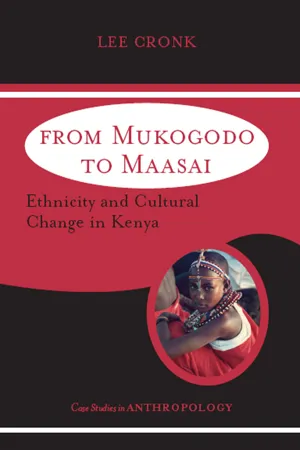
This book focuses on the strategic manipulation of ethnic identity by the Mukogodo of Kenya. It is about how Mukogodo people changed their way of life to a radically different one, that is their change as Maasai people, giving them a new way of living, a new language, and a new set of beliefs.
Information
1
Koisa’s People
“WHERE’s KOISA?”
“Write to your father in America,” the man instructed. “Tell him to tell Koisa to come home.” Simple enough, it would seem. But, unfortunately, he asked the impossible.
The speaker was Parmentoi LeSakui, a Mukogodo man in his late fifties or early sixties. Like most Mukogodo of his generation, he could not be sure of his exact age because birthdates were not recorded until recently. Physically, he was a fairly typical Mukogodo man: tall and thin, dressed as always in a favorite hat, cloak, and loincloth. One distinguishing feature was his big toe, which jutted out from inside his tire sandals at a right angle due to an injury he received as a young man. Though he could be cantankerous, LeSakui was extraordinarily helpful and generous.
Along with his best friend Parmashu, LeSakui had been acting as guide for me and my wife, Beth Leech, during our first two weeks of fieldwork among the Mukogodo of Kenya during late 1985. Although Mukogodo men of their generation could rarely read, Mukogodo children had been attending schools for a few decades by the time we arrived. A few of the kids living in the area where we began our work had been looking through some of my books and papers and sounding out words when they stumbled across the name Koisa LeLengei. Hearing that name, all of the adults around began to pay close attention.
Koisa had been one of LeSakui and Parmashu’s best friends, though at that point they had not seen him for more than fifteen years. Back in 1969, a German linguist named Bernd Heine had visited the Mukogodo area in order to study their old language, known as Yaaku. Even by that time the language was mostly unspoken, having been replaced by Maa, the language of a variety of peoples living in the Rift Valley area of Kenya and Tanzania, but a few older men and women, including Koisa, could still speak it. Heine, who was teaching at the University of Nairobi, asked Koisa to come with him to Nairobi so that he could learn more about the language before it disappeared entirely. Like many Mukogodo men of his generation, Koisa had no wife or family to support, and he agreed to come along.
Koisa disappeared about two weeks after arriving in Nairobi, and he has not been seen since. Readers who are familiar with Nairobi can probably imagine what might have happened. Like many big cities, Nairobi can be a dangerous place. Heine speculated that Koisa had become a victim of one of Nairobi’s criminal gangs, and he dedicated his study of the Yaaku language to Koisa’s memory.
But Mukogodo of Koisa’s generation are not familiar with Nairobi and its perils, and the idea that he might have died was not something that they found easy to accept. More often, they would insist that he had gone off to Ulaya, the land of the white people, in order to teach them the Yaaku language. Older Mukogodo often assume that Ulaya must be a small place with few people because there seem to them to be so few white people in the world, so the idea that Koisa might have been able to teach Yaaku to a large proportion of the world’s white people seems to them quite logical and reasonable. Very often during our time with the Mukogodo, older people would greet us in the Yaaku way—“Aichee!”—in order to hear us respond in the way we had learned from Heine’s articles: “Eiuwo!” But then they would be disappointed to learn that not only could we say no more than that in the old language, but we also had no idea where Koisa was and had never seen him. Occasionally, we would get requests like LeSakui’s for us or our kin to find him and send him home. Rarely, we would be confronted with anger and disbelief that someone that they held so dear could have been torn away from them the way Koisa was.
Younger Mukogodo usually had a different reaction. They knew the story of Koisa well enough, but many younger Mukogodo men and a few women have spent time in Nairobi, usually working as nightwatchmen, and they know its dangers well. To them, the idea that Koisa became a crime victim is not so hard to accept.
The contrasting reactions among Mukogodo about Koisa’s disappearance show, in abbreviated form, the essence of this book: change. Mukogodo of Koisa’s generation and before were born in rockshelters, grew up speaking Yaaku, and ate honey and wild game. Younger people were born in small houses, grew up speaking Maa, and drink milk and eat meat from goats, sheep, and cattle. In the past few decades, Mukogodo have also begun attending schools, getting jobs in and outside the Mukogodo area, and even traveling to Ulaya itself. Change has been the norm for most of humanity for the past century or more, and nowhere has it been faster or more dramatic than among the Mukogodo.
FALLING OFF A LOG
Becoming interested in the Mukogodo had been as easy as falling off a log. In fact, that’s exactly how it happened. It was the summer of 1981, and I was one of twenty Northwestern University students being shown around East Africa by Gary Gaile and Alan Ferguson, who at that time worked in Northwestern’s Geography Department. The most fascinating part of our six-week trip was spent among the Samburu, a Maa-speaking pastoralist group in northern Kenya. An American named Michael Rainey had set up a field school there, giving American students the chance to live among Samburu herders for a few days.
Part of our time with the Samburu was spent with a group of murran (singular: murrani). Murran is usually translated as “warriors,” and it is true that one of the roles of a murrani is to defend his family’s livestock. But the name actually means something more like “circumcised guys,” reflecting the fact that one becomes a murrani while a teenager after going through an initiation procedure that includes circumcision. These days most murran spend more time primping, hanging out with friends, and flirting with girls than in military engagements.
One favorite murrani pastime is to take a sheep or two into the forested hills that dot the East African countryside, camp in a cave, and gorge themselves on mutton. We had the privilege of sharing this experience for a couple of nights with a group of Samburu murran, including everything from singing around the campfire to lapping up blood from the neck of the slaughtered animals. During the days, we would take hikes in the forest, which is how I fell over the log.
Let me say in my defense that it was a huge log, it was very slippery, and it was right across our path. But what was it doing there? I could see that it had been deliberately chopped down. After I had picked myself up, I asked our Samburu guides through a translator why the tree had been cut down. “Il-torrobo,” they replied, using the Maa term for people who live in and around the forested hills that dot the East African countryside and who once lived primarily by hunting, gathering, and beekeeping. The Samburu murran thought it likely that these mysterious, poorly studied people had cut the tree down in order to get honey, one of their favorite foods. To my young imagination, shaped by the fantasy novels of J. R. R. Tolkien and his imitators, this was like walking through Mirkwood and finding evidence that elves or hobbits lived nearby and yet kept coyly out of sight, as if trying to pique my curiosity about them even further.
PREPARING FOR THE FIELD
In retrospect, the idea that the Torrobo (as they are known to scholars) of the Karissia Hills had chopped down that tree to get to a beehive seems farfetched. I now know that honey hunters do not routinely cut down large trees, preferring instead to climb them to get at a hive. But the memory stuck, and a few years later when it was time for me to pick a group to study so that I could obtain my Ph.D. in anthropology, I turned to the literature on the Torrobo.
That literature is mostly about a group more properly called Okiek. The Okiek live in and around forests in central Kenya and speak a language called Kalenjin, varieties of which are also spoken by groups of herders and farmers in western Kenya. What makes the Okiek and other groups “Torrobo” is the fact that they have at some times in their history lived near Maa speakers, hunting and keeping bees. As you will learn in more detail in a later chapter, il-torrobo is a term Maa speakers use to refer to hunters, and it is better thought of as a status designation than as an ethnic label. Nevertheless, there was a small but interesting literature on various Torrobo groups, and I read everything I could find.
I needed to find a group where I could test my advisor William Irons’s ideas about adaptation and cultural change. I knew that many Torrobo groups had been changing in recent decades, hunting less and herding and farming more and sometimes going through drastic cultural changes along the way. One particularly intriguing group was the Mukogodo, or, as I called them after having read Heine’s articles on their old language, Yaaku. I wrote to a variety of experts in the field and was greatly encouraged by their replies. Christopher Ehret, a historian at UCLA well known for his pathbreaking use of Yaaku and other languages to reconstruct East African history, was particularly heartening: “I can think of no better group for you to study, given your interests, than the Mukogodo.” Armed with Irons’s hypothesis and Ehret’s endorsement, I obtained funding for my fieldwork from the Population Council, National Science Foundation, and Institute for Humane Studies. Knowing that I would need someone who could talk to women about sensitive reproductive topics, I asked my girlfriend (now my wife), Beth Leech, to be my research assistant. As a journalist, Beth had conducted many interviews. Like me, she had been a student on that fateful 1981 trip to Kenya, and while in college she had studied anthropology, African history, and Swahili. Beth turned out to be a perfect fieldworker: patient, curious, observant, tolerant of adversity, and possessing a knack for languages.
Although Swahili is the common language for communication between ethnic groups in East Africa, Beth and I knew that not everyone in the Mukogodo area would be able to speak it. The Mukogodo used to speak their own unique language, called Yaaku, but for the past few decades their language has been Maa, the same language spoken by larger groups like the Samburu and Maasai. We set out to find a Maa speaker in the Chicago area, where we were living at the time, who would be willing to give us some lessons in the language. I prepared posters saying “Maa speaker wanted” and distributed them to all locations in the Chicago area where a Maa speaker—or at least someone who spoke more of it than we could at the time—might be passing by: universities, African studies centers, and places with lots of missionaries, like the Moody Bible Institute. We did not really expect anything to come of those posters, but a Kenyan student at Moody did spot one and took it home to her husband, a Maasai named James Ole Takona who was earning his doctorate in education at Loyola University. James agreed to tutor us every week for a few months before we left for Kenya, so by the time we left we had a good grasp of Maa grammar and the ability to say a few important phrases.
FREQUENTLY ASKED QUESTIONS
We traveled from Chicago to Kenya in the fall of 1985 by a somewhat circuitous route that took us to New York, London, France, and Moscow before we finally landed in Nairobi. On the way, Americans and others asked us many questions about our fieldwork, and I noted the most common ones in my journal. The questions ranged from insightful to silly, but since many readers might be asking the same questions, perhaps it’s worth answering them again here:
Do they know you’re coming? Probably not! Before leaving home, I sent letters to all government officials and others in the Mukogodo area whose mailing addresses I could find, informing them about our plans to work in the area and asking them to let people know we were coming. After we arrived, it became clear that few of these letters had arrived, and those that had made it there had not had any effect.
What will you eat? Some anthropologists eat what the people they study eat and little else, but when you are studying an impoverished group like the Mukogodo, that is often not feasible. Many families simply do not have enough food on hand to feed extra people. We also wanted to avoid having too much influence on how Mukogodo individuals behaved, and even if we had paid for food we would have changed the amount of time they had to spend acquiring it. So we made plans to buy and prepare our own food. We had enough experience in Kenya to know that our food would need to be nonperishable, easy to cook, and portable, like rice and beans. And, despite their poverty, Mukogodo are quite generous with the food they have, and we drank a great deal of milk, tea, and a curds-and-whey preparation called kule naaoto, and ate many meals of maize meal. Meat was a very rare treat because animals are usually slaughtered only on special occasions, such as a marriage or the birth of a child, and every once in a while we would get a taste of honey or a cup of honey wine.
How will you bathe? This is a detail we had not worked out before we left, but soon after arriving we learned to keep clean with just a bucket of warm water, some soap, and a wash cloth.
How often will you get to town, and what size town is near there? We really had no idea how to answer this question because we had not yet been to the Mukogodo area. We anticipated spending most of our time backpacking and making it to a town only rarely. As it turned out, we spent only about a third of our time backpacking, and we were able to drive to the bustling market town of Nanyuki about once a month to buy supplies. Don Dol, the dusty headquarters of Mukogodo Division, was much closer but had little to offer.
Will you have a gun? No. A gun is rarely a good idea in an anthropological field setting. Kenya has strict laws governing gun possession, and we had no use for one and no interest in acquiring one.
How dangerous are the animals? Not as dangerous as the traffic in Nairobi! While there certainly are dangerous animals in Africa, they are only rarely a problem for people. Two of the most dangerous species, hippos and crocodiles, do not even live in the Mukogodo area.
You must be having more supplies shipped over (asked after seeing our bags). No! When Beth and I arrived in Kenya, we each had a backpack and a daypack and nothing more. The other supplies we needed were easy to buy in Nairobi and Nanyuki.
IN THE FIELD, AT LONG LAST
There is a saying in Maa: Te nilo enkop nanya nkik, nenya sii iyie. Translation: If you go to a land where people eat shit, eat it yourself. Anyone who could actually follow this advice would make a good anthropological fieldworker, because the watchword of the discipline is immersion. Different fieldworkers have different goals and different styles, and they immerse themselves in the society and culture to different degrees. Some barely get their feet wet, so to speak, spending only a short time in the field, using translators to speak with informants and assistants to gather data and living apart from the people they are studying. Others dive in head first, spending years in the field, learning the local language, converting to the local religion, becoming adopted by a family, going through appropriate rituals, and generally living as much as possible like the people they are studying. Beth and I operated somewhere in between those two extremes, metaphorically wading in up to our chests or so in the Mukogodo way of life.
We arrived in Kenya in October 1985. Our first few weeks were spent buying a vehicle and supplies and obtaining a research permit from the Kenyan government. The permit process was lengthy, which gave us plenty of time to travel around Kenya and ask those who might know about the Mukogodo area. What we learned was not encouraging. No one we spoke with—government officials, journalists, fellow researchers—had ever heard of the “Yaaku,” as we were calling them at the time. Few had even heard of the “Mukogodo,” which, as we soon learned, is a much more common name than Yaaku. But, with nothing to lose but time, once we had a permit we headed off for the field, hoping that somehow we would find these elusive people.
As it turned out, they were not elusive at all. In fact, they were positively eager to be “discovered.” Not knowing where exactly we would find people who identified themselves as “Yaaku,” we took a tip from Bernd Heine’s article on their language that they can be found near a mountain called Ol Doinyo Lossos. We drove toward the mountain, taking the most direct route shown on the map and stopping at a police post called Loregai on the way. The chief of the police was quite amused by our arrival. It was clear that he expected us to have a look around for a day or two and then leave, and he generously offered to introduce us to some friends of his who might be able to help us find these “Yaaku” we sought.
The policeman, Beth, and I squeezed into our tiny Suzuki jeep and drove into the Mukogodo forest a few miles until we reached a huge glade called the Anandanguru Plain. There he introduced us to some acquaintances of his, including a man he referred to as “the chief of the Mumonyot,” the name of another Maa-speaking people in the general area. We chatted as best we could in a mixture of bad Swahili and even worse Maa and accepted shots of throat-searing moonshine whisky called chang’aa, still warm from the still. When the police chief said goodbye, Beth and I set up camp, explaining as best we could to the handful of people who had assembled to watch that we were looking not for them but rather for some people called “Yaaku.”
“That’s us!” they cried. It turned out that everyone around us was “Yaaku.” The “chief of the Mumonyot” turned out to be Parmentoi LeSakui, a full-blown Mukogodo with no claim to the position of Mumonyot chief. His best friend, a man from the Parmashu family, was also there. Though they were nearly constant companions, Parmashu was quite different from LeSakui. Quiet and self-effacing, he had a peculiar gait thanks to an incident when he was a murrani. While hunting an elephant with friends, the animal had picked him up with its trunk and thrown him, and he landed on both his knees. Despite whatever profits he made from the ivory trade, Parmashu, like many Mukogodo men, could not afford to marry until late in life, so he had only one wife and several young children. He was known as a good carver, and during our travels in the forest he would keep an eye out for high-quality timber for things like bows, stools, and game boards. Leboo LeMoile, a slightly younger man with a passion for shooting rats with his bow and arrow and a good sense of humor, was there as well. LeMoile was a forest guard, hired by the Kenyan government agency that had jurisdiction over most of the Mukogodo area to keep an eye out for illegal logging and forest fires. They were positively delighted to be referred to as “Yaaku,” a quaint, old-fashioned name that they themselves had nearly forgotten but that they much preferred to the way outsiders usually referred to them: “Torrobo.” The policeman’s confusion about the identity of the people in the area undoubtedly reflected not only a lack of interest on his part but also a common Mukogodo tactic of being cagey and evasive with outsiders, particularly those perceived as actual or potential enemies.
What a relief it was to know that we had found the people we had set out to find and to be so warmly and quickly accepted by them. It was the rainy season, so LeSakui, Parmashu, and LeMoile he...
Table of contents
- Cover
- Half Title
- Title Page
- Copyright Page
- Table of Contents
- List of Figures
- List of Tables
- Series Editor Preface
- Preface
- 1 Koisa’s People
- 2 “People Who Live in Rocks”
- 3 From Mukogodo to Maasai
- 4 Poverty as Routine
- 5 Boys and Girls, Words and Deeds
- 6 Are They Maasai Yet?
- Postscript
- Glossary
- Bibliography
- Index
Trusted by 375,005 students
Access to over 1.5 million titles for a fair monthly price.
Study more efficiently using our study tools.
Frequently asked questions
Yes, you can cancel anytime from the Subscription tab in your account settings on the Perlego website. Your subscription will stay active until the end of your current billing period. Learn how to cancel your subscription
No, books cannot be downloaded as external files, such as PDFs, for use outside of Perlego. However, you can download books within the Perlego app for offline reading on mobile or tablet. Learn how to download books offline
Perlego offers two plans: Essential and Complete
- Essential is ideal for learners and professionals who enjoy exploring a wide range of subjects. Access the Essential Library with 800,000+ trusted titles and best-sellers across business, personal growth, and the humanities. Includes unlimited reading time and Standard Read Aloud voice.
- Complete: Perfect for advanced learners and researchers needing full, unrestricted access. Unlock 1.5M+ books across hundreds of subjects, including academic and specialized titles. The Complete Plan also includes advanced features like Premium Read Aloud and Research Assistant.
We are an online textbook subscription service, where you can get access to an entire online library for less than the price of a single book per month. With over 1.5 million books across 990+ topics, we’ve got you covered! Learn about our mission
Look out for the read-aloud symbol on your next book to see if you can listen to it. The read-aloud tool reads text aloud for you, highlighting the text as it is being read. You can pause it, speed it up and slow it down. Learn more about Read Aloud
Yes! You can use the Perlego app on both iOS and Android devices to read anytime, anywhere — even offline. Perfect for commutes or when you’re on the go.
Please note we cannot support devices running on iOS 13 and Android 7 or earlier. Learn more about using the app
Please note we cannot support devices running on iOS 13 and Android 7 or earlier. Learn more about using the app
Yes, you can access From Mukogodo to Maasai by Lee Cronk in PDF and/or ePUB format, as well as other popular books in Social Sciences & African Politics. We have over 1.5 million books available in our catalogue for you to explore.