Skills for Effective Learning in School
eBook - ePub

Skills for Effective Learning in School

Supporting Emotional Health and Wellbeing

  1. 266 pages
  2. English
  3. ePUB (mobile friendly)
  4. Available on iOS & Android
eBook - ePub

Skills for Effective Learning in School

Supporting Emotional Health and Wellbeing

About this book

One of the five books in the Mental Health and Wellbeing Teacher Toolkit, this practical resource focuses on the topic of 'Skills for Learning'. The book offers research-driven, practical strategies, resources and lesson plans to support educators and health professionals. This is a resource book for practitioners looking to have a positive impact on the mental health and wellbeing of the children and young people in their care; both now and in the future. Chapters span key topics including Metacognition, Learning Dimensions, Problem Solving and Cognitive Strategies. A complete toolkit for teachers and counsellors, this book offers:

• Easy to follow and flexible lesson plans that can be adapted and personalised for use in lessons or smaller groups or 1:1 work

• Resources that are linked to the PSHE and Wellbeing curriculum for KS1, KS2 and KS3

• New research, 'Circles for Learning', where the introduction of baby observation into the classroom by a teacher is used to understand and develop self-awareness, skills for learning, relationships, neuroscience and awareness of others

• Sections on the development of key skills in communication, skills for learning, collaboration, empathy and self-confidence

• Learning links, learning objectives and reflection questions.

Offering research-driven, practical strategies and lesson plans, Skills for Effective Learning in School is an essential resource book for educators and health professionals looking to have a positive impact on the mental health and wellbeing of the children in their care; both now and in the future.

Frequently asked questions

Yes, you can cancel anytime from the Subscription tab in your account settings on the Perlego website. Your subscription will stay active until the end of your current billing period. Learn how to cancel your subscription.
No, books cannot be downloaded as external files, such as PDFs, for use outside of Perlego. However, you can download books within the Perlego app for offline reading on mobile or tablet. Learn more here.
Perlego offers two plans: Essential and Complete
  • Essential is ideal for learners and professionals who enjoy exploring a wide range of subjects. Access the Essential Library with 800,000+ trusted titles and best-sellers across business, personal growth, and the humanities. Includes unlimited reading time and Standard Read Aloud voice.
  • Complete: Perfect for advanced learners and researchers needing full, unrestricted access. Unlock 1.4M+ books across hundreds of subjects, including academic and specialized titles. The Complete Plan also includes advanced features like Premium Read Aloud and Research Assistant.
Both plans are available with monthly, semester, or annual billing cycles.
We are an online textbook subscription service, where you can get access to an entire online library for less than the price of a single book per month. With over 1 million books across 1000+ topics, we’ve got you covered! Learn more here.
Look out for the read-aloud symbol on your next book to see if you can listen to it. The read-aloud tool reads text aloud for you, highlighting the text as it is being read. You can pause it, speed it up and slow it down. Learn more here.
Yes! You can use the Perlego app on both iOS or Android devices to read anytime, anywhere — even offline. Perfect for commutes or when you’re on the go.
Please note we cannot support devices running on iOS 13 and Android 7 or earlier. Learn more about using the app.
Yes, you can access Skills for Effective Learning in School by Alison Waterhouse in PDF and/or ePUB format, as well as other popular books in Education & Education General. We have over one million books available in our catalogue for you to explore.

Information

Publisher
Routledge
Year
2019
eBook ISBN
9780429765865
Edition
1

Chapter 1
Metacognition

THINKING ABOUT THINKING
PLANNING OUR PROJECT
MONITORING OUR LEARNING
REVIEWING OUR WORK
METACOGNITIVE TALKING

Thinking about thinking!

Session objectives

To develop an understanding about what a thought is and how thinking about our thinking supports us with our learning.

Session outcomes

  • To be able to share our ideas about thinking.
  • To be able to verbalise our thinking about learning.
  • To be able to define metacognition.

Lesson plan

  • Remind the children about a time when they watched their class baby ‘think’ about a task.
  • Support the children to remember and think about a time when they watched their baby undertaking a task and their parent watching and thinking about them.
For those classrooms not able to undertake the Circles for Learning Project, video clips or photographs can be used to support the discussion around the topic and stimulate thoughts and ideas from the children and young people.

Task

  • KS1: To explore where they think best and what they need to be able to think well.
  • KS2: To create something using a selection of ‘junk’ and share their thinking process.
  • KS3: To explore ways that they learn facts for a test and then create their own revision resource.
KS1
  1. Read the book I am Henry Finch by Alexis Deacon and Vivian Schwartz.
  2. Ask the children about how Henry felt about thinking and what he needed to be able to think.
  3. Explore where they think best and what they need to think.
  4. Ask the children to draw a thought that they had about the book.
KS2
  1. Read the book Going Places by Peter and Paul Reynolds.
  2. Discuss what they thought about the book.
  3. Ask the children to work individually or in small groups. Give each group the same variety of ‘junk’ and ask them to make something as a group.
  4. As they work, ask them to draw the different thoughts that they had inside the thought bubbles to create a thinking timeline.
  5. Create a small exhibition showing the creation and their thinking timeline.
  6. Discuss their thinking as a group after the exhibition. What did they learn about their thinking process?
KS3
  1. Share a short historical information sheet with the young people.
  2. Ask them to create a resource to help them learn the information for a test.
  3. Discuss their immediate thoughts – even if they are negative? Share them as a group.
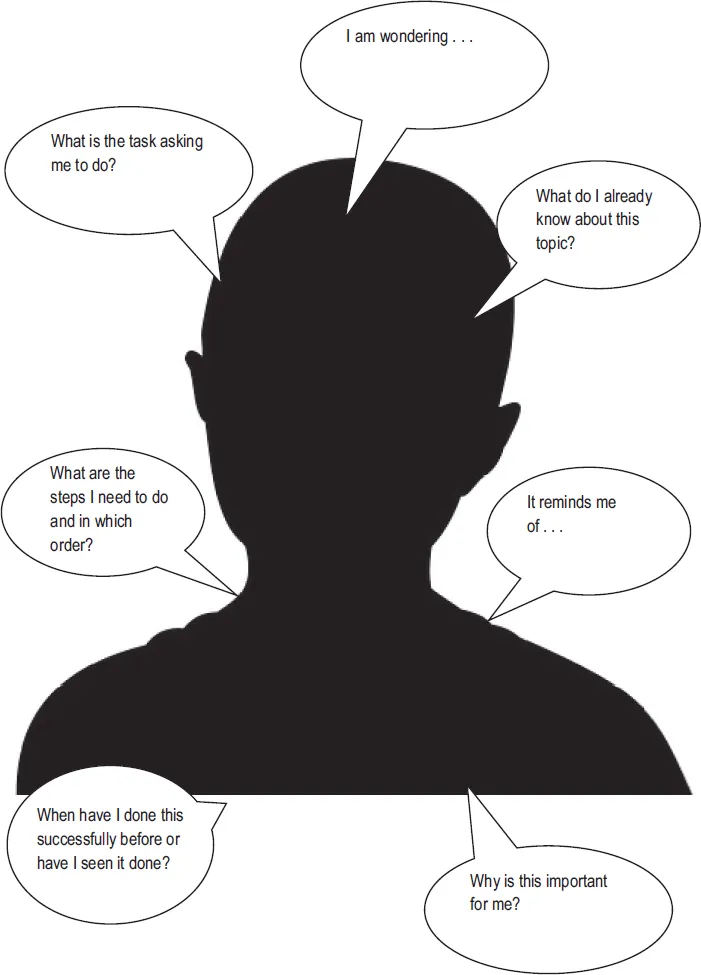
  4. Ask the young people to work in small groups, pairs or on their own and document their thinking process using the metacognition question sheet.
  5. Ask the young people to create their resource.
  6. Share the resources and the metacognition question sheet as a walk around exhibition.
  7. Discuss what they have learnt from undertaking the task and from looking at what other people have done.

Resources

  1. I am Henry Finch by Alexis Deacon and Vivian Schwartz
  2. Thought bubbles
  3. Going Places by Peter and Paul Reynolds
  4. Thought bubble timeline
  5. Metacognition question diagram

Important points

We are often not aware of our thinking. However, if we stop and think about our thinking it can help us to learn and review our learning.

Learning links

Metacognition, planning and reviewing work.

Reflection

Questions:
Positive comment from child:
Positive comment from adult:
LEARNING DIMENSIONS SOCIAL & EMOTIONAL SKILLS
Strategic awareness
Emotional literacy
Learning relationships
Neuroscience
Curiosity
Self-regulation
Creativity
Self-development
Meaning making
Changing & learning
Resilience

Metacognition Question Diagram

Planning our project

Session obj...

Table of contents

  1. Cover
  2. Half Title
  3. Title
  4. Copyright
  5. Dedication
  6. Contents
  7. Introduction
  8. Chapter 1 Metacognition
  9. Chapter 2 Learning dimensions
  10. Chapter 3 Problem solving
  11. Chapter 4 Cognitive strategies
  12. Bibliography