Writing development and pedagogy is a high priority area, particularly with standardised testing showing declines in writing across time and through the years of schooling. However, to date there are relatively few texts for teachers and teacher educators which detail how best to enable the children to become confident, autonomous and agentic writers of the future.
Developing Writers Across the Primary and Secondary Years provides cumulative insights into how writing develops and how it can be taught across years of compulsory schooling. This edited collection is a timely and original contribution, addressing a significant literacy need for teachers of writing across three key stages of writing development, covering early (4-7 years old), primary (7-12 years old) and secondary years (12-16 years old) in Anglophone countries. Each section addresses two broader themes — becoming a writer with a child-oriented focus and writing pedagogy with a teacher-oriented focus.
Together, the book brings to bear rigorous research and deep professional understanding of the writing classroom. It offers a novel approach conceiving of writing development as a dynamic and multidimensional concept. Such an integrated interdisciplinary understanding enables pedagogical thinking and development to address more holistically the complex act of writing.
1 Developing writers in primary and secondary school years
Debra Myhill and Honglin Chen
Introduction
In the 21st century, writing remains a ubiquitous mode of human communication. Indeed, the rapid technological changes witnessed over the past 25 years have actually increased the amount of writing that most of us routinely engage with, at the same time as altering the nature of the writing we do. In this period, email, Twitter and various forms of texting applications have decreased our use of oral communication through phones and made written communication an intrinsic (sometime invasive) part of our everyday lives. In parallel, the multimodal possibilities afforded by the web have also changed how we can communicate across time and space, and through creative combinations of text, hypertext and image.
Arguably, the new technological possibilities for writing have democratised it as a mode of communication, with more people than ever before using written forms as an everyday tool for connecting with others. Political activism, for example, has been significantly enhanced by the affordances of rapid digital written communication: revolutions, election campaigns, and protest movements are sustained by it. Think of the Arab Spring revolutions in 2010–2013, or the #MeToo campaign in 2017, or American President Donald Trump’s preference for Twitter as a means of mass communication. But writing is more than democratic engagement. Through writing, we can express our most private thoughts, our deepest fears, and our greatest hopes. And through writing, we can reflect on the past, critique the present, and generate new ways of seeing the future.
And yet, despite the evident power of writing, our understanding of being a writer and the teaching of writing lags behind our understanding of the teaching of reading. In this chapter, we provide an introductory overview of research on writing, including the different ways writing has been theoretically described; what we know about becoming a writer, and about development in writing; and empirical evidence about pedagogies for writing. The chapter closes by presenting the rationale for this book and the chapters which follow.
Interdisciplinary perspectives on writing
Research which investigates how we learn to write and become writers is much younger than its sister field of reading, and it has been approached by researchers who come from very different theoretical perspectives – and they rarely talk to each other! From the point of the classroom teaching of writing this is not helpful, and in this section, we will explain the three major theoretical ways of thinking about writing and look at how they all have something valuable to offer in understanding growing into and becoming a writer.
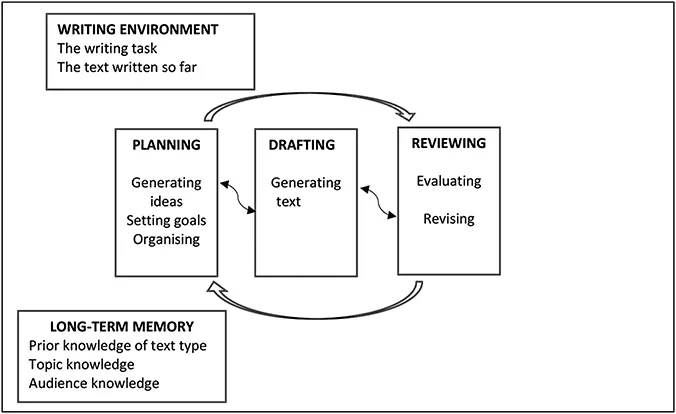
The first theoretical models of writing were cognitive, in other words, they focus on the mental processes we use to produce written text. Cognitive models of writing frame writing as a problem-solving process, in which we have to work out both what to say it and how to say it (Bereiter and Scardamalia 1987). The Hayes and Flower model (1980) was the first cognitive model (see Figure 1.1), and although there have been many variations and adaptations since, the core components have remained largely the same. This model identifies three principal components of the writing process – planning, generating text, and reviewing. The planning process is not what we often think of in school settings as planning, that is, writing an outline plan of the text we are about to write. Rather cognitive models conceive of planning as a much broader process of thinking about and preparing to write, which includes, for example, researching a topic; generating ideas through activities such as freewriting, concept-mapping, notetaking; and thinking about the goals for writing – what is the purpose for writing the text. The drafting process relates principally to getting text from ideas in the head into words on the page and may involve the production of multiple drafts before a final piece of writing is completed. The reviewing process is principally about judging the effectiveness of the text and revising it to make it more effective. Crucially, these three processes interact during the writing process: it is not a stage model of plan-draft-revise as is typical of many pedagogical approaches. It recognises the messy recursiveness of writing, and that when we are drafting we often generate new ideas, and that when we are planning we are often evaluating and selecting, as well as generating.
Figure 1.1 A cognitive model of writing based on Hayes and Flower (1980)
In addition, cognitive models recognise that the process of producing written text also involves our long-term memory as this is the ‘resource bank’ from which we draw out ideas and experiences to inform the content of our writing. The long-term memory also encompasses our knowledge of different kinds of texts and how they are structured – this is why it is harder to write unfamiliar texts, because we have limited existing knowledge of how they are constructed. Finally, cognitive models note the importance of the environment in which the writing is occurring, though this relates very much to the writing task itself, and how as we write the text, we re-read the text to inform what we write next.
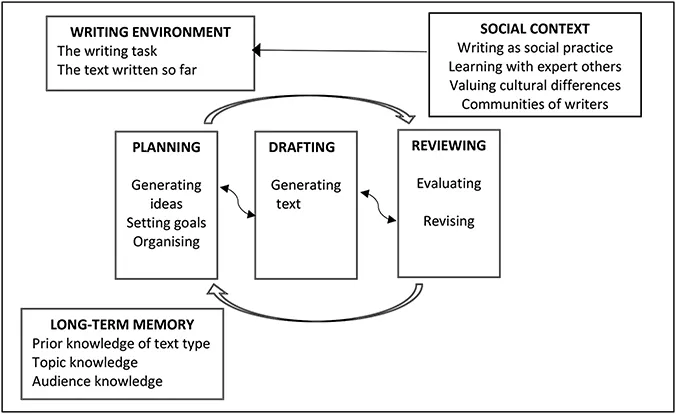
Cognitive models essentially position writing as a solitary activity, and focus on the lone writer and what is happening in the writer’s head. In contrast, socio-cultural models position writing as a social activity (Prior 2006, Dyson 2009), which is learned through interactions with others, and which is situated within communities of writers (see Figure 1.2). Socio-cultural thinking draws heavily on Vygotsky (1978) who challenged solely cognitive views of learning by arguing that learning is both cognitive and social. He placed particular emphasis on how we learn with and through others, particularly more knowledgeable others, and how a learner can begin to succeed with new learning with the right kind of support and scaffolding. Socio-cultural models are particularly important in recognising that written texts are social texts, and that what counts as ‘good’ writing is socio-culturally determined: what is valued as good writing in an English classroom in the UK may be different from what is valued in an Australian classroom, or a Chinese classroom. So when we teach children to write, we are inducting them into the social practices of writing in that community.
Figure 1.2 Integrated representation of cognitive and socio-cultural models of writing
The socio-cultural emphasis on learning to write through social interactions with others has pedagogical implications, particularly in creating classrooms where children can collaborate in writing, rather than working alone. One influential interpretation of the socio-cultural model of writing was the process approach, advocated by Graves (1983) and Murray (1982). A process approach classroom would typically adopt a workshop approach to writing, where young writers are given stimuli or starting points for writing, and where experimentation, drafting and editing, and sharing work are encouraged. Teachers and peers play roles as more knowledgeable others, and contexts are created for children to learn to write through social interactions with others, learning together before learning as an individual. The writing conference is a cornerstone of this approach and involves an oral conversation between the teacher and the child about their writing, where the teacher gives feedback, but also gives primacy to the child’s voice and experiences. However, there have been critics of the process approach (Smagorinsky 1987, Lensmire 1994, Beard 2004) and there are socio-cultural models of writing realised in many ways in contemporary classrooms, such as through careful modelling and scaffolding of writing; acknowledging the home literacy experiences of learners; creating culturally inclusive writing classrooms; and addressing the multimodality of many 21st-century texts.
A third theoretical perspective on writing is that it is a process of increasing linguistic mastery.
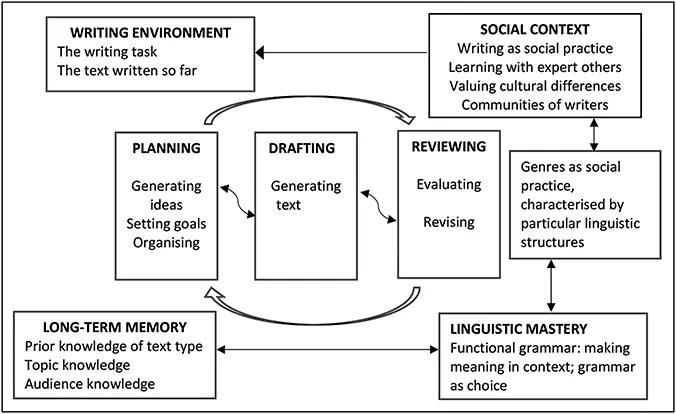
Linguistic perspectives overlap with both cognitive and socio-cultural models (see Figure 1.3). Language production and comprehension involve the mental processing of language, and writing involves decision-making (Kellogg 2008), both of which are cognitive functions. At the same time, socio-cultural perspectives emphasise how language is learned through social interactions in meaningful contexts, and that genres are socially determined text types with clear communicative purposes (Swales 1990). But the key aspect of a linguistic model of writing is that it focuses very sharply on the language of text composition, and children’s increasing mastery of it. Whilst one body of research in this area looks at linguistic mastery in terms of the presence of different grammatical structures as markers of increasing mastery (Hunt 1965, Harpin 1976), this approach does not sufficiently take into account the effectiveness of the grammatical structures present in a text. It is more useful in describing how writing emerges in young early-years writers, from mark-making and scribble writing through to being able to capture ideas fluently in written form (Ferreiro and Teberosky 1982); but it is less useful in describing how children become writers increasingly able to shape their texts for a range of purposes and audiences.
Figure 1.3 Integrated representation of cognitive, socio-cultural and linguistic models of writing
However, the work of Halliday in re-framing grammar as social semiotic, a resource for meaning-making (Halliday 1975, 1978, Halliday and Mathiessen 2004), represents a significant shift in how linguistic mastery is conceived. By linking grammar and meaning, linguistic mastery can be more helpfully aligned with how grammatical structures shape meaning in texts. Taking Halliday’s Systemic Functional Linguistics as a theoretical frame, research has demonstrated the salience of pedagogical attention to the interrelationship of grammar and meaning (Christie and Unsworth 2005, Derewianka and Jones 2010, Macken-Horarik and Morgan 2011, Jones and Chen 2012) and the importance of explicit teaching of the typical grammatical structures of different genres (Rose 2009). Halliday’s influence also shapes the body of complementary research which foregrounds the idea of grammar as choice (Schleppegrell 2012, Myhill et al. 2012, 2018), particularly in contradistinction to traditional representations of grammar as principally concerned with accuracy and rule compliance. This research foregrounds how linguistic choices fulfil the function of a particular text, the needs of the implied reader, and the writer’s own authorial intention. In a somewhat different vein, more recently, cognitive linguistic perspectives have been used to inform research on linguistic mastery (Giovanelli 2014, Giovanelli and Clayton 2016), although this research has tended to devote more attention to the teaching of literature and analysing the linguistic characteristics of published texts (Cushing 2018).
Both cognitive and linguistic perspectives draw attention to the role of thinking about writing, both metacognitive and metalinguistic, in writing development. Metacognition in writing – the capacity to think about your own writing and how you write – has been shown to be a characteristic of more mature and developed writers (Martlew 1983), although research has shown that very young children are capable of metacognitive thinking about their writing (Jacobs 2004). The self-regulatory aspect of metacognition, in other words, a writer’s capacity to manage the writing process and regulate how they respond to their emerging text is viewed as significant in raising writing attainment, and programmes to support self-regulation in the writing classroom have been developed and shown to be effective (Harris et al. 2010). In parallel, more recent research has investigated metalinguistic understanding for writing, conceptualising metalinguistic understanding both as thinking about language choices, and using metalanguage to discuss writing (Myhill and Newman 2016, 2019). Although there is a significant body of research on metalinguistic understanding as a general concept, it has focused more on early years writers, second language learning, and the more technical aspects of spelling and orthography, the research on metalinguistic understanding for writing across the age phases and in first language writing is very much an emergent field, with considerable scope for further research.
This necessarily concise overview of different disciplinary perspectives on writing is important in showing that writing research is not a coherent and unified body of research, but has tended historically to divide into these different disciplinary camps. Bringing them together into a more integrated interdisciplinary perspective enables pedagogical thinking and development to address more holistically the complex act of writing. In general, the cognitive model of writing focuses on the writer as an individual; the socio-cultural models of writing locate the writer within a community of writers with culturally ascribed practices and preferences; and the linguistic model positions the writer as a creator of text. All are important for the teaching of writing and at different points in a teaching sequence it is likely that a teacher may be emphasising one more than the other, but over the timeframe of a teaching sequence all need to be addressed.
Development in writing
Understanding what constitute...
Table of contents
Cover
Endorsements
Half Title
Title Page
Copyright Page
Table of Contents
List of figures
List of tables
List of boxes
List of contributors
Foreword
1. Developing writers in primary and secondary school years
2. Children learning to write in early primary classrooms
3. Writing before school: The role of families in supporting children’s early writing development
4. Bringing more than a century of practice to writing pedagogy in the early years
5. Teaching writing in digital times: Stories from the early years
6. Developing textual competence: Primary students’ mastery of noun groups in two factual text types
7. Apprenticing authors: Nurturing children’s identities as writers
8. Developing confident writers: Fostering audience awareness in primary school writing classrooms
9. Developing a pedagogy of empowerment: Enabling primary school writers to make meaningful linguistic choices
10. Writing their futures: Students’ stories of development and difference
11. Wordsmiths and sentence-shapers: Linguistic and metalinguistic development in secondary writers
12. Growing into the complexity of mature academic writing
13. Articulating authorial intentions: Making meaningful connections between reading and writing in the secondary classroom
Index
Trusted by 375,005 students
Access to over 1.5 million titles for a fair monthly price.
Study more efficiently using our study tools.
Frequently asked questions
Yes, you can cancel anytime from the Subscription tab in your account settings on the Perlego website. Your subscription will stay active until the end of your current billing period. Learn how to cancel your subscription
No, books cannot be downloaded as external files, such as PDFs, for use outside of Perlego. However, you can download books within the Perlego app for offline reading on mobile or tablet. Learn how to download books offline
Perlego offers two plans: Essential and Complete
Essential is ideal for learners and professionals who enjoy exploring a wide range of subjects. Access the Essential Library with 800,000+ trusted titles and best-sellers across business, personal growth, and the humanities. Includes unlimited reading time and Standard Read Aloud voice.
Complete: Perfect for advanced learners and researchers needing full, unrestricted access. Unlock 1.5M+ books across hundreds of subjects, including academic and specialized titles. The Complete Plan also includes advanced features like Premium Read Aloud and Research Assistant.
Both plans are available with monthly, semester, or annual billing cycles.
We are an online textbook subscription service, where you can get access to an entire online library for less than the price of a single book per month. With over 1.5 million books across 990+ topics, we’ve got you covered! Learn about our mission
Look out for the read-aloud symbol on your next book to see if you can listen to it. The read-aloud tool reads text aloud for you, highlighting the text as it is being read. You can pause it, speed it up and slow it down. Learn more about Read Aloud
Yes! You can use the Perlego app on both iOS and Android devices to read anytime, anywhere — even offline. Perfect for commutes or when you’re on the go. Please note we cannot support devices running on iOS 13 and Android 7 or earlier. Learn more about using the app
Yes, you can access Developing Writers Across the Primary and Secondary Years by Honglin Chen, Debra Myhill, Helen Lewis, Honglin Chen,Debra Myhill,Helen Lewis in PDF and/or ePUB format, as well as other popular books in Education & Education General. We have over 1.5 million books available in our catalogue for you to explore.