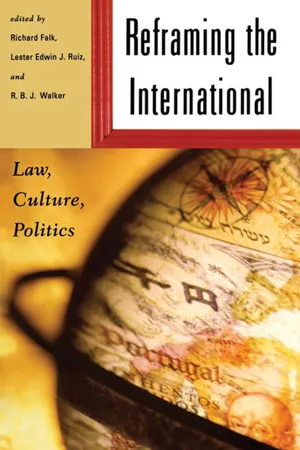
Re-Framing the International insists that, if we are to properly face the challenges of the coming century, we need to re-examine international politics and development through the prism of ethics and morality. International relations must now contend with a widening circle of participants reflecting the diversity and uneveness of status, memory, gender, race, culture and class.
eBook - ePub
Reframing the International
Law, Culture, Politics
- 272 pages
- English
- ePUB (mobile friendly)
- Available on iOS & Android
eBook - ePub
About this book
Information
CHAPTER 1
After the Future: Enclosures, Connections, Politics
THE GREAT ESCAPE
To inquire systematically into our possible futures is to encounter complex fields of paradox and contradiction. Futures seem to be more difficult to imagine even as we approach them with increasing rapidity. They are becoming more difficult to imagine even as we claim to know more and more about the world, or worlds, in which we imagine them. Futures are always elusive, although in some senses also inevitable. In an age of science fictions and computer-assisted extrapolations, of long-range forecasts, conceptual innovations, and cross-cultural conversations, our grasp on what we might become seems to dissolve into ever more trivial claims about some coming anarchy, an end of history, a conflict of civilizations, the obliviously benign, or a descent into hell.
Many of these paradoxes and contradictions are well known. They are so well known that we have largely ceased to be perplexed by their paradoxical and contradictory character. Puzzles have congealed into received wisdoms, into grounds for asserting that all is as it should be. The ideal is the real, as someone might have said in a slightly different context; these are the facts of life whether we like it or not, as the disciplinary emperors keep chanting in their tattered underwear.
Much of our capacity to imagine our possible futures hangs on our capacity to recover some sense of puzzles that have been rendered so unpuzzling by the conventions of modern politics. Much of our prevailing sense of what our futures might bring, and of who this “we” is that might have a sense of these future possibilities, is predicated upon a curiously unproblematic understanding of what and where we now are. Although we may be keen to respond to so many problems in the present, the present itself is all too easily read as an unproblematic ground from which we might imagine our possible futures. Knowing where we are, or at least being able to negotiate the rhetorical and institutional practices that allow us to claim to know where we are, we place ourselves in an apparently perfect but, I want to argue here, also quite impossible position to know where we should be going. As an initial stance in any systematic enquiry into our possible futures, it seems to me to be necessary to stake our ground not with or against some received account of where we are now—and especially not in the familiar and quite insidious brawls between political realists and political idealists, or between various kinds of positivism and various claims about the importance of the normative in which these accounts are constantly reproduced in our dominant understandings of international relations or world politics, or, still less, between moralizing accounts of the saved and the damned, the civilized and the barbarian. We do need to begin with some more critical sense of the conditions under which we are enabled to imagine futures that have possibilities. Such accounts cannot avoid encounters with paradoxes and contradictions.
For example, it may be that we are all familiar with many variations on a popular and soothing story to the effect that our futures lie in a straight-line trajectory from now to then—a journey from a present to a future along a singular arrow of time, usually portrayed as an historic shift from a warlike and barbaric fragmentation to a mature and peaceful unity. This story may be endorsed even by some of the most eminent minds of our time. It may be invoked as the only ground on which we can envisage worlds that are somehow better than the ones we live in now. It is a story that allows many people to sleep at night, although suspicions also abound about its capacity to induce violent nightmares. While it may be pleasing in its aspirational or soporific effects, however, we all also know that there is no simple straight line from the present to the future, just as—to allude to two of the key cultural mappings through which modern accounts of our possible futures have been charted—there is no simple road from earth to heaven or from the finite to the infinite. Modern life might well be much easier if there were; but if there were then modern life would also be impossible.
As the theologians will remind us, the road from earth to heaven is full of contradictions—contradictions that may be resolved, disconcertingly, only by faith or by death. As the philosophers will also insist, the road from the finite to the infinite is full of quite similar contradictions. These contradictions have been resolved most frequently, at least in the canonical accounts of Western modernity, either by affirming an inevitable and unbridgeable—Cartesian—chasm between human finitude and the infinite universe (even if this involves pretending to erase the chasm by looking at only one supposedly monistic side of it) or by affirming the infinite as the necessary—Kantian or universalizing-moral—ambition of every finite subject (or, conversely, by affirming the finite subject as the agency of potentially infinite ambition). In such contexts especially, we become aware that the soothing although often disturbing story about a straight line to the future is, paradoxically, a product of a culture organized around (Greek, Christian, and modern) stories about an unbridgeable dualism, whether between heaven and earth, being and becoming, mind and brain, subject and object, subject and sovereign, or, in the realm of the “international” or “global” that concerns me here, sovereign and sovereign.
To imagine our possible futures is thus to encounter not just fields of paradox and contradiction, but historically specific fields of paradox and contradiction. Many of these paradoxes and contradictions are embedded in assumptions we take for granted, especially in modern accounts of what it means to be an individual, to own property, or to be a subject of legal authority. These accounts did not spring out of thin air, despite our tendency to treat them as simply natural, as given in the very nature of things, or at least in the original tablets of micro-economic theory. Paradoxes and contradictions are especially embedded in claims about sovereignty and the authorization of authority. These claims often work to efface the ways in which, as a historically and culturally specific site of paradox and contradiction, sovereignty produces not only an account of how the world is and must be organized politically, but also an account of what it would mean to imagine a future without sovereignty. One of the key paradoxes that has been exposed by claims about our potential global futures, in fact, is that so many of the accounts of the decreasing significance of sovereignty that now inform grand claims about our contemporary fates tend to affirm the extraordinary capacity of sovereignty to tell us how to think about the decreasing significance of sovereignty.
This is why it is so important to come to terms with the ways in which sovereignty has to be taken much more seriously as a site of political practice than has generally been the case, especially but certainly not only in the context of international relations and international law. Again paradoxically, these are fields that place a great deal of explicit emphasis on the importance of sovereignty, but they are also fields that—quite understandably, and many would suggest quite properly—tend to assume that sovereignty is a relatively simple starting point for subsequent discussion. Sovereignty, it often seems, simply is. It marks the place at which we may put a stop to an infinitely regressive concern with those apparently abstract and metaphysical principles that can be addressed more appropriately by the philosophers and theologians, the specialists in the abstract and the arcane rather than the specialists in the supposedly real world of power, violence, and policy.
As much recent literature has insisted in many different contexts, however, and as the classic texts often insist even more vehemently, sovereignty is anything but a simple starting point. Whatever it is, and it is far from clear what ontological status ought to be assigned to such an elusive political site, modern sovereignty expresses a very powerful answer to some of the greatest mysteries of human existence. It is an answer that rests upon historically and culturally specific resources for framing and answering these mysteries. Not least, modern sovereignty is an answer that affirms and reproduces some highly dubious accounts of the difference between the abstract and the real, the decorous metaphysics and the dirty world of policy. These accounts in turn enable some quite extraordinarily naive even if endlessly reiterated accounts of power and authority and encourage us to envisage future possibilities without thinking about either power or authority.
To try to imagine alternative futures on terms set by assumptions about sovereignty, even if those assumptions are embedded in claims about the decreasing significance of sovereignty, is to court the eternal repetition of stories about the straight road from present to future that has become so seductively familiar but that serves largely to keep us as we have become. Likewise, to pretend that we can think of the future on grounds that somehow evade assumptions about sovereignty is to assume that we can somehow stand outside the cultural assumptions of Western modernity that give us our most basic understanding of what it means to be inside or outside a way of thinking or a way of life. I certainly hold no brief for those who still want to insist that sovereignty is the reality we have to take for granted. Moreover, I would suggest that anyone who thinks it is could do no better than to read Hobbes’ prescient attack on what passes for political realism in twentieth-century theories of international relations and elsewhere.1 I do want to insist, however, that we have to think about our possible futures by thinking through the ways in which modern sovereignty works—and I stress the activist implication of this word—as a claim about all possibilities, past, present, or future.
In the following section, therefore, I want to offer a very general and somewhat impressionistic sense of what this involves. At the risk of being simplistically formulaic, where so many attempts to imagine future possibilities have been framed as attempts to move away from or to simply ignore sovereignty, I believe we have no option but to work our way through the specific practices of modern sovereignty, thereby seeking to resist sovereigntist accounts of what it means to move away, to be outside, to be engaged with futures or with possibilities. To use a formulation I have used elsewhere, we now find ourselves in a series of puzzles, both logical and practical, trying to identify an outside to a conception of politics that is already constituted as a system of insides and outsides.2 To try to get outside, to frame accounts of historical change or ambitions for alternative futures as the search for something outside a system of insides and outsides, is liable to merely reproduce the (spatially privileging) framing that both encourages and prohibits us from other (temporally privileging) possibilities. This formulation, I believe, offers some sense of what is at stake in challenging the crucial modern expression of how the paradoxes and contradictions of space and time must be resolved. The most impossible thing for sovereignty to be is something that simply is, and yet as a claim to be something that simply is it works so as to affirm the impossibility of any other way of being.
In working through some of these puzzles, many of which are increasingly familiar from various debates about the status of modernity and modern accounts of subjectivity, I want to move toward an affirmation of the increasing importance of temporal trajectories, movements, and flows rather than of spatial separations, and consequently toward an affirmation of lines of connection and relation rather than lines of inclusion and exclusion. Our understanding of future possibilities, I want to suggest, depends very largely on what we think it means to draw the line in the many different context in which this, for us, largely spatial metaphor now expresses meaning and legitimacy.
In the process, however, I also want to underline both the importance and the difficulty of thinking about our futures politically. The primary reason that we have to struggle with the paradoxical and contradictory legacies of the modern principle of sovereignty is that it expresses our most fundamental sense of what and where politics is. Contemporary challenges to this principle must also be understood to be challenges to our understanding of politics. My argument here is motivated very largely by a sense that the most striking characteristic of contemporary debates about globalization and change in the international system is a very serious absence of discussion of what these debates suggest for politics. Questions about the constitution of legitimate authority especially have been sidelined in favor of worries about many other things, especially about governance, policy, and ethics. While undoubtedly important, neither governance nor policy nor ethics can be addressed in the absence of an engagement with the limits of our understanding of politics as a pattern of limits, of spatial separations and temporal impossibilities. While I do not think that it is especially difficult to imagine alternative futures in terms of our contemporary understanding of movements and flows or networks and connections, it is certainly difficult to imagine such futures in terms we might recognize as somehow political. This is a problem that will engage us, and help reshape those who engage with it, for some time to come.
THE GREAT CONTAINMENT
Sovereignty is something, or some principle, or some practice—these different characterizations already suggest a range of interesting puzzles that are part of the problem I want to explore—that is of crucial importance to international law and international relations and is more or less omnipresent in attempts to imagine our possible futures in political terms.
Sometimes sovereignty is of interest as a bedrock on which to ground all else, as if sovereignty could be something so simple and stable as to constitute a bedrock for anything. It is as an assumed foundation that sovereignty appears in so many accounts of international law and international relations, both positivist accounts of what is and normative accounts of what must be. As an assumed foundation, it affirms the necessary character of political necessity and the necessary limits of freedom under conditions of necessity.
The primary puzzle that arises in this context is how sovereignty came to be a foundation in the first place, and thus what one makes of a claim to foundations that rests, as the popular metaphors go, on stilts in a swamp, on turtles all the way down, on the irrational assertion of rationality, or on an instantaneous leap from a state of nature to a state of law. Again, anyone persuaded that Hobbes’ account of sovereignty offers a safe platform from which to launch claims about the way things are should simply look at the extraordinary magic and light show he had to put on in order to make his account of it seem even marginally credible. Hobbes, after all, was a nominalist, an anti-realist, a trader in names that bore no necessary connection to things named. He needed all his considerable imaginative resources to make his authorization of authorities that might authorize seem entirely natural. Sovereignty, we might say, may function as a foundation, but any analysis that treats it simply as a foundation can say very little about all those practices, those myriad equivalents of Hobbes’ magic and light show, through which contingent convention acquires the status of natural necessity. Sovereignty may have become the great indispensable principle of the modern political order, but it is simultaneously the most obviously artificial and fictitious principle of that order. Believe in it, as Hobbes tried to show we should, and all will be well. Otherwise, as Hobbes argued, there can be no present, no future, not even a past from which to envisage a present or a future.
It is of considerable consequence that this most secular affirmation of modern political authority should rest so firmly, or so feebly, upon belief. We have all encountered the familiar slide from declarations of openness and toleration to brutal demonstrations of dogma and the iron fist. The secular exploration of possibilities collides with a quasi-religious affirmation of necessities. Nationalism, revolution, defense policy, and war are familiar sites at which tensions between the secular and religious are often exposed. Similarly, modern liberalism stands or falls on its capacity to cope with its internal contradictions in this respect, not on its proclamation of certain articles of faith. It may be advantageous in many circumstances to stay away from the fields of paradox and contradiction that become visible if we think about this affirmation long enough, but neither the advantages nor the circumstances can be assumed to be uncontentious.
Conversely, sovereignty is sometimes of interest as a condition to be avoided, evaded, or transcended, as if sovereignty is some thing one can avoid, evade, or transcend. It is in this guise that sovereignty appears in so many accounts of structural change in the international system and of the emergence of novel forms of transnational or global politics and legal obligation. The necessity of assumptions about political necessity is challenged, alternative accounts of necessity are broached, and we are then asked to imagine alternative accounts of our obligations, our freedom to do what we have to do, under conditions other than those framed by sovereignty. It is in this context that we can understand the importance of attempts to imagine alternative accounts of governance, policy formation, legal regimes, and so on. It is in this context, also, that we can see that it is so much easier to talk about forms of governance, policy formation, and legal regimes than it is to come to terms with fundamental questions about the constitution of legitimate authority—about politics. For it is one thing to make simple claims about the decreasing importance of sovereignty—just as easy, in fact, as it is to assert that sovereignty is what there is. It is quite another to see how we might imagine other ways of constituting authority.
Claims about sovereignty are especially susceptible to seductive stories about the future as a destination imagined at the end of a straight road. Sometimes the road leads from a world in which sovereignty is ever-present to a world in which it is somehow absent. Sometimes the road keeps taking us to the same old destination, to the world of states that somehow changes but always remains essentially the same. In the former case, we are usually told that we are on the road to utopia, to idealism, to somewhere in the vicinity of cosmopolis. In the latter case, the signs insist that we are staying close to the way things are, to realism, to somewhere in the vicinity of the polis, our proper political home.
Once upon a time, it seems, sovereignty was not there. Then it was. Different accounts of when it was there—with Roman law, with Bodin, with...
Table of contents
- Cover
- Half Title
- Title Page
- Copyright Page
- CONTENTS
- ACKNOWLEDGMENTS
- INTRODUCTION The International and the Challenge of Speculative Reason
- CHAPTER 1 After the Future: Enclosures, Connections, Politics
- CHAPTER 2 “Tainted by Contingency”: Retelling the Story of International Law
- CHAPTER 3 Reframing the Legal Agenda of World Order in the Course of a Turbulent Century
- CHAPTER 4 The Ideas of 1989: The Origins of the Concept of Global Civil Society
- CHAPTER 5 Overcoming the Dysfunction of the Bifurcated Global System: The Promise of a Peoples Assembly
- CHAPTER 6 Orders of Inhumanity
- CHAPTER 7 From Modernization to Democratization: The Political Economy of the “New” International Law
- CHAPTER 8 In Pursuit of the “Body Politic”: Ethics, Spirituality, and Diaspora
- CHAPTER 9 Conflict, Convergence, or Coexistence? The Relevance of Culture in Reframing World Order
- CHAPTER 10 Feminist Futures: Contesting the Political
- ABOUT THE CONTRIBUTORS
- INDEX
Trusted by 375,005 students
Access to over 1.5 million titles for a fair monthly price.
Study more efficiently using our study tools.
Frequently asked questions
Yes, you can cancel anytime from the Subscription tab in your account settings on the Perlego website. Your subscription will stay active until the end of your current billing period. Learn how to cancel your subscription
No, books cannot be downloaded as external files, such as PDFs, for use outside of Perlego. However, you can download books within the Perlego app for offline reading on mobile or tablet. Learn how to download books offline
Perlego offers two plans: Essential and Complete
- Essential is ideal for learners and professionals who enjoy exploring a wide range of subjects. Access the Essential Library with 800,000+ trusted titles and best-sellers across business, personal growth, and the humanities. Includes unlimited reading time and Standard Read Aloud voice.
- Complete: Perfect for advanced learners and researchers needing full, unrestricted access. Unlock 1.5M+ books across hundreds of subjects, including academic and specialized titles. The Complete Plan also includes advanced features like Premium Read Aloud and Research Assistant.
We are an online textbook subscription service, where you can get access to an entire online library for less than the price of a single book per month. With over 1.5 million books across 990+ topics, we’ve got you covered! Learn about our mission
Look out for the read-aloud symbol on your next book to see if you can listen to it. The read-aloud tool reads text aloud for you, highlighting the text as it is being read. You can pause it, speed it up and slow it down. Learn more about Read Aloud
Yes! You can use the Perlego app on both iOS and Android devices to read anytime, anywhere — even offline. Perfect for commutes or when you’re on the go.
Please note we cannot support devices running on iOS 13 and Android 7 or earlier. Learn more about using the app
Please note we cannot support devices running on iOS 13 and Android 7 or earlier. Learn more about using the app
Yes, you can access Reframing the International by Richard Falk,R.B.J. Walker,Lester Ruiz in PDF and/or ePUB format, as well as other popular books in Politique et relations internationales & Droit international. We have over 1.5 million books available in our catalogue for you to explore.