eBook - ePub
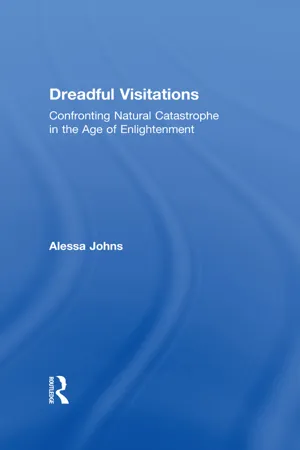
Dreadful Visitations
Confronting Natural Catastrophe in the Age of Enlightenment
- 198 pages
- English
- ePUB (mobile friendly)
- Available on iOS & Android
eBook - ePub
About this book
Throughout history, varying responses to catastrophe have revealed much about a society's cultural and philosophical character. In Dreadful Visitations , leading scholars of different disciplines examine eighteenth-century responses to natural disaster, showing how human agency played an active role in the creation of destructive circumstances, and how these disasters helped to establish national and moral identities in the Age of Reason. Contributors: David Arnold, Daniel Gordon, Carla Hesse, George Starr, Alan Taylor, Steven Tobriner and Charles Walker.
PART I
European Responses to Catastrophe
1
Confrontations with the Plague in Eighteenth-Century France
“Cancer”: why does it frighten us with its name, as if thereby the unnameable were designated? … Here is a cell that doesn’t hear the command, that develops lawlessly, in a way that could be called anarchic. It does still more: it destroys the very idea of a program, blurring the exchange and the message. It wrecks the possibility of reducing everything to the equivalent of signs. Cancer, from this perspective, is a political phenomenon, one of the rare ways to dislocate the system, to disarticulate, through proliferation and disorder, the universal programming and signifying power. This task was accomplished in other times by leprosy, then by the plague.
—Maurice Blanchot, The Writing of the Disaster, 1986
In the history of modern Europe, certain periods are evocative of progress, while others symbolize the backward condition from which progress supposedly has been made. We are all familiar with the concept of the eighteenth century as an age of “Enlightenment,” a period in which the prejudices of the traditional “Old Regime” began to yield to rationality and humanity. But we have also learned to be skeptical of historical schemes that separate ages of light from ages of darkness. Scholarship shows that the relationship between two apparently opposed historical moments is dialectical, not purely adversarial. Every critical movement owes something to the culture against which it stands; it absorbs the energy of its opponent as part of its strategy of combat. From this perspective, one can observe that Voltaire’s hatred of the clergy had a messianic tone, or that Rousseau’s Social Contract expresses absolutism in a democratic form.
Dialectic, however, is not the only technique for questioning the relationship of the Enlightenment to the traditions that it challenged. Another method is inversion—a thought experiment in which one swaps the conventional definitions of a movement and its context, proceeding then to verify, as far as possible, this ironic exchange of meanings. Perhaps the Enlightenment articulated rudimentary ideas about some phenomena that had been conceptualized with great sophistication under the Old Regime. The following discussion aims to show that disaster, specifically the bubonic plague, is a case in point.
The articles on “Plague” in the Encyclopédie of Diderot and d’Alembert (the central work of the French Enlightenment) provide good material for an analysis of Enlightenment attitudes toward natural disaster. These articles are complex, but overall they reveal the tendency of thinkers in the French Enlightenment to turn a blind eye toward the ravages of disaster and to insist in a doctrinaire manner that all events are subject to human control. It was not merely the belief in “progress” that produced this tendency to underrate disasters; it was also the specific way in which Enlightenment thinkers construed the locus and mechanics of progress. Progress, in the minds of a broad range of Enlightenment thinkers, occurred in “civil society” understood as a network of exchanges—conversations, commercial transactions—that enriched and civilized humankind.1 Contagious epidemic diseases were especially difficult to acknowledge in this framework, for contagion represented the perversion of social exchange, the transmission not of wealth, knowledge, or refinement, but of death. As critics of traditional hierarchies, Enlightenment thinkers forged a positive vision of horizontal human action—of all socioeconomic processes in which the goal was not to reproduce the eternal Chain of Being but to create new relationships of mutual service. The phenomenon of contagion, however, imposed a limit upon the benefits of exchange. In the Encyclopédie, we can see some representatives of the Enlightenment confronting this limit and struggling to avoid giving it full recognition.
While a refusal to recognize the limits of civil society was a feature of the Enlightenment, a fascination with these limits was common both before the Enlightenment and in other fields of discourse throughout the eighteenth century. A suggestive counterpoint to the Encyclopédie is the plague literature—a large corpus of poems, novels, histories, and medical treatises—published in Marseilles in the eighteenth century. As the center of trade between France and the Levant (in which European plague epidemics frequently originated), Marseilles was repeatedly devastated by the dreaded illness. This city was a site of intensive reflection on the causes of the plague and on the relationship of epidemic disease to commercialization. In Marseilles, one can see the formation of an attitude toward disaster that is clearly distinct from Enlightenment thought but that is difficult to classify as either traditional or modern. On the one hand, the Marseilles plague literature is traditional on account of its emphasis on the terrible and uncontrollable nature of natural disasters. On the other hand, this literature is modern because it often portrays the plague as a product of commercial, not divine, agency. The plague literature is thus a form of social analysis, though a more tragic form than what we usually find in the writings of the Enlightenment. The plague literature was also in itself a type of commerce, a set of texts for sale, though the content of these texts did not contribute to the idealization of commerce that was a recurrent theme in the Enlightenment. A fuller comparison of the concept of plague in the Encyclopédie and in the Marseilles literature can reveal the nuances of different early-modern attitudes toward disaster as well as the competition among them to fix the meaning of commercial society.
THE WORD PESTE BEFORE THE ENLIGHTENMENT
In the first edition of the Dictionnaire de l’Académie Française (1694), the word peste is defined as: “A contagious illness, a kind of epidemic malady, which is usually caused by a general corruption of the air and which causes a great mortality.”2 It was common in the seventeenth century to attribute epidemic diseases to bad air stemming from either the decomposition of organic matter or from what were called “exhalations” of the earth—putrid gases released from underground by earthquakes. The definition in the Dictionnaire also indicates that the plague is contagious. Doctors hotly debated the precise nature of contagion, but on certain points they generally agreed. From the fifteenth century onward, it was accepted that some diseases were transmitted from person to person through physical contact.3 The contagious nature of la peste (which around the middle of the sixteenth century ceased to refer to epidemics in general and came to refer specifically to one disease, the bubonic plague) was rarely questioned. What remained unsolved was the relationship between atmospheric corruption and interhuman contagion. The miasmatic conception of the disease’s source did not square easily with observations of its direct transmission from person to person. This incongruity between the disease’s imagined causes, on the one hand, and its path of transmission, on the other, opened a space for a broad range of debate about the ultimate nature of the plague and how to prevent and cure it.
However, nearly everyone in late-seventeenth-century Europe—the lay public as well as doctors—recognized that the disease was indeed contagious and highly destructive. The Dictionnaire registers the widespread perception of the plague as uncontrollable and devastating when it notes that it “causes a great mortality.” In addition, a set of figurative meanings itemized in the Dictionnaire shows that the plague was not just a concrete evil but one of the great symbols of misfortune in general. Plague signified a specific illness, but the illness was so devastating that the word also functioned more generally as a shorthand for everything that was excessive and irremediable. Thus, one could say of a person whom one hated, “He is a plague.” In a severe frost, one could say, “Plague, it’s cold!”4
Furetière’s Dictionnaire Universel (1690) offers essentially the same image of the plague: the plague is contagious, dangerous, and symbolic of all suffering that is not susceptible to human control. “Plague: A contagious and generally fatal malady.” Furetière adds: “Galen calls the plague a wild beast, the mortal enemy of humankind.” He repeats the conventional thesis that the cause of the disease is corruption of the air. He also notes that no remedy is reliable; the best measure is simply to flee. His examples of proper usage of the term refer to plague, war, and famine as the most severe “scourges” of God. Figuratively, he observes, one can describe as plagues the most profound forms of immorality: heresy and libertinage, which corrupt the minds of men.5 Here the figurative usages are clearly more religious and moral in tone than those in the Académie’s dictionary, but the use of the word plague to establish the extremity of an evil is evident in both dictionaries.
Let us pass from these two French dictionaries, the most comprehensive and authoritative in the late seventeenth century, to the Encyclopédie of Diderot and d’Alembert, which was an attempt to create an alternative and more authoritative dictionary based on principles of reason. That the Encyclopédie (which began to appear in 1751) was nothing other than an effort to propagate a rational lexicon is evident from its subtitle: Dictionnaire raisonné des sciences, des arts et des métiers, par une société de gens de lettres (A Systematic Dictionary of the Sciences, Arts, and Professions by a Society of Men of Letters). Older French dictionaries were based on the standard of “usage.” They registered the meaning of the term in a Wittgensteinian sense: the meaning must be derived from the examples already established by a community of speakers in France. That is why the abstract definitions are followed by complete sentences in which the term is commonly employed. It is true that the usages of the court and of other areas of “polite” society counted more than the usages of the poor. Yet popular proverbs and everyday expressions of ordinary people are not entirely absent, even in the dictionary of the elitist Académie Française.
In the older dictionaries, to define a term meant to reveal the rules of its usage; in contrast, for the Encyclopédie, to define a term was to systematize it, to assign it a permanent denotation consistent with the definitions of other things, not merely to collect its actual usages. The Encyclopédie imposes definitions; it does not distill them from preexisting conventions. According to Diderot, the purpose of the Encyclopédie was to form a “universal vocabulary” in which terms would designate “the essential attributes of things” through “exact, clear, and precise” definitions.6 Authority thus inheres not in a community of speakers external to the text but in the definitions themselves and the men of letters whose function was, in the words of d’Alembert, “to fix the use of language” and to “legislate for the rest of the nation in matters of philosophy and taste.”7 Another way of stating the same thing is to say that while the older dictionaries tended to collect meanings from the social environment, the Encyclopédie tended to exclude them. It sought to improve reality by reducing the sense of each word to a single clear denotation.
At this point, it would seem appropriate to compare the definitions of plague in the Encyclopédie with those examined above. But there is a more nuanced way to reveal the process by which the Encyclopédie attempted to limit the sense of terms. This approach is to compare the way the word plague is discussed in the articles devoted to it in the Encyclopédie to the way the word is used incidentally in all other articles of the Encyclopédie. In this manner, one can detect a tension not merely between the Encyclopédie and previous dictionaries but within the language of the Encyclopédie itself: a tension between the rationalization of attitudes toward disaster in the main articles and the persistent use of older usages elsewhere in the text.
In more formal terms, while author A might define word X in a certain fashion, there was no way to coordinate all the other contributors to the Encyclopédie so that those who uttered X in their respective articles would stick to A’s definition. From a logical viewpoint, the goal of the Encyclopédie, to create a new and self-consistent lexicon, could have reached fruition only by having every author write his article after all the other ones were written—a logical impossibility that the older dictionaries were not subject to!
Systematic attention to all occurrences of the word peste and its variants (pestiféré, pestilentiel, etc.) bears out this hypothesis of a discrepancy between the primary definitions of plague and the incidental usages of the word throughout the text. The word peste and its variants occur 581 times in the Encyclopédie. Of these, 137 occur in the main articles on “Peste.” The rest, or more than three-quarters of the occurrences, are incidental usages in other articles that are not primarily devoted to the subject of plague.8 Needless to say, many of the contexts hold little interest, such as when an author states that a certain person died of the plague in a certain year. But if one pays close attention to occurrences that are not merely statements of historical fact, occurrences in which plague refers not to one incidence of the disease but to the malady in general, then it is evident that many contributors to the Encyclopédie continued to envision the plague as it had been envisioned earlier: as a highly contagious, destructive, and terrifying disease, a symbol of everything that creates chaos and sorrow. Before turning to the main entries on plague, we will consider some of these incidental usages.
Concerning the extremely lethal nature of the plague itself, we are told, in one article, that the plague is so swift and deadly that people often collapse and expire suddenly...
Table of contents
- Cover
- Title Page
- Copyright Page
- Table of Contents
- List of Illustrations
- Acknowledgments
- Introduction
- Part I: European Responses to Catastrophe
- Part II: Colonial Perspectives and New World Calamities
- Afterword
- Contributors
- Index
Trusted by 375,005 students
Access to over 1.5 million titles for a fair monthly price.
Study more efficiently using our study tools.
Frequently asked questions
Yes, you can cancel anytime from the Subscription tab in your account settings on the Perlego website. Your subscription will stay active until the end of your current billing period. Learn how to cancel your subscription
No, books cannot be downloaded as external files, such as PDFs, for use outside of Perlego. However, you can download books within the Perlego app for offline reading on mobile or tablet. Learn how to download books offline
Perlego offers two plans: Essential and Complete
- Essential is ideal for learners and professionals who enjoy exploring a wide range of subjects. Access the Essential Library with 800,000+ trusted titles and best-sellers across business, personal growth, and the humanities. Includes unlimited reading time and Standard Read Aloud voice.
- Complete: Perfect for advanced learners and researchers needing full, unrestricted access. Unlock 1.5M+ books across hundreds of subjects, including academic and specialized titles. The Complete Plan also includes advanced features like Premium Read Aloud and Research Assistant.
We are an online textbook subscription service, where you can get access to an entire online library for less than the price of a single book per month. With over 1.5 million books across 990+ topics, we’ve got you covered! Learn about our mission
Look out for the read-aloud symbol on your next book to see if you can listen to it. The read-aloud tool reads text aloud for you, highlighting the text as it is being read. You can pause it, speed it up and slow it down. Learn more about Read Aloud
Yes! You can use the Perlego app on both iOS and Android devices to read anytime, anywhere — even offline. Perfect for commutes or when you’re on the go.
Please note we cannot support devices running on iOS 13 and Android 7 or earlier. Learn more about using the app
Please note we cannot support devices running on iOS 13 and Android 7 or earlier. Learn more about using the app
Yes, you can access Dreadful Visitations by Alessa Johns in PDF and/or ePUB format, as well as other popular books in History & Early Modern History. We have over 1.5 million books available in our catalogue for you to explore.