eBook - ePub
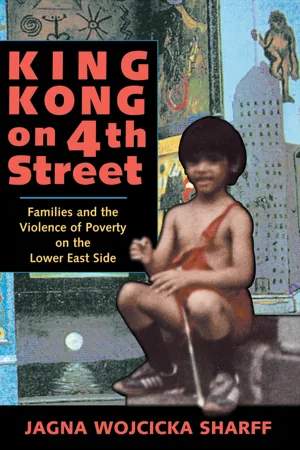
King Kong On 4th Street
Families And The Violence Of Poverty On The Lower East Side
- 272 pages
- English
- ePUB (mobile friendly)
- Available on iOS & Android
eBook - ePub
King Kong On 4th Street
Families And The Violence Of Poverty On The Lower East Side
About this book
This book chronicles an ethnographic teams involvement over a span of fifteen years with the people of a poor, largely Puerto Rican neighborhood in New York City. Jagna Sharff focuses on a group of families who live within a radius of a few blocks of her storefront office, especially the children who come first to interact with the team. She contrasts her teams initial observations of how people grapple with daily life with the residents expressed hopes and dreams in a community lacking jobs but rife with underground activities. Through lively and interconnected stories, she traces over time the fate of the neighborhood and the outcomes for individual children and adults during an era when the local and national policy of the war on poverty was transmuted into a war against the poor. The books lyrical, cinematically vivid style makes it appealing both for college social science courses and for the general public. }In King Kong on 4th Street, Jagna Sharff chronicles an ethnographic teams involvement over a span of fifteen years with the people of a poor, largely Puerto Rican neighborhood in New York City. Anchoring her observations in field notes, she recounts the joys, fears, and disappointments of daily life as well as the drama of large events. Arson, the murder of a popular local teenager, the mobbing of a grocery store as an act of retribution for his deathall are projected onto a canvas of shifting local and national policies toward poor people and neighborhoods.Sharff provides new insights into gender and family roles, how adaptations to available resources from the welfare state may shape the membership of households, and how children may be trained for specific adult roles that will advance the familys well-being. She also reveals how the underground economy, particularly the commerce in drugs whose profits are realized outside of the neighborhood, undermines neighborhood-wide solidarity and sends people scrambling against one another for jobs in the quasi-licit and illicit sector. Following the lives of a number of families into the next generation, Sharffs ethnographic team documents how external political decisions that change the war on poverty into a war on the poor affected them. Paramilitary sweeps of the neighborhood, in tandem with gentrification and declining social services, produce severe dislocations and relocation to homeless shelters, welfare hotels, and prisons. But the reality described is not all grim.The books vivid style shows that life is more than grim reality. People get real pleasure from raising children and taking part in the human drama around them. Kinfolk, real and fictive, keep each other afloat and reconnected to new neighborhoods and opportunities, including that of upward mobility through religious conversion. Adults and children achieve satisfaction and a measure of security through grit, wit, and acts of heroism and solidarity. }
Information
1
You Can Hear the Birds Singing
When I think of the Lower East Side, I think of Luz. Luz means clarity, light. I see Luz, or Lucita as everyone called her, then a little doll of a nine-year-old, with her shiny black braid, dark rosy face, and almond eyes, coming around the corner onto East Fourth Street. In my mind she is always carrying a bag of groceries from which a loaf of Italian bread is sticking out; though a block away, she is already smiling at me, this responsive and responsible woman-child.
One of those memories takes me back to a cold February day in 1978, about six months after our ethnographic project had started. The temperature had dipped to ten degrees, and I was hanging out on the corner of Fourth and Avenue B, trying to keep warm with a bunch of kids aged ten to fourteen. They were waiting for Isabel, Lucita's older sister, to go with them to see two horror films over on Delancey Street, and I was locked out of my office. Since it was Saturday, my research team members Nilda and Paul wouldn't be moseying in to work until afternoon; they spent long evening hours in the neighborhood on weekends. Nilsa, our youngest colleague, whose official title was secretary but who was also a terrific field worker, would not be coming in at all; her weekends were reserved for her husband and four-year-old son. My only hope of rescue was Emilio, a fifteen-year-old, who from the beginning of the project had declared himself our official housekeeper, and who had my keys to the office. Emilio, alas, was nowhere to be seen.
While waiting for Isabel the kids tried to keep warm by talking about the movies they were about to see. The oldest, skinny fourteen-year-old Lisa Moreno with golden hair, and her rotund twelve-year-old brother Paco, had seen the movies already twice and thrice respectively. Now they were recounting the gory details to twelve-year-old Ginny Cortez. Lisa narrated the story almost to the climax. "Wait till you see it. You gonna scream!"
She looked up toward the clock hanging over Hanover Bank on Third Street. "Where the fuck is Isa at? She was supposed to be here at twelve-thirty and it's almost one." She then dispatched Marco, Ginny's gentle younger brother, whose glasses were patched at the bridge with a Band-Aid, and her own usually mercurial younger brother Jimmy, who was too cold at the moment to give her back any lip, to Lucita's and Isabel's house. "Tell her she doesn't get her ass down here now, we're leaving without her."
In a few minutes we saw Lucita, her little round face beaming from a block away as she rounded the corner from Fifth Street, a burned-out block with one intact building in which her family lived. She was on her way to the Dulceria Bakery to get fragrant coffee and a loaf of bread for her mother's breakfast. She said Isabel would be down in a minute. "The landlord didn't give no heat or hot water this morning," the third day in a row. Isa was waiting to bathe in a friend's apartment on the next block. The others nodded. No self-respecting child would sally forth into the outside world without a daily bath.
The children stomped their feet. They were all wearing sneakers, the only all-weather shoes their mothers could afford to buy, except for Lisa, who was wearing Fourteenth Street plastic cheapo high heels. She had on a black cowl synthetic sweater under a lilac nylon blouse, rayon trousers, and a thin raincoat. All dressed up and shivering. Daniel, an African American fourteen-year-old who lived below Delancey, now sauntered up to the group, cool in his belted beige raincoat, no doubt an Orchard Street special, and asked what was happening. The kids told him they were going to see Telefon and Carrie. Pretending to have just been invited, Daniel apologized for not being able to go with them. With a charming smile and a bow toward Lisa, he said: "You refused my invitation last week, now I am forced to refuse yours." As he went on his way, Lisa smiled at him, obviously charmed. The rascal knew Puerto Rican etiquette from hanging around with the local boys. He was already of an age considered dangerous for young señoritas, so he would have needed permission from Lisa's family to go with her to the movies, even surrounded as she was by a crew of obnoxious, underaged dueñas. And even then, the question of Daniel's race and ethnicity would have needed to be thrashed out before he was allowed to do any courting, to say nothing of an examination of his extended family, and so on and so forth, all very complex and already being fine-tuned in these pubescents' social repertoire.
As usual, Lisa was getting a lot of attention today. Now Loopy, a hyper fourteen-year-old with acne, joined the group and started teasing Lisa about her father, who had left the family five years ago and now lived in New Jersey with another woman and her children. Loopy said he had seen her father's car when he came to take the children to the beach last summer. He extended one accusatory hand toward an old station wagon parked on the block—"It's an old wreck, like this one!"—and pointed the other toward an ancient heap, belching exhaust at the stop light: "And smoking like that one!" Paco gazed down at his sneakers, Lisa's eyes flashed, and at this point I entered the conversation, asking Loopy what he was doing in the neighborhood, my tone suggesting that the rumor that he had moved away to the Bronx would not cause extreme sadness among those presently assembled. This was enough to defuse a potentially awkward situation: Lisa could not allow her father to be maligned, nor could she count on mellow Paco to play the macho and be his avenger. My seemingly innocent question was enough to put Loopy in his place.
Lucita passed by again, returning with the groceries, and Lisa once more warned her, in tones even more ominous, about leaving Isabel's ass behind. Lucita smiled good-naturedly, nodded, and went on. Then the rest of them left to see if they could persuade yet another girl to go with them. I stood frozen, gazing down the street, wondering idly where the fuck Emilio was at with my keys, and then catching myself; in less than a year's time I had begun to employ the children's linguistic constructs, at least in my head.
When I was finally installed in the office two hours later, Lucita stopped by for a chat, as she and other members of her family often did. She was on her way to the Key Food store on Avenue A in hopes that she could work that day. The massive Jamaican security guard at the store, nicknamed Jumbo by the children, was often capricious about allowing the girls to pack groceries for customers in exchange for tips. He didn't allow the boys to even set foot in the store, being well acquainted with their appetites and nimble fingers, but with the girls he played favorites. He was the final authority on who could work, and he picked and chose at will from the large group of eager workers in the neighborhood.
When she was allowed to pack, Lucita earned $10 to $15 a week for twenty to thirty hours' work. With these earnings she purchased her own clothing and school supplies and even saved for special occasions, such as Christmas dinner, which required expensive ingredients. Before departing, Lucita commented about how cold the office was. Like hers, our landlord was "not giving no heat or hot water," and it had been going on for a week. She also admonished me to stop smoking. "It's a matter of life and death," she said, furrowing her delicate brow for emphasis.
Later in the afternoon, the horror movie bunch returned for a visit. They vied with each other in recounting the bloody details blow by blow, watching my face with the satisfaction children get from making an effect on adult sensibilities. I wondered if seeing abstract horror relieved them, somehow, from the recurring crises in their own neighborhood.
Luz had been the first in her family to start frequenting our storefront anthropological field office. Curious, bouncing, affectionate, she shone among the eager group of children of all ages who turned up after school for tutoring and game playing. When she wasn't working at Key Food, she hung around the office as much as she could, trying to be helpful, often late into the night. On occasion, we had to carry her out bodily before closing shop, and we usually had to search before starting meetings to see if Luz was again hiding with some other little children under benches or inside cupboards. I was never sure whether it was our status as relatively exotic strangers or our rather mellow attitudes that encouraged these unending games of hide-and-seek.
The rest of her family approached us more gradually and cautiously, familiar to us by sight before we discovered they belonged to Luz. Early on in the research I had noticed an emaciated barefoot old man asleep in a doorway on the block. Over time he became a well-known figure, shuffling between the doorway and the corner. His head was shaved, his cheeks were sunken, and a lot of his teeth were missing. He smiled sweetly and mumbled to himself. The kids called him loco (crazy) behind his back, or teased him, begging him to sing some romantic Spanish song. On one occasion he actually obliged, and I was surprised by the scratchy yet melodious quality of his voice, rendering the echo of some long-forgotten ballad. Looking closer, I realized he wasn't much over forty.
It took a few months before I found out that he was Luz's mother's brother, her uncle Pedro, who had indeed been a singer of note in the neighborhood when he was a younger man. He had also had a factory job then, had been married and the father of a little girl. One day when the little girl was six, a sanitation driver had carelessly backed his truck up a little too fast and too far onto the sidewalk, as they tend to do on the Lower East Side. It crushed Pedro's daughter's head.
Pedro went berserk, attacking a sanitation crew (perhaps a different one) with a knife. He was arrested and was only allowed to attend his daughter's wake for a few minutes some days later, handcuffed and escorted by police officers. As I later learned, the prevailing opinion in the neighborhood dated the onset of Pedro's locura (craziness) to this incident and especially to the fact that he hadn't been able to express his grief properly, with respect, in company with the rest of his kin at the funeral. From that moment on, it was said, Pedro went downhill, drinking like crazy, losing his job, his wife, and his talent.
By the time I learned Pedro's story, I also knew he was not an abandoned derelict like so many others in the adjacent area of the Bowery He was carefully monitored from a close distance by his sister Meri and her children. Late at night one of Lucita's brothers, seventeen-year-old Julio, fourteen-year-old Richie, or twelve-year-old Miguel, would guide Pedro to his one-room apartment on Fifth Street, secured for him and maintained by Meri with a small public assistance grant. During the day either Luz or her fifteen-year-old sister Isabel would get money from their mother to buy him a big hamburger (his lack of teeth made it hard for him to chew) from the tiny Dominican greasy spoon around the corner on Avenue B. He was also watched by other adults on the block, who conversed with him sociably whenever he was in shape to converse. He was not exactly confined, but someone always had an eye on him. Periodically, when he stopped eating altogether and drank too much, Meri would call the police to take him to Manhattan State Hospital for a few weeks' rest in the ward for the mentally ill. She said she did it to "make him fat." To the cops she said he was crazy.
After Luz became comfortable in my office, she brought in her brother Miguel, then Richie and Julio, then Isabel, and finally her mother. One summer day, Meri came in shyly, encouraged by Julio, who was learning from Paul how to use a video camera. She was a compact, shapely woman in her early forties, with a beautiful, mature round face. It was easy to tell where Luz got her looks. She didn't say anything, but just stood in the doorway smiling and gazing curiously around the office.. Needing to go on an errand, Paul and I excused ourselves and asked Julio to watch the office. Upon returning, we found Julio behind the camera in the midst of persuading his mother to sing. Startled by our reappearance, she retreated, laughing. But from that day on she became a daily visitor, and I learned a great deal about her life.
Both her parents came from large families in rural Puerto Rico. Her father, who had been a cane cutter, came to New York in the 1940s and got his first job as a house painter, a profession he kept for the next thirty years, until he was in his mid-seventies. Her mother, a young woman at that time, had arrived to join her own mother, who was working in a lamp factory. She met and married Meri's father, and then stopped working, after the first of their seven children was born.
Dependent only on the father's wages, the family's existence was very precarious. Meri remembered being embarrassed about going to school in the clothes she owned. When one of the teachers offered her a hand-me-down dress in front of the other children, she was so ashamed that she dropped out of school. "Ay, Jagna," she told me, "I couldn't go back to the class." For a time she helped her mother with the care of her younger siblings; then, at the age of sixteen, she went to work in a garment factory to bring in extra money
On the job she met the father of her first child, whom she did not marry. She had her first son when she was twenty. That year her mother died. And that same year, the whole neighborhood in which she had grown up was bulldozed to make way for public housing. She resettled in an old tenement close by and over the years had moved from one apartment to another within a close perimeter of her old home turf, vainly trying to improve her housing situation.
When I met Meri, she had had an application on file with the Housing Authority to obtain public housing for the past ten years. Every week she stopped at a furniture store on Allen Street to deposit a few dollars on credit for furniture to furnish her dream-to-come apartment. Over the years she had saved up $1,000 worth of credit in this store and another $1,000 in a furniture store in Brooklyn. As I discovered, this type of "saving" is typical in the neighborhood because public assistance regulations forbid any bank savings.
Aside from being responsible for her own children and her brother Pedro, Meri was also saddled with the care of her now incontinent and brain-damaged father, a consequence, she was sure, of his inhalation of paint fumes. She had to feed him, change his diapers, and constantly either watch him or have one of the children watch him, for he was fond of smoking and wasn't particularly careful about the matches or butts. Occasionally, and only after a great deal of nagging, one of her younger married sisters would relieve her for a couple of months by taking him in, but then Meri would discover that his small social security benefit had been misspent on things needed by the sister's children. She would not consider putting her father in an old folks' home: He had spent his life sacrificing for his children and now deserved good care in return.
Meri's life was full of problemas. After separating from the father of her first child, she met and married Ricardo Valiente, a man with whom she would have four more children. He worked in a garment factory, not making much money, and in the end started living with another woman. Then, in an argument, he pushed the woman into the East River. He was arrested, sentenced, and sent upstate. (Meri was vague about whether the woman had drowned.) With her husband incarcerated, Meri and her children were vulnerable physically and economically. They had no one to protect them "in the street," and instead of receiving material support from her husband, Meri was now obliged—despite his former dalliance—to help him in prison with occasional visits and small gifts.
Also doing time upstate was Felipe, her younger brother, who Meri said had been framed for murder by his brother-in-law, for whom he was taking the rap because the latter threatened to harm his wife if Felipe told the truth. Every few months Meri went to visit Felipe, usually taking Lucita with her. They got up very early in the morning to take the special 6:00 A.M. bus from Columbus Circle along with other women going to visit their relatives at various prisons now dotting the bucolic former vacation paradise of the Catskills. Depending on what prison Felipe was currently in—prisoners were moved frequently so they didn't develop any lasting ties—Meri and Lucita would spend two to three hours visiting and then ride back, late into the night, on the same cheap 1950s-vintage bus. Meri had tried to get the pastor of St. Theresa's over on Seventh Street involved in obtaining a release for her brother. He promised, but her brother remained in prison.
Meri ascribed her problems to the premature death of her mother. She felt she had been too suddenly thrust into the role of feminine head of the family. She also missed the experience and practical help that in most Puerto Rican families a mother provides for her daughter's children. In addition, Meri thought her mother would have provided a moral backup to curb Meri's husband's behavior. Meri's sisters lived in Brooklyn, too far away to exert any influence through women's opinion networks, even if they had wanted to get involved. And they didn't. They were involved in their Pentacostal church communities. So Meri's life was a lonely saga, as she told it. In times of crises she had no one to lean on.
For example, when her fourth child, Miguel, was born, she was home alone. She gave birth all by herself, squatting by the bed and holding on to it. It was a terribly painful experience, but not as humiliating as giving birth at the hospital. Meri hated and mistrusted hospitals, saying that the personnel showed no respect. Nevertheless, after suffering the pain and fear of giving birth to Miguel alone at home, she returned to the hospital to have Lucita. After Lucita's birth, when she was still groggy, some doctor asked her to sign something. She did, and the next thing she knew when she woke up was that she had been "operated" on—sterilized.
La operatión, as it was known in the neighborhood, was a matter of serious consequence.1 Some of the younger, upwardly mobile women elected to do it, even traveling to Puerto Rico if they couldn't find a doctor to perform it here. But these were women who usually had some advantages: combined family support, a mother's help with child care, some higher education, a good job, or a middleclass husband whose job situation was secure. For other women, there was a high premium on fertility as a means of attracting and holding a potential spouse.2 For the people of the neighborhood it was simple: Every man wants to father a child. That way at least he has accomplished something in this life. Something to make him live on, even if he dies at a young age—which many do. And a woman needs a man, because she cannot survive on public assistance or the kinds of wages she could earn by herself. So Meri was bereft by la operatión. For a few years she had a steady, common-law partner, Sito, fifteen years younger than she, but he eventually drifted off to a nubile younger woman who had only two children and would probably be willing to have more.
Meri's analysis of her own situation, while quite correct in pointing out the helpful role of a mother in a woman's life and the role of fertility in attracting and holding a mate, did not go much further. She made some astute observations about things currently happening to her, but she did not yet comprehend that the constant humiliations she experienced were systemic, experienced by other women of the neighborhood as well.
For example, four evenings a week she attended an adult education class. She was given a small stipend of $30 a week to attend, a very helpful addition to her tight budget. She knew that there was something wrong with the class because she had been given the same texts, the same lectures, and the same exercises in the same class for the past five years. Only the teachers had changed. There was no progress, no advance from one level to another, and there was no talk of even the possibility of obtaining a G.E.D., or high school equivalency diploma. Her current teacher joked and abused the women verbally, calling them "a bunch of clowns," a phrase that questioned Meri's dignity as an adult. "Me, a clown, Jagna? I am the mother of five children!" She continued going to school because of the money, knowing that no one expected or wanted h...
Table of contents
- Cover
- Half Title
- Title
- Copyright
- Contents
- Acknowledgments
- Introduction
- 1 You Can Hear the Birds Singing
- 2 Dancing
- 3 Homing Pigeons
- 4 A Gentle Young Man
- 5 Chulito Flying
- 6 Victoria's Baptism
- 7 Blue Bayou
- 8 A Dream-Come-True Apartment with a 1949 Stove
- 9 Summertime
- 10 Sometimes the War Close to Home Is the Most Difficult to See
- 11 The Day of the Big Gun
- 12 A Death Foretold
- 13 Settling a Blood Feud
- 14 King Kong on 4th Street
- 15 I, Miguel Valiente
- 16 Jail, Jail, All Your Life Jail
- Epilogue: Walking My Baby
- Appendix A: Methodology
- Appendix B: Changes in the Patterns of Incarceration in New York State
- Notes
- References
- About the Book and Author
- Index
Trusted by 375,005 students
Access to over 1.5 million titles for a fair monthly price.
Study more efficiently using our study tools.
Frequently asked questions
Yes, you can cancel anytime from the Subscription tab in your account settings on the Perlego website. Your subscription will stay active until the end of your current billing period. Learn how to cancel your subscription
No, books cannot be downloaded as external files, such as PDFs, for use outside of Perlego. However, you can download books within the Perlego app for offline reading on mobile or tablet. Learn how to download books offline
Perlego offers two plans: Essential and Complete
- Essential is ideal for learners and professionals who enjoy exploring a wide range of subjects. Access the Essential Library with 800,000+ trusted titles and best-sellers across business, personal growth, and the humanities. Includes unlimited reading time and Standard Read Aloud voice.
- Complete: Perfect for advanced learners and researchers needing full, unrestricted access. Unlock 1.5M+ books across hundreds of subjects, including academic and specialized titles. The Complete Plan also includes advanced features like Premium Read Aloud and Research Assistant.
We are an online textbook subscription service, where you can get access to an entire online library for less than the price of a single book per month. With over 1.5 million books across 990+ topics, we’ve got you covered! Learn about our mission
Look out for the read-aloud symbol on your next book to see if you can listen to it. The read-aloud tool reads text aloud for you, highlighting the text as it is being read. You can pause it, speed it up and slow it down. Learn more about Read Aloud
Yes! You can use the Perlego app on both iOS and Android devices to read anytime, anywhere — even offline. Perfect for commutes or when you’re on the go.
Please note we cannot support devices running on iOS 13 and Android 7 or earlier. Learn more about using the app
Please note we cannot support devices running on iOS 13 and Android 7 or earlier. Learn more about using the app
Yes, you can access King Kong On 4th Street by Jagna Wojcicka Sharff in PDF and/or ePUB format, as well as other popular books in Social Sciences & Marriage & Family Sociology. We have over 1.5 million books available in our catalogue for you to explore.