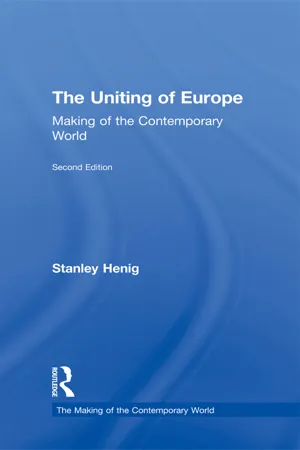
The Uniting of Europe provides an accessible introduction to the history of European integration and places European unification within a wider political and economic context The book shows how institutional developments have been conditioned by wider international considerations. The Uniting of Europe considers:
* the impact of the Cold War and the superpowers on Europe
* Britain's decision to join the Community
* the consequences of German reunification
* the problem of nationalism in Eastern Europe
* key personalities, parties, regimes and political systems.
This Second edition brings the history of the European Union up to date to include the Amsterdam and Nice treaties, as well as other contemporary issues such as the impact of events in Yugoslavia, the changing relationship with the US and British membership of the single currency.
- 152 pages
- English
- ePUB (mobile friendly)
- Available on iOS & Android
eBook - ePub
About this book
Information
1 Europe in 1945
The Second World War consolidated the verdict of the First in shifting irrevocably the balance of world power away from Europe. Two phases summarise the purely military conflict in Europe. In the first, Germany conquered almost the entire continent. In the second, two essentially extraneous forces – the USA and the USSR – defeated Germany and liberated Europe. The USA with its British and other allies, on the one hand, and the Soviet Union, on the other, fought substantially separate campaigns against German armies. There were no joint operations and no joint military command. With Germany defeated, the victorious armies simply occupied adjoining space. Thus Western Europe was liberated by US-led forces and Eastern and Central by the Red Army. It is possible to attribute the later division of Europe to agreements made by Churchill, Roosevelt and Stalin at Yalta and elsewhere. The reality is that these agreements were determined to all intents and purposes by the military situation on the ground whilst Germany was being defeated. The so-called Iron Curtain which was to divide Europe for four and a half decades was brought about by the realities of power and not by any treaties. Indeed even now, more than half a century later, there has been no attempt to emulate 1919 with a comprehensive series of peace treaties. In the immediate aftermath of 1945 the settlement was purely military; and ironically it was to last very much longer.
Extending this Euro-centric approach, it is worth considering also the impact on European states of the world-wide conflict. At a simplistic level the war beyond Europe was equally a struggle against aggression and the final defeat of Japan was as decisive as that of Germany. However, for those imperial European countries involved outside their own continent, the flow of the war and the issues involved were in many ways more complex whilst the final verdict was not so clear cut. To all intents and purposes, the European states lost effective control of their overseas territories partly as a result of their own internal collapse, partly from defeat by the Japanese and partly from the new world order and very different imperialisms favoured by the new super-powers. Prior to 1939 there was a significant interlink between the domestic economies of Britain, France, Belgium, the Netherlands and Portugal and their overseas ‘possessions’. The loss of the link could not fail to affect these European economies. There is a difference in reactions to the verdicts of the internal and external conflicts. No European politician or leader could fail to recognise the military verdict of the European war and its stark political implications. There are quite different dimensions to assessment of the extra-European conflict. For some time, the purely military verdict concealed political realities and their economic implications.
Militarily Europe was dependent on its liberators and potentially at their mercy. Disagreements between those liberators were another ingredient in a dangerous world. However, in another sense Europe had also lost its political paramountcy. The system of predominantly nation states as established by the 1919 settlement had simply collapsed. With the exceptions of Britain, Sweden and Switzerland, every European state had witnessed either the relatively violent overthrow of its constitutional arrangements or had been militarily occupied by an enemy or both. There had always been some ethical dimensions to imperialism. European countries could claim prior to 1939 to be offering something by way of ‘political tutelage’ to their colonies. Political collapse and military defeats in Europe and elsewhere destroyed such illusions. Confronted with former imperial possessions looking for their own independence, Europe lacked both the physical means and the moral authority to make any effective response. Resistance to the reality that the old colonial empires had gone for ever was to store up considerable potential for de-stabilising domestic politics.
The collapse of so many nation states in the period 1920–45 is particularly significant in the evolution of ideas for uniting Europe. Throughout the nineteenth century, the nation state had been presented as the legitimate alternative to the old hybrid monarchies and empires which dominated much of Europe. It was easy to assume that there was a natural alliance between nationalism and liberalism as the two new ‘dynamic’ forces. Nationalism was posited as creative and liberating: liberals failed to assess its destructive potential. By 1914 significant numbers of national groups had won the right to statehood. Whatever its shortcomings as a settlement, Versailles legitimated these and other claims. As a result, more peoples than at any time in Europe’s previous history could boast of their ‘own’ state. Adoption of liberal democratic systems by these new states seemed to grant initial confirmation to the nineteenth-century view that nationalism was creative and basically benevolent. A short excursion into the politics of many of the states of Central and Eastern Europe quickly belies the myth. It is a commonplace assertion that the united Germany of Bismarck was begotten in violence. It is all too often forgotten that the post-1919 successor states were themselves established as a result of a very much bloodier conflict than any provoked by Bismarck. In most cases few of the conditions for liberal democracy were present. This was soon reflected in the turbulent politics and frequent resorts to violence which characterised so many of these new states.1 Nor did the creation of so many nation states remove nationality and ethnicity as political factors.
In Central and Eastern Europe the result of the war was to take away any element of choice about post-1945 forms of political organisation. Regimes and governments would have to be acceptable to the USSR. The Communists simply swallowed or outlawed other political forces. However, nationalism in effect went underground – to emerge two generations later as an apparently legitimate alternative to the extraneously imposed regimes.
Western Europe was different. The history of nation states was longer, and in most cases there had been a gradual evolution of political structures. Prior to 1939 Germany, Italy and Portugal adopted fascist regimes, as did Spain after a civil war the outcome of which was decided by foreign intervention. Other states in Western Europe survived internal dissension. Although fascist and neo-fascist parties appeared throughout Europe, parliamentary democracy was in no real danger elsewhere in the Western part of the continent. However, most countries fell to military aggression in the early part of the war and this led to the imposition of new regimes which sometimes included these same native fascist groups. Throughout the whole of Europe, the price of military defeat was without precedent. It led to occupation and subordination of the entire machinery of government to the victors for whom the spoils of war were unlimited. It is traditional for defeated armies to surrender, but this now extended to the entire citizenry. It is this more than anything else which gives resonance to the phrase ‘total war’.
These shared formative experiences are crucial to an understanding of post-war developments. The philosophical basis for organised society is that the individual is protected against external aggression and given a framework of law and order within which to carry on with daily life. Judged by such criteria, most European states had quite simply failed. Nazi forces marching through Brussels, Copenhagen and Paris or ensuring the victory of an armed insurgency against the government in Madrid; mayhem, street violence and political assassination in Germany, Italy and much of Eastern Europe: all delivered an unequivocal message as to the inability of individual European states to fulfil the prime purpose of protecting and safeguarding their citizens.
The past failure and current weakness of nation states in 1945 is a prime well-spring of what was to become known as the ‘European movement’ dedicated to the broad notion of seeking to unite the states and people of Europe through some new entity. Such a new entity might have the size and strength to avoid the calamities which had befallen the post-1919 state system. It might also offer Europe a better basis for handling its changed relations with the rest of the world – both the super-powers and the former colonies. It would be fanciful to suggest that such ideas played a major role in the development of resistance movements during the later stages of the war, but they did feature in their political programmes. Certainly for many Europeans there was a sameness of historic experiences during those years, which also witnessed reconciliations between some historic ideological enemies. Prior to 1939 the divide between liberal, secular, republican forces and groups supportive of the church had been central to basic political cleavages in many European countries. Indeed this was one powerful factor to be exploited by fascist forces in their attempts at political ascendancy. One of the key political forces in 1945 – Christian Democracy – was dedicated to bridging that divide. Extolling a broad Christian heritage, Christian Democrat parties unequivocally accepted secular democratic states and recognised the need for central intervention to promote social and economic welfare. There is a considerable difference between these continental parties which occupied the political centre and the more ancient British conservative party which, unlike the Christian Democrats, had to an extent inherited traditional liberal laissez faire attitudes
Christian Democrat parties rapidly reached positions of dominance in both Italy and West Germany. Their French equivalent, the MRP, played a key role in government in the early years after 1945. In Belgium, the Netherlands and Luxembourg (Benelux), Christian Democrat parties held similar positions. A shared Christian legacy also gave these parties the rudiments of a trans-national ideology which was another factor distancing them from the traditional, often nationalist right. Christian Democracy was to become closely identified with the ‘European movement’.
THE GERMAN PROBLEM
An immediate political problem confronting Europe was the future of Germany. At one level German aggression seemed at the heart of a series of wars. Logically there was an incompatibility in seeking to heap the blame on Germany and all Germans if it were also held that Nazism was the key culprit. Harking back to the 1920s offered mixed messages. The then victorious allies had alternatively sought to crush and to conciliate Germany but had ended by doing neither. In terms of economic potential Germany remained the strongest European country and despite war losses was much more populous than Britain, France or Italy. The Iron Curtain which was to fall over Europe cut Germany in two, but even this did not resolve the ‘German problem’. In the narrower context of Western Europe, Britain and France faced exactly the same policy dilemma as in 1919 – to crush or to conciliate. The German problem lay at the very heart of any discussion about European unification and both were significantly affected by the division of the continent.
From 1945 onwards there is a close umbilical link between the German problem and what we may term the ‘European idea’. It rapidly became obvious that there was no possibility that the Soviet Union would allow the countries it controlled in Eastern and Central Europe to join in any free association with the West. However, if a united Europe comprised only the western part of the continent, it could hardly be a reality without Western Germany. On the other hand a united Europe also offered one possible route for containing German strength. These considerations were reinforced by a further factor. Whatever the historic basis for fears of Germany on the part of its immediate neighbours, in the context of 1945 the Soviet Union and Red Army constituted a potentially much more dangerous threat. The apparent immediacy of the new threat ultimately determined Western European response to the classic policy dilemma concerning Germany.
The weakness of Europe’s nation states and their need to find a solution to the problem of Germany are key features in the development of European integration. Equally important was the state of international politics. The division of Europe, whether promoted, sanctioned or merely legitimated by Yalta, did not resolve the potential for conflict between the two new super-powers. Nor in the period 1945–50 did the alignment of the frontier between East and West seem to offer any guarantee of long-term stability. By 1948 the only continuing partnership between the allies was in Austria. Almost every other country was clearly in one or other sphere of interest/influence.2 Germany had simply been split into two and the Soviet Union had attempted to squeeze the other occupier out of Berlin. The Communist take-over in Czechoslovakia – alone in Central and Eastern Europe it had operated a democratic party system throughout the period from 1919 to 1939 – and the crises over Communist participation in the French and Italian governments suggested to the West that the Soviet Union was still basically expansionist. The states of Western Europe were finding themselves increasingly dependent on the USA for both economic aid and military protection. Unification offered Western Europe a means of strengthening itself against both super-powers. There was some suggestion of an alternative ideology. In post-war France the soubriquet ‘third force’ was attached to the potential alignment between the Socialists and the MRP. It was not difficult, although it was always a fantasy, to extend the idea to the point of envisaging Europe as some kind of ‘third force’ between the two super-powers.
The central argument postulated in this chapter is that unification was a specific response to a series of problems confronting a group of countries in Western Europe in the immediate aftermath of 1945. More than a half century later it is easy enough to praise or condemn those who propagated the ‘European idea’ as idealists, but such an epithet – whilst at times convenient to protagonists and antagonists alike – is largely meaningless. The statesmen and leaders concerned were seeking new solutions to very real practical problems. They were national politicians seeking what they considered the national interest. It is interesting to contrast the views of Harold Macmillan who was to be Prime Minister when Britain first applied to join the Community, with those of Edouard Daladier, who had been French Prime Minister at the time of Munich. According to Macmillan:
The most important motive behind the movement for European integration is the need to attach Germany permanently to Western Europe, but in such a manner that she cannot dominate it. This is as much a British as a continental interest. After all, we have fought two wars about this in one generation.3
Daladier occupies a niche in history as a supporter of appeasement of Germany before 1939, but years later he proclaimed his unswerving opposition to the European idea: ‘When they say Europe, they mean Germany, and when they say Germany, they mean greater Germany.’4 Although Macmillan was only ten years younger, there is a generational clash inherent in these views, but both politicians had seemingly assessed lessons from history in formulating a response to the major issue of the post-1945 period. The controversy is about the practicalities of power politics rather than about political ideals. As national politicians, each was concerned with the national interest, and on this occasion the Briton seems much more far-sighted and clear thinking.
ORIGINS OF EUROPEAN UNITY
Like every political movement, that espousing European unification needed a vibrant mythology to help persuasion and it was not above inventing a certain amount of pre-history. Of course, myths do not have to be true and can appear in strange places! Thus one French survey of European history – admittedly written from a highly critical standpoint – proclaimed that ‘Europe began in unity: it is older than the nations of which it consists’.5 This is nonsense. Most of Europe’s history has revolved around conflict between different groups – tribal, religious, national. Past periods of unity have been transient and have resulted from conquest. Much has been made of cultural, religious and social linkages between national elites, but these do not amount to any kind of united Europe.
Efforts have been made to boost the significance of a variety of references to notions of European unity by writers as disparate as the Abbé de Saint-Pierre and Goethe and by political activists such as Mazzini and the Cobdenite free traders. Immediately after the First World War Luigi Einaudi, who was to become President of Italy after the Second, wrote a series of articles advocating federalism rather than the League of Nations as a solution for Europe’s problems. In the 1920s Count Coudenhove Kalergi established Pan Europe as a campaigning organisation. He presumably won over French Prime Minister Aristide Briand, who produced a vague proposal for a European constitution. Prior to the 1939 war, more organisations came into existence – all at the time quite uninfluential. The period of pre-history was, though, to end with a powerful gesture linking it to the central, practical politics of the post-war period. Confronted with the imminent collapse of France in 1940 the British government proposed ‘a declaration of indissoluble union’. Instead of two nations there would be ‘one Franco-British union’. Whether the gesture was idealistic or merely quixotic, it reflected Britain’s desperation to keep France in the war against Germany. As a piece of realpolitik it provides a link to the future: the truth is that neither Churchill’s 1940 offer nor the rest of this pre-history has any specific relevance to the post-1945 course of European integration.
The real history of the European movement begins with a plethora of now mostly forgotten organisations active in the immediate post-war period in promoting the concept of unification. The historian Alan Milward puts forward a powerful, if a little over-stated, argument to deny any real link between all these movements and the actual process of European integration:
these ill-matched movements were of little importance … in the political life of their own countries … The European Unity Movement which they eventually formed in 1947 appears to have had practically no influence on the negotiations for the Treaty of Paris three years later.6
The relationship between ideas and actions is always complex and frequently obscure. Milward is perhaps a useful antidote to some who give exaggerated importance to the activities of these various European pressure groups. However, what is true is that once they came together in 1947 to form what was to become the European Movement they acquired sufficient mass to have an impact on the ebb and flow of contemporary ideas. Membership, although a loose concept, included a considerable number of significant political figures in a variety of European countries.7 ‘Networking’ is often considered as a process developed during the 1990s, but it has a long and respectable history amongst European, particularly, federalist groups.
There is one final aspect of the motivations for seeking European integration which is worthy of some analysis and that is the argument of scale, or, put more bluntly, the attractions of sizeism. It was easy in 1945 to equate success with size. Europe’s political failures could be attributed to smallness; the military victory over Germany could be accredited to the sheer size of the new super-powers. The USA and the USSR seemed to be the future. It was equally assumed that in the Far East the advantage was now with China rather than Japan. The early literature of European integration is full of references to size as a key determinant for economic success. In most cases they were simple assertions. There were some major economic studies of the advantages of scale, but there was a tendency simply to take the case as proven. It was assumed that there was a direct relationship between size and economic potential/success. It was equally taken for granted in the immediate aftermath of 1945 that the new economics incorporating Keynesianism could predict and plan growth and prosperity. This was a key u...
Table of contents
- Cover
- Half Title
- Title Page
- Copyright Page
- Contents
- Dedication
- Introduction
- 1 Europe in 1945
- 2 The changing context for integration
- 3 The emergence of the Six
- 4 The European Community
- 5 The Six in search of an identity
- 6 Widening and deepening
- 7 From Community to Union
- 8 Maastricht and European Union
- 9 From consolidation to enlargement
- 10 Conclusion – beyond federal Europe
- Glossary of major terms and abbreviations
- Notes
- Bibliography
- Index
Trusted by 375,005 students
Access to over 1.5 million titles for a fair monthly price.
Study more efficiently using our study tools.
Frequently asked questions
Yes, you can cancel anytime from the Subscription tab in your account settings on the Perlego website. Your subscription will stay active until the end of your current billing period. Learn how to cancel your subscription
No, books cannot be downloaded as external files, such as PDFs, for use outside of Perlego. However, you can download books within the Perlego app for offline reading on mobile or tablet. Learn how to download books offline
Perlego offers two plans: Essential and Complete
- Essential is ideal for learners and professionals who enjoy exploring a wide range of subjects. Access the Essential Library with 800,000+ trusted titles and best-sellers across business, personal growth, and the humanities. Includes unlimited reading time and Standard Read Aloud voice.
- Complete: Perfect for advanced learners and researchers needing full, unrestricted access. Unlock 1.5M+ books across hundreds of subjects, including academic and specialized titles. The Complete Plan also includes advanced features like Premium Read Aloud and Research Assistant.
We are an online textbook subscription service, where you can get access to an entire online library for less than the price of a single book per month. With over 1.5 million books across 990+ topics, we’ve got you covered! Learn about our mission
Look out for the read-aloud symbol on your next book to see if you can listen to it. The read-aloud tool reads text aloud for you, highlighting the text as it is being read. You can pause it, speed it up and slow it down. Learn more about Read Aloud
Yes! You can use the Perlego app on both iOS and Android devices to read anytime, anywhere — even offline. Perfect for commutes or when you’re on the go.
Please note we cannot support devices running on iOS 13 and Android 7 or earlier. Learn more about using the app
Please note we cannot support devices running on iOS 13 and Android 7 or earlier. Learn more about using the app
Yes, you can access The Uniting of Europe by Stanley Henig in PDF and/or ePUB format, as well as other popular books in Politics & International Relations & 20th Century History. We have over 1.5 million books available in our catalogue for you to explore.