![]()
CHAPTER 1
The Birth of the Pool
It all began at Jody’s Club Forest. Jody’s bills itself as “A Taste of Irish in Staten Island.” The family-friendly North Shore West Brighton neighborhood eatery and bar organized the first known bracket pool in 1977. The entry fee was $10 and 88 patrons filled out brackets (Rushin 2009). The bracket had only 32 teams that year. This first bracket pool involved picking only the Final Four®, the champion, and the number of points scored in the championship game, not the full bracket. Marquette beat North Carolina in the championship game that year.
A year later, Bob Stinson, a U.S. Postal Service employee, started a bracket pool that may stand as the first using the typical modern format and rules in Louisville, Kentucky. According to Stinson, before that people would just pick random team names out of a hat and the newspaper did not print a bracket. He wanted a contest that rewarded knowledge of the game of basketball. The pool had 15 participants in its first year (Hill 1997). Tim Trowbridge of Kent, Ohio independently started a pool that involved picking a winner for every game in the bracket back in 1981 (Allard 2017). The NCAA tournament had 48 teams back then. The National Collegiate Basketball Association, or NCAA, is the governing body for much of U.S. college basketball. Trowbridge and his friend Jeff Hunt managed the pool. They worked out the format over a few beers in a local pub. Their goal was to “once and for all determine who knew the most about college basketball.” This pool also had 15 entries the first year and that grew to 200 entries by the fourth or fifth year. The filled-out bracket entry sheets were collected from local bars. An engraved plaque memorializing the names of all the winners of the “Trowbridge Hunt & Trowbridge Annual NCAA Tournament” used to hang in the Rusty Nail bar. It now hangs near the door of Trowbridge’s office. The first description of an “office pool” involving the NCAA tournament bracket was in 1984 among books and sources indexed by Google (Wayne 1984).
1.1 The Tournament
In the first intercollegiate basketball game, played in 1896, the Chicago Maroons beat the Iowa Hawkeyes. Yale was a powerhouse team in the early years. The Ivy League was the first conference. A conference is an organized group of teams in a region that mostly play each other. The Southern Conference held the first college tournament at the end of its regular season in 1921 (ESPN 2009).
Tournaments caught on. Tournaments are interesting and exciting for a number of reasons. These are single elimination tournaments—so each game is a sudden death match that (in the case of the NCAA tournament) ends the season for the losing team. Since the seniors on the team will graduate or lose eligibility, it marks the last game that a losing team would ever play together. This can be a very emotional moment. Only one team emerges from the tournament victorious in all games. Another appeal of a tournament is that it tends to be an equalizer. The best team in a conference may be favored to win all the conference games it plays all season. But playing in a tournament is like running a gauntlet. It’s often the case that even the best team is more likely than not to lose the tournament. A tournament is a challenge for even the best teams, and it gives every team a chance to shock the rest and emerge victorious. This level of unpredictability is riveting for the fans. The first NCAA tournament, consisting of eight teams, was held in 1939. It expanded to 16 teams in 1951. In 1953, the NCAA tournament added six more teams; this was the first unbalanced bracket requiring six play-in games. The tournament expanded to 32 teams in 1975, and 64 teams in 1985. In 2011, the field expanded to 68 teams, requiring four play-in games, but most bracket pools ignore the play-in games and use a balanced format involving the 64 teams that include the winners of the play-in games. (The NCAA has started calling the play-in round of four games the “first round.” But this book will stick to the earlier convention of calling the round of 64 teams the “first round.”)
1.2 The Bracket Pool Emerges
A number of events happened around 1977 that might explain why the bracket pool caught on. UCLA dominated the tournament for 12 years before 1976, winning 10 of 12 championships, making the championship game somewhat anti-climactic. UCLA’s coach for that period, John Wooden, retired in 1975, and the UCLA dynasty was over. The championship game became more competitive. Fans started anticipating a close, exciting game. Television ratings soared when Larry Bird dueled Magic Johnson in the 1979 championship game. The NCAA tournament became a national institution in the United States. The phrase “Final Four” was coined in 1975. The Xerox machine was becoming more common in offices, allowing easy duplication of the bracket printed in newspapers just before the tournament. The stage was set for the office bracket pool to emerge.
Why did the bracket pool begin in Staten Island? Why not Las Vegas, the center of the legal sports betting universe in the United States? Las Vegas is a tourist town, and tourists rarely stay for the four weeks between placing bets and seeing the outcome of the tournament. Bracket pools made sense in neighborhoods or offices where the participants live and work together. Betting on the win/lose outcomes of sport competitions is illegal in most of the United States, including Staten Island, but some state penal codes carve out exceptions for “social gambling” when the pool organizer does not profit by charging a fee or taking a cut of the pot. The fairly expansive social gambling exception in the New York State penal code led to the toleration of a public bracket pool, open to all, at a business establishment. Even in states where social gambling is illegal or when federal laws apply, bracket pools are rarely prosecuted (Edelman 2017). Edelman recommends limiting entrants to close friends and paying out all entry fees as prizes. After 29 years of continuous operation, Jody’s pool was discontinued in 2007 after Jody Haggerty was investigated by the IRS and fined by the New York State Liquor Authority for promoting gambling in an establishment licensed to serve liquor (Daily News 2007). Press reports indicate that the 2006 pool winner had reported his winnings as income to the IRS, leading to investigations. The pool pot had grown to $1.5 million, and Jody was not reporting the payout of the winnings to the IRS as required by regulations.
The tournament is played after the regular college basketball season, which runs each year from October to March. There are about 350 teams in the NCAA Division I. Division I is composed of the larger colleges, and these generally have the better teams. These teams are organized into conferences consisting of 8 to 16 teams each. During the regular season, each team plays about 30 games, mostly with other teams in their conference. Just after the regular season, each conference plays a conference tournament. The winners of all these tournaments get an automatic invitation (called an “automatic bid”) to the NCAA tournament. The rest of the tournament field is fleshed out with teams chosen by an NCAA selection committee. These “at-large bids” are awarded to teams that had a good season with many wins but were eliminated during the conference tournaments.
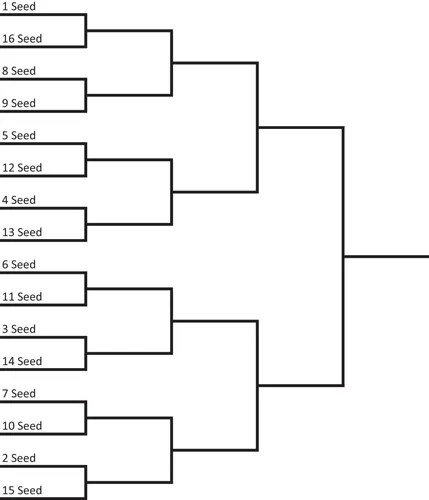
In the course of the NCAA tournament, all but one team is eliminated by losing a game. The tournament starts with 64 teams (not counting the play-in games) and ends after 63 are eliminated in 63 games. The NCAA tournament is organized into four regional tournaments of 16 teams each. The teams are seeded 1 to 16 in each regional tournament. The teams are seeded by the selection committee based on their season performance and a few other considerations. The lower numbered seed is actually the higher ranked seed, typically referred to as the “higher seed.” So, the number 1 seeds tend to be the favorites. Figure 1.1 shows how the brackets for each regional tournament are structured. The victors in the four regions, the Final Four, meet in the final two rounds of the NCAA tournament to decide the national champion.
FIGURE 1.1 The bracket structure for an NCAA tournament region.
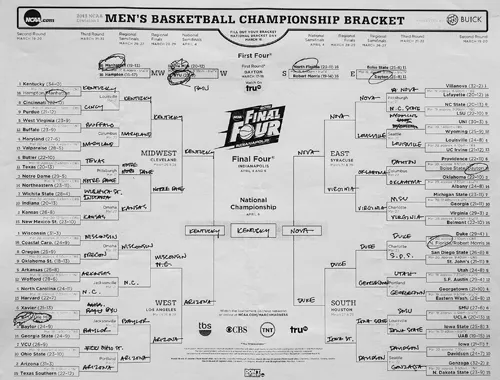
The selection committee meets in March on “Selection Sunday©” to determine the at-large bids, to assign teams to regions, and to seed each team in their region. The bracket, with all teams assigned to a specific slot, is revealed around 6:00 p.m. on Selection Sunday. The first game of the first round of the tournaments begins around noon on the following Thursday. During those 90 hours (between the revelation of the bracket and the tip-off of the first game) is when the bracket pool game is played, because you can’t fill out a bracket until you know how the tournament is seeded and you are not allowed to enter a bracket in a pool after the games have begun. Your goal is to rack up the most points. You get points for each game when you correctly predict the winner of that game. The specific scoring rules vary from one bracket pool to another, but more points are awarded for games in the later tournament rounds in most pools. Your bracket along with your entry fee must be delivered to your office pool’s manager before the games begin. Figure 1.2 shows President Barack Obama’s 2015 bracket.
FIGURE 1.2 President Obama’s 2015 Men’s bracket (Wall 2015). Licensed under CC BY 3.0.
Now comes the waiting and watching to see how your bracket fares against your opponents’ brackets. The 32 games of the first round of the four regional tournaments are played over Thursday and Friday, 16 games per day, with two or three teams defeated and eliminated per hour at some points. The second round of 16 games among the 32 victors in the first round is played on Saturday and Sunday. Then there is a breather till the next Thursday, then four more days of tournament play that winnow the field down to just four teams. Then another breather till the next Saturday night when two games are played and only two teams are left standing. Then, after a rest day, the final game of the tournament, the championship game, is played the following Monday night. The last two teams learn their fate, as do all the hopeful bracket pool players who still have a bracket sheet in the running. In some years, all fates are determined by a ball flying toward a hoop in the last split-second of the last game. The tournament champion is crowned, and all the pooled money is distributed to the bracket pool winners who have the best scores on their bracket sheets.
All gambling is illegal in some states. In 1992, Robert S. Plain of East Greenwich High School in Rhode Island was arrested for possession of gambling paraphernalia. He had in his possession bracket pool entry sheets that he was handing out during homeroom. Mary McNulty, his math teacher of all people, reported him to the police. District Court Judge Robert K. Pirraglia ordered Plain to pay $84.50 in court costs (AP 1992). Fortunately for the future of the bracket pool, this conviction did not create a trend in the United States. Some students at Greenwich protested that betting pools involving teachers were common at the school. The bracket pool was on its way to becoming something of a national institution.
The NCAA created the tournament, but it has no love for the peculiar institution of the bracket pool that the tournament spawned. In the NCAA’s own words: “Does the NCAA really oppose the harmless small-dollar bracket office pool for the Men’s Final Four? Yes! Office pools of this nature are illegal in most states. The NCAA is aware of pools involving $100,000 or more in revenue. Worse yet, the NCAA has learned these types of pools are often the entry point for youth to begin gambling. Fans should enjoy following the tournament and filling out a bracket just for the fun of it, not on the amount of money they could possibly win” (NCAA 2010). The NCAA is OK with some bracket contests that give prizes but do not require a wager. The NCAA sponsors its own bracket contest at the website bracketchallenge.ncaa.com.
1.3 A Natural Experiment in Economics
About 15 years after the first bracket pool at Jody’s, Andrew Metrick somehow convinced his thesis advisor, Eric Maskin (winner of the Nobel Prize for Economics in 2007), to allow him to write a PhD thesis ...