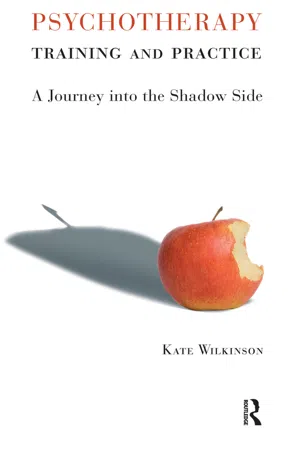
- 266 pages
- English
- ePUB (mobile friendly)
- Available on iOS & Android
eBook - ePub
About this book
An exploration of the extensive intra-personal, interpersonal and group dynamic landscape of human experience pertinent to the understanding of the human shadow in the training of psychotherapists. Using phenomenological enquiry this book invites unique, in-depth experiences, provides new insights and addresses the complexities and diversities inherent in the emergence and containment of shadow experience in psychotherapy training. This book takes the reader through a process of qualitative research and invites the reader to explore his or her own relationships to the love of others, through the exploration of all the things that love is not. It argues that without hate we cannot truly love. Interspersed throughout the book are suggestions for personal exploration and it is hoped that reading this book will both stimulate practitioners to a process of self-reflection and questioning, and also support practitioner researchers in their own journey to self-understanding.
Information
CHAPTER ONE
Surveying the crossing
“I want to know if you can see beauty, even when it's not pretty, every day, and if you can source your own life from its presence”
(Oriah Mountain Dreamer, 1999, p. 70)
Rationale for these explorations
Personal experience
Having worked as a general nurse in acute psychiatry, and in search of a deeper understanding of the human pain I witnessed, I began Registered Mental Nurse Training. My Christian upbringing led me to look for the loving aspects of human nature and to want to seek to abolish what I then understood as “harmful and bad” behaviours. I had much to learn about human destructiveness.
Work in a large mental institution was a rude awakening for me, introducing me to the real, unsanitized world; a very different place to that which I had previously allowed myself to see through my “Christian rose-coloured glasses”. Experiences of bullying, physical and emotional neglect, depersonalization, and annihilation were just as evident as the caring, sometimes “blind” caring, as opposed to a considered and realistically thought out approach, which was also part of the psychiatric system. My interest in understanding human aggression and destruction led me to work in a Regional Forensic Unit, with ill people who had offended against society to the extreme of committing rape, arson, manslaughter and murder. The appalling learning that struck me was that the most significant difference between staff and patients was simply the degree to which feelings and thoughts were acted out behaviourally. The potential to destroy is inherent in being human, and as such is within each and every one of us. I believe that our prisons house people who are as much themselves victims as their victims.
Searching for understanding of human shadow took me to psychotherapy training. My interview for psychodynamic training brought disappointment. I was advised to undertake a year’s analysis and reapply the following year; they considered me out of touch with my own dangerousness! I later learned the truth of this. Since that time, I have undergone five long-term counselling and psychotherapy trainings in four different northern institutes, plus very many seminars and workshops around the world. Human destructiveness, which I have witnessed on this journey, has been primarily at the level of emotional and verbal, often at a deep and profoundly painful level, yet with some physical experience.
The physical ramifications of destructive impulses were primarily turned against the self. Despite much wide and varied experience in psychotherapy and psychiatric settings, I was ill-prepared for the impact of the shadow experience I was to encounter myself as a psychotherapy trainer and Director of a training institute.
These shadow experiences include repeated aggression from the environment, such as
- seventy letters of complaint from neighbours to the local Borough Council, resisting the Council’s readiness to allow permission to practise from our premises. This resulted in a sense of insecurity and unsettledness, a concern for the future existence of the institute, and feelings of anxiety for those who used the institute; trainers, trainees, and clients alike;
- neighbourhood meetings being held in nearby hotel to address the strategies for the proposed removal of the institute from this area;
- my arrival at work on many occasions to find that eggs had been thrown at the front door and windows of our premises;
- my arrival at work to find faeces piled on the top doorstep of our premises;
- a close neighbour approaching people entering our premises with shouts of “We don’t want your sort here!” and incidents of verbal abuse to staff, trainees, and clients;
- a close neighbour watching from a window and recording in detail the timing of arrival and leaving of people entering the premises, along with a note of car registration numbers;
- the invasion of my personal space by the environment, with unordered pizzas being delivered to, and taxis arriving at, my home in the early hours of the morning;
- twenty- and thirty-page letters of scrawled, disturbing, psychotic thinking arriving regularly at the institute from an unknown source. While this may be one way of a psychotic client “containing” his/her own madness by packing it up and sending it off to a psychotherapy institute, the shadow element is evident in the imposition of this material on whoever opened and read it, without any prior agreement that this might happen;
- similarly, and probably of the same process, books arriving, of deep philosophical thinking, all extensively and confusingly annotated to say that the world is about to end.
I felt pursued and haunted by these experiences.
Police intervention and discussion with neighbours stopped most of these behaviours from outside the institute. From within the institute,
- books were removed from a reference library and were never returned despite supportive requests;
- people legitimately staying over at the institute heard others on the premises during the night, sometimes in a drunken state;
- small items were stolen occasionally from the institute;
- the Psychotherapy Training Institute’s telephone bill increased by £300 when someone used the computer (in the locked office) during the night to access internet porn (only practitioners seeing clients at the institute had keys).
Since embarking on consideration of this theme, several colleagues who are Directors of other institutes have told me of their own similar experiences. I am interested that it has taken, for me, an open, almost interrogative stance for such sharing to be forthcoming. In a talking profession, this theme is not talked about!
Within training groups, members scapegoated, rejected, and verbally attacked each other, and experienced facilitation was needed to contain these dynamics. I learned of trainers and of qualified and trainee therapists being dismissed professionally from other member organizations for severe breach of boundaries with trainees, for offences ranging from sexual contact to financial exploitation.
My reasons for exploring this theme are partly to raise my own awareness, thus enhancing my skill as a psychotherapist and trainer, and partly a wish to raise awareness generally in the field of what is needed in integrative psychotherapy training organizations in the way of a holding environment in order to address and contain what currently remains experienced and yet insufficiently addressed. I would hope, also, that the novice psychotherapy researcher might find the process of research methodology described here useful in gleaning understanding for research projects of their own.
Information from the field
It is increasingly acknowledged in the therapy professions that it is the relationship between client and therapist that heals old wounds and promotes personal growth (primarily for the client and also in the therapist). This human connectedness is the very core of integrative psychotherapeutic work, and therapist personality plays an important part here. The British Association for Counselling and Psychotherapy (BACP) now values the importance of therapists undertaking their own therapy—forty hours of personal work—to become able to practise openly and effectively. Integrative psychotherapy trainings believe that personal therapy throughout the duration of four years’ training is necessary in order to ensure a certain level of self-reflection in the therapist, enhancing the qualities necessary in a therapist to prevent and optimally minimize any potentially abusive behaviour towards clients. The BACP (2002) lists these personal qualities necessary for professional competency as follows: empathy, sincerity in relationships, integrity, resilience, showing respect, acknowledging one’s own strengths and weaknesses, employing skills competently, being fair, possessing wisdom, and courage.
While I honour this without hesitation, I wonder where the less welcome human qualities might be in a therapist. What is being insufficiently addressed here? Only one of the ten qualities listed above pays reference to human weaknesses. It is never professional practice to collaborate with abuse of our clients, and in order to ensure that this does not happen, I believe that we need to recognize more fully what it is in ourselves that could so easily result in that happening. Our Codes of Ethics indicate some unacceptable behaviours of the therapist, although no ethical code could cover all the possibilities. However, what is not explicitly acknowledged by the BACP, or by many training organizations, is that as human beings we have destructive impulses, resentments, hatred, violent and toxic thoughts, self-gratifications met through the manipulation of others, of our clients. To only implicitly or subtly address these powerful human dynamics, under the heading of “weaknesses”, may contribute to a splitting process whereby professionals see themselves as “good” with potential for “bad” to become projected on to our clients and colleagues.
Walker (2002) gives one example of this dynamic, describing how clinical evangelism can result in the anger of a client being interpreted as resistance, when the therapist had made a poor, rather attacking intervention and client anger was justified. She notes also that psychotherapy trainers can turn against trainees in a way that invalidates and disempowers the trainee;
All trainings need to be careful not to fall into the potential traps that can paradoxically be created by the very strengths and essence of the model that they are teaching. [Walker, 2002, p. 43]
To teach only the loving acceptance of another actually promotes a splitting process and denies the search for wholeness that incorporates all of human qualities. To teach only the loving acceptance of another actually promotes a splitting process and denies the search for wholeness that incorporates all of human qualities. It is beneficial in the training milieu to provide a space for airing our apprehensions and fears. These fears are better explored than avoided.
It is unwise to place too much emphasis on the positive aspects of the therapist's personality, as this may result in therapists developing an inflated idea of who they are. And in such inflation, vulnerability is defensively defended. In working holistically, we cannot deny our negative attributes so blatantly, or tilt the balance of qualities towards the positive without some consequences resulting, which themselves could be dangerous. Guggenbuhl-Craig tells how, if we fail to accept our own shadow and to model the painful expression and working through of this to our clients, then “all the patient learns from us is how to fool himself and the world” (Guggenbuhl-Craig, 1971, p. 25).
I believe that we actually do some of our best work from our most vulnerable places, where we are at our most open.
Most clients seek support as a result of painful experience. In examining our own pain, both received and what we may inflict, we inform our clients that, however wonderful life may be at times, pain must also be faced, and we enhance a relationship whereby this becomes possible. Fox supports this view in stating that “if we fail to let pain be pain . .. then pain will haunt us in nightmarish ways” (Fox, 1991, p. 142).
We would not unquestioningly amputate a broken leg, but rather encourage the healing of this. We cannot hope to heal emotionally if we were to deny (amputate) some of our life experience. And this philosophy supports the holistic practice of integrative psychotherapy. In addition, while we may defensively choose not to address our shadow, nevertheless it will inevitably have an impact upon our work. “When two people meet, the totality of their psyches encounter each other—even if much of what happens is neither stated nor directly expressed” (Guggenbuhl-Craig, 1971, p. 41).
Self-deception on the part of the therapist, with denial of shadow, cannot fail to influence the therapeutic process. Addressing our shadow, bringing the unsanitized world into the arena, promotes the healthy pathway to wholeness, in that choices can be taken over the behaviours that we employ in response to destructive, as well as caring, urges, drives, and emotions.
As Bly states,
The savage mode does great damage to soul, earth, and humankind; we can say that though the savage man is wounded he prefers not to examine it. The Wild Man is crucial throughout. The Wild Man who has examined his wound resembles a Zen priest, a shaman, or a woodsman more than a savage. [Bly, 1990, p. x]
And Bly refers to Yeats to support this belief;
A woman can be proud and stiff,
When on love intent:
But love has pitched his mansion in
The place of excrement;
For nothing can be sole or whole
That has not been rent
When on love intent:
But love has pitched his mansion in
The place of excrement;
For nothing can be sole or whole
That has not been rent
(Yeats, 1983, p. 218)
I support those of my clients who fear the loss of their joy in life if they were to become open to shadow by referring to a local country estate, which boasts a lake supporting many different species of waterlily. This is a magnificent and splendid sight and each of these lilies has its roots firmly embedded in the mud.
Without a willingness to experience animal forces of human nature, which incorporate the terror, murderousness, and destructive shadow inherent in life itself, psychotherapeutic growth becomes superficial and avoidant. In integrative psychotherapy, Clarkson (1995) believes that those animal forces, shadow phenomena somatically experienced, are part of the healing process. She tells of her client’s phenomenology:
It is not at all unusual for people to come into spiritual paths while their psyches are still so much in need of earthly help. One client, Lilly, who was regularly and frequently physically and sexually abused by both her parents and their friends, found a millenialist [sic] religion which helped her to forgive them through the spirit for what they had done to her. It was only the incessant, recalcitrant paralysis of her back which eventually seemed to force her to face some denied dimensions of herself. Her body carried scars internally as well as externally and what was needed was the re-establishment of her healthy animal reflexes such as pain, surprise, anger and fear. These she had sublimated before and desensitized her body to its animal life. However, in her own words, “It was only after I had claimed my body and its rage, the terror in my cells and the murder of my natural childhood, that my forgiveness of my parents became true and meaningful instead of a spiritualised defence”. [ibid., p. 197]
I honour the words of Martin Luther King on violence:
The ultimate weakness of violence is that it is a descending spiral, begetting the very thing it seeks to destroy. Instead of diminishing evil, it multiplies it. Through violence you may murder the liar, but you cannot murder the lie, nor establish the truth. Through violence you may murder the hater, but you do not murder hate. In fact, violence merely increases hate. So it goes. Returning violence for violence multiplies violence, adding deeper darkness to a night already devoid of stars. Darkness cannot drive out darkness: only light can do that. Hate cannot drive out hate: only love can do that. [King, 1963]
However, we can only love if we can hate. What we resist in our own personalities merely becomes a projection, perhaps somatically turned against our self, or escaping our awareness in small or larger doses that are toxic to others. We cannot truly reach a place of wholeness without incorporating the whole spectrum of human experience. The stance of loving recognition of our clients can only be achieved through acknowledging the less loving aspects of humankind, primarily in ourselves. In order not to reach the negative experience described by King, we need to phenomenologically experience our own violence in order to choose a healthy expression of its existence. I have experienced a trainer telling a trainee that he is not willing to be persecuted by the trainee, and then withdrawing from contact with that trainee. Without the willingness to support the trainee to experience and explore the more difficult to tolerate emotions, however can the trainee’s negative persecutory energy be transformed? I wonder, on reflection, whose persecutory tendencies the trainer was paradoxically both avoiding and enacting. In conte...
Table of contents
- Cover
- Half Title
- Title
- Copyright
- Contents
- ACKNOWLEDGEMENTS
- ABOUT THE AUTHOR
- INTRODUCTION: Contemplating the journey
- CHAPTER ONE Surveying the crossing
- CHAPTER TWO Taking in provisions
- CHAPTER THREE Charting the waters
- CHAPTER FOUR Navigating a route
- CHAPTER FIVE Weathering the storm
- CHAPTER SIX Life at sea
- CHAPTER SEVEN Be calmed
- CHAPTER EIGHT The journey ends; the journey begins
- GLOSSARY OF PSYCHOTHERAPEUTIC TERMS
- REFERENCES
- BIBLIOGRAPHY
- INDEX
Trusted by 375,005 students
Access to over 1.5 million titles for a fair monthly price.
Study more efficiently using our study tools.
Frequently asked questions
Yes, you can cancel anytime from the Subscription tab in your account settings on the Perlego website. Your subscription will stay active until the end of your current billing period. Learn how to cancel your subscription
No, books cannot be downloaded as external files, such as PDFs, for use outside of Perlego. However, you can download books within the Perlego app for offline reading on mobile or tablet. Learn how to download books offline
Perlego offers two plans: Essential and Complete
- Essential is ideal for learners and professionals who enjoy exploring a wide range of subjects. Access the Essential Library with 800,000+ trusted titles and best-sellers across business, personal growth, and the humanities. Includes unlimited reading time and Standard Read Aloud voice.
- Complete: Perfect for advanced learners and researchers needing full, unrestricted access. Unlock 1.5M+ books across hundreds of subjects, including academic and specialized titles. The Complete Plan also includes advanced features like Premium Read Aloud and Research Assistant.
We are an online textbook subscription service, where you can get access to an entire online library for less than the price of a single book per month. With over 1.5 million books across 990+ topics, we’ve got you covered! Learn about our mission
Look out for the read-aloud symbol on your next book to see if you can listen to it. The read-aloud tool reads text aloud for you, highlighting the text as it is being read. You can pause it, speed it up and slow it down. Learn more about Read Aloud
Yes! You can use the Perlego app on both iOS and Android devices to read anytime, anywhere — even offline. Perfect for commutes or when you’re on the go.
Please note we cannot support devices running on iOS 13 and Android 7 or earlier. Learn more about using the app
Please note we cannot support devices running on iOS 13 and Android 7 or earlier. Learn more about using the app
Yes, you can access Psychotherapy Training and Practice by Kate Wilkinson in PDF and/or ePUB format, as well as other popular books in Psychology & Education in Psychology. We have over 1.5 million books available in our catalogue for you to explore.