- 272 pages
- English
- ePUB (mobile friendly)
- Available on iOS & Android
eBook - ePub
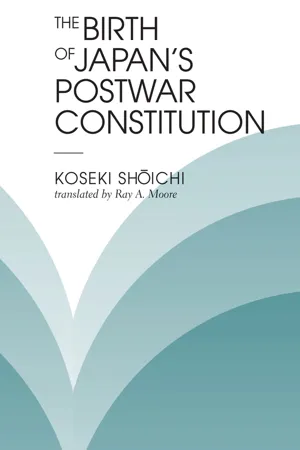
The Birth Of Japan's Postwar Constitution
About this book
This 1989 Yoshino Sakuzo prize-winning book is essential reading for understanding Japans postwar constitution, political and social history, and foreign policy. In this, the most complete English account of the origins of Japans Constitution, the author presents new interpretations of the behind-the-scenes actors who shaped the Japanese Constitution: the petulant General Douglas MacArthur, Japanese defenders of the conservative order, Japanese liberal and socialist reformers, and moderate Allies sitting on the Far Eastern Commission. }This 1989 Yoshino Sakuzo prize-winning book is essential reading for understanding Japans postwar constitution, political and social history, and foreign policy. The most complete English account of the origins of Japans constitution, it analyzes the dramatic events of 19451946 that lead to the birth of Japans new constitution. Koseki Shoichi challenges t he simplicity of the current interpretation that General Douglas MacArthur in February 1946, faced with inept Japanese efforts at constitutional reform and Soviet interference through the Far Eastern Commission, secretly ordered his staff to write a constitution in seven days and then imposed it on Japan. Differentiating between the adoption procedure and the framing process, the author argues that the latter was varied, complicated, and rich, going beyond the actions of two nations and their representatives. It involved the clash of legal ideas, the conflicting efforts of individuals of different cultures and different political persuasions, and significant contributions by people with no connection to government.Drawing on Japanese, American, and Australian archives as well as recent scholarly research, Koseki presents new and stimulating interpretations of MacArthurs actions, the Ashida amendment of Article 9, Yoshidas role, and much more. Criticizing Japanese conservative defenders of the old order, he explores Japanese liberal and socialist ideas on constitutional reform and reevaluates the Far Eastern Commissions influence on MacArthurs policies and on the shaping of the basic principles of Japans antiwar constitution. }
Information
1
The Probing Begins
Konoe Fumimaro Calls on MacArthur
The first person to suggest the revision of the Japanese Constitution was General Douglas MacArthur. At 5 p.m. on September 13,1945, Prince Konoe Fumimaro, prime minister three times before the war and minister without portfolio in the first postwar Higashikuni cabinet, made his way to the Customs Building near Yokohama Harbor, where MacArthur's general headquarters (GHQ) was located. On September 17 MacArthur would move to the Daiichi Insurance Building in Tokyo, across from the Imperial Palace, and on October 2 would establish his headquarters as the Supreme Commander for the Allied Powers (SCAP).1 Meanwhile, however, he was commander of the United States forces in the Pacific. At the time, none of this was known to the Japanese, nor did it matter much, for Konoe needed to meet with MacArthur in any case.
Tbmita Kenji, chief secretary in the Konoe cabinet before the war and later a close adviser to Konoe, has said that Konoe made the trip to Yokohama on September 13 because "MacArthur summoned him."2 To the Japanese, however, Konoe's reasons for the visit were not that simple. The political critic and adviser to Konoe, Iwabuchi Tatsuo, thought that "the Japanese side felt it necessary to inform MacArthur of conditions in Japan," and later explained that the "request for the meeting was made" by Konoe.3 Obata Toshishiro, a minister in the Higashikuni cabinet who had worked with Konoe during the war, agreed with Iwabuchi's view of events.4 Konoe's position in the Japanese government certainly justified his request to meet with MacArthur. Konoe had exceptionally rich international experience: He had been appointed to the House of Peers at the age of twenty-five while still a student at Kyoto University; he had served roughly three years as prime minister during a long political career; he had attended the Paris Peace Conference in 1919 as an aide to the Japanese delegation; and he had later traveled to the United States and other countries.5 It was precisely for these reasons that he was appointed to the cabinet in August 1945 and given the rank of deputy prime minister under Prime Minister Prince Higashikuni.
Konoe thus proceeded to MacArthur's headquarters in Yokohama, acting as the unofficial representative responsible for probing MacArthur's intentions. This was two days after the Supreme Commander had issued an order to arrest Tojo Hideki and others as suspected war criminals. Konoe's meeting ended after only about an hour primarily because, it was said, MacArthur's American interpreter was unable to perform his duties adequately.
Konoe and MacArthur met a second time on October 4. The location this time was the waiting room next to MacArthur's office on the sixth floor of the Daiichi Insurance Building in Tokyo, the headquarters of the U.S. occupation. This time the interpreter was Okumura Katsuzo, a Foreign Ministry official who had also served as the interpreter at the first meeting of MacArthur and the Japanese emperor just a week before. Hie time was 5 P.M., the same time as their first meeting in Yokohama. Konoe first met MacArthur's chief of staff, Lieutenant General Richard Sutherland. Then, after waiting about twenty minutes, he entered the room where, besides MacArthur and Sutherland, George Atcheson, Jr., the political adviser to the Supreme Commander, was also waiting. On the Japanese side were only Konoe and his interpreter, Okumura.
The reason for the twenty-minute delay according to Okumura years later, was that "Atcheson, who was in Japan as the representative of the State Department, also wished to hear what Konoe had to say In order to summon him suddenly from the Mitsui Building in Nihonbashi, where he had set up his office, it must have taken some time."6 This is quite a shrewd observation, since it would have taken Atcheson about twenty minutes to drive from Nihonbashi to Hibiya. But it seems unlikely that this was the only reason for the delay. For on this day at 6 P.M., MacArthur had issued a very important directive to the Japanese government. Usually referred to as the "human rights directive," this document ordered the immediate release of political prisoners, the abolition of the Special Police, the abrogation of repressive laws, and so forth. Because of this directive, on the following day the Higashikuni cabinet resigned, and on October 10 some three thousand political prisoners—including Tokuda Kyuichi and other members of the Japan Communist Party— were released. It is clear now that MacArthur was finalizing approval of the human rights directive at the very moment that he was to meet with Konoe. It seems reasonable to surmise, therefore, that this was probably the reason for the delay. Meanwhile, Konoe had no way of knowing that a directive was being issued while their talks were in progress.
When the meeting finally got under way, Konoe, according to Okumura, launched into a monologue on the causes of the war. He spoke of the militarists and Marxists and their responsibility for the war. "Cooperating with the militarists and nationalists, the Marxists were the ones who provided theoretical backing; and this union of militarists and leftists is what led Japan down the path to destruction."7 No matter how staunch an anticommunist MacArthur was, it is easy to imagine his astonishment when he heard Konoe's assertion that responsibility for the war lay with those leftist political criminals whom he himself was about to release from prison.
In any case, after talking at length, Konoe, "with a slight change of tone," asked MacArthur (Okumura reconstructs the conversation in the following way): "I'd like to know whether you have any ideas or suggestions regarding the organization of the Japanese Government and the composition of the Diet." On hearing this, MacArthur—suddenly sitting erect and speaking in a certain military tone—said in a loud voice, as if reprimanding him: "First of all, the Japanese Constitution must be revised. It is essential to introduce into government sufficient liberal elements through constitutional revision."8
Whether or not MacArthur in fact said "constitutional revision" on this occasion was later to become a major point of contention. The Foreign Ministry's record of the meeting, probably written by Okumura, indicates that MacArthur used these words.9 Furthermore, Atcheson's dispatch to the secretary of state on October 10 corroborates that the October 4 meeting was one "at which I was present and at which the General told Konoe that the Japanese Constitution must be revised."10 Thus it appears certain that MacArthur did in fact utter these words. Okumura states that in the car returning from the meeting Konoe said to him, "Today we heard something remarkable."11
It was not only Konoe who thought that MacArthur had said "something remarkable." In fact, Atcheson thought so too. When he returned to his office, he quickly sent the following short telegram to the secretary of state:
As there appears to be considerable discussion among politically-minded Japanese in regard to questions of the revision of Japanese Constitution, it is suggested that completion of the directive on this subject be expedited as much as possible. Meanwhile please telegraph outlines of draft so that we may know direction which American Government thought is taking in the matter.12
For both Konoe and Atcheson, "something remarkable" had happened. They each began moving in earnest toward constitutional revision; Konoe, especially, moved quickly. As the Higashikuni cabinet had already resigned, Konoe would lose his cabinet post as soon as the next cabinet was formed. Determined to move ahead without delay, Konoe, still formally a cabinet member, went to see Atcheson on October 6. This time at his side were Takagi Yasaka, Tokyo University professor and Japan's leading authority on U.S. political history; Matsumoto Shigeharu, chief editor at D5mei News Service during the war and a close associate of Takagi; and Konoe's private secretary, Ushiba Tomohiko.
Atcheson had not yet received a reply from the secretary of state; nonetheless, he expressed his own views quite explicitly, while careful to remind Konoe and his associates that he spoke "unofficially." According to Takagi's memorandum of the meeting, Atcheson named nine points of revision to the Meiji Constitution,13 while Atcheson's own report to the secretary of state mentioned seven points, organized as special features of the Meiji Constitution.14 Although at a glance they may appear to differ, the contents of both reports are largely the same. The basic change that was discussed would make the Diet a representative institution elected by the Japanese people. The cabinet would be responsible to the Diet, and consequently the House of Peers and the Privy Council would be abolished. The major points were that the powers of the emperor, beginning with his right of supreme command of the army and navy, would be reduced; the legislative power of the Diet would be expanded; human rights would be guaranteed; and centralized control of police and education would be abolished. Nothing was said about the position of the emperor as sovereign.
The Struggle for Authority over Constitutional Revision
As soon as the meeting had finished, Konoe quickly called on the Lord Privy Seal, Kido Kōichi. Kido and Konoe agreed that Konoe would undertake the work of constitutional reform as a special appointee in the Office of the Privy Seal. The formation of the Shidehara cabinet was to take place the following day. Konoe, accompanied by Takagi, went directly to the home of Hosokawa Morisada, Konoe's son-in-law and private secretary. Over dinner they refined their plans for revising the constitution. They agreed to ask Professor Sasaki Soichi of Kyoto University, with whom Konoe had studied, to direct the work of revision. Hosokawa hurriedly departed for Kyoto to meet with Sasaki.15
On October 9, Konoe had an audience with the emperor to explain events of recent days, and at noon on October 11 received as planned his appointment as special assistant in the Office of the Privy Seal. On the same day at 5 P.M., the new prime minister, Shidehara Kijūrō, called on MacArthur at his office. It was on this occasion that MacArthur issued instructions to Shidehara regarding what came to be known as the "five great reforms directive." Two days later MacArthur's judgment, introduced as "the General's view," appeared in the morning papers: "In carrying out the Potsdam Declaration, the traditional social order under which the Japanese people for centuries have been subjugated will be reformed. This will unquestionably involve a liberalization of the Constitution." Following this the "five great reforms" were presented.
Briefly, these were emancipating women, encouraging labor unions, liberalizing and democratizing education, abolishing secret and oppressive organizations, and democratizing economic institutions. In short, although MacArthur had already made clear that it was essential to revise the constitution, the revision itself was not to be included among the five great reforms mentioned in the directive to the Shidehara cabinet. Moreover, the directive was not mentioned in the lead articles of the newspapers. Instead, the top news stories reported the emperor's appointment of Konoe to the Office of the Privy Seal. With the appearance of these news accounts, the Japanese people first learned that Konoe would be involved in constitutional reform. Without information on the contents of the two MacArthur-Konoe meetings, the news reports gave two distinct impressions: that the emperor had ordered Konoe to revise the constitution, and that MacArthur had ordered Shidehara to carry out five major reforms,16 Years later Takagi gave the following testimony at the Liberal Party's Constitutional Investigation Commission on the background of how tine events of this momentous day, October 11, were reported:
Since we predicted that the problem of constitutional reform would definitely come up in Shidehara's meeting with MacArthur, we tried to develop a preliminary strategy by consulting with Brigadier General [Bonner] Fellers. That is, for us it was undesirable that constitutional reform should be included among the political reforms which we fully expected MacArthur would demand when the new Prime Minister went to see him on October 11. We called the attention of the other side to our hope that constitutional revision could be undertaken in a different way. We secured an understanding that no demand for constitutional reform would be made along with, for example, the issues of raising the status of women, reforming the system of labor unions and education and the other reforms suggested by MacArthur. On the basis of that understanding, Shidehara met with MacArthur. ... In short, we on the Japanese side were trying to devise a way by which we could independently consider constitutional reform.17
The Japanese strategy seemed feasible in view of the fact that all newspapers were subject to daily American censorship, and because Takagi— a specialist on U.S. political history—had lo...
Table of contents
- Cover
- Half Title
- Title
- Copyright
- Contents
- Translator's Preface and Acknowledgments
- A Note on the Translation
- Preface to the English Edition
- Introduction: Seeking a New Perspective
- 1 The Probing Begins
- 2 Restoration of the People's Rights Ideology
- 3 Captive Legal Scholars: The Committee to Study Constitutional Problems
- 4 A Week in a Secret Room: Writing the SCAP Draft
- 5 A Second Defeat "Imposed" on Japan?
- 6 The Struggle to Japanize the American Draft
- 7 MacArthur Against the Storm
- 8 The Draft Constitution in the Last Imperial Diet
- 9 Behind the "Ashida Amendment" of Article 9
- 10 Blooming Brightly in May: Popularizers of the Constitution
- 11 Yoshida Shigeru's Counterattack
- 12 The Forgotten Sequel
- About the Book and Author
Trusted by 375,005 students
Access to over 1.5 million titles for a fair monthly price.
Study more efficiently using our study tools.
Frequently asked questions
Yes, you can cancel anytime from the Subscription tab in your account settings on the Perlego website. Your subscription will stay active until the end of your current billing period. Learn how to cancel your subscription
No, books cannot be downloaded as external files, such as PDFs, for use outside of Perlego. However, you can download books within the Perlego app for offline reading on mobile or tablet. Learn how to download books offline
Perlego offers two plans: Essential and Complete
- Essential is ideal for learners and professionals who enjoy exploring a wide range of subjects. Access the Essential Library with 800,000+ trusted titles and best-sellers across business, personal growth, and the humanities. Includes unlimited reading time and Standard Read Aloud voice.
- Complete: Perfect for advanced learners and researchers needing full, unrestricted access. Unlock 1.5M+ books across hundreds of subjects, including academic and specialized titles. The Complete Plan also includes advanced features like Premium Read Aloud and Research Assistant.
We are an online textbook subscription service, where you can get access to an entire online library for less than the price of a single book per month. With over 1.5 million books across 990+ topics, we’ve got you covered! Learn about our mission
Look out for the read-aloud symbol on your next book to see if you can listen to it. The read-aloud tool reads text aloud for you, highlighting the text as it is being read. You can pause it, speed it up and slow it down. Learn more about Read Aloud
Yes! You can use the Perlego app on both iOS and Android devices to read anytime, anywhere — even offline. Perfect for commutes or when you’re on the go.
Please note we cannot support devices running on iOS 13 and Android 7 or earlier. Learn more about using the app
Please note we cannot support devices running on iOS 13 and Android 7 or earlier. Learn more about using the app
Yes, you can access The Birth Of Japan's Postwar Constitution by Koseki Shoichi,Ray A Moore in PDF and/or ePUB format, as well as other popular books in Politics & International Relations & Japanese History. We have over 1.5 million books available in our catalogue for you to explore.