- 224 pages
- English
- ePUB (mobile friendly)
- Available on iOS & Android
eBook - ePub
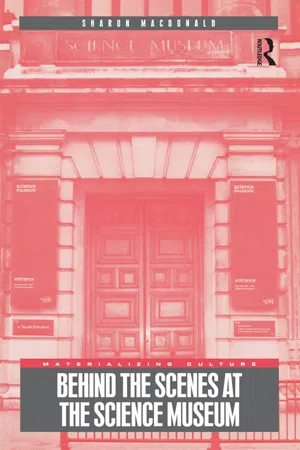
Behind the Scenes at the Science Museum
About this book
What goes on behind closed doors at museums? How are decisions about exhibitions made and who, or what, really makes them? Why are certain objects and styles of display chosen whilst others are rejected, and what factors influence how museum exhibitions are produced and experienced? This book answers these searching questions by giving a privileged look behind the scenes at the Science Museum in London. By tracking the history of a particular exhibition, Macdonald takes the reader into the world of the museum curator and shows in vivid detail how exhibitions are created and how public culture is produced. She reveals why exhibitions do not always reflect their makers original intentions and why visitors take home particular interpretations. Beyond this local context, however, the book also provides broad and far-reaching insights into how national and global political shifts influence the creation of public knowledge through exhibitions.
Information
one
Admission: Going In
The aim of carrying out ethnographic research in the Science Museum was to study the construction of science in museum exhibitions, exploring the agendas and assumptions involved in creating science for the public. On 3 October 1988, the day that I began fieldwork, admission charges were introduced at the Science Museum. This was one of the first national museums in Britain to initiate what was later to become a much more widespread practice of charging for admission, a practice which was, and continues to be, highly controversial.1 There were pickets and media reporters at the main entrance to the Museum and many (though not all) of the Museum staff were wearing ‘Stop Charges at the Science Museum!’ stickers.2
Although I had read about debates over the possible ‘commodification’ or ‘Disneyization’ of museums, and had read articles about charging which had appeared in the press in the preceding months, I had not fully appreciated the passion that the introduction of charging would generate, the national and historical significance with which it would be imbued, or the many other changes in museums – and national culture more broadly – with which it would be associated. Neither had I anticipated the degree of contention which it, and its associated changes, would arouse within the Museum itself. This seemed to be an important moment in the history of public culture, one which was bound up with more widespread shifts in the relationships between national institutions and their publics and the government. Debates, many of which had been long simmering, were thrown into particularly sharp relief: debates over public accountability, consumerism, the role of national cultural institutions, knowledge, authority and authorship. To be permitted to do fieldwork in an institution so much engaged with these dilemmas, and whose actions were seen as so symbolically significant, was a great privilege. It was exciting, absorbing, demanding and, sometimes, a political nightmare.
At the time, although fascinating and ethnographically irresistible, the debates over museums and their changes sometimes felt like a distraction from the main stated aim of the ethnographic research – to investigate the construction of science for the public. Like other researchers working on ‘the public understanding of science’, I sometimes worried that ‘science’ was disappearing from the study.3 However, as I was to find, these debates and changes in the Science Museum were thoroughly enmeshed with (though not simply determinative of) the ways in which ‘science’ was imagined into public display.
On day one of fieldwork, a delay on the Circle Line (something with which I was to become all too familiar) had made me late for a meeting with Mr Suthers, the head of the Museum’s newly created Division of Public Services. So, instead of rushing to join the commotion at the Museum’s main entrance, I followed the instructions that Mr Suthers had given me by phone the previous week and slipped into the Post Office next door where there was an entrance leading to some of the Museum offices. The warder checked that the divisional head was still available to see me and I was given directions – up what felt like ‘secret’ staircases behind the scenes of the Museum – to his office. Mr Suthers, a bearded and very amiable Yorkshireman, was not wearing a ‘Stop charges at the Science Museum!’ sticker. He was dressed smartly and arose to shake my hand. As I apologised for my lateness and sat down, my eyes fell upon the capacious glass bowl of fruit and bottles of Perrier on his wide and tidy desk. ‘Very healthy,’ I remarked. He grinned: ‘Well, we like to try to give the right impression.’
As Head of Public Services, Mr Suthers was responsible for those aspects of the Museum which were defined as dealing with ‘the public’. Its tasks, which ranged from educational services and mounting exhibitions to managing the restaurants and toilets, could to some extent be defined as ‘impression management’.4 Public Services was concerned with managing and maintaining the Museum’s ‘front stage’. The Museum’s other main division, ‘Collections Management’, dealt, as its name implies, with the Museum’s collections of artefacts. It was focused on work which for the public was mostly ‘back-stage’: the acquisition, conservation, restoration, storage, researching and cataloguing of artefacts. To have named these sections of Museum organisation ‘divisions’ was highly appropriate, for, as I was to learn, the division between ‘the objects’ and ‘the visitors’ was one which ran through much of Museum discourse. Objects and visitors made different demands – demands which could not always be easily reconciled.
Mr Suthers explained the role of Public Services and outlined the recent managerial restructuring in the Museum for me. At the time I could not really grasp quite what had been collapsed into what, or appreciate its significance. ‘Don’t worry’, he told me, ‘You’ll hear plenty more about it and you’ll soon get the hang of it.’ He was right. The restructuring was a recurrent topic of conversation in the Museum and usually one of the first things, especially in my early days, that Museum staff explained to me. It was regarded as crucial for understanding other things going on in the Museum, and, indeed, what was happening in ‘the museum world’ more generally. In particular, it was regarded as crucial for understanding exhibitions, the making of which was to be the focus of my study.
On my first day in the Museum I also met several other curators, most of whom seemed to walk and talk very fast, to joke a lot, to work in offices piled high with books, papers, intriguing-looking objects and coffee cups, and to be full of ideas and of a sense of ‘living in interesting times’ (as one put it). There was lots of talk of ‘the Director’, of ‘before’ and ‘after’, of ‘the old guard’, of the ‘public understanding of science’. One curator told me that I would ‘end up with a model of factional warfare’, another that ‘curators are stubborn buggers – the most opinionated people that you could ever meet – we are all convinced that we are right’, and Mr Suthers described his job as ‘90 per cent firefighting’. This was a world behind the scenes that I had not quite expected. It seemed almost like the world of David Mamet’s play, The Museum of Science and Industry Story (1988), in which Chicago’s Museum of Science and Industry comes alive at night with skirmishing groups – railroad workers living in the transport exhibits, miners in a display of coal mining, ‘Potowatamies’ in an area devoted to ‘primitive technologies’ – seeking to stake out and protect their own territories and interests while commenting ironically on the museum’s subject matter and its role. My task was to enter the behind-the-scenes world of the Science Museum, to find out how it works, what kinds of passions and ideas motivate practice, and whether and how this percolates into the science that is put on public display.
Framing and Following
This research was part of a broader programme of research on the ‘public understanding of science’, research which sought to investigate understandings of science in diverse public settings.5 Studying the makers and consumers of a science exhibition was a means of following the processes involved in ‘translating’ expert scientific knowledge into knowledge for a lay public. One of the particular interests of the research was to consider how the specific demands of museum exhibition would shape what was presented to the public and also what visitors would make of it. In an earlier study of the making of a science television programme, Roger Silverstone (who devised the Science Museum research) had shown how televisual demands (such as, the need for a good story and dramatic pictures) ‘framed’ and shaped the representation of science.6 What kinds of demands would a three-dimensional exhibition, a representation which would remain in place for a decade or more, make on the representation and understanding of science? By observing the day-to-day activities and negotiations involved in producing an exhibition, the hope was that such demands would become evident – as indeed they did.
As I have already noted, and as will be described more fully in the chapters which follow, the museum study also spread beyond these concerns with the nature of the medium to consider the nature of the broader cultural ‘moment’. Given that the changes under way within the Science Museum were of such pervasive local concern, given that the exhibition whose making I was following in detail was explicitly framed in terms of such changes, and given the echoes that I heard at so many museum conferences and other museums that I visited, this I felt to be inevitable. What this means for the account which follows is that this is a story about a particular time as well as a particular place. This specificity is important. It is important not only because specificity matters but also because it throws some of the more long-standing features and ambivalences of museum ambition and practice into relief. Like the ‘social dramas’ of which Victor Turner has written, this ‘time-place’ seems to me to be worth speaking from, in order to speak of and to broader political-cultural concerns.7
Edging beyond original research aims and reformulating some of the models initially used is often a consequence of ethnographic research as the ethnographer struggles to make sense of local priorities and ways of seeing. As well as spreading wider, this ethnography also shows that the ‘communication model’ with which the research began – a model in which science was taken from the world of science and translated by the museum into something to be ‘responded to’ by the public – is far too neat in practice. By participant-observing messy actuality, it becomes clear that scientists sometimes intervene later than this model would imply and visitors earlier. Moreover, the process itself, while in some respects a matter of translation, is more multi-faceted and did not straightforwardly ‘begin’ – or indeed ‘end’ – with ‘the science’. Neither, indeed, are ‘science’, ‘scientists’, ‘the public’ or ‘museum staff’ necessarily homogeneous groups or categories. Carrying out ethnography highlights some of the important differences within each of these – differences which have significant consequences for the kinds of displays, and forms of knowledge, constructed.
Following the local players and trying to understand their concerns and their ways of seeing and doing, was, then, a principal and in many ways traditional aim of this ethnography. While ethnographic research often has the useful capacity to redefine itself and move beyond its original remit, it does nevertheless inevitably begin somewhere and with particular players. Most often these are human players. An important strand of social research on science and technology, which has come to be called actor network theory, has, however, argued that we should not accord agency only to humans.8 Instead, we should recognise that non-humans (particular technologies or objects for example) may also be actors and exercise agency. While this perspective sometimes seems to me to pay too little attention to language and classification, taking into account the actions of the non-human as well as the human does more empirical justice to the case here than would considering only human actions. Moreover, one of the problems that an ethnographer working in a relatively ‘unexotic’ setting may face is how to defamiliarise the familiar.9 Trying to overcome my own original presuppositions about agency, and the discreteness of the social and the technical, was a useful defamiliarising strategy which helped me to see, or frame, things in new ways. In the story below, my own beginning point was ‘the exhibition’ – an exhibition about food which came to be called ‘Food for Thought. The Sainsbury Gallery’. In terms of primary actors, this led me to pay particular day-to-day attention to a group of Museum staff charged with the task of creating the exhibition; but beyond this I attempted to follow a myriad of different kinds of actors who came to be involved as the exhibition was negotiated into being.10
Writing in and Reading off
As Handler and Gable point out in their superb study of Colonial Williamsburg, ‘most research on museums has proceeded by ignoring much of what happens in them.’11 Instead, it is generally based on the finished exhibition, with a tendency to assume that researcher interpretations somehow map onto meanings ‘written in’ by the culture producers. Moreover, just who (or what) is ‘the culture producer’ is also rather unproblematically assigned. Sometimes it is the particular individuals who have been directly involved who are so assigned, at others it is institutions in general, ‘the state’, ‘dominant ideology’ or ‘corporate capitalism’ (with these sometimes being elided with one another). What an ethnography, especially one coupled with historical and political-economic analysis, can provide is a fuller account of the nature and complexities of production: of the disjunctions, disagreements and ‘surprise outcomes’ involved in cultural production. It can highlight what did not survive into finished form as well as what did, and also some of the reasons for particular angles or gaps. As the ethnography here shows, agency and authorship – the social allocation of agency – are contested and negotiated in ways which have consequences for the nature of the cultural product and for some of the ways in which it will be interpreted.
In chapter four I set out in more detail an ‘authorial puzzle’ which constitutes a main plot of this book. In brief, this was the fact that the food exhibition turned out differently in some significant respects from the Museum exhibition team’s expectations. For the exhibition team, it was an opportunity to create a democratising, empowering exhibition. Yet, the final product also came to be interpreted as a representation of a rather less than democratising free-market enterprise culture in which the public is expected to make choices but denied some of the means to make them. How an exhibition can end up different from original intentions in politically significant respects is one of the stories that this ethnography tells. It shows us that the process which is sometimes called ‘encoding’ in cultural studies can be just as multi-faceted and disjunctive with cultural texts as ‘decoding’ by audiences.12
As we shall see below, exhibition team members themselves give accounts for the disparity between their original aims and the finished exhibition. My account differs from these, however. This is not because their accounts are dishonest (though given the importance of impression management in an institution like the Science Museum it is likely that any account will be carefully constructed). Rather, it is because events are understood, described and even perceived according to particular conventions and circumstances. The ethnographer tries to understand these and also to draw attention to assumptions and details that participants may have taken for granted or not noticed.13
My account here has also benefited from being able to move backwards and forwards across time to use insights derived from visitors to revisit the material on exhibitionary production and vice-versa. I should also note that, while I am critical of analyses of cultural products which simply ‘read off’ production and intention (or, indeed, consumption) from ‘texts’, I also think that theoretically-informed critical readings of cultural products are a valid and often insightful contribution to understanding. Such analyses seek to explore the possible significations of specific representations through an understanding of broader cultural practices of meaning construction.14 Sometimes, in discussion in the Museum and at museum conferences, I have heard comments to the effect that such analyses are redundant and that all that matters is ‘what the visitors think’. While I agree that it is important to research visitors (chapter eight discusses this in detail), this is ideally coupled with consideration of more critically-informed accounts. The task of any audience resea...
Table of contents
- Cover
- Half Title
- Series Page
- Title Page
- Copyright Page
- Dedication Page
- Contents
- List of Figures
- Thanks and Credits
- Taster
- 1 Admission: Going In
- 2 Cultural Revolution in South Kensington
- 3 A New Vision for the 21st Century: Rewriting the Museum
- 4 A ‘Hot Potato’ for a New Public: A ‘Flagship’ Exhibition on Food
- 5 ‘Reality Sets In’: Managing and Materialising Dreams (and Negotiating Nightmares)
- 6 Virtual Consumers and Supermarket Science
- 7 Opening and Aftermath: Ritual, Reviews and Reflection
- 8 The Active Audience and the Politics of Appropriation
- 9 Behind and Beyond the Scenes
- Appendix
- Bibliography
- Index
Trusted by 375,005 students
Access to over 1.5 million titles for a fair monthly price.
Study more efficiently using our study tools.
Frequently asked questions
Yes, you can cancel anytime from the Subscription tab in your account settings on the Perlego website. Your subscription will stay active until the end of your current billing period. Learn how to cancel your subscription
No, books cannot be downloaded as external files, such as PDFs, for use outside of Perlego. However, you can download books within the Perlego app for offline reading on mobile or tablet. Learn how to download books offline
Perlego offers two plans: Essential and Complete
- Essential is ideal for learners and professionals who enjoy exploring a wide range of subjects. Access the Essential Library with 800,000+ trusted titles and best-sellers across business, personal growth, and the humanities. Includes unlimited reading time and Standard Read Aloud voice.
- Complete: Perfect for advanced learners and researchers needing full, unrestricted access. Unlock 1.5M+ books across hundreds of subjects, including academic and specialized titles. The Complete Plan also includes advanced features like Premium Read Aloud and Research Assistant.
We are an online textbook subscription service, where you can get access to an entire online library for less than the price of a single book per month. With over 1.5 million books across 990+ topics, we’ve got you covered! Learn about our mission
Look out for the read-aloud symbol on your next book to see if you can listen to it. The read-aloud tool reads text aloud for you, highlighting the text as it is being read. You can pause it, speed it up and slow it down. Learn more about Read Aloud
Yes! You can use the Perlego app on both iOS and Android devices to read anytime, anywhere — even offline. Perfect for commutes or when you’re on the go.
Please note we cannot support devices running on iOS 13 and Android 7 or earlier. Learn more about using the app
Please note we cannot support devices running on iOS 13 and Android 7 or earlier. Learn more about using the app
Yes, you can access Behind the Scenes at the Science Museum by Sharon Macdonald in PDF and/or ePUB format, as well as other popular books in Social Sciences & Education Theory & Practice. We have over 1.5 million books available in our catalogue for you to explore.