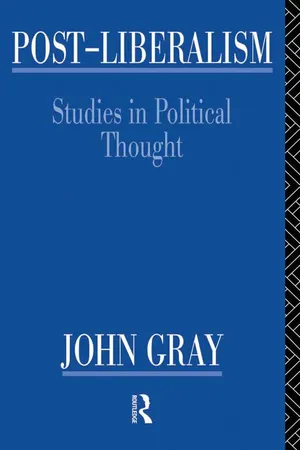
John Gray has become one of our liveliest and most influential political philosophers. This current volume is a sequel to his Liberalisms: Essays in Political Philosophy. The earlier book ended on a sceptical note, both in respect of what a post-liberal political philosophy might look like, and with respect to the claims of political philosophy itself.
John Gray's new book gives post-liberal theory a more definite content. It does so by considering particular thinkers in the history of political thought, by criticizing the conventional wisdom, liberal and socialist, of the Western academic class, and most directly by specifying what remains of value in liberalism. The upshot of this line of thought is that we need not regret the failure of foundationalist liberalism, since we have all we need in the historic inheritance of the institutions of civil society. It is to the practice of liberty that these institutions encompass, rather than to empty liberal theory, that we should repair.
- 368 pages
- English
- ePUB (mobile friendly)
- Available on iOS & Android
eBook - ePub
About this book
Information
Part IThinkers
1 Hobbes and the modern state
DOI: 10.4324/9781315004648-1
Thomas Hobbes lived in, and wrote for, an age of civil and religious wars. For this reason, it may seem that we have little to learn from him today that we do not already know. To be sure, anyone who reflects upon the intractable religious conflicts of Northern Ireland or the Middle East will see that wars of religion are as much an evil of our age as they were of Hobbes’s, and civil peace as precious a good. Beyond these commonplace reflections, it would appear that Hobbes has indeed little to teach us. His entire system of thought, conceived and developed at a time when the scientific revolution was barely under way, may have the aspect of an anachronism, of an intellectual construct whose terms and postulates are so far removed from our own that we are hard put to make sense of it, and cannot put it to work to illuminate the dilemmas that confront us today. On this conventional view, we may read Hobbes’s writings as literature (for he is one of the greatest prose stylists in English) or as history, but we will not turn to them for instruction or enlightenment.
Much as might be said in support of this conventional opinion, it is radically misguided. It is true that Hobbes’s system of ideas encompasses extravagances we find hard to credit, and that his entire mode of thought has an archaic character, recalling medieval ways of reasoning more than the methods of modern science by which he supposed his theorizing was governed. Yet there is an arresting contemporaneity about many of Hobbes’s insights that we can well profit from. Nor is this relevance to our age a matter of surprise, for Hobbes wrote at the start of the modern age (he was born in 1588 and died in 1679), and few have seen further to the bottom of the dilemma of modernity than he. By comparison or contrast with Hobbes, John Locke is truly a remote thinker, Kant hollow and Burke not much more than a nostalgist. Far from being an anachronistic irrelevance, Hobbes’s thought is supremely relevant to us, who live at the end of the modern era whose ills he sought to diagnose. With all of its limitations and its excesses, Hobbes’s thought goes far to account for the maladies of the modern state, and does so in ways that are as surprising and paradoxical as they are instructive. The lesson of Hobbesian theory for us is that the modern state is weak because it aims too high and has grown too large. Worse, the modern state has failed in its task of delivering us from a condition of universal predation or war of all against all into the peace of civil society. Modern democratic states have themselves become weapons in the war of all against all, as rival interest groups compete with each other to capture government and use it to seize and redistribute resources among themselves. In its weakness the modern state has recreated in a political form that very state of nature from which it is the task of the state to deliver us. In this political state of nature, modern democratic states are riven by a legal and political war of all against all, and the institutions of civil society are progressively enfeebled. And the conflicts which rack the modern state are not merely economic in origin. All modern democracies, but especially the United States, have transformed the state into an arena of doctrinal conflicts, wherein under the banners of fundamental rights or social justice contending political movements vie for supremacy. Worst of all, the totalitarian states of the Communist world have created a monstrosity that even Hobbes (for all his vaunted, and genuine, pessimism) could not have envisaged – a political order in which the state of nature and a lawless Leviathan are inextricably intertwined. Distracted from its true purposes by the political religions of our time, Communism and liberalism, the modern state has become a burden on civil society, sometimes (as in Communist regimes) a burden that is too heavy to bear. Even in the Western democracies, it has become more of an enemy of civil society than its guardian. We have been delivered from the lawless chaos of society without the state into an anarchic servility of unlimited government.
That modern governments are weak because they do too much and claim authority they do not have, and so are at the furthest remove from Hobbesian states, is a paradox, but like every genuine paradox it is a truth expressed in the form of an apparent contradiction. We can discern the reasons for this truth, and the outlines of an Hobbesian critique of the modern democratic state, if we look again, with fresh eyes, at Hobbes’s chief doctrines about man, society and government. Consider first Hobbes’s conception of human nature. What is most distinctive in it is its departure from the classical conception of man, most notably theorized by Aristotle and given a Christian rendition by Aquinas. In the classical conception, man is like everything else in the world in having a natural end, telos or perfection, which it is his vocation to realize. By comparison with Hobbes’s view, the content of this perfection – a life of contemplation in Aristotle and salvation in Aquinas – is less important than its affirmation. In Hobbes’s view, mankind has no supreme good which it is called to achieve, no summum bonum, but only a summum malum, a supreme evil, which we aim to elude. A good life for a human being consists, not in possessing any final or supreme good, but simply in satisfying our restless desires as they spring up. Hobbes tells us that
Continual success in obtaining those things which a man from time to time desireth, that is to say, continual prospering, is what men call Felicity; I mean the Felicity of this life, for there is no such thing as perpetual tranquility of mind, while we live here; because Life itself is but Motion, and can never be without Desire, nor without Feare, no more than without Sense. 1
For Hobbes, as his most distinguished twentieth-century interpreter, Michael Oakeshott, has put it, human fulfilment is to be found,
not in pleasure – those who see in Hobbes a hedonist are sadly wide of the mark – but in Felicity, a transitory perfection, having no finality and offering no repose. 2
As Hobbes puts this view emphatically:
the Felicity of this life, consisteth not in the repose of a mind satisfied. For there is no such finis ultimus (utmost aim) nor summum bonum (greatest good) as is spoken of in the Books of the old Moral Philosophers.…Felicity is a continual progress of the desire, from one object to another; the attaining of the former, being still but the way to the later. The cause whereof is, that the object of man’s desire is not to enjoy once only, and for one instant of time; but to assure forever, the way of his future desire. 3
For Hobbes, then, the human good is life in movement, which is pursuit of one’s passing desires. For human beings, it follows, the greatest evil can only be immobility, or death, since that is the cessation of all movement and all desire. It is indeed Hobbes’s view that men avoid death, and above all a violent and painful death, before all else. Just as Epicurus had seen in the absence of pain rather than in pleasure the good for men, so Hobbes gave the avoidance of death and not life itself as the pre-eminent human end. What do these claims imply for man in society? They suggest an incessant competition for the means whereby death can be avoided, or delayed. Human life, Hobbes avers, can be compared to a race – a race which has no other ‘goal’ or ‘garland’ than ‘being foremost’.
In it to endeavor is appetite; to be remiss is sensuality; to consider them behind is glory; to consider them before is humility … to fall on the sudden is the disposition to weep; to see one outgone when we would not is pity; to see one outgo when we would not is indignation; to hold fast by another is love; to carry him on that so holdeth is charity; to hurt oneself for haste is shame …continually to be outgone is misery; continually to outgo the next before is felicity; and to forsake the course is to die. 4
The consequence of this competition, as well as its primary cause, is
a general inclination of all mankind, a perpetual and restless desire of power after power, that ceaseth only in Death. And the cause of this, is not always that a man hopes for a more intensive delight, than he has already attained to; or that he cannot be content with a moderate power: but because he cannot assure the power and means to live well, which he hath present, without the acquisition of more. 5
Hobbes’s master thesis is that, in the absence of a sovereign power which binds them to peace, men’s natural condition is a condition of conflict or war. As he famously sums up his chain of reasoning:
Whatsoever is consequent to a time of Warre, where every man is Enemy to every man; the same is consequent to the time, wherein men live without other security, than what their own strength, and their own invention shall furnish them withall. In such conditions, there is no place for Industry; because the fruit thereof is uncertain; and consequently no culture of the earth, no navigation, nor use of the commodities that may be imported by Sea; no commodious building; no instruments of moving, and removing such things as require much force; no knowledge of the face of the Earth; no account of time; no Arts; no Letters; no Society; and which is worst of all, continual fear, and danger of violent death. And the life of man, solitary, poor, nasty, brutish and short. 6
No less famous than this passage is Hobbes’s conclusion: human beings can be delivered from their natural condition of war, only by the creation of ‘an artificial man’, a sovereign authority which is empowered to do all that is necessary to bring into being, and keep, a civil peace. This sovereign must be unlimited in his powers of action, and must be a unitary authority, since otherwise dispute will be engendered as to the limits of the sovereign’s authority, and peace will be put in jeopardy. The Hobbesian political remedy for the natural misery of mankind is then a state whose authority is unlimited, save by its task of keeping the peace. More, Hobbes believed that his analysis would find support among men, who would be driven by prudence and experience of the fearful consequences of weak or divided government to enter into a covenant which instituted Leviathan, the Hobbesian state.
What is to be said of Hobbes’s argument? The overwhelming preponderance of critical opinion goes against his analysis at almost every point. Hobbes has remained what he was for his contemporaries, a scandal and a scapegoat for the false consciousness of his critics. As Oakeshott delightfully observes,
Against Hobbes, Filmer defended servitude, Harrington liberty, Clarendon the Church, Locke the Englishman, Rousseau mankind and Butler the Deity. 7
Much, if not most in the traditional criticisms of Hobbes’s doctrine represents it crudely, and so goes astray. It is said, truly enough, that human behaviour is not governed predominantly by the imperative of death-avoidance. If it were, how could we explain the heroic resistance of the Afghans against Soviet conquest in our own day, and many another similar instance in history? It is suggested that Hobbes held to another falsehood about human nature, the theory of psychological egoism, according to which whatever any man does he does at the behest of his own interests. And it has even been alleged that the model of a Hobbesian state is a totalitarian government, from which civil society and autonomous institutions have been extirpated. Despite occasional inadvertencies in Hobbes’s writings, all of these charges are wide of the mark. As a recent commentator 8 has shown beyond reasonable doubt, Hobbes held not that all human conduct was motivated by self-interest, but only that self-interest was a powerful human passion, and sheer concern for others, especially those who are not near to us in our affections, is rare and politically insignificant. More precisely, it is the interest in self-preservation that Hobbes supposes to be decisive in human conduct – and, most precisely, the interest in avoiding a violent death at the hands of other men. This last point is not clear in Hobbes’s literary masterpiece, Leviathan, where it is death itself that is specified as the supreme human evil, but it is explicit in his De Homine, where Hobbes observes:
the greatest of goods for each is his own preservation. For nature is so arranged that all desire good for themselves.… On the other hand, though death is the greatest of all evils (especially when accompanied by torture), the pains of life can be so great that, unless their quick end is forseen, they may lead men to number death among the goods. 9
Hobbes’s is not, then, the mechanistic theory in which an egoistic account of human nature is conjoined with the claim that merely avoiding death is the passion which most decisively governs men. Nevertheless, Hobbes is certainly open to criticism for his neglect of the moral and political importance of collective identification – the pervasive human phenomenon in virtue of which personal identities are constituted by membership in some nation, religion, tribe or other collectivity. The fact is that the man who conceives himself as a solitary individual, whose identity is unencumbered by any collective identification, though he is real, is vanishingly rare. As the novelist and aphorist, Elias Canetti, author of a fascinating study in Hobbesian political psychology, Crowds and Power, has said of Hobbes:
He explains everything through selfishness, and while knowing the crowd (he often mentions it), he really has nothing to say about it. My task, however, is to show how complex selfishness is: to show how what it controls does not belong to it, it comes from other areas of human nature, the ones to which Hobbes is blind. 10
Hume had rightly criticized Hobbes for his radical individualist picture of human beings as solitaries, who contract as much into society as into government. Such a picture must be a distortion, he urged, since we are born into families, which are social institutions, and come to consciousness speaking a language, which presupposes that we have a common life and a shared history. Anticipating the twentieth-century arguments of Ludwig Wittgenstein for the impossibility of a private language, 11 Hume pointed out that our ability to contract into government presupposes that we already have the practice of promising. Hume’s point against Hobbes is that we are social beings au fond. Canetti’s is the subtler one that our identities as persons are not natural but artifactual and are formed in a matrix of collective identifications (of which the crowd is perhaps the crudest). Because we derive our self-conception from membership in common forms of life, self-interest cannot be a primordial motivation in our lives in even the qualified way we have seen Hobbes make it so. The extravagant individualism of Hobbesian psychological theory, which flies in the face of much in experience and historical knowledge, comes in part from the method he sought to adopt in political theorizing, which aimed to be rigidly deductive. As he avows in De Homine,
politics and ethics (that is, the sciences of just and unjust, of equity and inequity) can be demonstrated apriori; because we ourselves make the principles – that is, the causes of justice (namely laws and covenants) whereby it is known what justice and equity, and their opposites injustice and inequity, are. For before covenants and laws were drawn up, neither justice nor injustice, neither public good nor public evil, was natural among men any more than it was among beasts. 12
Hobbes, like many another rationalist after him, here neglects the origins in natural social relationships of the moral and legal norms that sustain and constitute the state. He neglects, in other words, the natural roots of the artificial virtues, whose relations with each other are theorized so well by Hume. Like subsequent rationalists, such as his near-contemporary Spinoza, Hobbes’s project was a sort of moral geometry, whereby moral theory (if not moral life) could be purged of all that was merely contingent, historical local and ephemeral. His adoption of the geometrical method encouraged him to ignore, when he did not altogether deny, the historicity of the various forms of moral and political life – a truth about them whose implications for philosophy were not elaborated upon until Hegel developed them (though they are prefigured in the work of Vico 13 ).
Even though traditional criticism of Hobbes is misplaced, it is true that his thought is disabled by a rationalism which obscures the social and historical character of the phenomena which are the subjects of his investigations. It is far from being the case, however, that Hobbes’s rationalism – which he may have derived from Descartes, and which is in sharp contrast with the empiricism of the nascent scientific revolution of the seventeenth century – leads him to a conception of government that anticipates twentieth-century totalitarianism. As Oakeshott has again put it,
It may be said … that Hobbes is not an absolutist precisely because he is an authoritarian. His scepticism about the power of reasoning, which applied no less to the ‘artificial reason’ of the Sovereign than to the reasoning of the natural man, together with the rest of his individualism, separate him from the rationalist dictators of his or any age. Indeed … Hobbes, without being himself a liberal, had in him more of the philosophy of liberalism than most of its professed defenders. 14
Oakeshott’s observations are much to the point here. Hobbes was not a proto-totalitarian just because the task of the state was for him the limited, but crucial one of securing the peace of civil society. Though he denies that subjects possess fundamental rights to liberty of conscience (or to anything else, apart from self-preservation), Hobbes is insistent that the control of belief by the promotion of an orthodoxy is no part of the duty of a sovereign, and may well run counter to his only duty of keeping the civil peace. The sovereign cannot in any case (and here Hobbes is at one with Spinoza) control belief, since belief is not a matter of will. The sovereign ought not (because it is beyond the purposes of government) to interfere with opinion or expression, except in so far as it may threaten peace. Nothing could be further from Hobbes’s intention (or more remote from anything he could have imagined) than the thought-police of twentieth-century totalitarian states, with their vast propaganda machines and interminable investigations into the ideological probity of their hapless subjects.
The paradox of the Hobbesian state is that, whereas its authority is unlimited, its duty is minimal – the maintenance of civil peace. Civil peace here comprehends more than merely the absence of civil war – it encompasses that framework of civil institutions whereby men may coexist in peace with one another, notwithstanding the diversity of their beliefs and enterprises and the scarcity of ...
Table of contents
- Cover Page
- Half Title Page
- Title Page
- Copyright Page
- Table of Contents
- Preface
- Acknowledgements
- Part I Thinkers
- Part II Critiques
- Part III Questions
- Notes
- Index
Trusted by 375,005 students
Access to over 1.5 million titles for a fair monthly price.
Study more efficiently using our study tools.
Frequently asked questions
Yes, you can cancel anytime from the Subscription tab in your account settings on the Perlego website. Your subscription will stay active until the end of your current billing period. Learn how to cancel your subscription
No, books cannot be downloaded as external files, such as PDFs, for use outside of Perlego. However, you can download books within the Perlego app for offline reading on mobile or tablet. Learn how to download books offline
Perlego offers two plans: Essential and Complete
- Essential is ideal for learners and professionals who enjoy exploring a wide range of subjects. Access the Essential Library with 800,000+ trusted titles and best-sellers across business, personal growth, and the humanities. Includes unlimited reading time and Standard Read Aloud voice.
- Complete: Perfect for advanced learners and researchers needing full, unrestricted access. Unlock 1.5M+ books across hundreds of subjects, including academic and specialized titles. The Complete Plan also includes advanced features like Premium Read Aloud and Research Assistant.
We are an online textbook subscription service, where you can get access to an entire online library for less than the price of a single book per month. With over 1.5 million books across 990+ topics, we’ve got you covered! Learn about our mission
Look out for the read-aloud symbol on your next book to see if you can listen to it. The read-aloud tool reads text aloud for you, highlighting the text as it is being read. You can pause it, speed it up and slow it down. Learn more about Read Aloud
Yes! You can use the Perlego app on both iOS and Android devices to read anytime, anywhere — even offline. Perfect for commutes or when you’re on the go.
Please note we cannot support devices running on iOS 13 and Android 7 or earlier. Learn more about using the app
Please note we cannot support devices running on iOS 13 and Android 7 or earlier. Learn more about using the app
Yes, you can access Post-Liberalism by John Gray in PDF and/or ePUB format, as well as other popular books in Politics & International Relations & Politics. We have over 1.5 million books available in our catalogue for you to explore.