The Sexual Subject brings together writing on sexuality which has appeared in ^Screen> over the past two decades. It reflects the journal's continuing engagement with questions of sexuality and signification in the cinema, an engagement which has had a profound influence on the development of the academic study of film and on alternative film and video practice.
The collection opens with Laura Mulvey's classic "Visual Pleasure and Narrative Cinema" with its conjunction of semiotics and psychoanalysis, the critical approach which is most closely associated with Screen's rise to international prominence. The reader then goes on to explore the particular questions and debates which that conjuction provoked: arguments around pornography and the represenation of the body: questions of the representation of femininity and masculinity, of the female spectator, and of the social subject.
Many of the writings in this Reader have become indispensable texts within the study of film. The purpose of the Reader is not only to make the articles available to a wider readership, and to a new generation, but also to pose new conjunctions, making connections in one volume between debates and inquiries which spanned two crucial decades of film theory.
The Sexual Subject is intended not only for all those with a particular interest in film and film theory, but for anyone with a serious commitment to cultural theory, theories of representation, and questions of sexuality and gender.
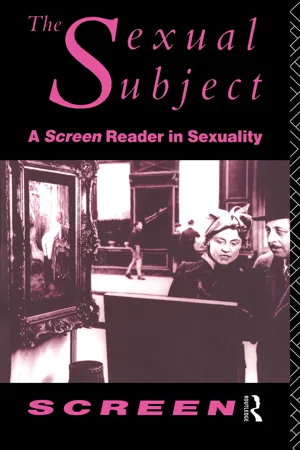
- 352 pages
- English
- ePUB (mobile friendly)
- Available on iOS & Android
eBook - ePub
About this book
Information
Part I
Psychoanalysis and Subjectivity
Introduction
Looking back over the debates of the 1970s, it might appear as if the new developments in film theory, often referred to as poststructuralist, were relatively straightforward. A closer study of the period, however, reveals important differences and numerous shifts of direction. One of the most crucial was the introduction of psychoanalytic theory – specifically Jacques Lacan’s theories of subjectivity, which developed from his rereading of Freud. In general terms this shift could be seen as moving from studies of the film text as autonomous and discrete to studies which concentrated on the text-reader relationship. The former approach, based on the disciplines of structuralism and semiotics, argued that meaning resides in the text, whereas the latter argued that meaning is constructed in the act of reading. This new development, which increasingly came to dominate film studies, explored the text-reader relationship through a number of related areas: point-of-view, classic realism, the Althusserian view of ideology. One of the most important of these areas, psychoanalysis, gave rise to a number of interesting theories designed to help explain the relationship between text and reader. These included: suture, notions of identification, the male gaze.
Lacanian psychoanalysis, particularly its theory that the subject is constituted in lack and separation in relation to the Symbolic order, exerted a profound influence on ideas about subjectivity and the text-spectator relationship. Gradually, however, psychoanalytic approaches to subjectivity and film viewing came under increasing attack. First, critics argued that the notion of the viewing subject that emerges is ultimately nothing more than a generalized abstraction. The Lacanian theory of the subject ignores important factors such as the individual’s own history as well as factors such as class, race and age. The final part of this book, ‘The Social Subject’, contains articles which address this issue. Defenders of the psychoanalytic approach argue that it does make sense to talk of an abstract notion of the subject outside of these empirical realities, in that the text does position the viewing subject in certain ways through the workings of its more formal mechanisms such as suture and the voyeuristic gaze. This does not mean that the viewing subject is or should be reduced to a passive object of the text’s formal operations; the viewing subject also contributes to the way in which meaning is constructed. If we ignore the formal operations of the text in the construction of meaning, we are left with the argument that the spectator is free to construct any meaning she or he wishes.
On the one hand, the psychoanalytic approach seeks to construct a meaning which is true for all viewers while, on the other hand, the sociocultural approach posits an infinite number of possible meanings. To avoid the abstraction of the former and the extreme pluralism of the latter one needs to explore ways in which the two approaches interact. A second major criticism of the Lacanian theory of subjectivity is that, because of a confusion which arises over the distinction between phallus and penis, it posits man as fullness and woman as lack in relation to the Symbolic order. It is this debate which is central to the chapters contained in this part.
Laura Mulvey’s ‘Visual Pleasure and Narrative Cinema’, first published in Screen in 1975, has probably generated more debate, both in the pages of Screen and elsewhere, than any other single article in the history of contemporary film theory. Drawing on Freudian and Lacanian theory from a feminist perspective, Mulvey set out the parameters of what was to become an ongoing debate about the nature of the screen-spectator relationship, with particular emphasis on the filmic constructions of femininity and masculinity as conceived within a phallocentric discourse. Her article has variously been supported, extended, debated, opposed and applauded. Regardless of the stand different theorists have taken towards her theory of spectatorship, probably all would agree that it had a revolutionary impact on existing film theory debates. Almost all of the articles in this collection refer at some point to Mulvey’s argument.
Mulvey argues that popular narrative film is primarily addressed to the male protagonist in the diegesis and by extension to the male spectator in the audience. She holds that in narrative film woman is represented as the passive object of the active male gaze. On the one hand woman as icon plays to male desire but on the other hand her image threatens to awaken man’s unconscious castration anxieties. The male unconscious can escape the threat of castration through one of two avenues: voyeurism or fetishistic scopophilia. Mulvey’s argument that woman functions as image and man as bearer of the look appeared to make immediate sense of the way sexual difference was represented in mainstream cinema, specifically the way it reflected the values of ‘a world ordered by sexual imbalance’. Analysing the films of Sternberg and Hitchcock, Mulvey considered various ways in which the figure of woman could signify ‘trouble’ within the classic text.
Unhappy with the binarism of Mulvey’s argument, various critics challenged the fixed positions Mulvey assigned to the representation of masculinity and femininity. They demonstrated that masculinity is not always equated with activity and the controlling gaze, nor is femininity necessarily aligned with passivity: two of these refutations, by Steve Neale and by Richard Dyer, are published in part IV, ‘Images of Men’. Crucial to Mulvey’s argument is the theory of the castration complex which feminist theorists gradually began to question, particularly its alleged universality as well as the position allocated to the female child. Despite the various criticisms, and Mulvey’s own reconsideration of femininity as set out in her article on Duel in the Sun,1 contemporary debates continue to be influenced by the issues raised in her article – the use of psychoanalysis as a radical tool for analysis, the importance of the look to narrative cinema, the mechanisms of voyeurism and fetishism, the workings of desire. Mulvey also argued that film theorists should lay bare the mechanisms by which cinematic pleasure is constructed and that filmmakers should attempt to expose these mechanisms even if that meant destroying pleasure itself.
The Winter 1975 edition of Screen included an article entitled ‘Statement: Psychoanalysis and Film’ in which some members of the editorial board voiced their criticism of the journal’s growing involvement in a psychoanalytic approach to film. They did not oppose the use of psychoanalytic theory altogether; rather they were critical of the way in which it was being used by some contributors to Screen. Their article (chapter 2) sets out a number of reservations: first, that some writers assumed on the basis of dubious evidence that psychoanalysis was a science; second, that the Lacanian version of psychoanalysis being used was notoriously inaccessible; and third, that an interpretive method based on clinical analysis is not necessarily applicable to a film text. These criticisms were also shared by others in the wider film community, and at the time Screen’s growing involvement with psychoanalysis aroused heated debate.
The authors of the ‘statement’ drew attention to the area of the screen-spectator relationship where they believed the use of psychoanalysis had been both ‘substantial and distinctive’ but nevertheless problematic. They argued that many of the psychoanalytic concepts employed, such as the mirror phase, the castration complex, voyeurism and fetishism, were not used consistently. They also voiced concern about the Freudian account of women and the lack of theorization about the female spectator in Mulvey’s article. Interestingly, it is this subject which became central to feminist debates in the 1980s and continues to provide a focus for contemporary debates about the cinema. Two important articles on this subject are included in part III, ‘The Female Spectator’. Although the authors of the ‘statement’ clearly held strong reservations about the use of psychoanalytic theory as it appeared in Screen during the mid-1970s, they were not opposed to its use altogether, but urged that psychoanalytic theory should be approached more critically.
Stephen Heath’s ‘Difference’ (chapter 3) critically examines the representation of sexual difference in psychoanalytic theory, specifically in Jacques Lacan’s 1972–3 seminar, ‘Encore’, which set out to explore Freud’s question, ‘What does woman want?’ Heath writes from a feminist perspective, although he is conscious of the problem that this poses – the problem of his gender: the difficulty ‘for me, for me not a woman’. Heath’s interrogation begins with Lacan’s discussion of Bernini’s famous statue of Saint Teresa. He first examines the nature of Lacan’s address, that is, the kind of audience Lacan has in mind, and concludes that from the beginning Lacan fails to take into account the problem of sexual difference; his discourse therefore reflects the sexist biases of a patriarchal order. Heath’s detailed attention to language, and its enunciation, is characteristic of his approach throughout.
In particular, Heath is critical of what he sees as a tendency towards essentialism in Lacan’s theory of sexual difference – an essentialism which is attached to Lacan’s use of the terms ‘penis’ and ‘phallus’. Although Lacan claims that the phallus is not an object, not the penis, but a signifier only, Heath sees this claim as a ‘pure analogical rationalization’. He is particularly critical of the way in which Freud and Lacan both construct a theory of castration around the dynamics of sight, seeing, the visible. Woman’s sex is unseeable; man’s sex is strikingly visible. It is an appeal to the visible which is used to explain and justify the theory of woman’s imaginary castration. As Heath rightly points out, ‘The vision, any vision, is constructed, not given …’. In Heath’s view, Lacan goes against the approach to psychoanalysis he himself developed, resorting instead to an appeal to the mythical and ‘natural’ in order to explain sexual difference.
Heath also draws attention to the feminist work on the pre-Symbolic or Imaginary period in the subject’s life. It is interesting to note the attention he devotes to this area, particularly as feminist work on the pre-Symbolic and the mother-daughter relationship was to become central to feminist writings of the 1980s. Heath views attempts to link woman to the pre-Symbolic with some concern, not only because of the way in which patriarchal ideology stresses relations between woman, duality and narcissism, but also because of its representation of woman as having a special relationship to the specular, the domain of images, the cinema. There is a fine line, frequently traversed, between arguing that woman is outside the Symbolic because of her essential nature and outside because of the nature of patriarchy.
In his concluding discussion, Heath reiterates his earlier assessment of psychoanalysis. He sees it as ‘an institution of representin’.2 ‘It is not the woman who is not-all but psychoanalysis, which is what the latter has been so generally unwilling to grasp.’3 In Heath’s view, psychoanalysis understands the unstable nature of subjectivity and gender, but continues to produce a theory of sexual difference based on the phallus as the sign of the symbolic construction of sexual difference because the phallus is something which man has and woman lacks. Difference is asserted through the processes of representation – but a ‘difference’ grounded in inequality. In Heath’s view, Lacanian psychoanalytic theory perpetuates male power at the expense of other sexual subjectivities. Not all feminists, however, are happy with the way in which Heath presents his critique. In her witty discussion of Lacan’s seminar, Jane Gallop subjects Heath’s critique of Lacan to a similar critique and finds him wanting.4
Dugald Williamson continues the debate on the usefulness of Lacanian psychoanalytic theory for the cinema in ‘Language and Sexual Difference’ (chapter 4). Like Heath, he is also concerned with the conflation of the penis/phallus in Lacan’s theory: however he tackles the problem from a different perspective. He argues that it is essential for Lacanian theory to refer to the phallus as both signifier and organ if the theory is to make sense. This is because a number of forms of reasoning, or discursive figures, used by Lacan to demonstrate his theory of subject formation and sexual difference are problematic.
Lacan draws on the Saussurean notion of the sign in which linguistic elements are defined in terms of their rule-governed relations. The signifier is not the servant of the signified but has its own principles of organization. This view of language criticizes the idea that the signifier exists only ‘to represent the signified or to serve a meaning that somehow exists outside language in an ideal world of intention or spirit’.5 For Lacan, meaning exists in the chain of the signifier. Language pre-exists the subject who must take up her or his assigned place in society and culture. The subject does not know the pre-existing structure of language, that is, the conditions which make speech possible, as these exist outside consciousness. Williamson argues that in Lacanian theory ‘the structure is defined as an ideal form existing in a dialectical relation to the subject who must realize the potential effects of the structure at the level of experience’. Thus the subject’s personal experience also plays an important role in understanding language. Williamson points out that the structure is seen as an ideal form while an empiricist view of learning is upheld.
Williamson illustrates what he believes is a confusion at the heart of Lacan’s theory of subjectivity and sexual difference with reference to his notion of the phallus. He draws attention to Lacan’s insistence that the phallus is a signifier only; it is the indicator of the Symbolic, not the biological, setting out of sexual difference. Williamson...
Table of contents
- Cover
- Half Title
- Title Page
- Copyright Page
- Table of Contents
- Notes on contributors
- General Introduction
- Part I: Psychoanalysis and Subjectivity
- Part II: Pornography
- Part III: The Female Spectator
- Part IV: Images of Men
- Part V: The Social Subject
- Index
Trusted by 375,005 students
Access to over 1.5 million titles for a fair monthly price.
Study more efficiently using our study tools.
Frequently asked questions
Yes, you can cancel anytime from the Subscription tab in your account settings on the Perlego website. Your subscription will stay active until the end of your current billing period. Learn how to cancel your subscription
No, books cannot be downloaded as external files, such as PDFs, for use outside of Perlego. However, you can download books within the Perlego app for offline reading on mobile or tablet. Learn how to download books offline
We are an online textbook subscription service, where you can get access to an entire online library for less than the price of a single book per month. With over 1.5 million books across 990+ topics, we’ve got you covered! Learn about our mission
Look out for the read-aloud symbol on your next book to see if you can listen to it. The read-aloud tool reads text aloud for you, highlighting the text as it is being read. You can pause it, speed it up and slow it down. Learn more about Read Aloud
Yes! You can use the Perlego app on both iOS and Android devices to read anytime, anywhere — even offline. Perfect for commutes or when you’re on the go.
Please note we cannot support devices running on iOS 13 and Android 7 or earlier. Learn more about using the app
Please note we cannot support devices running on iOS 13 and Android 7 or earlier. Learn more about using the app
Yes, you can access The Sexual Subject by Mandy Merck in PDF and/or ePUB format, as well as other popular books in Medios de comunicación y artes escénicas & Historia y crítica cinematográficas. We have over 1.5 million books available in our catalogue for you to explore.