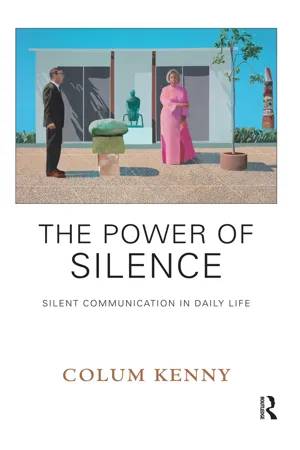
This book demonstrates that silence is eloquent, powerful, beautiful and even dangerous. It surrounds and permeates our daily lives. Drawing on a wide range of cross-cultural, literary and historical sources, the author explores the uses and abuses of silence. He explains how silence is not associated with solitude alone but has a much broader value within society.The main themes of The Power of Silence are positive and negative uses of silence, and the various ways in which silence has been understood culturally, socially and spiritually. The book's objectives are to equip people with a better appreciation of the value of silence and to enable them to explore its benefits and uses more easily for themselves.
- 320 pages
- English
- ePUB (mobile friendly)
- Available on iOS & Android
eBook - ePub
About this book
Information
Chapter One
Silent types
Not everyone thinks highly of silence. Shakespeare, in the Merchant of Venice (Act I, sc. 1, lines 111–112), has Gratiano declare that,
Silence is only commendable
In a neat’s [cow’s] tongue dried and a maid not vendible [marketable].
Yet it remains true that many people believe silence to be “commendable” in more cases than Gratiano was willing to admit—or sometimes so, at least. Asking “Is it good in general to practise silence?”, Basil of Caesarea (c329–379) answered that question as follows: “The good of silence is dependent on the time and the person, as we are taught by the God-inspired Scripture” (Silvas, p. 387).
Some people practise reticence or silence so habitually that they become known as “the silent type”. They are, to use an unusual and even archaic word, “silentious”. Various types of silence will be considered here, although not all are mutually exclusive. More than one may be manifest in a particular person at the same or different times. Nor is this classification necessarily exhaustive. It is, however, sufficient to illustrate the truth of a statement made in the Book of Ecclesiastes (3:7) that there is “a time to keep silence”.
Understanding the functions of silence in daily life can help us to deal with its challenges. François, Duc de La Rochefoucauld, (1613–1680), advised that,
We should observe the place, the occasion, the temper in which we find the person who listens to us for if there is much art in speaking to the purpose, there is no less in knowing when to be silent. There is an eloquent silence which serves to approve or to condemn, there is a silence of discretion and of respect. In a word, there is a tone, an air, a manner, which renders everything in conversation agreeable or disagreeable, refined or vulgar (Willis-Bund & Friswell, p. 93).
Likewise, Henry David Thoreau (1817–1862) observed that, “Silence is of various depths and fertility, like soil. Now it is a Sahara, where men perish of hunger and thirst, now a fertile bottom, or prairie, of the west” (Torrey, vol. 2, p. 472).
There are quite mundane reasons for remaining silent. For example, in the scriptures commended above by Basil, Abraham’s servant gazes in silence at Rebekah to gauge from her reaction if certain words that he has spoken to her have the consequence that he hopes they will (Genesis 24:21). On occasion, silence is simply a form of good manners or common sense. Thus, elsewhere in those same scriptures, the Book of Proverbs advises that, “Whoever belittles another lacks sense, but an intelligent person remains silent” (11:12). We should be willing to fall silent while a friend helps us to understand how we have gone wrong (Job 6:24), to be silent and ponder our problems rather than distract ourselves (Psalms 4:4), and to keep silent when people have something to say that is worth hearing (Acts 15:12 and 19:33). Job kept silent about his sins because he feared the contempt of others (31:34).
Sacred as well as secular sources point to other forms of silence. In the New Testament, some of the disciples are silent with embarrassment or shame when Jesus discovers them arguing with one another about which among them is the greatest (Mark 9:33–35). Not all would agree, although some still do, that “A silent wife is a gift from the Lord, and nothing is so precious as her self-discipline” (Sirach 26:14). Even then, scribes and prophets recognized that silence might be forced on people punitively (Isaiah 47:5; Lamentations 2:10), a phenomenon that will be considered later in some detail.
It is quite evident to the author of the apocryphal Book of Sirach (also known as Ecclesiasticus) that there are different kinds of everyday silence:
Some people keep silent and are thought to be wise,
while others are detested for being talkative.
Some people keep silent because they have nothing to say,
while others keep silent because they know when to speak.
The wise remain silent until the right moment
but a boasting fool misses the right moment.
Whoever talks too much is detested,
and whoever pretends to authority is hated (Sirach 20:5–8).
while others are detested for being talkative.
Some people keep silent because they have nothing to say,
while others keep silent because they know when to speak.
The wise remain silent until the right moment
but a boasting fool misses the right moment.
Whoever talks too much is detested,
and whoever pretends to authority is hated (Sirach 20:5–8).
One man with a reputation for talking at length, if not too much, was the English historian Thomas Babington Macaulay (1800–1859). It was said of him, perhaps quite waspishly,
There are no limits to his knowledge, on small subjects as well as great; he is like a book in breeches …. Yes, I agree, he is certainly more agreeable since his return from India. His enemies might perhaps have said before (though I never did so) that he talked rather too much; but now he has occasional flashes of silence that make his conversation perfectly delightful (Holland, p. 234).
An English chancellor, Francis Bacon (1561–1626) addressed the topic of “loquacity” within a range of “examples of the colours of good and evil, both simple and comparative” (Spedding, Ellis & Heath, vol. 4, pp. 484–485). He advanced arguments both for and against silence. In favour are his assertions that silence is “the sleep which nourishes wisdom”; it is “the style of wisdom” and “aspires after truth”; it is “the fermentation of thought” and “gives to words both grace and authority”. His first assertion in favour echoes Pliny’s Epistles where it is said (book 9, ep. 36) that, “Mire enim silentio et tenebris animus alitur” (For in silence and darkness the mind is wonderfully nourished). Bacon’s arguments against silence include the opinions that, “He that is silent betrays want of confidence either in others or himself” and that, “Silence, like night, is convenient for treacheries”. More oddly perhaps, he also stacked against it the fact that, “Silence is a kind of solitude”. He appears to have taken a dim view of solitude, as did Dr Johnson—whose views on the matter will be considered later.
If Bacon saw the colours of silence metaphorically, they appear almost real for Hodgken. The latter finds that “a drab silence” is made generally by a company of tired men and women, “busy with countless cares, dusty with worries, each wrapped in his own thoughts, bearing his own burdens, unmindful of his neighbours except to criticise them”; but “a blue silence” is “the silence that is found often out of doors, sometimes during simple services on shipboard, far away at sea …. For this deep blue is the creative silence in the world of thought” (pp. 217–218).
One of the great Victorian admirers of silence was Thomas Carlyle (1795–1881). He is believed to have been the first person to write in English the phrases “Speech is silvern, silence is golden”, doing so when in his Sartor Resartus of 1836 he translated from German an inscription found on doorways in Switzerland (p. 172). Given that the observation that “silence is golden” is now common, and was even the title of a very popular song recorded in the 1960s by The Tremeloes, it is surprising to learn of its relatively recent migration into English.
Carlyle was a prolific writer and made so many fond references to silence that Augustine Birrell, later the United Kingdom’s chief secretary for Ireland, was led to remark that,
No man talked against talk or broke silence to praise it more eloquently than he, but unfortunately none of it is in evidence. All that is given us is a sort of Commination Service writ large. We soon weary of it. Man does not live by curses alone (pp. 108–109).
The Commination Service is a Church of England liturgy for Ash Wednesday (a day marking for Christians the start of the penitential season of Lent) that includes strong warnings to impenitent sinners.
Indeed, silent people themselves can irritate others by their very silence. William Hazlitt (1778–1830) thought that at least some of those who pride themselves on their restraint are merely manifesting a national characteristic rather than a moral one. He says of the English that, “We compliment ourselves on our national reserve and taciturnity by abusing the loquacity and frivolity of the French” (Hazlitt & Horne, p. 68). Carlyle too made a comparison of that nature, although not with the French. Referring to “the Saxon British” (of 1840!), he wrote in the context of political reform that, “With this strong silent people have the noisy vehement Irish now at length got common cause made” (1840, p. 30). Given Carlyle’s very favourable views on silence, there is in his statement an implicit negative judgement on the Irish.
A more explicit judgement is evident in the lines of one Irish political refugee who made his home in America. John Boyle O’Reilly (1844–1890) was a journalist and a Fenian activist, transported by the British from Ireland to Australia. He escaped from prison and made his way to the United States, where he became such an influential public figure in Boston that local people later erected a statue in his memory. In an “aphorism in rhyme”, delivered on 1 February 1890, O’Reilly said,
I judged a man by his speaking;
His nature I could not tell;
I judged him by his silence,
And then I knew him well (Roche, p. 343).
His nature I could not tell;
I judged him by his silence,
And then I knew him well (Roche, p. 343).
O’Reilly did not enumerate particular kinds of silence by which one might know a man or woman. However, for her part, Saville-Troike attempted a broad functional classification. She identified 20 or so types of silence, and clustered these into the institutionally-determined, group-determined, non-interactive, and individually-determined or negotiated (pp. 16–17). Even then, she maintained, these types require further amplification and refinement. Such an elaborate taxonomy is useful for some purposes, but the types of silence that will be considered here below are more simply defined. They are broad enough to encompass many daily experiences of the phenomenon, being,
- Wise or virtuous
- Modest
- Cunning or calculating
- Eloquent
- Dumbfounded
- Culpable
- Strong
- Weak
- Ceremonial
- Satisfied
- Idle
- Dead.
The wise or virtuous silent
This is a quiet and gentle silence. It does not arise from a sense of superiority and is one of the signs of compassion. It reflects an unwillingness to pass judgement harshly or definitively, or to hold oneself out as purporting to understand the nature of reality in any way that is arrogant. It arises from being aware that what we put into words frequently fails to express truth adequately and may be regretted.
This type of silence is acknowledged by old sayings in many cultures. For example, adages attributed to the Chinese sage known as Lao-Tse include (sections 1 and 56 respectively),
The name that can be named
is not the enduring and unchanging name.
is not the enduring and unchanging name.
and
He who knows (the Tao) does not (care to) speak (about it);
He who is (ever ready to) speak about it does not know it.
He (who knows it) will keep his mouth shut and close the portals …
He who is (ever ready to) speak about it does not know it.
He (who knows it) will keep his mouth shut and close the portals …
The Italians say, “Ci più sa, meno parla”, the French, “Qui plus sait, plus se tait” and the Spanish, “Quien mas sabe, mas calla”, all meaning that the person who knows most speaks least. Sometimes wisdom lies simply in knowing that one does not know, and sparing others an opinion that is mere bluster. For, as one ancient Jewish writer has it (Ecclesiastes 10:14), “A fool multiplies words, though no man know what is to be, and who can tell him what will be after him?”
This is also the wisdom of Socrates who, as Plato tells the story in the Apologia, was regarded as being the wisest because he knew what he did not know, and did not have an opinion on everything. Hebrew texts indicate that there are times when it is prudent and wise, in particular, to refrain from expressing moral disapproval of others (Amos 5:13; Sirach 20:1). Similarly, in his fifth “Nemean Ode”, Pindar (c520–438 BC) recognised that silence might be the best course, when he wrote, as translated,
‘Tis not for every truth to show
Its undisguised and open brow –
Oft the best prudence of the wise
In silent meditation lies (p. 183, lines 35–38).
Its undisguised and open brow –
Oft the best prudence of the wise
In silent meditation lies (p. 183, lines 35–38).
The Romans had a saying: “Indictum sit” (Let it stay unspoken). That was the course taken by Jesus when faced with interrogation by the Roman governor Pilate. His silence then was enigmatic and complex. While, at one level, this perhaps led some people to believe that Jesus had consented to the charge that he claimed to be the son of God, his silence may also be seen as marking a moment when the underlying truth of an encounter could no longer be encompassed within language. Accounts of his entire life are distinguished by enigmatic silences, including that concerning his years before the age of 30 and that of the 40 days and 40 nights that he later spent on retreat in the desert. Indeed, the parables that Jesus used to tell sometimes baffled even his own followers (Matthew 13:10–17). His parables conveyed more meaning than the words themselves literally signified. As Funk observes, this was a use of language that brought the kingdom of God nearer. In this respect the parables are akin to some poetry. Funk adds that St Paul’s letters also are “a language gesture”, in that the language used and its form “likewise evidence traces of the silence that surrounds language” (p. 237).
The most eloquent way to communicate wisdom may be through one’s way of life and not one’s words. In a popular Jewish compilation known as “Pirque Aboth” (also “Pirqei Avot”) which formed part of the Mishnah by the end of the second century, it is reported that,
Shime’on his son said, All my days I have grown up amongst the wise, and have not found aught good for a man but silence; not learning but doing is the groundwork; and whoso multiplies words occasions sin (Taylor, pp. 24–25).
This Shime’on, or Simeon, is himself thought to have lived in the first century after Christ. Much later, Philip Sydney (1554–1586), courtier and poet, and eldest son of the lord deputy of Ireland, preferred silence to sound, “Nightingales seldom sing, the [mag]pie still chattereth …. Shallow brooks murmur most, deep silent [brooks] slide away …” (p. 52). Also in the 16th century, at Avila in Spain, a certain nun wrote of the great go...
Table of contents
- Cover
- Half Title
- Title
- Copyright
- Dedication
- CONTENTS
- FOREWORD
- ABOUT THE AUTHOR
- CHAPTER ONE Silent types
- CHAPTER TWO Busy silence
- CHAPTER THREE Theories of silence
- CHAPTER FOUR Silence and the arts
- CHAPTER FIVE Film, TV, and music
- CHAPTER SIX Constraints of silence
- CHAPTER SEVEN Silence in therapy
- CHAPTER EIGHT Sacred silence
- CHAPTER NINE The silence of God
- EPILOGUE
- BIBLIOGRAPHY
- INDEX
Trusted by 375,005 students
Access to over 1.5 million titles for a fair monthly price.
Study more efficiently using our study tools.
Frequently asked questions
Yes, you can cancel anytime from the Subscription tab in your account settings on the Perlego website. Your subscription will stay active until the end of your current billing period. Learn how to cancel your subscription
No, books cannot be downloaded as external files, such as PDFs, for use outside of Perlego. However, you can download books within the Perlego app for offline reading on mobile or tablet. Learn how to download books offline
Perlego offers two plans: Essential and Complete
- Essential is ideal for learners and professionals who enjoy exploring a wide range of subjects. Access the Essential Library with 800,000+ trusted titles and best-sellers across business, personal growth, and the humanities. Includes unlimited reading time and Standard Read Aloud voice.
- Complete: Perfect for advanced learners and researchers needing full, unrestricted access. Unlock 1.5M+ books across hundreds of subjects, including academic and specialized titles. The Complete Plan also includes advanced features like Premium Read Aloud and Research Assistant.
We are an online textbook subscription service, where you can get access to an entire online library for less than the price of a single book per month. With over 1.5 million books across 990+ topics, we’ve got you covered! Learn about our mission
Look out for the read-aloud symbol on your next book to see if you can listen to it. The read-aloud tool reads text aloud for you, highlighting the text as it is being read. You can pause it, speed it up and slow it down. Learn more about Read Aloud
Yes! You can use the Perlego app on both iOS and Android devices to read anytime, anywhere — even offline. Perfect for commutes or when you’re on the go.
Please note we cannot support devices running on iOS 13 and Android 7 or earlier. Learn more about using the app
Please note we cannot support devices running on iOS 13 and Android 7 or earlier. Learn more about using the app
Yes, you can access The Power of Silence by Colum Kenny in PDF and/or ePUB format, as well as other popular books in Psychology & Ethnopsychology. We have over 1.5 million books available in our catalogue for you to explore.