- 256 pages
- English
- ePUB (mobile friendly)
- Available on iOS & Android
eBook - ePub
About this book
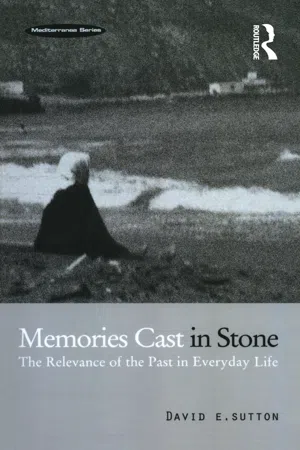
How does the past matter in the present? How is a feeling of 'ownership' of the past expressed in people's everyday lives? Should continuity with the distant past be seen as simply a nationalist fiction or is it transformed by local historical imagination? While recent anthropological studies have focused on reconstructing disputed histories, this book examines the multiple ways in which the past is used by people as a critical resource for interpreting the meanings of a changing present. It poses the issue of the felt relevance of the past in constructing present day identities. The Greek island of Kalymnos is a barren and seemingly bucolic setting of tourist imagination. But its history has been one of almost continuous occupation by foreign powers and of often fierce resistance. This has made Kalymnians particularly sensitive to seeing their island in a much wider context and to understanding the 'games played by the powerful'. In examining changing gender relations, European integration, and local perceptions of the war in the former Yugoslavia, this book brings together local, national and international perspectives in a unified field. Controversial contemporary practices of dynamite throwing and dowry giving serve as tropes through which Kalymnians explore alternative ways of living in a changing world. Further, the author argues persuasively for the crucial importance of situated fieldwork in 'peripheral'places in understanding the issues and conflicts of a transnational world. This book serves as an highly readable case study of the complex connections between local and global discourses and practices, and how they are shaped by their relationship to the past.
Information
one
Kalymnos: The Barren Island
DOI: 10.4324/9781003086079-2
Kalymnos: rock and light.
Kalymnos: salt air, drying octopus, sunset.
Kalymnos: the island of the faithful and brave.
On Kalymnos you meet history.
On Kalymnos Hestia cooks for you too.
On Kalymnos the impregnable fortress of monasticism.
Kalymnos: the capitol of the sea, the border of the world.
On this island the sun cast all its light.
lanes sprinkled, tradition.
Kalymnos: salt air, drying octopus, sunset.
Kalymnos: the island of the faithful and brave.
On Kalymnos you meet history.
On Kalymnos Hestia cooks for you too.
On Kalymnos the impregnable fortress of monasticism.
Kalymnos: the capitol of the sea, the border of the world.
On this island the sun cast all its light.
lanes sprinkled, tradition.
from Kalymnos, Archbishop Nektarios 1986 (my translation)
Even today, many of the houses of Kalymnos still are painted blue and white, the national colors of Greece, a vivid testimony to the long years of spirited resistance to foreign rule. That the memory of these difficult years lives on was forcefully brought to the author's attention when he was mistaken for a German and stoned in the streets by the children of Kalymnos.
Kasperson 1966: 91
The History
On the wall [of the fortress-city of Rhodes] two armies are fighting with wooden swords - a dozen children in paper hats against half a dozen bareheaded ones. They are not Knights and Saracens, as one might think, but British and Germans. The battle sways backwards and forwards... High up against the sun an eagle planes above us, watching history plagiarizing itself once more upon these sun-mellowed walls.
Lawrence Durrell, from Reflections on a Marine Venus, 1953
Although Durrell was writing about Kalymnos' neighbor, Rhodes, he believed this "historical plagiarism" to be a property of the Dodecanese islands, which lived, as he describes it, in the "historical present," where time is abolished, and "there is no past, present or future."1 History, in this formulation, doesn't repeat itself. Rather it plagiarizes: it takes from the past, in acknowledged and unacknowledged ways, that which is useful in the present. As I offer a background history of Kalymnos (and the surrounding islands in the Dodecanese chain), in a book with history as its subject, I am made particularly aware that history is not just a jumbled collection of things past. It is one story, or many, often conflicting stories, told with particular purposes in mind. Like a well-made Kalymnian story, and based partly on Kalymnian historians' own telling of their history, my brief review is not meant to be comprehensive, certainly not "objective," but is organized around themes, premised on the idea of repetition (a topic I investigate at length in Chapter 6 onwards). This concept of repetition is not based on the mechanical Fordian notion of perfect reproduction which erases the need to remember the prior model, but on Durrell's sense of plagiarism.
The twelve islands off the coast of Turkey which constitute the Dodecanese have a distinctive history in relation to the rest of Greece.2 Although they were loosely part of the Byzantine Empire until the beginning of the thirteenth century, the empire scarcely administered the Dodecanese. Instead, from the fourth century onwards, they faced constant pirate raids which caused the decline of the economic and demographic fortunes of the islands. After the sack of Constantinople in 1204 AD had further weakened the Byzantine Empire, the Dodecanese were ceded to (more accurately, taken by) Venetian and Genoese merchants. These merchants ruled until 1310 AD, when they were replaced by the Knights of Saint John. The Knights taxed the population heavily, but they also built fortifications, curbed piracy, and brought a degree of prosperity to the islands for the two centuries of their rule before they fell to the Ottoman Empire in the 1520s and 1530s.
Ottoman rule was extremely light in the Dodecanese. Except for Kos and Rhodes,3 they were given the title "privileged islands" by the Ottomans. These privileges were decreed by imperial orders (firmans) which formed a charter of local autonomy. The content of this autonomy is described by Booth and Booth (1928: 32) as follows:
In matters of personal status, such as religion, marriage, divorce and inheritance, all the islands enjoyed complete freedom. Educational institutions were left under the control of the Orthodox community, and no attempt was made to interfere in questions of language. Rhodes and Cos had Turkish governors with a certain control over local administration. The other islands conducted their own affairs through elected councils called Demogerontia, the only limit of their freedom being the payment of "maktou," a yearly tax levied by the Turks to cover the cost of protection.
Each island elected its own "council of elders" (Επαρχος). which, with a number of other annually elected bodies, administered the secular affairs of the island. Thus the Dodecanese had a highly developed system of democratic elections which can be traced back to Roman times, if not before.4
Despite their privileged status, many Dodecariesians joined in the War of Independence in the 1820s, and succeeded in liberating the islands. The Greek government sent a temporary administrator to Kalymnos in 1828. This administrator seems to have spent most of his time trying to keep public order, and to instill in Kalymnians a respect for the law by comparing them to their island neighbors (Patellis 1994: 44). This mistrust of centralized authority is a theme I shall examine at length in Chapter 3. Kalymnos' experience of central Greek authority was brief, it lasted a mere two years. In 1830, Greece traded the Dodecanese back to the Ottomans in exchange for Euboiea, largely at the behest of the British Foreign Office. Thus the islanders tasted the Great Power machinations which were to plague them and the rest of Greece up through the 1990s.5
Ottoman rule became more severe in the nineteenth century, as administrators attempted to squeeze higher taxes from the islands. During the mid- to late nineteenth century island leaders on Kalymnos, and other islands, made great efforts to preserve their privileged status through negotiations with the Ottoman Sultan.6 Local Turkish administrators' focus upon tax matters is unsurprising given that the nineteenth century was a period of growth and prosperity for the Dodecanese, unparalleled since ancient times. But it also reflected the tanzimat reforms, i.e. the concerted efforts of the Ottoman rulers to streamline their imperial system during this period.7 Kasperson distinguishes the sponge-diving islands from the rest of the Dodecanese at this time as follows: "During the nineteenth century... the sponge-fishing islands spearheaded the resistance to the Turkish occupation. Educational and cultural achievements, voluntary theaters and intellectual organizations, and local community government were most fully developed on the islands of Symi and Kalymnos" (1966: 170).
By 1912 the population of the Dodecanese was at its peak at 150,000. However, in this year Italy invaded, and seized, the islands in the course of its war with the Ottomans over Libya. Subsequently, Kalymnos set up its own government and bureaucracy, which included government seals that read "State of Kalymnos." At the same time Kalymnians let the Italians know of their wish to be made part of Greece, and they received a number of reassurances from the Italian admiral, Viale, that they would remain "free."8 The islanders assumed that they had been relieved of the Ottoman yoke, but the Italian government had other plans. They hoped to use the islands as a bargaining chip: first in their negotiations with the Ottomans over Libya, and similarly in their negotiations over Greek expansion into Albania during the Balkan wars. During the first years of Italian occupation there seemed a strong possibility that Great Power negotiations would lead to a granting of the Dodecanese to Greece. However, Italy eventually decided that the islands were "a pawn [which she could not] let slip from her hand."9 Italy believed that the Dodecanese might also prove useful as a stepping-stone for Italy's commercial and military aspirations in Asia Minor. Thus, instead of their promised ceding of the Dodecanese,10 the Italians instituted thirty years of harsh rule over the islands. This rule was particularly severe after the beginning of the fascist period in Italy in 1926, when Italy began to introduce assimilation policies.
In the early period Italian rule consisted of rigorous taxation, press censorship, secret police, and the exclusion of Greek labor from public works. After 1926, when Italy introduced active policies to make the Dodecanese into Italian islands, some restrictions were placed on the use of the Greek language in schools (it was outlawed after 1937). All references to the Greek nation were also proscribed. Attempts were made to separate the Dodecanese diocese from its leadership in Istanbul, and to bring it under greater Italian control. Finally, land left uncultivated for three years or more was occasionally appropriated for settlers from Italy.11 In this period active resistance to Italian rule became most pronounced, the most notorious act of resistance was the Rock War of 1935 (discussed fully in Chapter 4).
The centralization and military focus of Italian administration meant that Rhodes and Kos regained a certain prominence during the Italian occupation. Leros, which neighbors Kalymnos to the north, also became significant owing to its apparent strategic military value. Extensive development occurred on these three islands, including the construction of roads, administration ...
Table of contents
- Cover
- Half Title
- Series Page
- Title Page
- Copyright Page
- Dedication
- Contents
- Acknowledgements
- Introduction
- 1 Kalymnos: The Barren Island
- 2 Kalymnian Constructions of Identity and Otherness
- 3 Debates on an Explosive Custom
- 4 Tales of Women Casting Stones
- 5 Memories of Matriarchy
- 6 Analogic Thinking as History
- 7 A Historical War: Local Conversations with Global Implication
- 8 History Revealed, Custom Concealed: Names as Heritage and as Inheritance
- Conclusion
- References Cited
- Author Index
- Subject Index
Trusted by 375,005 students
Access to over 1.5 million titles for a fair monthly price.
Study more efficiently using our study tools.
Frequently asked questions
Yes, you can cancel anytime from the Subscription tab in your account settings on the Perlego website. Your subscription will stay active until the end of your current billing period. Learn how to cancel your subscription
No, books cannot be downloaded as external files, such as PDFs, for use outside of Perlego. However, you can download books within the Perlego app for offline reading on mobile or tablet. Learn how to download books offline
Perlego offers two plans: Essential and Complete
- Essential is ideal for learners and professionals who enjoy exploring a wide range of subjects. Access the Essential Library with 800,000+ trusted titles and best-sellers across business, personal growth, and the humanities. Includes unlimited reading time and Standard Read Aloud voice.
- Complete: Perfect for advanced learners and researchers needing full, unrestricted access. Unlock 1.5M+ books across hundreds of subjects, including academic and specialized titles. The Complete Plan also includes advanced features like Premium Read Aloud and Research Assistant.
We are an online textbook subscription service, where you can get access to an entire online library for less than the price of a single book per month. With over 1.5 million books across 990+ topics, we’ve got you covered! Learn about our mission
Look out for the read-aloud symbol on your next book to see if you can listen to it. The read-aloud tool reads text aloud for you, highlighting the text as it is being read. You can pause it, speed it up and slow it down. Learn more about Read Aloud
Yes! You can use the Perlego app on both iOS and Android devices to read anytime, anywhere — even offline. Perfect for commutes or when you’re on the go.
Please note we cannot support devices running on iOS 13 and Android 7 or earlier. Learn more about using the app
Please note we cannot support devices running on iOS 13 and Android 7 or earlier. Learn more about using the app
Yes, you can access Memories Cast in Stone by David E. Sutton in PDF and/or ePUB format, as well as other popular books in Social Sciences & Anthropology. We have over 1.5 million books available in our catalogue for you to explore.