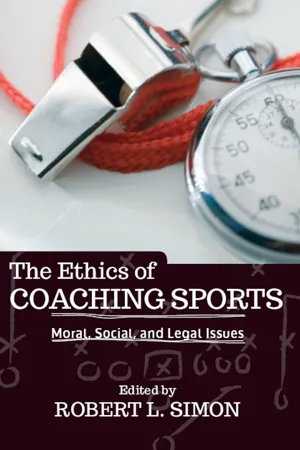
The Ethics of Coaching Sports features invited contributions written by prominent scholars examining a broad range of normative or evaluative issues that arise from the role of the coach in competitive sports. The collection is accessible and comprehensive, including discussion of concrete issues in coaching, such as the distribution of playing time, bullying, the implications of recent events surrounding the Pennsylvania State scandal, and Title IX and gender equity. The contributing authors also explore the larger ethical considerations of the role of the coach as educator, leader, and moral role model; special considerations when coaching children; and an examination of the failures of coaches to meet appropriate standards when they do not respect their players and their programs. Each contributor presents the main arguments and positions relevant to their chosen topic and, with the ground set, the authors then seek to advance the reader's theoretical and philosophical understanding of coaching. Robert L. Simon's introductions to each of the book's four parts help to summarize the main theses of the contributors' chapters and examine differences between how each author approaches their chosen subject. Study questions are also provided for each chapter, making The Ethics of Coaching Sports the perfect companion for classes on sports ethics and coaching.
- 326 pages
- English
- ePUB (mobile friendly)
- Available on iOS & Android
eBook - ePub
About this book
Information
PART 1
Introduction
One
The Ethics of Coaching
The television program Friday Night Lights was an especially thoughtful, well-acted series that explored the role of high school football in a small Texas town while following the lives of local young people and adults over several football seasons.1 The central character, Coach Eric Taylor (played by actor Kyle Chandler), while not without faults, was not only a good father and husband, a leading educator in the area, but a great coach and, most importantly, a role model for his players. Although he sometimes made bad decisions, both in his family life and on the field, he could be counted on by his family members and his players, who came from a variety of backgrounds and economic circumstances and often confronted major personal and social crises.
In the real world, many issues facing the coaching profession, particularly in high profile sports, raise significant ethical questions about the behavior of coaches. Joe Paterno’s fall from grace at Penn State, due to the allegations of sexual abuse leveled against former assistant Jerry Sandusky, is a case in point. Some have argued that Paterno fulfilled his moral obligations by informing the university athletic director about the problem and that the scandal was external to football. However, the devastating report by former FBI director Louis Freeh alleges that Paterno contributed to the cover-up of sexual abuse of children and that fear of going up against the renowned Penn State football program deterred some university employees from reporting the abuse. The Paterno case did not directly involve his coaching practices; by all accounts Coach Paterno ran a clean program, made sure his players graduated, and used funds raised by Penn State football to support the academic mission of the university. However, Paterno’s legacy has been significantly tarnished as the Freeh report, released in July 2012, charged that Penn State officials, including Paterno, showed “total and consistent disregard by the most senior leaders at Penn State for the safety and welfare of Sandusky’s child victims.”2 On July 23, 2012, the National Collegiate Athletic Association (NCAA) announced unprecedented penalties against Penn State, imposing a $60 million fine (to be used to help victims of child abuse), vacating Penn State football victories from 1998 to 2011, and reducing the number of football scholarships the program can offer.
Moreover, a significant number of NCAA Division I intercollegiate programs were involved in serious rule violations, apparently with the knowledge and even support of the coaching staff. These range from NCAA violations committed in the Ohio State football program under Coach Jim Tressel (which led to his firing) to cases of academic fraud, such as the University of Minnesota case where an NCAA investigation found that tutors did academic work for some basketball players with the knowledge of their coaches. Recently NFL investigators have charged that players on the New Orleans Saints football team were awarded bonuses for hard hits against rival players that resulted in the targets being removed from the game, all with the knowledge and possible support of some members of the coaching staff.3
While coaches in youth sports are mostly volunteers and high school coaches who put in enormous amounts of time for little financial reward, men’s basketball and football coaches at elite high profile intercollegiate programs make huge incomes, some earning more than the presidents of their institutions. In 2011 Rick Pitino, the basketball coach at Louisville, had a total pay of well over $7 million. Mike Krzyzewski, the basketball coach at Duke, had a reported total payout of over $4 million, and John Calipari, whose teams at different institutions have been cited for violating NCAA rules, made nearly $4 million at Kentucky. Salaries for top collegiate football coaches are comparable.4 While some argue that huge compensation packages are justifiable as the result of free market bargaining, others have raised questions about whether this reward structure is economically sustainable and whether it is appropriate to pay coaches so much more than top faculty members.
On the other hand, many coaches (perhaps most coaches) at both the collegiate and the interscholastic level not only play by the rules but, like Coach Taylor, play a positive role in the athletic development of their athletes as well as in their educational and personal growth. It is important to look past the negative publicity surrounding some high profile coaches and understand that coaching is a practice that takes place in a wide variety of contexts ranging from professional to youth sports. These good coaches often don’t get the attention the media bestow on bad behavior in high profile sports.
Nonetheless, many ethical dilemmas arise among coaches who labor in youth, high school, and college sports and in various low profile clubs and leagues, perhaps especially in such cases. For example, is winning the coach’s primary goal? Which value takes precedence when winning clashes with other goals, such as showing loyalty to experienced players who are less skilled than newcomers, allowing all the players on the roster to participate, protecting the athletes’ health, and showing good sportsmanship when doing so hurts the team’s chances at winning? Should coaches tolerate gamesmanship by their players and should they set rules or codes of conduct that apply to the behavior of their players off the field or during the off-season? Is it permissible for coaches to “work” officials, even to the point of intimidation, or bully players in an attempt to improve their performance? To what degree, if any, should coaches stress competition, as opposed to developing skills or just having fun, in youth sports?
The chapters in this book deal with some of the most significant ethical issues facing coaches. They also explore the role of the coach and the duties, responsibilities, and even ideals that apply to coaching behavior, in both ethics and law. In particular, they explore the reasoning that may be used to support different positions on the issues being examined and so provide an analytical as well as a moral perspective on the role of the coach and the practice of coaching.
Sports, Coaching, and Philosophical Analysis
Sports attract attention around the world. The World Cup and the Olympic Games enjoy the greatest visibility, but many sports such as basketball and golf are becoming increasingly international in scope, with Asian as well as American and European players making a major impact. Soccer (elsewhere called football) is arguably the most popular sport worldwide. Children are becoming increasingly involved in youth sports and developmental programs. In the United States, college and high school athletic competitions attract huge audiences throughout the country. Sports are the subject of major films such as the award-winning Chariots of Fire, Hoosiers, and Million Dollar Baby.
Increasingly, sports are receiving attention from various academic disciplines. Psychologists, economists, and sociologists study empirical questions, for example, investigating what mental qualities tend to contribute to success in athletic competition (sports psychology), or whether highly visible Division I college sports actually bring in revenue for their institutions rather than operate deep in the red (economics).
However, many questions about sports go beyond the ordinary parameters of the natural and social sciences. Social scientists can describe the effects of competitive sports on participants, but can they tell us whether competition is good or bad, ethically permissible, desirable, or morally reprehensible? Whether a high school coach should give significant playing time to the less skilled players on the team, what responsibilities coaches should be expected to meet in protecting the safety of their players, or how much they should involve their players in making strategic decisions (a democratic vs. authoritarian style of coaching) raises ethical issues that are beyond the scope of the natural and social sciences.
Philosophy can help us approach such evaluative issues in part by helping to clarify key concepts and assessing arguments that attempt to justify answers to questions such as, What counts as fair play in sports?
Before turning directly to coaching, however, we need to view the practice of coaching in the broader context of sports and athletic competition. Ethical issues involving such concerns as athletes’ use of performance enhancing drugs, questions of gender equity in university athletic programs, and misbehavior by elite athletes are widely discussed in the media, by fans, and even by casual observers. Some behaviors, such as doping to achieve a competitive advantage, are alleged to be violations of the ethics that should govern sports. But even if that claim is true, it presupposes that we have some idea of what that ethic should be. Criticizing a practice as unethical suggests that we have some notion of what is ethical.5 But while we all have intuitive ideas about, for example, what counts as fair play, it is not easy to articulate the principles that justify our intuitions, defend them, or apply them to hard cases where our principles may appear to conflict.
This suggests a deeper set of questions that go beyond current headlines. Is athletic competition a good thing? Are competitive sports valuable activities? If so, why? Does their value depend on circumstances or context? What circumstances are important or relevant to moral evaluation? Are sports purely recreational or do they also have an educational function, especially in youth sports but perhaps also at the interscholastic, intercollegiate, and professional levels?
In developing responses to such questions, we may ask about the role coaches do play and should play at the different levels of sports. Are coaches purely technical advisers who help their athletes develop better techniques, like a swing coach in golf? Or are they more like generals or CEOs who develop and maintain a “program” as at elite Division I colleges and in professional sports? Or are coaches more like teachers or professors, educating their players about the sport and even about the kind of character needed to play well? Should they aim at developing personal virtues among their charges? Or does that take them beyond their proper role? Does the coach’s role depend on context? For example, perhaps different ethical guidelines apply to coaches in youth sports than to coaches in intercollegiate athletics. But even if that is true, are there some universal principles that apply to coaching in all contexts?
Indeed, the role and moral duties of the coach not only change significantly from one context to another (e.g., professional vs. youth sports) but arguably from one cultural context to another. At times in ancient Greece, as well as in nineteenth-and early-twentieth-century England, athletes were expected to succeed on their own; working with a coach was considered unsporting. Part of the charm and interest of the movie Chariots of Fire, which tells the story of two contenders for the 1924 Olympics, is that it illustrates the British aristocratic ethics of the time, which frowned on the use of a coach by one of the characters, Harold Abrahams, thereby showing how people’s beliefs about sports ethics can be influenced by existing social practices and cultural norms. (Of course, whether the views are defensible depends on the soundness of justifying arguments, not merely on what people at a given time believe is ethical.)6
The prevailing attitude throughout most of the world today is very different, but to what extent can the attitude prevalent at a given time and place be justified? What ethical rules, principles, and ideals apply to coaching? Should coaching as we now know it be regarded as purely instrumental, designed only to promote winning, or is it a multifaceted activity subject to moral standards? If the latter, which moral standards apply? How can we justify the moral considerations we believe apply?
The contributors to this book attempt to clarify, explore, and in some cases resolve ethical and related legal questions about coaching, including some of those raised above. They look beyond the daily sports headlines and analyze in depth the ethical issues that arise in coaching as most of us experience it; in such contexts as youth sports, high schools, colleges and universities, clubs and other informal organizations, as well as professional and elite teams and institutions. All the contributors hope to advance our theoretical and philosophical understanding of coaching. However, just as important, they also present well-reasoned examinations of issues that coaches face in carrying out their duties and suggest recommendations for coaching practices that can be explored and debated by students, coaches, sports administrators, and fans.
Each chapter, other than the two introduction chapters, is followed by a series of review questions designed to bring the main theses and potential lines of criticism of them into focus. A short list of suggested readings also follows, which may include works cited in the footnotes if the author regards them as especially deserving of attention. Those interested in exploring the issues raised even further should consult the sources cited in the endnotes.
Two
The Coach as Moral Exemplar
Unquestionably, sports play a significant role in our society. Just consider the enthusiasm generated by March Madness, the Olympic Games, the Super Bowl, and the World Series. But perhaps their greatest significance is the moral role sports play for both the participants and society in general. I have argued that given their nature and design, sports provide a unique model for understanding our society, for seeing who we are, our values, and our ethics.1
Americans recognize the potential for sports to build character and promote necessary virtues for a greater cause. As a society, Americans value sports and what they can offer. But Americans also believe that an overemphasis on winning threatens sports, possibly by motivating rule breaking and by taking the fun out of it for too many people. Role models, particularly coaches, can play an important part in maintaining the integrity and value of sports. Coaches often function as surrogate parents, bonding strongly with the people they coach. A study by the U.S. Anti-Doping Agency (USADA), in partnership with Discovery Education, concluded that coaches, more than parents, teachers, peers, religion, and school, have the greatest influence on youth sport participants.2
Sport can be great fun to play and entertaining to watch. However, it offers something more important. The lessons it provides—taught properly—apply directly to life. Many of those lessons are usually taught first by a good mother and father, but sports can help make them stick and add a few more.3
Given the results of the study, the people entrusted to teach these lessons must be the coaches. Like parents they teach skills, but they also teach life lessons, including morals, ethics, tolerance, and most of all respect, both for themselves and for others. So coaches must be good teachers as well as good role models.
A recent USADA survey showed that more than three-fifths of US adults, approximately 162 million Americans, claim some relationship to sports-related activities. Thus, given the engagement and power of sports and more importantly the power of coaches, ethics and sports must be integrated in the coaches who influence those they coach. But this cannot happen unless coaches possess character and integrity, and intentionally teach and model these values. Since sports play a significant moral role in society, coaches have a greater responsibility in how sports fulfill this role. Of course coaches are not the only ones who bear this responsibility; others, particularly well-known athletes, bear some responsibility as well. However, “coaches have an … unparalleled power and platform in young people’s lives.”4 This is an awesome and sometimes frightening platform for transforming people’s lives. What makes it so is that this is a role they have freely chosen. With that choice comes great responsibility, not just to teach what they know and how to perform and behave, but to model this behavior as well. “There are at least five million coaches with the potential to become one of the most influential adults in a young per...
Table of contents
- Cover
- Half Title
- Title Page
- Copyright Page
- Dedication
- Table of Contents
- Preface
- PART ONE: INTRODUCTION
- PART TWO: THE COACH’S ROLE: CONCEPTIONS OF COACHING
- PART THREE: COACHING AND THE ETHICS OF COMPETITION
- PART FOUR: COACHING, COMPLIANCE, AND THE LAW
- Notes
- About the Contributors
- Index
Trusted by 375,005 students
Access to over 1.5 million titles for a fair monthly price.
Study more efficiently using our study tools.
Frequently asked questions
Yes, you can cancel anytime from the Subscription tab in your account settings on the Perlego website. Your subscription will stay active until the end of your current billing period. Learn how to cancel your subscription
No, books cannot be downloaded as external files, such as PDFs, for use outside of Perlego. However, you can download books within the Perlego app for offline reading on mobile or tablet. Learn how to download books offline
We are an online textbook subscription service, where you can get access to an entire online library for less than the price of a single book per month. With over 1.5 million books across 990+ topics, we’ve got you covered! Learn about our mission
Look out for the read-aloud symbol on your next book to see if you can listen to it. The read-aloud tool reads text aloud for you, highlighting the text as it is being read. You can pause it, speed it up and slow it down. Learn more about Read Aloud
Yes! You can use the Perlego app on both iOS and Android devices to read anytime, anywhere — even offline. Perfect for commutes or when you’re on the go.
Please note we cannot support devices running on iOS 13 and Android 7 or earlier. Learn more about using the app
Please note we cannot support devices running on iOS 13 and Android 7 or earlier. Learn more about using the app
Yes, you can access The Ethics of Coaching Sports by Robert L. Simon in PDF and/or ePUB format, as well as other popular books in Sciences biologiques & Droit des médias et du divertissement. We have over 1.5 million books available in our catalogue for you to explore.