eBook - ePub
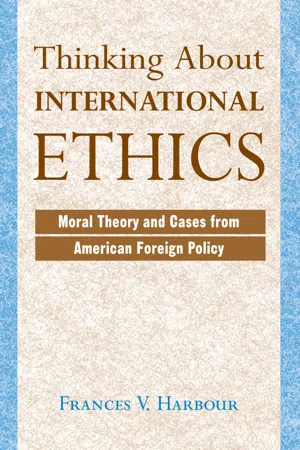
Thinking About International Ethics
Moral Theory And Cases From American Foreign Policy
- 228 pages
- English
- ePUB (mobile friendly)
- Available on iOS & Android
eBook - ePub
Thinking About International Ethics
Moral Theory And Cases From American Foreign Policy
About this book
This book describes and analyzes important moral theories as they pertain to international politics and the study of international relations, examining the role that moral thinking actually played in specific cases in American foreign policy.
Information
Part One
What Role for Ethics in Foreign Policy?
1
Realism Versus Idealism in the Twentieth Century
The role of ethics in international politics and foreign policymaking is deeply interrelated with the history of international relations (IR) as an academic field of study. The study of international relations goes back to Thucydides and can be traced through Machiavelli, Grotius, Hobbes, Rousseau, Kant, and Marx, to name just a few. However, scholars did not really begin to consider IR separately from its parent disciplines of history, philosophy, public law, and the general study of politics until after World War I. The field came to maturity after World War II as the Cold War was emerging into international consciousness. Avoiding a repetition of World War II, this time between the Western bloc and the Soviet bloc, was uppermost in everyone’s mind.
Postwar Paradigm Shift or an Interwar Debate?
The first of the Great Debates in the “new” field of international relations has been caricatured as the realist versus idealist debate. With all due respect to generations of IR textbooks, after World War II the discussion was less a debate than a paradigm change. To the extent that there had been a real debate, it occurred in the 1920s and 1930s, as liberal institutionalists, who came to be called idealists, and realists argued about the right approach to the League of Nations, the Chemical Weapons Convention of 1925, the establishment of the World Court in The Hague, the Kellogg-Briand pact outlawing war as an instrument of national policy, and the proper response to the spread of totalitarianism in the 1930s.
Examination of the books published in the late 1940s to mid-1950s suggests that in the United States, with very few exceptions, the postwar “debate” consisted of the self-declared realists publicly and vehemently repudiating the views of interwar liberal institutionalists, whom the realists dubbed idealists, moralists, legalists, or even utopians.* The only serious debate was over how far from the interwar “idealist” position a theorist chose to go.
As Table 1.1 shows, these classical realists strongly disagreed with liberal idealists of the previous generation on almost every issue. The realists rejected idealist accounts of the nature of the international system, especially of what constituted proper roles for states and international institutions. They differed about human nature, power politics, and the possibility of long-term peace.
The realists shared the idealist belief that human reason was a possible source of order in the international arena. Those who prided themselves on what they saw as a realistic and clear-eyed pessimism also believed that the dark side of human nature doomed the human animal to conflict; the tendency toward conflict was reinforced and transformed into the organized hell of war by the always dangerous, rulerless, interstate system. For the realists, international politics was inherently conflictual power politics, and human reason had to be turned to dealing with that reality.
The interwar idealists had insisted that their prescriptions for international cooperation were neither Utopian nor against the national interest but realistic in their own right. Woodrow Wilson, in enunciating his Fourteen Points for American war aims in World War I, said that what the United States wanted was “that the world be made fit and safe to live in; and particularly that it be made safe for every peace loving nation.”1 Idealists did not place the safety of the world ahead of the safety of the United States but rather saw U.S. safety closely tied to that of the world.
In spite of differences on almost every subject, the role of ethical principles in international political decision making came to symbolize the disagreement between the paradigms. The liberal idealists, following Immanuel Kant, had argued in favor of a more universal or cosmopolitan account of the bases of right and wrong. They had, above all, however, believed in progress. Law and international institutions, education and reason would ultimately spread cosmopolitan moral values, improve the behavior of humanity, and eventually prevent war. Following Thomas Hobbes, the postwar realists argued that, on the contrary, the only secure base of morality is the community or, in a world of states, the state. “In the absence of an integrated international society,” wrote Hans J. Morgenthau, the best-known of the postwar realists, “the attainment of a modicum of order and the realization of a minimum of moral values are predicated upon the existence of national communities capable of preserving order and realizing moral values within the limits of their power.”2
TABLE 1.1 Views of Classical Realists and Liberal Idealists
| Classical Realists | Liberal Idealists | |
|---|---|---|
| Human Nature | Greedy, competitive, self-interested, fearful, prestige-hungry. Negative features of human nature are reinforced by dangers of anarchic international system. Can be restrained only by central power or prudence. Human nature is fixed. | Capable of either good or evil, greed or cooperation. May be improved with better education and better institutions and laws. Progress is possible. |
| International System | Anarchic system. Dangerous, rulerless, driven by need for self-help. | Rudimentary society. Good institutions and laws can moderate dangers of anarchy. |
| State-centered. Nonstate entities are arms of states, places where states can go to practice diplomacy, or dangerous sources of interference and unwarranted confidence in international cooperation. | States are currently most important actors, but nonstate actors such as international organizations, nongovernmental organizations, and multinational corporations play an increasingly important role. | |
| Ideology | Not important, except as a “stand-in” for national interest. | One important source of beliefs and norms, thus affecting behavior. |
| Ethics in the International System | Against “moralism,” not moral judgment per se. | Judgments of right and wrong should play a much greater role in determining the foreign policy of states and the behavior of other actors than they do. |
| Strong moral duties to fellow citizens, almost none to foreigners. Prudence or necessity may dictate doing wrong to protect state. | Criteria of right and wrong are global, not national. | |
| International system does not have enough coherence to produce true international ethics. | Good of the world, good of individual states, and good of individual people are deeply intertwined. |
Paradoxically, and despite clear statements that national decisionmakers should not overtly apply moral principles in international politics, those we have come to see as the founding fathers of twentieth-century realism—Hans Morgenthau, Reinhold Niebuhr, George Kennan, Walter Lippmann, and Dean Acheson in the United States, and E. H. Carr and Raymond Aron in Europe—did not believe that theirs was an amoral theory, much less an immoral theory.3 Indeed, Morgenthau, Niebuhr, and Kennan specifically argued that their version of prudent realism was morally as well as pragmatically superior to what they perceived as the illusions of idealism. As Morgenthau wrote in his In Defense of the National Interest, “the choice is not between moral principles and the national interest, devoid of moral dignity, but between one set of moral principles divorced from political reality, and another set of moral principles derived from political reality.”4 The founders of twentieth-century realism rejected what they considered moral illusion and hypocrisy, not the concept of moral judgment per se.
Order in an Anarchic World
The twentieth-century realists were driven by a profoundly moral vision. They offered what they believed was the only plausible hope for order in an anarchic world: the balance of power. Realists believe that international conflict is inevitable. Rational, unitary state actors also know, however, that too much greedy behavior provokes harsh, often collective reactions by equally self-interested opponents. To avoid punishment at the hands of others, most states moderate their behavior, however immoderate their desires. According to realists, this limited balance or order based on fear is all the peace that the anarchic international system can offer. To make the balance work, powerful states should pursue national interests defined in terms of power and consistently counter others’ encroachment on those interests. A balance of power based on consistently and firmly pursuing national interests thus was the only realistic hope of reducing the chances of another world war.
The realists were not consistent themselves about whether their vision of the operation of the balance of power was a prescription for good policy or a description of the mechanics of the international system. Morgenthau in particular argued that the operation of the balance was an inherent, virtually automatic product of an international system without a ruler. This claim is hard to reconcile with simultaneous critiques of Woodrow Wilson and other world leaders for having failed before the start of World War I to recognize their nation’s material interest in maintaining that balance.5
Whether seen as description or prescription, the realists were consistent in insisting that they, not those whom they dubbed idealists, had correctly and realistically understood ethics, human nature, and the international system. For example, on the eve of World War II, E. H. Carr fired the opening rounds of the debate in his now classic Twenty Years’ Crisis. “What confronts us in international politics today,” he wrote, “[is] nothing less than the complete bankruptcy of the conception of morality which has dominated political and economic thought for a century and a half.”6
It is also important to remember that the interwar idealists did not advocate institution building and international law primarily in order to be ethical. Rather, theorists such as Nicholas Murray Butler, James T. Shotwell, Alfred Zimmern, and Gilbert Murray, and policymakers such as Woodrow Wilson simply concluded that education and international institutions were more likely to produce peaceful resolution of the world’s conflicts than what they regarded as the uncertain traditional balance-of-power politics.7 After World War I, Murray wrote, for example, that finally “we seem most conspicuously to have discovered the right method for rebuilding our ordered world. We have invented the League of Nations: before we fight we confer, and when conference gives no immediate answer, we convoke disinterested experts and set them to study the question.”8 A world of cooperative institutions and peaceful states, they thought, was bound to advance all nations in prosperity and safety. American idealists believed that a prosperous and peaceful world was particularly well suited to the interests of the United States—a democracy, as Wilson noted, with no territorial designs on any other state.9
Shades of Realism
A generation later, as the Cold War emerged after World War II, the main question was not that of realism versus idealism; it was that of how far from the institutionalists of the interwar period a theorist chose to go. For the two next decades, a few lonely souls continued to aver “the realism of idealism,”10 but the mainstream—and the tenure process in Ameri...
Table of contents
- Cover
- Half Title
- Title Page
- Copyright Page
- Dedication
- Contents
- Acknowledgments
- Introduction: Ethics, International Affairs, and American Foreign Policy
- Part I What Role for Ethics in Foreign Policy?
- Part II Ethics, Intentions, and Consequences in Making Foreign Policy
- Part III Human Rights, Cultural Relativism, and National Duties
- Index
Trusted by 375,005 students
Access to over 1.5 million titles for a fair monthly price.
Study more efficiently using our study tools.
Frequently asked questions
Yes, you can cancel anytime from the Subscription tab in your account settings on the Perlego website. Your subscription will stay active until the end of your current billing period. Learn how to cancel your subscription
No, books cannot be downloaded as external files, such as PDFs, for use outside of Perlego. However, you can download books within the Perlego app for offline reading on mobile or tablet. Learn how to download books offline
Perlego offers two plans: Essential and Complete
- Essential is ideal for learners and professionals who enjoy exploring a wide range of subjects. Access the Essential Library with 800,000+ trusted titles and best-sellers across business, personal growth, and the humanities. Includes unlimited reading time and Standard Read Aloud voice.
- Complete: Perfect for advanced learners and researchers needing full, unrestricted access. Unlock 1.5M+ books across hundreds of subjects, including academic and specialized titles. The Complete Plan also includes advanced features like Premium Read Aloud and Research Assistant.
We are an online textbook subscription service, where you can get access to an entire online library for less than the price of a single book per month. With over 1.5 million books across 990+ topics, we’ve got you covered! Learn about our mission
Look out for the read-aloud symbol on your next book to see if you can listen to it. The read-aloud tool reads text aloud for you, highlighting the text as it is being read. You can pause it, speed it up and slow it down. Learn more about Read Aloud
Yes! You can use the Perlego app on both iOS and Android devices to read anytime, anywhere — even offline. Perfect for commutes or when you’re on the go.
Please note we cannot support devices running on iOS 13 and Android 7 or earlier. Learn more about using the app
Please note we cannot support devices running on iOS 13 and Android 7 or earlier. Learn more about using the app
Yes, you can access Thinking About International Ethics by Frances V Harbour in PDF and/or ePUB format, as well as other popular books in Politics & International Relations & Political Philosophy. We have over 1.5 million books available in our catalogue for you to explore.