- 176 pages
- English
- ePUB (mobile friendly)
- Available on iOS & Android
eBook - ePub
About this book
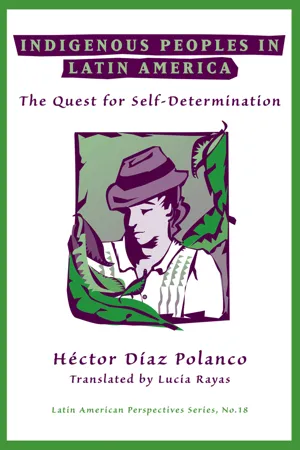
This book deals with the perennial tensions between ethnic groups and the modern nation-state and does so from the perspective of a leading Mexican anthropologist with deep and long experience in these matters. As such, it is both a superb introduction to the basic issues and a presentation of the author's own original contributions. The appearance of this book in English gives North American readers access to these important and political currents in Latin American anthropology and political economy. It is required reading for anyone wishing to understand the current recrudescence of indigenous peoples at this moment in history?when conventional wisdom had predicted its demise.
Information
Part One
Excluded Identities
Chapter One
Nation Building and the Ethnic Question
During the past few decades, the theoretical-political tendency to separate ethnic issues from national dynamics and structure has lost its impetus in Latin America. Instead, there has been a revitalization of the Latin American analytic tradition of linking ethnic issues with regional and national development. The discussion that follows falls within this tradition.
Not only are ethnoregional and national issues related but it is impossible to understand the so-called indigenous problem (or any other problem having to do with groups distinguished ethnically) apart from the regional and national contexts (political, economic, and sociocultural) that inform it. This simple principle has important consequences not only epistemologically but also politically, since its acceptance or rejection has an effect on policymaking.
Historically, the importance of ethnicity can be understood only in terms of the processes that have determined the makeup of national societies in Latin America and, in particular, guided the emergence of its nation-states. It is important to note that in using this concept of nation, I am referring not to any sociopolitical organization in particular but to a historically determined form that gives shape to the modern nation-state. The term "nation" is applied to a great variety of sociopolitical formations.1 This undifferentiated and chaotic use positions the "modern nation" alongside other "nations" (e.g., the Maya, Yaqui or Zapotec). (Here I am speaking of theoretical or scientific usage; the political denominations these peoples apply to themselves are beyond question.)2 In many cases the main reason for this—to avoid the ranking associated with domination and political oppression—is laudable. However, proceeding in this way obscures the understanding of what is specific to contemporary nationalism and precludes any understanding of the significant relationships (the very basis of domination and oppression) that develop when indigenous "nations" persist within the framework of modern nation-states. As Leonard Tivey has put it, "Although men have always joined together in some kind of unit, their grouping in nation states is a modern characteristic whose full development is certainly an essentially contemporary phenomenon."3 Disregarding some early forms, nation-states first appeared during the eighteenth and nineteenth centuries; before that there were nationalities or states but no nation-states. According to Cornelia Navari, the nation-state not only expresses continuity with earlier social formations but "implies the process of its own destruction and replacement by new contents, ideas, and kinds of social relations."4 Its development implies huge transformations that correspond to a given historical stage and that distinguish the nation-state from previous forms of organization of which it is often the negation.
Several transformative forces interacted organically in the genesis of the nation-state: (1) rationalism, a system of thought that modified the idea of the state, conceiving it as at the service not just of the monarch but of the "citizen" and producing uniform legal systems patterned mainly on the Napoleonic code and the notion of legal equality, among other fundamental innovations; (2) capitalism, a complex process of transformations in economic and social relations that created the "free worker" (free to sell her/his labor power), a new culture of efficiency and accumulation, and the framework for the development of modern social classes as well as for the vast linkages of a world economy; and (3) the state, which formulated common systems (educational, legal, and so on) and organized bureaucracies capable of rationalizing the functioning of the new sovereign sociopolitical structures. "These are the characteristic features of the modern state, precisely the features that constitute its modernity. But they are also the characteristic features of the nation-state, the ones that helped create it. The modern state and the nation-state are coextensive phenomena. In the development process, modernization and nation building imply the same program."5 This is not the place to attempt a detailed historical analysis of the genesis of nation-states. Rather, I will examine, from the perspective of the national development process, some aspects of the treatment of sociocultural issues characteristic of Latin America.
With regard to the construction of the majority of nation-states in Latin America and their sociocultural makeup, there are at least two characteristics worthy of detailed analysis. The first is the early reiterated concern, which in some cases has become a political obsession, with the "incomplete" or "inauthentic" character of the nation attributable to the persistence of ethnic groups, and the second, a corollary of the first, is the eager pursuit of a formula that would allow the "completion" or "integration" of societies whose fabric is socioculturally heterogeneous. This heterogeneity is often considered a stigma, a defect to be overcome.
Coincidentally, ethnic heterogeneity as an opprobrious blemish has repeatedly been the subject of discussion among ideologues and scholars in a number of Latin American countries. In contrast, national homogeneity has been presented as a desirable and necessary goal. Manuel Gamio's approach to this issue can be considered paradigmatic. Gamio was an important Mexican intellectual whose ideas were influential throughout Latin America. Until his death in 1960 he was the director of the Instituto Indigenista Interamericano (Inter-American Indigenist Institute), charged with launching a campaign for the integration of indigenous peoples throughout the continent—one of the basic agreements of the first Inter-American Indigenist Congress, held in Mexico City in 1940, in which delegates from nineteen countries participated. From this institutional platform Gamio's ideas expanded to other countries through local indigenist agencies that he himself helped to found.6
Gamio developed the idea of a link between the forging of a nation and the elimination of the ethnic heterogeneity that characterizes most Latin American countries.7 The fact that he was concerned well into the twentieth century with the urgent need "to form a true nation" and that he considered the "ethnic heterogeneity of the population" an obstacle shows the durability of this point of view.8 This paradigmatic perspective has loyal followers to this day.9
Ethnic-National Heterogeneity in Europe
As an initial working hypothesis, it can be said that there was generally little concern for the problem of heterogeneity in the Western European countries in which capitalism developed early (e.g., England, France, Holland, Switzerland) or at least no such policy proposals as Gamio's. This is not to be explained in terms of the absence of ethnic-national heterogeneity within the European national formations. On the contrary, the makeup of these nations, a product of the development of modern states, is diverse and protean. Nearly every European national society, even those that achieved a coherent nation-state through fundamentally endogenous processes, includes many ethnic-national groups. The examples of Scotland, Wales, and Ireland (Ulster) in Britain, Aquitaine, Brittany, and Corsica in the French case, and the various sociocultural groups organized in Swiss cantons illustrate that ethnic differences need not be perceived as problematic for nation building and point to differences between Western Europe and Latin America in the processes that led to the formation of nation-states. Generally, it would seem that in this part of Europe a previous unification that in some cases included strong socioeconomic integration, was crucial. This unifying process was determined, among other factors, by the development of an internal market driven by the expansion of market relationships and by the emergence of a new bourgeoisie whose Social identity did not rest upon the division into estates as did that of the aristocracy. The bourgeoisie proposed a model of society based not on sociocultural or ethnic differences but on the unity established by "equality" among citizens, free labor, the regulatory action of the market, and open competition. These were the foundations for the nation.
In this context, the ethnic question was not a critical obstacle to the formation of the European nation-states. According to Andrés de Bias Guerrero,
the most complete form of political nation, the nation-state, coincides with the development of the middle classes that have become the reference group for the majority of the population; this is the case in England, Holland, Switzerland, the United States of America, and—with its own peculiarities—France, Ethnic conflict plays a minimal role because there are no ethnic separations between the middle and lower classes, and therefore upward social mobility is not hindered by ethnicity. The national project of these national states therefore, emerges free of historical mortgages, dominated by a sense of rationality and empirical concerns. This would explain the success of nation building in societies as intimately divided by cultural factors as Holland or Switzerland or, to a lesser degree, states such as the English, the North American, and the French.10
In many cases, European nationalities11 or "nationality" groups were formed during the eighteenth century, even before the nation as such had appeared in its modern form as the nation-state. The latter was constituted out of that plural reality rather than against it. This does not mean that ethnic-national conflicts were absent, but as a rule solutions to these conflicts were not sought through the total elimination of diversity. Certain sociocultural components allowed the distinction of some ethnic-national groups from others, but these ethnic configurations never became an insurmountable socioeconomic obstacle or a political hindrance to nation building. This tolerance of or, rather, relative indifference to sociocultural variety arose not from the elaborations of ideologues but from transformations originating at the base of society. Structural processes and in particular the expansion of market relations that prepared the way for modern capitalism served as the cement for the political fusing of socioculturally heterogeneous components. They also prevented the establishment of rigid socioeconomic hierarchies stemming from "cultural" differences, particularly with regard to the characterization of the labor force. The hegemonic actions of the bourgeoisie or the aristocracy-turned-bourgeoisie converted these elements, originating in the socioeconomic substratum, into sociopolitical realities: nation-states.
To sum up, these initial economic activities influenced the emergence of a minimal socioeconomic articulation that facilitated the integration of "nationality" groups into a larger national unit, making sociocultural heterogeneity a secondary concern—at least during the stage of modern state building. Thus, the ethnic or linguistic differences that persisted in many regions were not an immediate handicap to the creation of unified nation-states, however multiethnic or, in some cases, even multinational. Thus, the question of ethnic-national heterogeneity did not generate the deep uncertainties about national viability or the acute homogenizing tendencies observed in the Latin American case.
Some of the Western European nation-states date to the end of the eighteenth century, but most of them emerged during the nineteenth century, generally developing from the bottom up. This does not mean that the role of the state during this phase was insignificant. Rather, it means that strong structural processes and the shaping of class systems headed by groups such as the bourgeoisie led to the development of nationalities and the cohesion conducive to nation building. National society was a product of this process, and during that phase of the development of capitalism, with its contradictory tendencies toward both universalization and the requirement of fixed spaces for production and for the realization of profit, it in turn required the structure of a nation-state.
This European process was the basis of the great schemes for explaining the national question. Marxist theory itself is, to a large extent, an outgrowth of this Eurocentric analytical tradition, and this is the source of certain persistent difficulties in comprehending the national processes of capitalism's peripheral regions, particularly in Latin America. Marx's incorrect and unfair judgment of Simon Bolivar, and his struggle for the emancipation of the Latin American colonies is an example of this misunderstanding.12
Nation Building and Ethnic Groups in Latin America
In spite of the great diversity of conditions that have influenced the structure of nation-states in the Latin American framework, certain broad patterns point to important differences from the European process. Among these patterns are that of the non-Hispanic Caribbean countries (English, French, Dutch), which developed out of societies that instead of emerging organically, were organized from the outside as businesses13 or entrepreneurial ventures (plantation and habitation as a production unit14); that of societies in which the plantation economy took root relatively late and the autochthonous population was completely eliminated; and that of formations in which the indigenous population survived the rigors of European invasion and became an important subordinate sector of soc...
Table of contents
- Cover
- Half Title
- Title
- Copyright
- Contents
- Preface
- Translator's Acknowledgments
- PART ONE: EXCLUDED IDENTITIES
- PART TWO: ON THE ROAD TO AUTONOMY
- EPILOGUE
- About the Book, Author, and Translator
- Index
Trusted by 375,005 students
Access to over 1.5 million titles for a fair monthly price.
Study more efficiently using our study tools.
Frequently asked questions
Yes, you can cancel anytime from the Subscription tab in your account settings on the Perlego website. Your subscription will stay active until the end of your current billing period. Learn how to cancel your subscription
No, books cannot be downloaded as external files, such as PDFs, for use outside of Perlego. However, you can download books within the Perlego app for offline reading on mobile or tablet. Learn how to download books offline
Perlego offers two plans: Essential and Complete
- Essential is ideal for learners and professionals who enjoy exploring a wide range of subjects. Access the Essential Library with 800,000+ trusted titles and best-sellers across business, personal growth, and the humanities. Includes unlimited reading time and Standard Read Aloud voice.
- Complete: Perfect for advanced learners and researchers needing full, unrestricted access. Unlock 1.5M+ books across hundreds of subjects, including academic and specialized titles. The Complete Plan also includes advanced features like Premium Read Aloud and Research Assistant.
We are an online textbook subscription service, where you can get access to an entire online library for less than the price of a single book per month. With over 1.5 million books across 990+ topics, we’ve got you covered! Learn about our mission
Look out for the read-aloud symbol on your next book to see if you can listen to it. The read-aloud tool reads text aloud for you, highlighting the text as it is being read. You can pause it, speed it up and slow it down. Learn more about Read Aloud
Yes! You can use the Perlego app on both iOS and Android devices to read anytime, anywhere — even offline. Perfect for commutes or when you’re on the go.
Please note we cannot support devices running on iOS 13 and Android 7 or earlier. Learn more about using the app
Please note we cannot support devices running on iOS 13 and Android 7 or earlier. Learn more about using the app
Yes, you can access Indigenous Peoples In Latin America by Hector Diaz Polanco in PDF and/or ePUB format, as well as other popular books in Sciences sociales & Politique. We have over 1.5 million books available in our catalogue for you to explore.