- 256 pages
- English
- ePUB (mobile friendly)
- Available on iOS & Android
eBook - ePub
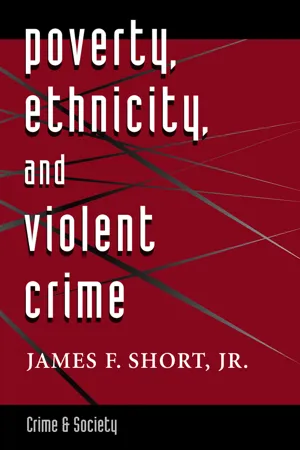
Poverty, Ethnicity, And Violent Crime
About this book
Violent crime in America is more strongly associated with poverty and with changing social and economic conditions than with race or ethnicity, and patterns of violence are changing. These are among the conclusions of Poverty, Ethnicity, and Violent Crime, a searching analysis that draws on scholarly research from all the social and behavioral sciences. By framing his analysis in terms of different levels of explanation, James Short is able to identify fundamental causal conditions and processes that result in violent crime. The book also examines current policies and political and scholarly controversies concerning the control of violent crime. This book can serve as a text or as supplementary reading for a variety of criminology courses. }Violent crime in America is more strongly associated with poverty and with changing social and economic conditions than with race or ethnicity, and patterns of violence are changing. These are among the conclusions of Poverty, Ethnicity, and Violent Crime, a searching analysis that draws on scholarly research from all the social and behavioral sciences. By framing his analysis in terms of different levels of explanation, James Short is able to identify fundamental causal conditions and processes that result in violent crime. The book also examines current policies and political and scholarly controversies concerning the control of violent crime. This book can serve as a text or as supplementary reading for a variety of criminology courses. }
Information
Chapter One
Introduction
Violence, aggression, violent crime. Although the terms are often used interchangeably, they have very different technical meanings. Depending on the specific behaviors classified under these labels and the contexts in which they occur, they also have very different consequences.
The National Research Council's Panel on the Understanding and Control of Violent Behavior defined violence as "behavior by persons against persons that intentionally threatens, attempts, or actually inflicts physical harm" and noted that "behaviors included in this definition are largely included in definitions of aggression" (Reiss and Roth 1993, p. 35). Aggression, thus, is a broader term than violence, encompassing behaviors that are intended to intimidate or humiliate, for example, but not to physically harm.
Much of what we know about the relationship between early childhood experiences and later violent behavior is based on research on the antecedents and observed correlates of aggression among children. Studies that follow children over a period of years find that children who are aggressive toward other children at around age 8 are more likely than others to exhibit violent behavior and to be delinquent or criminal as adolescents and adults (Reiss and Roth 1993, p. 103; Farrington 1989, 1991). The majority of such youngsters do not become seriously delinquent, criminal, or violently aggressive, however, and the mechanisms that distinguish those who do from those who do not are not well understood. I shall have more to say about the antecedents and correlates of aggressive childhood behavior in later chapters.
Violence and aggression are both more general classes of behaviors than are violent crimes. Violent crimes are distinguished from violence and aggression in that they are prohibited by the criminal law. Under the criminal law, specific classes of behavior are defined as crimes. Crime statistics result from the accounting practices of criminal justice and other governmental agencies charged with such responsibilities. Because data are collected by law enforcement and other official systems concerning the frequency with which such crimes are reported to the police, or the frequency of arrests or convictions of persons for commission of these crimes, large bodies of data are available for analysis. In addition, other official agencies, such as the U.S. Census Bureau and the Centers for Disease Control, collect data on some types of violent crime. These and other data systems are discussed and evaluated in Chapter 2, The availability of such data is both a strength and a weakness—a strength because data on homicide, in particular, are as reliable and valid as any system of data concerning human behavior are likely to be; a weakness because the behaviors classified as violent crimes, including homicide, mask a great deal of variability in behavior.
News accounts illustrate this point daily. A 1993 Conference on Urban Violence used a case study of weekend violence in a fictional city, "Cornet," to orient conference participants to the variety of violent behaviors that they, as members of an "Antiviolence Task Force," must deal with. The fictional report is similar to the actual report (cited by the NRC panel) from the New York Times of nine homicides that occurred in the New York City area on Christmas Eve and Day, 1990 (see Reiss and Roth 1993, pp. 31-32).
Six Slain in Weekend Murders; Victims Include 3-Year-Old
In the city's bloodiest weekend this year, six people died under circumstances ranging from child abuse to robbery.
On Friday evening there was an emergency call to an apartment in the Southwood section of the city, where police found a 3-year-old girl on the living room floor. The child had broken bones and multiple skull fractures, and was pronounced dead at the scene. Frank Cartwell, the common-law husband of the child's mother, was taken into custody. The mother has not yet been located.
In a second domestic matter a woman was shot by her estranged husband as she left her apartment. The previous week Teresa Cordoba had tried to get her husband arrested for threatening to kill her. A restraining order had been issued, according to Superior Court officials.
On Saturday night a convenience store clerk was shot twice in the head after being robbed by two men. Sung K. Suk, father of the slain man and the store's owner, witnessed the murder. He said that his son had offered no resistance. "He had given them [the] money and he was on his knees with his hands on [his] head. But the guy stood there ... shot him point-blank. It was really brutal."
Early Sunday morning an argument in the parking lot of a local bar left one man dead of multiple knife wounds. His assailant, Lawrence J. Peterson, also was wounded during the altercation and is listed in stable condition at the County Hospital. Patrons of the Hitching Post said the fight started when Peterson and the deceased, Michael Harrington, tried to leave the parking lot at the same time and had a minor collision. This was the third violent altercation at the bar so far this month.
A 17-year-old restaurant employee who was fired last week returned to his former place of work and opened fire on employees in the kitchen. The restaurant's owner was killed and several employees were wounded, one seriously. The youth, whose name is being withheld because of his age, fled the scene but was later arrested at his home.
Finally, 22-year-old Anita Woods was gunned down in the 700 block of Forten Street, in an aging section of Southwood known as Poplar Hills. CCPD detectives report that they have no motive at this time. (Kelly 1994)
These examples, diverse as they are, are only a sampling of the many types of behaviors that are classified as murder and nonnegligent manslaughter (homicide) thousands of times each year in this and in other countries. Such diversity is multiplied many times over by the inclusion of other legally classified violent offenses such as simple and aggravated assault and robbery. These and other types of illegal violent behavior will be discussed as we probe ethnographic studies for illustrations of theoretical points and clues to explanation.
It is important also to note that data systems of comparable scope and comprehensiveness are not available for noncriminal violent and other aggressive behaviors. This is particularly true for data regarding the socioeconomic status (SES) and ethnicity of offenders. For this reason the primary focus throughout the book is on criminal violence.
This focus is not as restrictive as it might at first appear, however. Violent crime covers a wide variety of specific behaviors and it is related in complex ways to many other types of behaviors and human conditions. The first task is to describe what is known about the historical background of violent crime (at the end of this chapter) and about patterns and trends of violent crime, the topic of Chapter 2. Chapter 3then discusses "levels of explanation" of violent crime, an important notion both for understanding violence and for the organization of the book. The next six chapters are the primary focus of the book as noted in the title—the role of poverty and ethnic status in violent crime. Chapter 4reviews studies that attempt to take into account a variety of contextual factors that enter into poverty-ethnicity-violence relationships, focusing especially on neighborhood and community contexts. Chapter 5 narrows the focus to youth groups, especially gangs, that are responsible for much violent crime. Building on previous chapters, the focus of Chapter 6 is on levels of explanation of violent crime committed in groups. Chapters 7, 8, and 9 are concerned with theories that attempt to explain violence and with integrating different levels of explanation. The final chapter focuses on what is known and, more importantly, what we need to know about controlling violent behavior.
The social distribution of violent crime—how much of it there is among categories of socioeconomic status, race, and ethnicity—explains neither offending nor victimization. Rather, it requires explanation. The "facts" concerning homicide offending or victimization, for example, do not explain how or why these events occurred. Instead they tell us what must be explained. The bulk of the book, therefore, is devoted to analysis of the research literature that informs and attempts to explain the occurrence of violent crime among individuals, groups, and communities that vary in racial, ethnic, and socioeconomic status composition.
The relevant literature is vast, complex, and controversial. Four conclusions from my review of this literature guide the organization of the book and its primary focus: (1) the linkage of what I shall call the individual, micro-and macrosocial levels of explanation is vital to the understanding and the explanation of violent crime; (2) although the precise nature of that linkage is unknown, it clearly involves the impacts of socioeconomic status on individuals, communities, and families; (3) understanding why teenagers and young adults commit so much violent crime is important to the explanation of violent crime; (4) violence among the young tends to involve others as co-offenders; hence, the nature of youth collectivities, such as gangs, is of special interest.
The relevance of categories of SES, race, and ethnicity to explanation—that is, to understanding the causes of violent crime—is problematic for many reasons, among them: (1) these relationships have changed markedly over the years; (2) they exhibit great variation from place to place; (3) rates of violent behavior, insofar as they can be determined, vary greatly within SES, racial, and ethnic categories; (4) the categories that are used to classify SES, race, and ethnicity mask a great deal of variation in th...
Table of contents
- Cover
- Half Title
- Title
- Copyright
- Contents
- List of Tables and Figures
- Foreword
- Preface
- 1 Introduction
- 2 Measuring Violent Crime: Trends and Social Distributions
- 3 "Levels of Explanation" of Violent Crime
- 4 Community and Neighborhood Contexts of Violent Crime
- 5 The Role of Unsupervised Youth Groups in Violence
- 6 Levels of Explanation of Violent Behavior Committed in Groups
- 7 Explaining Violent Crime: The Macrosocial Level of Explanation
- 8 The Individual Level of Explanation: Biobehavioral Influences and Control
- 9 Explaining Violence: Learning, Personality, and Social Contexts of Poverty, Race, and Ethnicity
- 10 Controlling Violent Crime
- Notes
- References
- About the Book and Author
- Index
Trusted by 375,005 students
Access to over 1.5 million titles for a fair monthly price.
Study more efficiently using our study tools.
Frequently asked questions
Yes, you can cancel anytime from the Subscription tab in your account settings on the Perlego website. Your subscription will stay active until the end of your current billing period. Learn how to cancel your subscription
No, books cannot be downloaded as external files, such as PDFs, for use outside of Perlego. However, you can download books within the Perlego app for offline reading on mobile or tablet. Learn how to download books offline
Perlego offers two plans: Essential and Complete
- Essential is ideal for learners and professionals who enjoy exploring a wide range of subjects. Access the Essential Library with 800,000+ trusted titles and best-sellers across business, personal growth, and the humanities. Includes unlimited reading time and Standard Read Aloud voice.
- Complete: Perfect for advanced learners and researchers needing full, unrestricted access. Unlock 1.5M+ books across hundreds of subjects, including academic and specialized titles. The Complete Plan also includes advanced features like Premium Read Aloud and Research Assistant.
We are an online textbook subscription service, where you can get access to an entire online library for less than the price of a single book per month. With over 1.5 million books across 990+ topics, we’ve got you covered! Learn about our mission
Look out for the read-aloud symbol on your next book to see if you can listen to it. The read-aloud tool reads text aloud for you, highlighting the text as it is being read. You can pause it, speed it up and slow it down. Learn more about Read Aloud
Yes! You can use the Perlego app on both iOS and Android devices to read anytime, anywhere — even offline. Perfect for commutes or when you’re on the go.
Please note we cannot support devices running on iOS 13 and Android 7 or earlier. Learn more about using the app
Please note we cannot support devices running on iOS 13 and Android 7 or earlier. Learn more about using the app
Yes, you can access Poverty, Ethnicity, And Violent Crime by James F. Short, Jr.,James F. Short Jr. in PDF and/or ePUB format, as well as other popular books in Social Sciences & Criminology. We have over 1.5 million books available in our catalogue for you to explore.