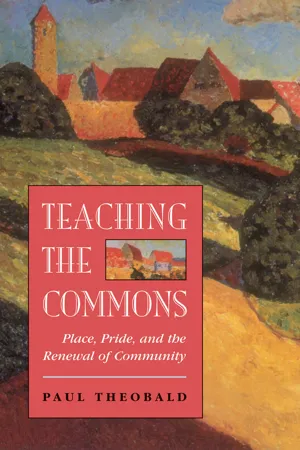
Reaching all the way back to the classical and medieval past, Teaching the Commons chronicles ideas and resulting policies that have shaped contemporary rural life and living in much of the industrial West. The book examines philosophical assumptions and charts their evolution into conventional wisdom about how human beings should meet their needs, govern themselves, and educate their children. Further, this book examines how policies emanating from these assumptions have slowly eroded the vitality of rural communities, finding that if there is sufficient interest in saving what is left of rural America, an educational agenda at the local level needs to be embraced by America's rural schools.Using concrete ideas generated in rural schools across the country, Teaching the Commons demonstrates that it is possible to simultaneously revitalize rural schools and communities. Through concerted curricular and pedagogical attention to place?the immediate locality?schools can contribute to rebuilding community in rural America on an educational foundation.Arguing that vital, self-governing communities rather than self-interested individuals represent the greatest hope for American democracy, Teaching the Commons lays out an institutional foundation that would turn the cultivation of civic virtue into an educational goal every bit as important and attainable as education for success in the economic market.
- 192 pages
- English
- ePUB (mobile friendly)
- Available on iOS & Android
eBook - ePub
About this book
Information
Part One
The Creation of Community from a Historical Perspective
1
Intradependence
I work to renew a ruined place that no life be hostage of my comfort.
—Wendell Berry, 1974
The movement toward greater environmental awareness since the 1960s has accomplished a number of things, not the least of which has been more widespread recognition of our dependence on nature. The word "dependence," according to Webster's New Collegiate Dictionary, means "to exist by virtue of necessary relations." For a time in this country, we prided ourselves on our independence from everything, including nature. We glorified the "rugged individualist" who needed nothing and no one. During the nineteenth century, we revered the image of the self-sustaining yeoman farmer. In myth, if not in reality, he personified independence. During the twentieth century, however, we began to speak of "interdependence," or existence by virtue of reciprocal relations. This term seemed to capture the modern economic scene in a way that independence did not. Still, although interdependence speaks of people doing things for each other, it does not completely capture the idea of nature as a player in necessary relations. "Intradependence," however, does. Intradependence means "to exist by virtue of necessary relations within a place."
Throughout most of human history, people lived their lives in a given locality and were highly dependent on the place itself and on those others with whom the place was shared. It has only been since the seventeenth century or so that intradependence of this sort has eroded and people have begun to think of themselves as individuals unencumbered by the constraints of nature or community. "Freedom" was the term we used to describe our unencumbered lives. Prior to this time, the definition of freedom was not so easily divorced from the entanglement of mutual obligations.
Classical Greece presents a fair example of intradependent living. The Greeks lived in a community-oriented world where status was tied to obligations well met. Although the Greeks were far from perfect, they spent a great deal of time and effort discussing the issue of freedom and its relationship to other grand ideas, such as dignity, rationality, and democracy. Operationalizing these ideas in terms of political, economic, and educational policy, as the Greeks did, has come to be known as "classical liberalism." It is important not to confuse this term with the word "liberal" as it is used by the popular media in the 1990s. Strictly speaking, to the degree that we create and execute public policy guided by the dictates of freedom, dignity, rationality, and democracy, we operate in a liberal system. However, use of the term "liberal" throughout this book is a reference to this larger social and political system and not to the ill-fitting contemporary use of the term.
Whereas classical liberals tended to think about freedom, dignity, rationality, and democracy in the context of a community, modern liberals, from the seventeenth century onward, have tended to think about these ideas in terms of what they mean for individuals as independent beings. For example, the Greeks often experimented with a kind of hands-on political obligation on the part of citizens, but modern liberals have preferred the idea of citizens merely choosing representatives. Whereas the Greeks worked at nurturing local economies built around key cities, modern liberals have worked to advance one large, national economy. And whereas education for the Greeks (of the Socratic tradition) tended to revolve around concerted study of ideas like truth, beauty, and justice and how these ideas might advance the quality of community life, education for modern liberals has centered around the preparation of individuals for the economic market, It doesn't take much reflection to recognize which of these ideas are most familiar. Indeed, modern liberal ideas seem so natural to us that it is difficult to see how circumstances might be different.
But things might have been far different. We might have started, for instance, with a definition of individuals as beings dependent on many kinds of relations, including those germane to the place in which they live. From this we might have concluded that the community is the basic human entity, and this would have prompted policy that better served community ends. Had we done this, our political, economic, and educational structures would have been significantly different from those we now know.
We can again turn to the classical Greek experience for an example. For the Greeks, freedom was the outgrowth of human dignity, something to be achieved through the exercise of rational power directed toward the betterment of the "polis," the Greek city-state. Individuals, as far as the Greeks were concerned, were first and foremost members of a community. A person's livelihood was assessed by considering the productive contribution it made to the life of the community. Although productive labor was highly valued, commercial enterprises like trading and banking were seen as parasitic and were considered to be beneath the dignity of citizens.
In a remarkably unmodern way, the classical Greeks lived their lives in the service of their community rather than in the service of their own individual wishes and desires. We will see that in the eighteenth century, modern liberals reversed this mindset and advanced the notion that one could best serve the community merely by pursuing one's own wishes and desires. Whereas the Greeks sought to replicate a kind of harmony in the universe, we have focused on manipulating the earth to our own ends. The Greeks believed there was one best way to live a life, whereas we have maintained that we must each march to our own drummer. The Greeks were so oriented toward community life that they simply did not have a word for "self" as we have since come to define it.
At this point the reader may well be asking "Why is it important to examine Greek thought?" The answer is that it is useful to understand that we borrowed heavily from Greek thinking about rationality, freedom, dignity, and democracy and that these concepts undergird our political, economic, and educational thought. But there is still one more crucial lesson embedded in the Greek experience that speaks directly to questions about the viability of rural communities and rural education. The Greeks demonstrated that it is possible to create a liberal system that is communally oriented. Steeped as we are within another worldview—an individually oriented one—it is often difficult to imagine that things might be done in a different way. The Greeks help us to see that human beings can in fact be motivated by something other than material accumulation, that something other than profit can drive an economy, that something other than occupational choice can direct one's education, and that political decisionmaking is the privilege and responsibility of all, not just of those who successfully run for office. The Greek worldview was external; that is, it looked out to the community in an effort to establish a kind of order or harmony. People looked at the community and its needs to find an individual "fit"—the communal role that an individual's life might occupy.
The contrast in worldviews provided by the Greeks is a useful concept. They measured the quality of their lives by the extent of their contributions to the community. Our outlook, however, measures the quality of lives according to what people can accumulate and proclaim as their own. One of the arguments of this book is that strengthening rural schools can help move us back in the direction of a community-oriented worldview.
In order to accomplish this, we need to recognize how very deeply embedded our modern worldview is. How did we move from classical to modern liberalism? How did the outlook change from external to internal? There is no simple answer, for the evolution took place over many centuries. The inward turn, however, is probably most directly attributable to St. Augustine, the Roman Catholic bishop who oversaw the demise of the classical world and the establishment of the feudal world. It was a subtle turn, not a dramatic one, and it was driven by the new idea that what was important about human life was not the relationship one created with the community, but rather the relationship one created with God. An individual needed to turn inward, to be introspective in order to assess the status of this relationship. Free will, according to St. Augustine, gave humans a great deal to inspect through introspection. "How did I handle the situation that came up today? Did I do it in a manner that was pleasing to God?" These are the kinds of questions that slowly turned an individual's attention inward. As the historian Thomas Cahill has pointed out, it was with St. Augustine that the world first witnessed heavy reference to the self, as manifested through the extensive use of the pronoun "I."1 The end result of a new emphasis on the individual's relationship with God was not the enhancement of community on earth, nor was it individual enhancement in the form of material accumulation on earth; it was, rather, individual salvation in heaven.
If this is the worldview and if these are the questions, one can see that the concern with the human ability to exercise rational power becomes significantly less important. And once again, this spills over into various arenas. It reopens the door to autocratic power, and it diminishes the propensity to emphasize the need for mass schooling. The feudal age witnessed both these effects. But life during these centuries remained very communally oriented. For one thing, even though the goal was individual salvation, the only way to get there was through the prescriptions and proscriptions of the church, a kind of community. Furthermore, as we shall see, the life of the medieval peasant was defined by intradependence; that is, it revolved around care and concern for the viability of shared places, something that demanded a communal outlook. In many ways the medieval world remained strongly communally oriented despite the fact that, with St. Augustine, a significant corner had been turned, opening a door to a modern, individually oriented outlook.2
The turn became more dramatic during the sixteenth-century Reformation. From the time of St. Augustine, the Catholic Church remained a pivotal focal point in medieval life, though it had been severely divided and tested from time to time. The collapse of its near-complete religious control over western Europe is most often attributed to two individuals, John Calvin and Martin Luther. Both of them rejected certain elements of the Catholic faith, but their theology is not what concerns us here. Rather, it was their promotion of the idea that humans had a choice in the matter of religion that caused the upheaval, for the work of Calvin and Luther handed this possibility to the Western world (though neither of these reformers would have made this one of their goals). John Rawls has argued that the Reformation, by introducing the concept of autonomy into what it means to be human, marks the very beginning of modern liberalism.3 What was essential about the Reformation was not that it cut into the power of the Catholic Church but that it gave people the opportunity to make choices. Individual autonomy, combined with Augustinian introspection, laid the foundation for an individual orientation to life that would take shape in the seventeenth century and would begin to touch the lives of millions during the eighteenth.
For hundreds of years the Catholic Church remained the authoritative source of knowledge about the world. The sixteenth-century Reformation called this tradition into serious question. Although it is true that the various Protestant groups tried to set up their own kinds of ecclesiastical authority, one can make the argument that a kind of "Pandora's box" was opened by the reformers and that the near-totally religious nature of the dominant way of looking at the world was torn apart.
Skeptics asked where they might go for answers about the world if the church did not possess ultimate authority on such questions. The immediate post-Reformation period is therefore often labeled the "Renaissance," or the period of the rebirth of inquiry, because more and more intellectuals, at least, turned to themselves for answers. And they were bolstered in their conviction to search for answers by revisiting the ancient Greek philosophers. They appropriated the Greek idea that humans have unlimited rational power, and they gave it a new twist. Instead of harnessing this power in the service of community, instead of being the passive recipients of a world order divined by God, humans could utilize their rational power for themselves by manipulating nature in such a way as to order the world to suit themselves.
The French mathematician and philosopher René Descartes was probably the most influential figure in shaping the increasingly individually oriented worldview. He took the Greek emphasis on human rationality as the measure of the individual's gift to the community and transformed it into the measure of a person's humanness. The quality of an individual life was determined by the rational power that a person could generate. For Descartes, the distinctive human attribute was simply thought, and we can see this in his now-famous phrase, "I think, therefore I am."4
One can readily see that renewing this Greek emphasis on rationality might not please church authorities. In fact, Descartes' life was filled with worry that he, too, like his contemporary Galileo, might be called before church authorities. In a curious way, however, the Cartesian emphasis on rationality meshed well with the introspective turn the notion of selfhood had taken after St. Augustine. Humankind,5 given its ability to think about the world, could thereby equip itself with the ability to act upon the world. Here, I believe the words of Descartes himself are instructive:
It is possible to reach knowledge that will be of much utility in this life; and that instead of speculative philosophy [about the divine order] now taught in schools we can find a practical one, by which knowing the nature and behavior of fire, water, air, stars, the heavens, and all other bodies which surround us, as well as we now understand the skills of our workers, we can employ these entities for all the purposes for which they are suited, and so make ourselves the masters and possessors of nature.6
Francis Bacon, Descartes' contemporary and colleague in England, believed that humans possessed the ability to render nature "our slave."
We can see that the seventeenth century added a couple of key ideas to the evolution of a modern worldview. Selfhood remained and in fact became increasingly defined by its introspective nature. Seventeenth-century thinkers like Descartes and Bacon were convinced that one determined who one was through inward searching and reflection. In addition, autonomy, or the power to make choices, was also a crucial contributor to selfhood. Both searching and reflection could be well pursued through the application of rational power. And with this power came the wherewithal to transform the world in order to achieve one's ends or desires.
It is now possible to list the building blocks of modern liberalism—introspection, autonomy, rationality, and a capacity for singular action on the world—and to see how they became the basis for a fundamental shift from a communally oriented to an individually oriented worldview. This individual orientation will become clearer if we look briefly at how these modern liberal tenets shake out in political, economic, and educational thought. In the realm of politics, for instance, modern liberals saw clearly what the Greeks had seen centuries earlier: that the capacity for rationality imbued humans with a certain dignity, a dignity that meant nothing without a commitment to human freedom. If you play out this thinking still further, you can see that there is no room for monarchical or totalitarian power in this worldview. But how, then, could free, autonomous, singularly acting individuals govern themselves? This was the question confronted by eighteenth-century Enlightenment philosophers, and their answer was something called "contract theory."
Keep in mind that fulfillment for modern liberals was tied up with the ability of an individual to pursue personal material desires. What was needed was a government that would not interfere in this process (thus the popular Enlightenment phrase "laissez faire"). But singularly acting individuals will inevitably run into other singularly acting individuals, and what's to keep one such person from interfering with another? To ensure there would be order in an individually oriented world, Enlightenment philosophers argued that autonomous, free, rational individuals needed to enter into a contract with one another to create a government that would be the great arbiter and peacekeeper in society (government was the entity charged with maintaining "domestic tranquillity," to use another eighteenth-century phrase). The function of government was to create a peaceful, harmonious society by harnessing the ostensible mutual benefit derived from individuals busily pursuing their own interests.
Next, in the economic realm, people were not to be burdened with producing a good society but rather were to be free to accumulate whatever wealth they could acquire. According to Adam Smith, author of two famous eighteenth-century economic treatises, The Theory of Moral Sentiments and The Wealth of Nations, an "invisible hand" would orchestrate the affairs of the marketplace and thereby produce the good society. Individuals would contribute to societal well-being simply by vigorously pursuing their own ends. Concern for producing either a kind of natural harmony or virtuous citizens who would shoulder the burden of meeting community needs was pushed aside in order to legitimate the manipulation of nature in the interest of profit. And if this ushered in forces that were "red in tooth and claw," as Alfred Lord Tennyson later described them, one should not be too quick to condemn the results. Adam Smith carefully explained that when our interpretation of human motives and God's purposes comes into play, we often "imagine that to be the wisdom of man, which is in reality the wisdom of God."7 In other words, God was creating the world through the expression of our material desires. Community traditions that impeded economic expansion, therefore, were increasingly seen as outdated, backward, or worse.8
Last, in the educational realm, the eighteenth century witnessed a great leap forward in the amount of formal schooling available in western Europe and the United States. By the end of the nineteenth century, free public schooling (though very often segregated by race) was almost universally available, at least in the United States. A worldview that rests heavily on human rational power cannot help but suggest that schooling ought to be widespread, and indeed, many of our founding fathers felt that a system of free schools ought to be one of the first orders of business in the various colonies-turned-states. Thomas Jefferson, for instance, tried (unsuccessfully) three times to get Virginia to pass a free-school bill.
It was in England, however, that the educational agenda for the emerging industrial state first began to take shape. Indeed, Adam Smith distinguished himself as one of England's first advocates of compulsory state-directed schooling. But whereas Smith was concerned with the creation of a common culture that would grease the skids for a smoothly functioning market economy, his early nineteenth-century followers, most nota...
Table of contents
- Cover
- Half Title
- Title
- Copyright
- Dedication
- Contents
- Acknowledgments
- Introduction
- Part One The Creation of Community from a Historical Perspective
- Part Two Public Policy and the Subordination of Community
- Part Three Education and the Renewal of Community
- Notes
- About the Book and Author
- Index
Trusted by 375,005 students
Access to over 1.5 million titles for a fair monthly price.
Study more efficiently using our study tools.
Frequently asked questions
Yes, you can cancel anytime from the Subscription tab in your account settings on the Perlego website. Your subscription will stay active until the end of your current billing period. Learn how to cancel your subscription
No, books cannot be downloaded as external files, such as PDFs, for use outside of Perlego. However, you can download books within the Perlego app for offline reading on mobile or tablet. Learn how to download books offline
Perlego offers two plans: Essential and Complete
- Essential is ideal for learners and professionals who enjoy exploring a wide range of subjects. Access the Essential Library with 800,000+ trusted titles and best-sellers across business, personal growth, and the humanities. Includes unlimited reading time and Standard Read Aloud voice.
- Complete: Perfect for advanced learners and researchers needing full, unrestricted access. Unlock 1.5M+ books across hundreds of subjects, including academic and specialized titles. The Complete Plan also includes advanced features like Premium Read Aloud and Research Assistant.
We are an online textbook subscription service, where you can get access to an entire online library for less than the price of a single book per month. With over 1.5 million books across 990+ topics, we’ve got you covered! Learn about our mission
Look out for the read-aloud symbol on your next book to see if you can listen to it. The read-aloud tool reads text aloud for you, highlighting the text as it is being read. You can pause it, speed it up and slow it down. Learn more about Read Aloud
Yes! You can use the Perlego app on both iOS and Android devices to read anytime, anywhere — even offline. Perfect for commutes or when you’re on the go.
Please note we cannot support devices running on iOS 13 and Android 7 or earlier. Learn more about using the app
Please note we cannot support devices running on iOS 13 and Android 7 or earlier. Learn more about using the app
Yes, you can access Teaching The Commons by Paul Theobald in PDF and/or ePUB format, as well as other popular books in Education & Education General. We have over 1.5 million books available in our catalogue for you to explore.