- 375 pages
- English
- ePUB (mobile friendly)
- Available on iOS & Android
eBook - ePub
About this book
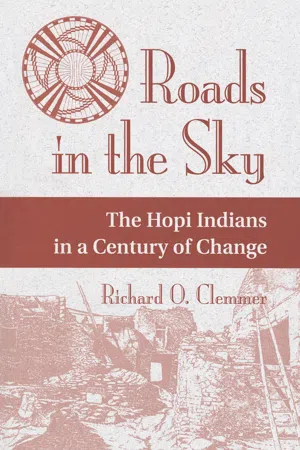
For the past 100 years, Hopis have had to deal with technological, economic and political changes originating from outside their society. The author documents the ways in which Hopis have used their culture and their socio-political structures to deal with change, focusing on major events in Hopi history. A study of "fourth worlders" coping with a dominant nation state, the book documents Hopi social organization, economy, religion and politics, as well as key events in the history of Hopi-US relations. Despite 100 years of contact with the dominant American culture, Hopi culture today maintains continuity with aboriginal roots while reflecting the impact of the 20th century.
Information
1
Hopi Prophecy, the World System, and Modernization
Prophecy and Events
Hopis have lived in their desert stronghold in northeastern Arizona for more than a thousand years. Yet as the world approached the millennium mark in the Twentieth Century, the same profound changes affecting the rest of humanity were also affecting Hopis. These changes, say Hopis, however, are no surprises; they were prophesied, as were others before them.
Late in the 19th century, several elderly Hopis prophesied that one day, roads would sweep across the sky, people would communicate through spider webs crisscrossing the land, and Pahaana — the Hopis' lost white elder brother — would return to help the Hopis overcome their problems. Decades later, airplanes flew over the reservation and telephone lines crisscrossed the land. Pahaana did not return. And a half-century later "Pahaana" had also become the term applied to all "white" people — Euro-Americans — despite the fact that none of them seem to have been the fulfillers of the Prophecy.
Roads in the Sky?
When I was a boy, down in the field, my father said someday, something pick you up, take you, drops you right at your. door. And someday, there'd be roads in the sky.
—Corn Clan man, 72, Shungopavi (Clemmer, Field Notes, 1968)
All this is known from prophecies: taxes, the road in the sky — that's airplanes — even the landing on the moon and the atomic bomb was prophesied. We know what is going to happen.
—Badger Clan man, 48, Hotevilla (Clemmer, Field Notes, 1968)
Our forefathers...told us that...there would be a road in the sky. How could anyone build a road in the sky...? When we see airplanes going back and forth over us we know what they were talking about.
—Sun Clan, ca. 90, Hotevilla (Kochongva 1956)
Hopi culture features prophecy as an important part of the ideology of tradition, and tradition as an important part of modern Hopi life. "What the whiteman calls 'prophecy,'"...said a Hopi teacher in 1982, "7 call the Hopi Life Plan. This life...was planned at some point in time. The Hopi call this tingavi. In Hopi, you set forth on a mission. This was how it was done at the beginning of this current life of the Hopi. A hard life, a life of confusion, turmoil, is predicted for the Hopis" (Hopi Health Department 1983:35-38).
Some of the confusion and turmoil are evident in issues of modern life that all Hopis must confront: pervasive factionalism; endemic political dissent; continuing controversy over a Tribal Council that sometimes loses its quorum for weeks at a time; "the evils of the white man (alcohol and drugs)" taking hold (Hopi Health Department 1984:20); quandaries over how to determine the appropriate role for tourists, anthropologists, missionaries, and partisans in the Hopi world. But modern Hopi life also features more measurable successes and tangible easing of life's hardships: the return of more than 1,000,000 acres of Hopi land; the return and repatriation of culturally and religiously significant art objects; achievement of increased control over mineral leasing; conquest of debilitating diseases and high infant mortality; demographic expansion and technological change.
The issues that Hopis confront in their everyday lives are part of a more global contest. This contest involves strategizing, battling, and negotiating for control over territories, resources, populations, and loyalties. It is a contest of politics, economics, and culture, full of unexpected outcomes, played out through the latest phase of human history — the phase of modernism and modernization. Despite apparent isolation, Hopis have been participants in this contest for 150 years.
This book documents the ways in which Hopis have collectively used their culture and their sociopolitical structures to deal with changes. I focus on six major events in Hopi history: a factionalist schism that split the largest Hopi village, Oraibi, into first three, then ultimately six separate villages; the impact of the federal Indian Reorganization Act of 1934; the rise of a political movement known as "Traditionalism"; the story behind far-reaching oil and coal leases of the 1960s; settlement of the Hopi-Navajo land dispute; and the disappearance of ceremonial objects into private collections and museums. I emphasize the role of ideology, but also the importance of a context formed by the world system, modernization, and political economic processes.
A Brief Introduction to Hopi Culture, History, and Context
Occupying the tops and escarpments of three mesas and a plateau to the south and east of the Grand Canyon, the Hopi are limited by legislative fiat and population pressure from neighboring Navajos to 1,500,000 acres. Descended from a mixture of prehistoric peoples loosely known as "Basketmaker" and Uto-Aztecan-speaking groups that migrated through the Colorado Plateau area sometime around 800 A.D. These immigrants contributed their language, "Hopic", which is related to Takic and Numic languages spoken by Cahuillas in southern California; Utes and Paiutes in Utah, Nevada, Oregon, eastern California, and northern Arizona; and Shoshones in Utah, Nevada, Wyoming, and eastern California. Among all of these linguistically related groups, the Hopi are the only people that have a distinctly Puebloan culture.
Puebloans share distinctive diagnostic cultural characteristics among themselves such as nucleated settlements built of two- and three-storey apartment complexes arranged in straight rows with streets and plazas; calendrical, collective ceremonies performed at specific times of the year; a pantheistic religion; and a subsistence strategy based heavily in horticulture. Puebloans were once widespread on the Colorado Plateau and the Rio Grande and San Juan River drainages, but population shrinkage and settlement nucleation resulted in Puebloans becoming concentrated in the Rio Grande and Pajarito Plateau areas of what is now the state of New Mexico by 1400. A few Puebloan groups settled to the west, however: at Acoma, Laguna, Zuni, and Hopi. Known as the western Pueblos, these peoples probably absorbed other Puebloans from abandoned settlements such as Mesa Verde, Chaco Canyon, the Mimbres River area, and even as far as Casas Grandes (Paquime') in northern Mexico. Hopis undoubtedly absorbed groups of Puebloans from Walnut Canyon, the Little Colorado River (Homolovi), and Sunset Crater (Wupatki, Wukoki) to the south as well as small Puelboan settlements in the Grand Canyon to the northwest and the Painted Desert area to the east. Therefore, Hopis' claimed aboriginal territory historically encompassed the San Francisco Peaks near Flagstaff, the Grand Canyon, all of Black Mesa, and areas south of Interstate 40 which cuts through northern Arizona — more than thirteen million acres.
In 1540, when first contacted by Spaniards, Hopis probably numbered between 5,000 and 6,000.1 When the United States formally extended jurisdiction into the Hopi area in 1870, several smallpox epidemics and famines had reduced the Hopi population to fewer than 2,400 (Dockstadter 1979:524-525; Simmons 1979:221.) Since then, villages have increased in number from seven to thirteen in the last 150 years, and the population has grown threefold to just over 9,000. Although mining and cattle grazing have come to dominate economically, many Hopis still regard earth and land as a sacred, rather than a secular, resource.
The Hopi are not only one of several hundred Native American "Tribes" enclaved on reservations, but also qualify as an "indigenous nation" within the scheme of international law and politics. Within this international scheme, indigenous nations began to assert collective rights to some degree of sovereignty, autonomy, and self-determination in the last quarter of the Twentieth Century. As one of these indigenous nations on the international stage as well as an American Indian Tribe with federal recognition, the Hopi are participants in a world-wide political and economic system in which efforts at modernization and attempts to maintain cultural pluralism often clash. Therefore, the Hopi provide a good case study not only for how a modern Puebloan group is handling the tensions of modernization and cultural preservation, but also of how a small indigenous nation is faring in the complex forces of world-wide modernization within the U.S. political and economic framework. Some of the problems that have confronted Hopis in the last century — such as those stemming from ecological and demographic events and even from population pressure from neighboring tribes — may be viewed independently from the impact of the world system; but other events and processes, such as the search for oil and coal; questions of cultural property; the spread of industrial technology; and the streamlining and rationalization of political forms and processes along Anglo-American and Eurocentric lines are being played out in an international arena. To the extent that the Hopi are affected by these processes and events — and thus are participants in them — their culture and history are as much products of forces originating well beyond the borders of Hopiland as much as they are products of historical traditions and trends that have been unfolding within Hopiland itself since time immemorial. Before focusing more specifically on the Hopi, then, a brief look at the concept of the "world system" and the parameters of the "modernity" that is taken as its hallmark, will provide a worthwhile perspective.
The World System, Modernization, and Cultural Pluralism
The concepts of a political economic "world system" and modernization provide the motivation for this study. World systems theory begins from the premise that identifiable social, political, and economic systems extend beyond individual nations, communities, and populations. Political and economic relations link and lock smaller social subsystems into larger ones. Production and distribution of goods, services, and people with the goal of maximizing profit and gaining economic advantage hold the system together. The world system started to form at least as early as the 15th century (Braudel 1981, 1982, 1984; Wallerstein 1974) and may have had its beginnings as early as the third century B.C. (Frank and Gills 1992).
Central to world systems theory are the concepts of core/periphery and metropolis/satellite. These pairs of concepts are similar. Cores are geographic areas where the most efficient production technologies are developed; where people have easy access to material goods and to the flow of money; where political and economic power-brokers hatch strategies for moving people and goods on a large scale, whether for military purposes or to develop new markets and products. Peripheries are geographical areas that provide labor and buyers of products, but have only small, dependent centers of commerce, money, and production. These small centers turn parts of peripheries, better termed semi-peripheries into little satellites of populations that work, buy, spend, and produce in response to the needs or whims of the power-brokers in the very centers — the metropoles — of the core areas (Jorgensen 1971:84-90; 1972:9-11). The core metropoles of the world system are generally acknowledged to have been in Germany and the United States during most of the 20th century; in England and France for the 18th, 19th, and early 20th centuries; and in Spain and Portugal in the 16th and 17th centuries, although Thornton (1992) has modified the picture somewhat by documenting the important role of competition from African states in the Dutch, Portuguese, and Spanish struggles for monopoly over the 15th-century world system.
Several general aspects of the world system are important to establish from the beginning. One is that the system has been spreading out from cores to peripheries for centuries, and in that spreading out, it has incorporated all or parts of pre-existing systems of trading, bartering, and marketing. These pre-existing systems, or parts of them, continue to function, often with relative autonomy, as subsystems of the world system. The linkage and locking of parts into the system has changed those parts, but the system itself is constantly being changed as well, by the specific cultural and social patterns which those parts bring to the system. The result is a trend toward homogenization, on the one hand, and pluralism on the other.
Secondly, there is a good deal of flexibility in the system, which usually benefits the power brokers most of all, but sometimes benefits participants in the subsystems at the expense of the power brokers. This flexibility stems from what might be called the "plug-in" factor. Populations and areas are sometimes connected by a very thin "wire" of distribution that either transmits labor and goods into the system or out. Whoever has the power to "pull the plug," so to speak, has the power to determine the relationship of the particular population and area to the entire system. But pulling the plug might result in merely greater autonomy for the isolated subsystem, following an adjustment period. Thus the "world system" is a system only in the sense that it has relatively few, but standardized, driving motivations: money, profit, valuation of material things, and the capacity to turn human labor and raw materials into money, profit, and material things. The question is whether those standardized, driving motivations of producing and selling things are pushing the world toward a single, homogenized cultural system.
The idea of a one-world, homogenized cultural system was introduced as the basis for the original concept of modernization back in the early 19th century. In the 1970s, some observers began to suggest the idea once again. One aspect of modernization is that political units have become larger while at the same time becoming fewer in number. Some observers took this trend plus the worldwide spread of such things as Pepsi- and Coca-cola, transistor radios, McDonald's hamburgers, Western-style clothing and music, and the world system's general commitment to constantly increasing production and maximizing economic advantage, as indications that a homogenous world culture was indeed emerging. They saw the idea of a homogenized world culture, with agreed-upon, shared values and attitudes, as a necessity if humans were going to solve problems such as warfare, famine, overpopulation, nuclear proliferation, runaway energy consumption, global warming, the hole in the ozone layer, pollution of the oceans, and desertification.
But other observers rioted just the opposite trend. Many peoples around the world have resisted various aspects of modernization, whether rightly or wrongly, and for a diversity of reasons, just as strongly as others have embraced them, and formerly large empires are currently undergoing "balkanization."
Indigenous Autonomy
Some of the strongest sources of that diversity continue to be the 5,000 or so indigenous peoples — some of them with shrinking populations — that anthropologists called "primitive" until not so long ago and studied intensively because they thought they were going to disappear. Many did (cf. Bodley 1989). But many did not. The Hopi are among those that did not disappear. They show no signs of doing so.
The most pressing questions embedded in the ideas of a world system, modernization, and cultural pluralism concern political and economic autonomy. Does cultural pluralism imply, or require political and economic pluralism? How likely is it that cultural distinctiveness can be pursued by a population unless it has territorial integrity, political autonomy, and control over its economic resources?
Some observers say it is very unlikely (Morris 1986; 1992; Robbins 1992). Yet few indigenous people have any degree of guaranteed territorial integrity or political autonomy within the nation-states that encompass them. Many have economic independence only to the degree that they are poverty-stricken and limited to a subsistence economy. Those in the United States — the 300 or so Indian Tribes — are virtually unique in that regard. And the degree to which the territorial integrity and political autonomy is real or illusionary is debatable (cf. Morris 1992; Robbins 1992; and Clemmer, Aberle, Jorgensen and Scudder 1989 with Washburn 1989).
Sills (1992) has suggested some measures of indigenous peoples' autonomy, largely in terms of a struggle against influence by the dominant nation-state. I suggest additional measures: (1) the degree to which an indigenous nation expands its territorial base; (2) the degree to which it bends the nation-state's political apparatus to its own political objectives; (3) the degree to which it is able to assert determining control over production and distribution of goods and services; and (4) the degree to which it successfully asserts its own cultural rules, norms, attitudes, values, and institutions as the basis for collective decision-making, problem-solving, and interaction with other indigenous nations as well as with the nation-state and with international bodies.
Against these measures of autonomy, and within the context of the world system, the six events taken for discussion raise some significant questions.
- Was the factionalist schism of 1906 a product of purely Hopi internal dynamics — a self-induced reshuffling of political relationship within an autonomous indigenous nation? Or a disintegration brought about by the imposition of U.S. rule?
- Did the Indian Reorganization Act implement a "prevailing system of colonial governance" (Robbins 1992:97) on behalf of the U.S.? Or did it grant Hopis' a relief from domination?
- Did the "Traditionalists" help to maintain Hopi cultural and political autonomy? Or did they just get in the way?
- Did oil and coal leases grant Hopis economic control? Or were they mere giveaways to multinational corporations?
- Did Hopis achieve a victory in a long-standing, on-going contest with Navajos? Or were they manipulated by outside interests, duped into internecine competition that benefitted third parties?
- Is the return and repatriation of ceremonial objects primarily a guilt-motivated good-will gesture to a Tribe whose ritual structure was meant to die? Or does it signify the impact of a minority's culture on the majority's thinking?
Some tentative answers lie in an analysis of Hopi culture and history at the points where they intersect Euro-American history and culture. Such an analysis must take into account the pressures and constraints, but also the opportunities and possibilities, that the interaction has created.
The dialogic, two-way nature of American and Hopi relationships has been defined largely by political, economic, and cultural factors. Hopis have developed cultural and political ideologies that mediate this dialogue. After 100 years of c...
Table of contents
- Cover
- Half Title
- Title
- Copyright
- Contents
- List of Tables and Illustrations
- Preface
- Acknowledgments
- A Note on Orthography
- 1 Hopi Prophecy, the World System, and Modernization
- 2 An Introduction to Hopi Society and Material Conditions
- 3 Spaniards, Navajos, Mormons: 1540-1875
- 4 Hopi Culture on the Edge of the Twentieth Century
- 5 The Oraibi Split of 1906 and the Great Transformation
- 6 Reorganization: 1910-1945
- 7 The Rise of the Traditionalists: 1946-1977
- 8 Mineral Leasing, 1961-1989
- 9 The Hopi-Navajo Land Dispute: 1958-1993
- 10 Repatriation: The Present, the Future, and Beyond
- 11 Conclusion: Hopi Society, the World System, and Modernization
- Notes
- References
- About the Book and Author
- Index
Trusted by 375,005 students
Access to over 1.5 million titles for a fair monthly price.
Study more efficiently using our study tools.
Frequently asked questions
Yes, you can cancel anytime from the Subscription tab in your account settings on the Perlego website. Your subscription will stay active until the end of your current billing period. Learn how to cancel your subscription
No, books cannot be downloaded as external files, such as PDFs, for use outside of Perlego. However, you can download books within the Perlego app for offline reading on mobile or tablet. Learn how to download books offline
Perlego offers two plans: Essential and Complete
- Essential is ideal for learners and professionals who enjoy exploring a wide range of subjects. Access the Essential Library with 800,000+ trusted titles and best-sellers across business, personal growth, and the humanities. Includes unlimited reading time and Standard Read Aloud voice.
- Complete: Perfect for advanced learners and researchers needing full, unrestricted access. Unlock 1.5M+ books across hundreds of subjects, including academic and specialized titles. The Complete Plan also includes advanced features like Premium Read Aloud and Research Assistant.
We are an online textbook subscription service, where you can get access to an entire online library for less than the price of a single book per month. With over 1.5 million books across 990+ topics, we’ve got you covered! Learn about our mission
Look out for the read-aloud symbol on your next book to see if you can listen to it. The read-aloud tool reads text aloud for you, highlighting the text as it is being read. You can pause it, speed it up and slow it down. Learn more about Read Aloud
Yes! You can use the Perlego app on both iOS and Android devices to read anytime, anywhere — even offline. Perfect for commutes or when you’re on the go.
Please note we cannot support devices running on iOS 13 and Android 7 or earlier. Learn more about using the app
Please note we cannot support devices running on iOS 13 and Android 7 or earlier. Learn more about using the app
Yes, you can access Roads In The Sky by Richard O. Clemmer in PDF and/or ePUB format, as well as other popular books in Social Sciences & Anthropology. We have over 1.5 million books available in our catalogue for you to explore.