- 240 pages
- English
- ePUB (mobile friendly)
- Available on iOS & Android
eBook - ePub
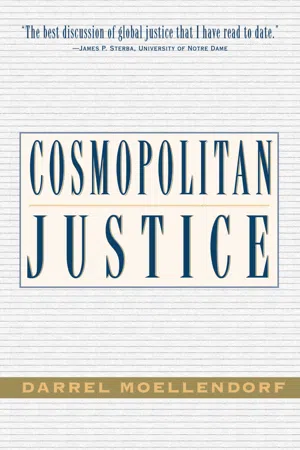
Cosmopolitan Justice
About this book
Increasing global economic integration and recent military interventions in the name of human rights have forced questions of global justice into political discussions. In presenting a systematic account of global duties of justice, Cosmopolitan Justice departs from many contemporary accounts that take the scope of justice to be limited to the state or nation. Is the unequal distribution of wealth across the globe just? Are the most indebted countries obliged to pay back their loans to international financial institutions? Does respecting state sovereignty prohibit intervening in the affairs of other states? What is the moral basis of international law? Cosmopolitan Justice takes on these questions and much more.
Information
INTRODUCTION
A Tale of Two Tendencies in International Law
All human beings are born free and equal in dignity and rights. They are endowed with reason and conscience and should act towards one another in a spirit of brotherhood.
—Universal Declaration of Human Rights1
JUSTICE IN PHILOSOPHY AND LAW
This book focuses on matters of social justice. Social justice concerns the moral nature of the institutions that mediate interactions among persons. Although so-conceived social justice may be narrower in scope than justice per se, for the sake of simplicity I shall use the term justice as equivalent to social justice. At base our moral duties of justice are directed to other persons, but these duties are usually discharged through conduct directed toward institutions, such as obeying existing institutional rules, defying them, or advocating and aiding in the construction of new institutions that will promote just interactions. For example, although a duty of justice to others involves protecting them from criminal wrongdoing and apprehending the wrongdoer, this duty is discharged by paying taxes to support the police and judicial system and by cooperating with police and judicial investigations. It does not typically require that citizens police the streets. Duties of justice are a part of morality, but not by any means the whole of it. Not all moral duties to others are institutionally mediated. For example, a duty to tell the truth may be, and usually is, satisfied without any reference to institutional rules at all.
This book is particularly focused on matters of international justice concerning the justification, content, and practical requirements of duties of justice to noncompatriots. Arguments about these matters fall within the province of political and moral philosophy. Justice is, however, a legal concept as well as a philosophical one. Some writers on international justice are concerned with making legal arguments about the existence, interpretation, and consequences of rules that govern existing institutions and patterns of international interaction. Although any distinction between moral and legal approaches to justice may be controversial, one way to think about it is that the former abstracts from existing institutional requirements and develops an account of the duties that persons owe to each other by considering the nature of justice itself; whereas the latter seeks a proper grasp of existing practices and institutions, endeavoring to understand what the rules that govern them imply about a person's obligation.2
As a philosophical approach to the matter of international justice, this book attempts to answer questions such as, What is the justification for human rights? What duties of justice do we have to persons in other countries? What is the justification and limit of state sovereignty? When, if ever, are wars justified?
The relationship between the philosophical conclusions to these questions and the legal treatment of similar issues is important. One position in contemporary jurisprudence, known as legal positivism, holds that the law can be known without an assessment of whether it is just.3 Ronald Dworkin rejects this position, in part, by maintaining that certain moral principles are part of the law even before they are expressed in legal holdings or statutes.4 A philosophical approach to justice may complement legal positivism by providing an account of what the law should be. It may also complement the Dworkinian approach by providing a justification of the principles that putatively are part of the basis of law. Either as an account of what the law should be or as a justification of what it is, there is a practical payoff to the philosophical account of justice. Therefore, it may prove useful as an introduction to subsequent chapters to consider some issues concerning the nature of international law.
STATISM AND COSMOPOLITANISM IN CONTEMPORARY INTERNATIONAL LAW
Treaties, including United Nations (UN) legal documents, are one important source of international law. This body of law includes the UN Charter, which governs relations among all member states, as well as various covenants that govern relations among the signatory states. Within these documents there exists significant tension about the proper and ultimate concern of international law. One conception of the basis of international law takes it to be based upon the principle of self-determination and respect for the sovereign equality of all states. This view holds that the UN seeks above all to protect the interests of states as corporate bodies and seeks in particular to prevent them from unwanted interference by other states. I call this view statist.
The following two paragraphs of Article 2 of the UN Charter appear to be expressions of statism:
2(4): All members shall refrain in their international relations from the threat or use of force against the territorial integrity or political independence of any state, or in any manner inconsistent with the Purposes of the United Nations.5 2(7): Nothing contained in the present Charter shall authorize the United Nations to intervene in matters which are essentially within the domestic jurisdiction of any state or shall require the Members to submit such matters to settlement under the present Charter; but this principle shall not prejudice the application of enforcement measures under Chapter VII.6
Paragraph 2(4) identifies territorial integrity and political independence as the two main interests of states. These are not expressed as indirect interests of persons, but as interests of states, which the Charter in this paragraph seeks to defend from unilateral usurpation by other states. Paragraph 2(7) seeks to shield certain matters "essentially within the domestic jurisdiction" against collective UN interference. Again, it would appear that it is states' interests that are being protected.7
The application of paragraph 2(4) has protected states from interference by others and thereby given them broad license to pursue domestic policy goals in the manner seen fit by their leaders. One consequence of this is that persons seeking to change the internal order of their state may not receive help from other states, whereas the state resisting the change may get help if it so wishes. Thus, the paragraph has been the basis for condemnation of what are considered to be indirect threats or uses of force by other states, such as actively assisting or encouraging civil strife or armed bands in other countries. On November 27, 1948, the General Assembly condemned Albania, Bulgaria, and Yugoslavia for aiding Greek communist guerrillas.8
Although third parties may not aid revolutionary movements within other countries, those countries, being sovereign, may legitimately use force to suppress such movements.9 This is the significance of the language "in their international relations." The use of force internally is not questioned; there would be then no symmetrical condemnation of third parties who actively assisted or encouraged states in their internal struggles. The Soviet Union sought to justify its intervention into Hungary in 1956 with the claim that it was intervening at the invitation of the Hungarian government. The United States defended its intervention into the Dominican Republic on April 28, 1965, by claiming a "threat to the lives of its citizens, and a request for assistance from those Dominican authorities still struggling to maintain or der."10 The net effect is a bias in favor of existing state arrangements. Thus, statist international legal principles have conservative implications.
Paragraph 2(4) does not impose an absolute bar against unilateral intervention. It would seem to permit unilateral intervention that does not violate territorial integrity and political independence of a state and that is consistent with the purposes of the UN. Hence, it may not be entirely conservative in its effect. It is a matter of some controversy among international lawyers, however, whether unilateral interventions to promote justice would be permitted by paragraph 2(4).11
Paragraph 2(7) seems to permit collective interventions that either do not affect matters essentially within the domestic jurisdiction of a state or that are required by Chapter VII. In light of the reference to Chapter VII, paragraph 2(7) is arguably more permissive of interventions than is 2(4). The most relevant section in Chapter VII is Article 39, which permits the Security Council to authorize measures in the event of "any threat to the peace, breach of peace, or act of aggression" in order to "maintain or restore international peace and security."12 The debate about the legality of unilateral intervention under paragraph 2(4) is paralleled by a debate about the extent to which collective intervention to promote justice is licensed by paragraph 2(7). This paragraph does not directly license interventions to promote justice.13 However, what are authorized are collective efforts to restore international peace and security that have the effect of promoting justice, such as Security Council Resolution 940 on Haiti in 1994.14 In any case, it does seem as if paragraph 2(7) would not warrant an intervention to promote justice if international peace and security were not at risk.15
The Declaration of Principles of International Law Concerning Friendly Relations and Co-operation among States in Accordance with the Charter of the United Nations was adopted in 1970 as an elaboration of the principles of the charter. In contrast to paragraphs 2(4) and 2(7), the declaration does lay down an absolute bar against intervention: "No State or group of States has the right to intervene, directly or indirectly, for any reason whatever, in the internal or external affairs of other States." This is an unambiguous expression of statism.
The United Nations came into existence at the end of the Second World War when the conscience of the world was horrified by the genocidal practices of the Nazi regime. Any consistent commitment to unqualified statism would have rendered the UN impotent against similar injustices in the future. Indeed, the post-war period also witnessed the blossoming of a very different conception of the basis of international law, as a variety of statements affirming a commitment to international human rights were issued. According to these statements, the claims of individual persons constitute the basis of international legal obligations. This view is sometimes called "cosmopolitanism."
The UN Charter expresses the cosmopolitan perspective at several points. The preamble reaffirms "faith in fundamental human rights, in the dignity and worth of the human person, in equal rights of men and women."16 Article 55 commits the UN to the promotion of "universal respect for, and observance of, human rights and fundamental freedoms for all without distinction to race, sex, language, or religion."17 Article 56 expresses a pledge "to take joint and separate action. . . for the achievement of the purposes set forth in Article 55."18 However, the content of this cosmopolitan commitment to human rights in the charter is left unspecified. The Universal Declaration of Human Rights adopted by the UN General Assembly fills out this content considerably, proclaiming rights to life, liberty, security of person, recognition as a person before the law, ownership of property, freedom of expression, assembly, and association, and freedom from slavery and torture.19 The status of the declaration, however, is less than a law of treaty,20 though there is some debate about whether it rises to the level of customary international law after more than fifty years of existence.21
The International Covenant on Economic, Social, and Cultural Rights and the International Covenant of Civil and Political Rights offer interpretations of the charter's commitment to human rights that do have the force of treaty law among their signatories. Protected by the first covenant are the rights to work under favorable conditions, to join trade unions, to the enjoyment of the highest attainable standards of physical and mental health, and to free compulsory primary education.22 The second covenant protects the rights to life, liberty, security of person, recognition as a person before the law, ownership of property, freedom of expression, assembly, and association, and freedom from slavery and torture.23
As indicated earlier in connection with the controversy surrounding the implications of paragraphs 2(4) and 2(7), there is considerable legal debate about how to reconcile the statist proclamations on sovereignty with the cosmopolitan ones on human rights, both of which exist in contemporary international law. This book does not take sides on the legal questions, but seeks instead a philosophical defense and extension of the cosmopolitan conception of justice. For the reasons noted above, the successful defense of this perspective will complement the efforts of international lawyers seeking to defend legal cosmopolitanism by providing a moral justification for their legal orientation. Similarly it will complement empirical work in political science and international relations by providing the basis for a moral assessment of the events and trends that they study. Finally, for those in policy studies, there are important implications of this account of what ought to be done to fulfill duties of justice to noncompatriots.
THE ROAD AHEAD
Chapter 2 takes up foundational issues in the justification of cosmopolitan justice. I defend a version of cosmopolitanism that draws heavily on the poli...
Table of contents
- Cover
- Half Title
- Title
- Copyright
- Dedication
- Contents
- Preface
- 1 Introduction: A Tale of Two Tendencies in International Law
- 2 Rawlsian Constructivism and Cosmopolitan Justice
- 3 The Borders of Justice
- 4 Global Egalitarianism and Imperialism
- 5 Cosmopolitan Sovereignty and Justified Intervention
- 6 A Cosmopolitan Account of National Self-determination
- 7 Political Realism, Pacifism, and the Justice of War
- 8 Concluding Remarks: Toward an Egalitarian World Order
- Notes
- Bibliography
- Index
Trusted by 375,005 students
Access to over 1.5 million titles for a fair monthly price.
Study more efficiently using our study tools.
Frequently asked questions
Yes, you can cancel anytime from the Subscription tab in your account settings on the Perlego website. Your subscription will stay active until the end of your current billing period. Learn how to cancel your subscription
No, books cannot be downloaded as external files, such as PDFs, for use outside of Perlego. However, you can download books within the Perlego app for offline reading on mobile or tablet. Learn how to download books offline
Perlego offers two plans: Essential and Complete
- Essential is ideal for learners and professionals who enjoy exploring a wide range of subjects. Access the Essential Library with 800,000+ trusted titles and best-sellers across business, personal growth, and the humanities. Includes unlimited reading time and Standard Read Aloud voice.
- Complete: Perfect for advanced learners and researchers needing full, unrestricted access. Unlock 1.5M+ books across hundreds of subjects, including academic and specialized titles. The Complete Plan also includes advanced features like Premium Read Aloud and Research Assistant.
We are an online textbook subscription service, where you can get access to an entire online library for less than the price of a single book per month. With over 1.5 million books across 990+ topics, we’ve got you covered! Learn about our mission
Look out for the read-aloud symbol on your next book to see if you can listen to it. The read-aloud tool reads text aloud for you, highlighting the text as it is being read. You can pause it, speed it up and slow it down. Learn more about Read Aloud
Yes! You can use the Perlego app on both iOS and Android devices to read anytime, anywhere — even offline. Perfect for commutes or when you’re on the go.
Please note we cannot support devices running on iOS 13 and Android 7 or earlier. Learn more about using the app
Please note we cannot support devices running on iOS 13 and Android 7 or earlier. Learn more about using the app
Yes, you can access Cosmopolitan Justice by Darrel Moellendorf in PDF and/or ePUB format, as well as other popular books in Philosophy & International Law. We have over 1.5 million books available in our catalogue for you to explore.