eBook - ePub
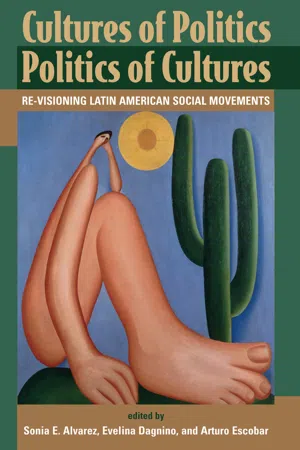
Cultures Of Politics/politics Of Cultures
Revisioning Latin American Social Movements
- 480 pages
- English
- ePUB (mobile friendly)
- Available on iOS & Android
eBook - ePub
Cultures Of Politics/politics Of Cultures
Revisioning Latin American Social Movements
About this book
This book argues the relationship between culture and politics can be productively explored by delving into the nature of the cultural politics enacted by Latin American social movements and by examining the potential of this cultural politics for fostering social change.
Information
Chapter One
Introduction: The Cultural and the Political in Latin American Social Movements
SONIA E. ALVAREZ, EVELINA DAGNINO, AND ARTURO ESCOBAR
As we approach the millennium’s end, what future is in store for Latin American societies? Unprecedented levels of violence, poverty, discrimination, and exclusion would seem to indicate that the “performance” and indeed the very design of Latin America’s “new” democracies are far from satisfactory. And it is precisely over possible alternative blueprints for democracy that much of the political struggle is being waged in Latin America today. Social movements, we will claim, play a critical role in that struggle. Fundamentally in dispute are the parameters of democracy—to be sure, the very boundaries of what is to be properly defined as the political arena: its participants, its institutions, its processes, its agenda, and its scope.
Programs of economic and social adjustment, inspired by neoliberalism, have entered this dispute as formidable and pervasive contenders. In response to the allegedly “inevitable” logic imposed by the processes of economic globalization, neoliberal policies have introduced a new kind of relationship between the state and civil society and advanced a distinctive definition of the political domain and its participants—based on a minimalist conception of both the state and democracy.
As civil society is charged with taking on the social responsibilities now eschewed by neoliberalism’s shrinking state, its capacity as a crucial political domain for the exercise of democratic citizenship is increasingly being downplayed. Citizens, in this view, should pull themselves up by their own private bootstraps, and citizenship is increasingly equated with individual integration into the market.
An alternative conception of citizenship—one advanced by several of the movements discussed in this volume—would view democratic struggles as encompassing a redefinition not only of the political system but also of economic, social, and cultural practices that might engender a democratic ordering for society as a whole. Such a conception calls our attention to a wide array of possible public spheres wherein citizenship might be exercised and societal interests not only represented but also fundamentally re/shaped. The scope of democratizing struggles would be extended to encompass not just the political system but also the future of “development” and the eradication of social inequalities such as those of race and gender, deeply shaped by cultural and social practices. This enlarged conception further acknowledges that the process of building democracy is not homogeneous but rather internally discontinuous and uneven: Different spheres and dimensions have distinct rhythms of change, leading some analysts to argue that this process is inherently “disjunctive” (Holston and Caldeira, forthcoming; see also Jelin and Hershberg 1996).
Social movements not only have sometimes succeeded in translating their agendas into public policies and in expanding the boundaries of institutional politics but also, significantly, have struggled to resignify the very meanings of received notions of citizenship, political representation and participation, and, as a consequence, democracy itself. Both the processes of translating movement agendas into policy and of redefining the meaning of “development” or “citizen,” for example, entail the enactment of “cultural politics”—a concept developed in the field of cultural studies, which, we will argue, can help shed new light on social movements’ cultural and political stakes in the contemporary struggle over the fate of democracy in Latin America.
Reconceptualizing the Cultural in Latin American Social Movements Research
From Culture to Cultural Politics
This book is intended primarily as an investigation into the relationship between culture and politics. We argue that this relationship can be productively explored by delving into the nature of the cultural politics enacted—with more or less clarity and to a greater or lesser extent—by all social movements and by examining the potential of this cultural politics for fostering social change.
Conventional social science has not systematically explored the connections between culture and politics. We alluded to this fact in our earlier work (Escobar and Alvarez 1992; Dagnino 1994). It is important to discuss the changing conceptions of culture and politics in anthropology, literature, and other disciplines as a backdrop to understanding how the concept of cultural politics arose from the intense interdisciplinary dialogue and blurring of boundaries that has taken place in the last decade, fostered by various poststructuralist currents. In our previous anthology, we pointed out that the conventional understanding of culture in various fields as static—embedded in a set of canonical texts, beliefs, and artifacts—has contributed greatly to rendering invisible everyday cultural practices as a terrain for, and source of, political practices. Theorists of popular culture such as de Certeau (1984), Fiske (1989), and Willis (1990) moved beyond this static understanding to highlight how culture involves a collective and incessant process of producing meanings that shapes social experience and configures social relations. Studies of popular culture thus pushed research in the humanities further away from the “high culture” emphasis originating in literature and the arts and closer to an anthropological understanding of culture. This closeness had already been propitiated by Raymond Williams’s characterization of culture as “the signifying system through which necessarily (though among other means) a social order is communicated, reproduced, experienced and explored” (1981, 13). As Glenn Jordan and Chris Weedon note, “Culture in this sense, is not a sphere, but a dimension of all institutions—economic, social and political. Culture is a set of material practices which constitute meanings, values and subjectivities” (1995, 8).
In a recent influential volume, Williams’s definition is elaborated upon to conclude that “in cultural studies ... culture is understood both as a way of life—encompassing ideas, attitudes, languages, practices, institutions, and structures of power—and a whole range of cultural practices: artistic forms, texts, canons, architecture, mass-produced commodities, and so forth” (Nelson, Treichler, and Grossberg 1992, 5). This characterization of culture points to grounded practices and representations as central to culture yet, in practice, its main emphasis continues to be on textual and artistic forms. This accounts, we believe, for a number of critiques waged at cultural studies such as the seemingly problematic reliance on “quick and dirty” ethnographies, the salience of textual analyses, and the importance ascribed to the culture industries and to paradigms of reception and consumption of cultural products. Whatever the validity of these criticisms—as we shall explain below—it is fair to say that cultural studies has not given sufficient importance to social movements as a vital aspect of cultural production.1
The notion of culture is also actively debated in anthropology. Classical anthropology adhered to a realist epistemology and a relatively fixed understanding of culture as embodied in institutions, practices, rituals, symbols, and the like. Culture was seen as belonging to a group and bounded in time and space. This paradigm of organic culture suffered significant blows with the development of structural, political economy-oriented, and interpretive anthropology. Building on hermeneutics and semiotics, interpretive anthropology moved toward a nonpositivist, partial understanding of culture, partly driven by the metaphor of “cultures as texts.” In the mid-1980s, a further displacement of culture sought to take account of the fact that “no one can write about others any longer as if they were discrete objects or texts,” and took to developing “new conceptions of culture as interactive and historical” (Clifford and Marcus 1986, 25). Since then, the growing awareness of the globalization of cultural and economic production has pushed anthropologists to question spatial notions of culture, dichotomies between homogeneous “us” and discrete “others,” and any illusion of clear boundaries between groups, self or other (see Fox 1991; Gupta and Ferguson 1992).2
One of the most useful aspects of the poststructuralist understanding of culture in anthropology is its insistence on the analysis of production and signification, of meanings and practices, as simultaneous and inextricably bound aspects of social reality. In this vein, Kay Warren (in this volume) argues that material conditions are too often viewed as “more autonomous, real, and basic than anything else. ‘But what about exploitation?’ is the critics’ common reply, through which they seek to convey a materialist urgency that trumps cultural issues, no matter how worthy.” Warren goes on to suggest that social movements’ “material demands are in practice politically advanced selective constructions, conveyed in fields of social relations that also define their significance” and advocates an alternative conceptualization that “would confront the cultural issues (and political interests) infused in the construction of materialist politics as well as the materialist concerns (and political interests) infused in cultural framings of politics.” While anthropologists have generally attempted to intertwine the analyses of “the symbolic and the material,” advances in the theory of discourse and representation have provided tools for more nuanced accounts of the mutual constitution, indeed inseparability, of meanings and practices (see Comaroff and Comaroff 1991 for an excellent example of this approach).
This development has useful lessons for cultural studies; in fact it jibes well with what is perceived to be a central issue in the field, namely, what the metaphors of culture and textuality both help to explain and fail to address. The issue is expressed eloquently in Stuart Hall’s retrospective account of the impact of the “linguistic turn” in cultural studies. For Hall, the discovery of discursivity and textuality brought forth the realization of “the crucial importance of language ... to any study of culture” (1992, 283). It was thus that cultural studies practitioners found themselves always “driven back to culture.” Yet despite the importance of the metaphor of the discursive, for Hall
there is always something decentered about the medium of culture, about language, textuality, and signification, which always escapes and evades the attempt to link it, directly and immediately, with other structures.... [We must assume that] culture will always work through its textualities—and at the same time that textuality is never enough.... Unless and until one respects the necessary displacement of culture, and yet is always irritated by its failure to reconcile itself with other questions that matter, with other questions that cannot and can never be fully recovered by critical textuality in its elaborations, cultural studies as a project, an intervention, remains incomplete. (1992, 284)3
Hall’s dictum that culture and textuality “are never enough,” in our view, refers to the difficulty of pinning down, through culture and textuality, “other questions that matter,” such as the structures, formations, and resistances that are inevitably permeated by culture, the “something nasty down below” to which Hall wants to return cultural studies from “the clean air of meaning and textuality” (1992, 278). Hall thus reintroduces politics into the midst of cultural studies, not only because his formulation provides a means to hold theoretical and political questions in tension but because it calls upon theorists—particularly those too prone to remain at the level of the text and the politics of representation—to engage with “the something nasty down below” as a question of both theory and politics.
In other words, the tension between the textual and that which underlies it, between representation and its grounding, between meanings and practices, between narratives and social actors, between discourse and power can never be resolved in the terrain of theory. But the “never enough” goes both ways. If there is always “something else” beyond culture, something that it not quite captured by the textual/discursive, there is also something else beyond the so-called material, something that is always cultural and textual. We shall see the importance of this reversal for the cases of social movements of very poor and marginalized people, for whom the first goal of the struggle is often to demonstrate that they are people with rights, so as to recover their dignity and status as citizens and even as human beings. In other words, this tension is only provisionally resolved in practice. We argue that social movements are a crucial arena for understanding how this perhaps precarious yet vital entanglement of the cultural and the political occurs in practice. Moreover, we believe that the conceptualization and investigation of the cultural politics of social movements is a promising theoretical detour that heeds Hall’s call.
From Cultural Politics to Political Culture
Despite its commitment to a broader understanding of culture, much of cultural studies, particularly in the United States, continues to be heavily oriented toward the textual. This has to do with disciplinary, historical, and institutional factors (Yúdice, in this volume). This bias finds its way into the use of the concept of cultural politics. In its current usage—despite the interest of cultural studies scholars in examining the relations between cultural practices and power and their commitment to social transformation—”cultural politics” often refers to disembodied struggles over meanings and representations, the political stakes of which for concrete social actors are sometimes difficult to discern.
We concur with the definition of cultural politics advanced by Jordan and Weedon in their recent book by the same title:
The legitimation of social relations of inequality, and the struggle to transform them, are central concerns of CULTURAL POLITICS. Cultural politics fundamentally determine the meanings of social practices and, moreover, which groups and individuals have the power to define these meanings. Cultural politics are also concerned with subjectivity and identity, since culture plays a central role in constituting our sense of ourselves.... The forms of subjectivity that we inhabit play a crucial part in determining whether we accept or contest existing power relations. Moreover, for marginalized and oppressed groups, the construction of new and resistant identities is a key dimension of a wider political struggle to transform society. (1995, 5–6)
However, by focusing their analysis on the “dominant... conception of culture,” which reduces it to “music, literature, painting and sculpture, theater and film,” now broadened to include the cultural industries, “popular culture” and the “mass media,” Jordan and Weedon appear to share in the assumption that the politics of representation—as gleaned mostly from textual forms and analysis—has a direct and clear link with the exercise of power and, correspondingly, with resistance to it. Not always, however, are these links made explicit in ways that illuminate the actual or potential stakes and political strategies of particular social actors. We argue that these links are evident in the practices, the concrete actions, of Latin American social movements, and we thereby wish to extend the concept of cultural politics in analyzing their political interventions.
It is important to emphasize the fact that in Latin America today all social movements enact a cultural politics. It would be tempting to restrict the concept of cultural politics to those movements that are more clearly cultural. In the 1980s, this restriction resulted in a division between “new” and “old” social movements. New social movements were those for which identity was important, those that engaged in “new forms of doing politics,” and those that contributed to new forms of sociability. Indigenous, ethnic, ecological, women’s, gay, and human rights movements were the candidates of choice. Conversely, urban, peasant, labor, and neighborhood movements, among others, were seen as more conventionally struggling for needs and resources. The following chapters clearly show that the urban popular movements of squatters, women, marginal people, and others also set into motion cultural forces. In their continuous struggles against the dominant projects of nation building, development, and repression, popular actors mobilize collectively on the grounds of very di...
Table of contents
- Cover
- Half Title
- Title Page
- Copyright Page
- Contents
- Preface and Acknowledgments
- 1 Introduction: The Cultural and the Political in Latin American Social Movements
- Part One The Cultural Politics of Citizenship, Democracy, and the State
- Part Two The Cultural Politics of Ethnicity, Race, and Gender
- Part Three Globalization, Transnationalism, and Civil Society
- Part Four Theoretical and Methodological Reflections on the Cultural and the Political in Latin American Social Movements
- About the Editors and Contributors
- Index
Trusted by 375,005 students
Access to over 1.5 million titles for a fair monthly price.
Study more efficiently using our study tools.
Frequently asked questions
Yes, you can cancel anytime from the Subscription tab in your account settings on the Perlego website. Your subscription will stay active until the end of your current billing period. Learn how to cancel your subscription
No, books cannot be downloaded as external files, such as PDFs, for use outside of Perlego. However, you can download books within the Perlego app for offline reading on mobile or tablet. Learn how to download books offline
Perlego offers two plans: Essential and Complete
- Essential is ideal for learners and professionals who enjoy exploring a wide range of subjects. Access the Essential Library with 800,000+ trusted titles and best-sellers across business, personal growth, and the humanities. Includes unlimited reading time and Standard Read Aloud voice.
- Complete: Perfect for advanced learners and researchers needing full, unrestricted access. Unlock 1.5M+ books across hundreds of subjects, including academic and specialized titles. The Complete Plan also includes advanced features like Premium Read Aloud and Research Assistant.
We are an online textbook subscription service, where you can get access to an entire online library for less than the price of a single book per month. With over 1.5 million books across 990+ topics, we’ve got you covered! Learn about our mission
Look out for the read-aloud symbol on your next book to see if you can listen to it. The read-aloud tool reads text aloud for you, highlighting the text as it is being read. You can pause it, speed it up and slow it down. Learn more about Read Aloud
Yes! You can use the Perlego app on both iOS and Android devices to read anytime, anywhere — even offline. Perfect for commutes or when you’re on the go.
Please note we cannot support devices running on iOS 13 and Android 7 or earlier. Learn more about using the app
Please note we cannot support devices running on iOS 13 and Android 7 or earlier. Learn more about using the app
Yes, you can access Cultures Of Politics/politics Of Cultures by Sonia E Alvarez,Evelyn Dagnino,Arturo Escobar in PDF and/or ePUB format, as well as other popular books in Politics & International Relations & Politics. We have over 1.5 million books available in our catalogue for you to explore.