eBook - ePub
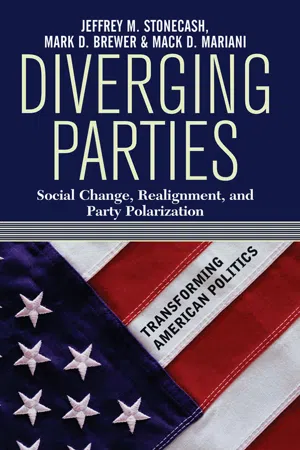
Diverging Parties
Social Change, Realignment, and Party Polarization
- 208 pages
- English
- ePUB (mobile friendly)
- Available on iOS & Android
eBook - ePub
Diverging Parties
Social Change, Realignment, and Party Polarization
About this book
Party polarization in the House of Representatives has increased recently. Explaining this development has been difficult given current interpretations of American elections. The dominant framework for interpreting elections has been to see them as candidate-centered or individualistic. This book explains the emergence of party polarization by focusing on how the constituencies of House districts affect partisan outcomes and the subsequent voting behavior of House members. The analysis is premised on the simple argument that members are elected from districts, and an explanation of polarization must begin with districts. The origins of polarization lie in the realignment of the electoral bases of the parties, and the shifting demographic composition of America. The analysis will focus primarily on changes since the 1960s.
Information
Preface
Conflict between Democrats and Republicans in the House of Representatives at the start of the twenty-first century was greater than it was thirty years before. Members of each party are more likely to join together and vote against the other party The parties increasingly adopt sharply differing policy positions. Democrats have more liberal voting records than they did thirty years ago, and Republicans have more conservative voting records. Party conflict is pervasive in the House.
In some regards this development is surprising, given current interpretations of American politicians and elections. In recent decades it has been common to argue that the attachment to parties in the electorate has declined and that elections should be seen as candidate-centered, or individualistic. The argument, in brief, has been as follows. Politicians face an electorate in which voters are more likely to be independents. Faced with voters inclined to split their tickets, candidates, and incumbents in particular, focus on using campaign and office resources to enhance their personal visibility. They call attention to their accomplishments rather than entangling their image with that of their party. In this view, members of Congress are seen as primarily concerned with their own fortunes and not those of the party. Yet for some reason members of Congress are voting more and more frequently with their party. That behavior seems odd if politicians want to create an independent image so their electoral fortunes are not tied to national swings of support for Democrats and Republicans.
This book offers an explanation of this increased party cohesion and conflict. The argument, building on the work of Roh de (1991), is that the emergence of greater party cohesion and conflict is largely a product of long-term secular realignment and social change. As a result of these changes, the diversity of constituencies within each party has decreased, while the difference between the electoral bases of the two parties has grown. Realignment has brought the Democrats an electoral base that is less affluent, urban, and non-white. Republicans have acquired an electoral base that is more affluent, suburban and rural, and primarily white. While this gradual realignment was occurring, social change unfolded in ways that accentuated existing differences or added new constituencies that became a further source of differences. Inequality after declining for several decades, began to increase in the 1970s, leading to constituencies with very real and significant differences about what role government should play in society. At the same time, immigration has resulted in a significant expansion of the "minority" population in the nation. These changes led to constituents with different needs and form the basis of more conflict between the parties.
The basis of analysis that follows is the argument that constituents, how they differ, and in which district they live, matter. Social groups differ in their partisan support. Who composes the population of districts affects partisan outcomes and the subsequent voting patterns of members of Congress. This connection between constituencies and partisan behavior has gotten less attention than it might in recent years, and we think that making that connection central to analyses will help make sense of the growing party polarization. As we will see, House districts vary enormously in their composition and these differences strongly affect which party is likely to win a seat. The result is that parties derive their seats from differing constituents. That leads to conflicting party policy concerns and voting records.
The plan for the analysis is as follows. We will first briefly review the evidence of increased polarization in party voting in recent decades. Following that, Chapter 2 will present an explanatory framework for the subsequent analysis. Because the argument is that the current situation is the consequence of long-term changes, in Chapter 3 we review the realignment changes each party experienced before the 1970s. The current differences in party bases began to emerge long ago, and understanding that history is crucial for understanding the present. Chapter 4 will present the economic and social changes that have occurred since 1970, focusing on the enfranchisement of the black electorate, the rise of inequality, and the dramatic increase in Hispanics. These changes have created new policy concerns and new constituents. The parties have responded by adopting differing positions, which has contributed to continuing realignment of the parties. Chapter 5 examines how the combination of social change and realignment has altered the electoral bases of the parties. Chapter 6 will then assess the implications of all these changes for the polarization of voting in the U.S. House over the last thirty years. Finally, the framework employed here and the empirical patterns presented have significant implications for the candidate-centered interpretation of elections and politicians, and Chapter 7 will develop those consequences.
1
The Reemergence of Party Polarization
Republicans and Democrats are finding it harder to work together. While Democrats and Republicans in Congress have always disagreed, their disagreements in the 1990s and early 2000s are more pronounced and more intense than they used to be.1 The increase in party conflict became particularly evident during the Clinton era. Partisan tensions led to bitter congressional debates, a string of ethical charges, countercharges, and investigations, several government shutdowns, and a House vote to impeach the president of the United States (Drew 1996, 2000). Roger Davidson calls the existing party divisions a "very deep chasm" and argues that we are now "in the midst of the most partisan era since Reconstruction" (Congressional Quarterly Almanac 1998, B6).
Greater party division in Congress has been accompanied by a change in the tone of debates on Capitol Hill. Congressional debates, which are televised to the American public via C-Span, frequently break down into shouting matches. An increasing number of members of Congress are reprimanded for engaging in personal insults and un-parliamentary attacks during congressional debates (Jamieson and Falk 2000). Party differences are now expressed in harsh, often personal terms. As Representative Pat Williams, Democrat of Montana, said before he left Congress in 1997, "Not long ago, partisanship was a tool with which one accomplished a policy agenda. Now it's a mechanism whereby one destroys the opponent, embarrasses his family and puts him in jail at the end of the day" (Clines 1998, 3).
The current atmosphere of intense party conflict makes it difficult for members from opposing parties to work together on Capitol Hill. Instead, party leaders attempt to identify clear differences between their party and the other party while using rhetorical attacks and procedural delays to slow or defeat the opposing party's agenda. Republican leaders used these techniques effectively in 1993 and 1994 when Democrats held a majority in both houses of Congress. By sticking together, congressional Republicans were able to defeat President Bill Clinton's first major legislative initiative, a $16 billion economic "stimulus" package. Republicans were also able to delay passage of the Democratic crime bill and to force Democrats to abandon President Clinton's health care proposal without even taking a vote (CQ Annual Report, 1993, 1994). Though unified, Republicans were not able to prevent Democrats from passing tax increases in 1993. But by forcing Democrats to pass the bill without any Republican votes, Republicans were able to portray Democrats as a "tax and spend" party during the 1994 campaign.
After Republicans gained the majority in Congress in November 1994, it was the Democrats' chance to play spoiler. Democrats turned up the rhetorical heat during congressional debates on the "Contract with America," the set of ten policy commitments that the House Republicans made during the 1994 election. Democrats derided them as the "Contract on America" (Congressional Record, February 22,1995, H2030) and a "War on the Poor" (February 24, 1995, H2219). Democrats aimed their fire at Republican Speaker Newt Gingrich in particular (Drew 1996), but intense conflict between the parties continued even after Gingrich announced his resignation in late 1998.
Though the parties were divided on a wide range of issues, the deepest divisions emerged over the tax issue. In proposing tax cuts in 1999 and 2000, Republicans fought for cuts in the personal income tax, arguing that any budget surplus, if left in Washington, would invariably be spent to increase the size of governme...
Table of contents
- Cover
- Half Title
- Title
- Copyright
- Contents
- Tables and Illustrations
- Preface
- Appendix: Congressional District Data
- Figure, Map, and Table Credits
- Bibliography
- Index
Trusted by 375,005 students
Access to over 1.5 million titles for a fair monthly price.
Study more efficiently using our study tools.
Frequently asked questions
Yes, you can cancel anytime from the Subscription tab in your account settings on the Perlego website. Your subscription will stay active until the end of your current billing period. Learn how to cancel your subscription
No, books cannot be downloaded as external files, such as PDFs, for use outside of Perlego. However, you can download books within the Perlego app for offline reading on mobile or tablet. Learn how to download books offline
Perlego offers two plans: Essential and Complete
- Essential is ideal for learners and professionals who enjoy exploring a wide range of subjects. Access the Essential Library with 800,000+ trusted titles and best-sellers across business, personal growth, and the humanities. Includes unlimited reading time and Standard Read Aloud voice.
- Complete: Perfect for advanced learners and researchers needing full, unrestricted access. Unlock 1.5M+ books across hundreds of subjects, including academic and specialized titles. The Complete Plan also includes advanced features like Premium Read Aloud and Research Assistant.
We are an online textbook subscription service, where you can get access to an entire online library for less than the price of a single book per month. With over 1.5 million books across 990+ topics, we’ve got you covered! Learn about our mission
Look out for the read-aloud symbol on your next book to see if you can listen to it. The read-aloud tool reads text aloud for you, highlighting the text as it is being read. You can pause it, speed it up and slow it down. Learn more about Read Aloud
Yes! You can use the Perlego app on both iOS and Android devices to read anytime, anywhere — even offline. Perfect for commutes or when you’re on the go.
Please note we cannot support devices running on iOS 13 and Android 7 or earlier. Learn more about using the app
Please note we cannot support devices running on iOS 13 and Android 7 or earlier. Learn more about using the app
Yes, you can access Diverging Parties by Jeff Stonecash,Jeffrey M. Stonecash,Mark D. Brewer,Mack Mariani in PDF and/or ePUB format, as well as other popular books in Politics & International Relations & American Government. We have over 1.5 million books available in our catalogue for you to explore.