eBook - ePub
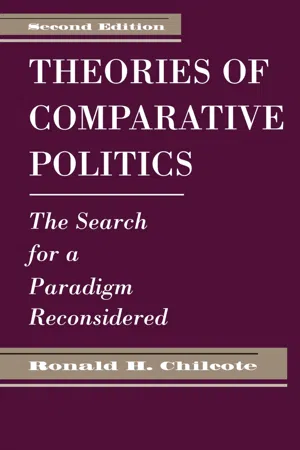
Theories Of Comparative Politics
The Search For A Paradigm Reconsidered, Second Edition
- 439 pages
- English
- ePUB (mobile friendly)
- Available on iOS & Android
eBook - ePub
Theories Of Comparative Politics
The Search For A Paradigm Reconsidered, Second Edition
About this book
Extensively revised and updated, this classic text revisits the central problem of searching for mainstream and alternative paradigms to guide us in comparative political inquiry. Building upon the first edition's comprehensive and systematic overview of frameworks, ideologies, and theories, the second edition highlights new directions and developments over the past decade, including the continuation of an ideological political science methodological innovations such as rational-choice, historical, and postbehavioural approaches new emphases on and links between political culture and participation the recasting of modernization theory and the revitalization of class analysis and a thoroughgoing post-Keynesian political economy point of view.The second edition continues the tradition of the first in updating what one reviewer commended as outstanding, excellent annotated bibliographies at the end of each chapter and the thorough survey of the general literature of comparative politics at the end of the book." In addition, the new edition includes an appendix of definitions that facilitate clarity and understanding of political science terminology, important for students at every level from the introductory on up.In a post-Cold War world in which challenges to comparative inquiry abound,ethnic conflict, authoritarian repression, state building and disintegration, new industrialization and postindustrialization, security systems redefined,the search for new paradigms that Theories of Comparative Politics represents gains in importance daily.
Information
PART ONE
Introduction
1
Comparative Inquiry
This initial chapter briefly examines comparative politics as a field in the study of politics and political science. I look at issues of theory in comparative inquiry, I describe the evolution of the field in five theoretical directions, and I identify the objectives of this book.
In addition, I have included two appendixes that relate to this chapter; both appear at the end of the book. The first attempts to clarify the terms employed in the mainstream of comparative politics, since the terminology of the field generally is used loosely and inconsistently in the literature. The other surveys the general literature of comparative politics.
Issues of Theory and Comparative Inquiry
The study of comparative politics has evoked much confusion for student and scholar alike. A variety of terms is used loosely and interchangeably in the comparative study of politics. Comparative government, for example, usually refers to the study of institutions and functions of countries or nation-states in Europe, with attention to their executives, legislatures, and judiciaries, as well as such supplementary organizations as political parties and pressure groups. Comparative politics, in contrast, studies a broader range of poli tical activity, including governments and their institutions as well as other forms of organizations not directly related to national government—for example, tribes, communities, associations, unions.
Political science and comparative politics relate both to theory and to method. Theory refers to sets of systematically related generalizations, and method is a procedure or process that involves the techniques and tools utilized in inquiry and for examining, testing, and evaluating theory. Methodology consists of methods, procedures, working concepts, rules, and the like used for testing theory and guiding inquiry, and the search for solutions to problems of the real world. Methodology is a particular way of viewing, organizing, and giving shape to inquiry.
Confusion arises over these terms because the comparative study of government often refers to the study of foreign governments, and comparative politics is utilized in the search for comparisons in the study of all forms of political activity—governmental as well as nongovernmental. Thus, the comparative politics specialist tends to view comparative politics as the study of everything political. Any lesser conception of comparative politics would obscure criteria for the selection and exclusion of what the field might study.
One might also explore the relationship of politics and comparative politics to other fields, as I do in Chapter 3.I note that both theory and method owe a great deal to the "classical" political philosophers Aristotle and Plato, Machiavelli and Montesquieu, and Hegel, Marx, and Mill. Comparative politics is also indebted to the early twentieth-century contributions of Woodrow Wilson, James Bryce, and Carl Friedrich, whose attention was directed toward the formal study of government and state. I also show that work in related fields has shaped comparative political inquiry, notably the work of A. R. Radcliffe-Brown and Bronislaw Malinowski in anthropology, Gaetano Mosca, Vilfredo Pareto, Max Weber, and Emile Durkheim in sociology and political sociology, and John M. Keynes, Karl Marx, and V. I. Lenin in economics and political economy. Finally I suggest that attention should be directed toward political economy.
The movement toward the study of all political phenomena and the need to draw upon the theories and methods of other disciplines gave to comparative politics an all-encompassing orientation. The Second World War heightened interest among scholars in the study of foreign systems, especially systems in Europe and Asia. The decline of empires after the war and the turmoil of independence in the Third World influenced scholars to turn their attention from the established to the new nations. The consequences for comparative politics were substantial. According to Braibanti (1968), there was an acceleration of research on the new nations, prompted by research technology and the funding by and interests of foundations and government, which exacted from scholars the knowledge needed to guide programs in foreign aid. Additionally, a fragmentation of case materials was the result of problems related to method in the gathering of data, to research terminology that has not been standardized, and to the rapid proliferation of new nations in which research conditions are uncertain and the cumulation of knowledge is uneven. There was also an expansion of the sphere of politics so as to allow the examination of politics as a total system, on the one hand, and as an analysis of individual behavior, on the other. Finally, there was a tendency toward model building, including highly imperfect and transitory devices, and classificatory schemes easily divorced from reality and undermined by unreliable and tentative data.
Given these trends, still another problem faces the students of comparative politics, that of value-free investigation. For the study of political behavior, many political scientists emphasize attention to explicit assumptions and to systematic, quantitative, and cumulative investigation. Investigators assume the role of objective social scientists, separating themselves from the role of active citizens. Despite the pretensions of such political scientists, however, there is now a widespread understanding that values enter into all investigations of politics. Christian Bay (1965), for example, argued that work that pretends to be neutral is actually imbued with real value biases and indeed is both conservative and antipolitical. These concerns are supported in other assessments as well (McCoy and Playford 1967; Myrdal 1969). Searing (1970) delved into the problem and concluded that value judgments enter six stages of research but do not necessarily bias consequences. In the first two stages, problem selection and concept formation, value decisions are significant but do not always bias research. The intrusion of value judgments into the stages of data selection, interpretation, and theory construction can result in bias. Searing admitted too that value choices represent a problem for the last stage, verification.
The above stages suggest a systematic method of procedure for social science investigation. That method may be construed as emulating the work of the natural scientists, who look for regularities in the abstractions that they select from the nonhuman world. Thus, social science might simply borrow the theories and rules of natural science to study the human world. But a stress on regularity will certainly obscure any recognition of irregularity. Values, beliefs, and personal interests might intrude upon the scientific enterprise, and in the end little understanding will be gained. Such has been the concern of many people interested in comparative politics.
All these problems relate to the search for theory and method in comparative politics. The reader may be interested in background reading and understanding in this search for theory and method, so I turn briefly to a summary of some of the major work that has influenced comparative politics.
Past Influences
More than a century ago Edward A, Freeman (1873) optimistically manifested his belief that comparative politics offered promise for the discovery of universal laws through global investigation. Often it is maintained that we have established no basic universal laws or principles, although well into the past there were social scientists who were conscious of theoretical and methodological problems.
Two people who wrote about such problems were Max Weber in The Methodology of the Social Sciences (1949) and Emile Durkheim in The Rules of Sociological Method (1938). Weber focused on the meaning of value judgment and neutrality in sociology and economics, examined the implications of objectivity in social science, and examined the methodological views of scholars of his time. Durkheim attempted to describe and define the method used in the study of social facts; at the same time he acknowledged that among his predecessors, Herbert Spencer had devoted no attention to the problem of method, and John Stuart Mill had dealt with the question at great length, but only by synthesizing what Auguste Comte had set forth in his earlier work. Durkheim suggested rules for the observation ot social facts, for classifying social types, for explaining social facts, and for establishing sociological proofs. Durkheim believed that his method separated social science and especially sociology from philosophy, as well as from positivistic, evolutionary, and idealistic orientations that had pervaded social science through successive periods.
Unlike Weber and Durkheim, Karl Marx did not prepare a manual on theory and method, but those concerns are apparent throughout his writings. Marx was a comparative analyst who focused on the monarchies of Europe but also extended his discussions elsewhere, most notably Asia. Marx would probably explain contemporary social science understandings of society in equilibrium as the consequence of actions of a ruling class. That class enforces rules and norms that legitimize the relations of production, which arise from particular means and forces of production. Those means and forces may become outmoded as change and equilibrium become dialectical parts of a single process. I shall elaborate later (Chapter 4) on the contributions of Marx and demonstrate that his theory and methodology tend to run counter to the dominant tendencies of the contemporary literature of comparative politics.
Theoretical and methodological problems of comparative politics were of concern to Maurice Duverger (1964), who offered an introduction that is useful to the reader. First, he explored the idea of social science, tracing the historical development of the social sciences. Second, he described and discussed the techniques of observation, relating to written documents, and statistics as well as questionnaire methods and interviews. Third, he examined the use of theory and hypotheses as well as classifications and conceptualization in research. Supplementing Duverger but delving into the ramifications of inquiry is work by Frohock (1967), who examined the implications and issues of theory and the scientific method. Scientific method was assessed in terms of the search for paradigms, and the work of Max Weber was introduced as one basis for contemporary social science.
Other writers have concentrated on methods that are helpful in comparative inquiry. For example, Howard Scarrow (1969) offered a brief introduction to the methods of comparative analysis, and Holt and Turner (1970) and Przeworski and Teune (1970) explored more deeply the subject of political inquiry. Galtung (1967) also looked critically at theory and method.
Outline of This Study
I have established the need for a new overview of comparative politics and have examined some general issues of theory and comparative inquiry. At the end of this book, Appendix 1 offers definitions that facilitate a clarity and an understanding of the terminology of political science and comparative politics; I also identify some prominent methods and techniques for comparative political inquiry. Appendix 2 traces the evolution of ideas that have influenced comparative inquiry since 1980, identifies the basic introductory literature of the field, and refers to recent important comparative works that make use of a macro theoretical approach in their attention to one or more national political systems or countries.
Since 1953 the major theoretical trends in the comparative field have tended to cluster into five general areas: state theories, culture theories, developmental theories, class theories, and theories of political economy. Each of these areas is the focus of a chapter in this book; the concluding chapter serves not only to show the importance of political economy to political science and comparative politics but also to introduce an extensive analysis and critical literature review that appears in my forthcoming sequel, Comparative Political Economy. It is instructive to identify briefly the major contributions that shaped and allowed each area to become a central thrust in the field of comparative politics.
State and Systems Theories
The impact of the systems literature on comparative politics first became evident during the early 1950s. Three writers are representative of trends in systems theory, and all three utilized the political system as a macro unit in comparative analysis. David Easton in The Political System (1953) and other works set forth the concept of the political system together with its inputs and outputs, demands and supports, and feedback. The basis of his conceptualization of system is contained in a well-known essay published in 1957. Gabriel Almond was influenced by the functionalist anthropologists Bronislaw Malinowski and A. R. Radcliffe-Brown as well as by the sociologists Max Weber and Talcott Parsons. Almond was also influenced by work on group theory, such as that of David Truman. Almond first offered a simplistic classification of political systems in Journal of Politics in 1956; he included systems in non-Western and newly independent nations. He then set forth categories of structure and function, relating them to all systems in the introduction to Politics of the Developing Areas. Later he related his conception of system to culture and development. Finally, Karl Deutsch in Nerves of Government drew heavily upon the cybernetic theory of Norbert Wiener in postulating a systemic model of politics.
Almond and other comparativists convincingly argued in the late 1950s that the notion of the state had long been obscured by a multitude of conceptualizations and should be replaced by the political system, which was adaptable to scientific inquiry in the emerging age of computers. Easton undertook to construct the parameters and concepts of a political system, though he recognized that political science owed its existence to the traditional emphasis on the state. These two political scientists insisted well into the 1980s on the importance of political system as the core of political study.
Mainstream attention to the state was not ignored altogether, however, as the emergence of military regimes in Argentina, Brazil, and elsewhere in Latin America during the 1960s and 1970s prompted a retrospective interpretation of state corporatism as it had emerged earlier in Europe, in particular in Spain and Portugal. This led to new understandings of corporatism elsewhere and a contrasting between traditional and societal corporatism, as in the work of Philippe Schmitter and Howard Wiarda. The persistence of dictatorship was interpreted along lines of the bureaucratic authoritarian model of Guillermo O'Donnell, who looked primarily to Argentina for his example. Alternative work also appeared with the publication of Ralph Miliband's The State in Capitalist Society (1969) and Nicos Poulantzas's State, Power, Socialism (1978), and political sociologists Peter Evans, Theda Skocpol, and others argued for more attention to the question of the state in their Bringing the State Back In (1985), signifying that despite the objections of Almond and Easton, the comparative mainstream had come full circle and restored a focus on the state to its important place in the study of politics. These studies tended to shift from a focus on the national political system to state and government and their role and impact on capitalist development. Mainstream political scientists emphasized bureaucracy and policy implementation in adapting to the terminology of state, and although economic issues were recognized in their analysis, they generally cast their perspectives in a traditional institutional framework in which executive, legislative, and judicial actions are dominant within the state, and political party, interest group, and individual actions prevail in the civil society.
Culture Theories
The cultural thrust in comparative politics, conspicuously prominent during the 1960s, emanated from traditional work on culture in anthropology, socialization and small group studies in sociology, and personality studies in psychology. The concept of political culture was related to nations or national cultures. In this sense political culture represented a sort of recasting of the older notions of national character. Political culture related to systems as well. Political culture consisted of beliefs, symbols, and values that define situations in which political action occurs. Types of political culture characterized systems; for example, parochial, subject, and participant political cultures. These types of political cultures reflected the psychological and subjective orientations of people toward their national system. The pioneer comparative effort to construct a theory of political culture was Gabriel Almond and Sidney Verba's Civic Culture, which was based on a survey of the attitude of citizens toward their nation in the United States, Great Britain, Germany, France, Italy, and Mexico. Inherent in this study was the proposition, set forth earlier in the work of Almond, that the ideal political or civic culture could be found in an Anglo-American model of politics....
Table of contents
- Cover
- Half Title
- Title
- Copyright
- Dedication
- Contents
- List of Tables and Figures
- Preface to the Second Edition
- Acknowledgments
- PART 1 Introduction
- PART 2 Ideology and Epistemology
- PART 3 Theoretical Directions
- PART 4 Conclusion
- About the Book and Author
- Index
Trusted by 375,005 students
Access to over 1.5 million titles for a fair monthly price.
Study more efficiently using our study tools.
Frequently asked questions
Yes, you can cancel anytime from the Subscription tab in your account settings on the Perlego website. Your subscription will stay active until the end of your current billing period. Learn how to cancel your subscription
No, books cannot be downloaded as external files, such as PDFs, for use outside of Perlego. However, you can download books within the Perlego app for offline reading on mobile or tablet. Learn how to download books offline
Perlego offers two plans: Essential and Complete
- Essential is ideal for learners and professionals who enjoy exploring a wide range of subjects. Access the Essential Library with 800,000+ trusted titles and best-sellers across business, personal growth, and the humanities. Includes unlimited reading time and Standard Read Aloud voice.
- Complete: Perfect for advanced learners and researchers needing full, unrestricted access. Unlock 1.5M+ books across hundreds of subjects, including academic and specialized titles. The Complete Plan also includes advanced features like Premium Read Aloud and Research Assistant.
We are an online textbook subscription service, where you can get access to an entire online library for less than the price of a single book per month. With over 1.5 million books across 990+ topics, we’ve got you covered! Learn about our mission
Look out for the read-aloud symbol on your next book to see if you can listen to it. The read-aloud tool reads text aloud for you, highlighting the text as it is being read. You can pause it, speed it up and slow it down. Learn more about Read Aloud
Yes! You can use the Perlego app on both iOS and Android devices to read anytime, anywhere — even offline. Perfect for commutes or when you’re on the go.
Please note we cannot support devices running on iOS 13 and Android 7 or earlier. Learn more about using the app
Please note we cannot support devices running on iOS 13 and Android 7 or earlier. Learn more about using the app
Yes, you can access Theories Of Comparative Politics by Ronald H Chilcote in PDF and/or ePUB format, as well as other popular books in Politics & International Relations & Political Economy. We have over 1.5 million books available in our catalogue for you to explore.