eBook - ePub
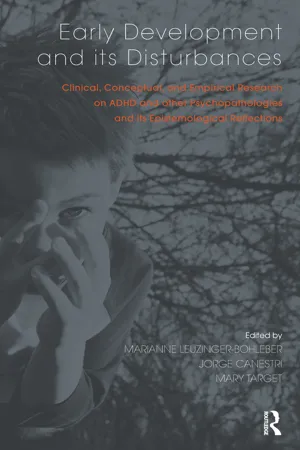
Early Development and its Disturbances
Clinical, Conceptual and Empirical Research on ADHD and other Psychopathologies and its Epistemological Reflections
- 310 pages
- English
- ePUB (mobile friendly)
- Available on iOS & Android
eBook - ePub
Early Development and its Disturbances
Clinical, Conceptual and Empirical Research on ADHD and other Psychopathologies and its Epistemological Reflections
About this book
In this volume internationally well known experts discuss whether psychoanalysis - with its rich mix of clinical experiences and conceptualizations of early development and symptoms - has something unique to offer through deepening the understanding of children suffering from this and similar developmental disturbances. The contributors consider therapeutic strategies as well as possibilities of early prevention. Surprisingly, psychoanalysts have only during the past few years actively engaged in the on-going and very important controversial discussions on attention deficit hyperactivity disorder (ADHD). There may be many reasons for the increasing interest in this topic over the past few years - for example the dialogue between psychoanalysis and contemporary neurobiology/brain research which opens a fascinating window on an old problem in European culture: the mind-body problem. This exchange also promises to enlarge the understanding of psychic problems probably connected with some neurobiologically-based pathologies, widely assumed to include ADHD.
Information
Part I
Introduction
CHAPTER ONE
Controversies on different approaches in psychoanalytic research on early development and ADHD
Marianne Leuzinger-Bohleber, Jorge Canestri and Mary Target
1 Introductory remarks
Surprisingly, psychoanalysts have only during the past few years actively engaged in the on-going and very important controversial discussions on attention deficit hyperactivity disorder (ADHD) (for example, the casebook on learning disabilities by Rothstein and Glenn, 1999; the special volume of Psychoanalytic Inquiry, 2002; and the panel on ADHD and trauma at the IPA Congress in Rio 2005 reported by Sugarman, 2006 and at the IPA Congress in Chicago, 2009, summarized by Sugarman, 2010).1 Carney (2002: 301) writes in his prologue to this volume: ‘Not so long ago, some practitioners both inside and outside psychoanalysis discouraged the use of psychodynamic treatment for patients with AD/HD.’ Salomonsson (2004: 132) agrees, writing: ‘Psychoanalysis is an often-neglected treatment method for children with neuropsychiatric disorders.’
There may be many reasons for the increasing interest in this topic over the past few years. We wish to mention just four possible
ones, which for us were essential in the decision to become involved in this topic:
- The dialogue between psychoanalysis and contemporary neurobiology/brain research opens a fascinating window on an old problem in European culture: the mind–body problem. This exchange also promises to enlarge the understanding of psychic problems probably connected with some neurobiologically founded pathologies, as postulated for ADHD.
- Twin studies postulate a strong genetic component in ADHD (see, for example, Faraone et al., 2005, Romanos et al., 2008). Only during the last years could epigenetic researchers empirically demonstrate that early traumatization might strongly influence the ‘triggering’ of gene disposition (see, for example, Caspi et al., 2003; Schulte-Körne and Allgaier, 2008; Goldberg, 2009; Risch et al., 2009; Rutter, 2009; Soumi, 2010). Therefore psychoanalysts feel more reassured to treat children with ADHD psychoanalytically: They are experts in understanding and treating children with early trauma, independent of their genetic disposition.
- New developments in psychoanalytic theory, taking up findings from empirical infant, attachment, and memory research, offer alternative conceptualizations and techniques for treating early disturbances in affect regulation, and in the development of symbolization and mentalization—all of which are central dysfunctions in ADHD.
- The growing ‘competition’ with other therapeutic approaches (for example, medication with Ritalin®, cognitive behavioural programmes, and so forth) and the political realities of a modern zeitgeist in the Western world probably motivate many self-critical psychoanalysts to engage intensely in relevant public and professional debates. One of these is about ADHD, which is considered to be one of the most heated controversies that child psychiatry has ever gone through (see Riedesser, 2006).
These heated debates on the medical treatment of even very young children were one of the main reasons that the Sigmund-Freud-Institut in Frankfurt conceptualized the so-called Frankfurt Prevention Study (FPS) in cooperation with the Institute for Psychoanalytic Treatments of Children and Adolescents in Frankfurt. The representative, cluster randomized Frankfurt Prevention Study2 was carried out from September 2003 to September 2006. In order to be able to draw a representative sample of roughly n = 500 children in the prevention/intervention group and a control-comparison group of another n = 500 children, we had to perform a basic assessment in all public kindergartens in Frankfurt (114 kindergartens with around 4,500 children). The main hypothesis of the study was that a two-year psychoanalytic (and non-psychopharmacological) prevention and intervention programme would result in a statistically significant decrease in the number of children suffering from psychosocial disturbances (particularly aggressive conflicts, frequently the main problem of ADHD children in social situations) in their first year of school (compared with the control group). The psychoanalytic prevention and intervention programme consisted of several components based on the psychoanalytic understanding of ADHD: psychoanalytic supervision of the kindergarten teams, a weekly offering of a psychoanalytically oriented educational programme for individual children or the children’s group, including a violence prevention programme called FAUSTLOS (‘NO FISTS’; a modification of the US American programme SECOND STEPS) developed by Cierpka and his group (see Cierpka and Schick, 2006); psychoanalytic therapies (always including the parents) offered to children with severe psychopathologies (including ADHD) mostly in the Kindergartens themselves; consultations and educational courses for parents; and finally intensive collaboration with medical doctors, child psychiatrists, mental health and welfare institutions and potential schools, if necessary.
In the meantime, we have obtained statistical results which support our main hypothesis: the level of aggression and anxiety of the children in the prevention group has decreased significantly compared with the control group (interestingly, there is a statistically significant decrease of hyperactivity only in girls). We have published these results in detail in other papers (see Leuzinger-Bohleber et al., 2007, 2008). In this introduction we only want to mention one aspect that is important for the topic of this volume. Seen from a psychoanalytical perspective, we found several different psychodynamic backgrounds with a final common pathway to ADHD syndrome according to DSM–IV: a) known brain damage (due to organic traumata during birth, an accident, encephalitis, and so on); b) early emotional neglect; c) personal and family trauma (for example, in refugees’ families); d) chronic under-stimulation of highly talented children in kindergarten; e) a mismatch of the temperament of the child with their primary caregiver, or object; f) a mismatch of family culture with the cultural ‘rules’ of the host country (for example, a Moroccan family living in Germany); and g) growing up with a chronically depressed mother (or ‘dead mother’, according to André Green3).
To summarize: in this large empirical and clinical study it was shown that in all of the children investigated, early disturbances of affect regulation had—in different and idiosyncratic combinations— led to behaviour then assigned an ADHD diagnosis. This is one of the major reasons that we argue for psychoanalysis to get involved in the public discussion of diagnosis and treatment for this group of children. Causation does not necessarily mean that treatment is required in the same domain, but we need to take seriously a developmental model which can make sense of such diverse aetiological pathways.
To this end, we decided to devote the ninth Joseph Sandler Research Conference 2008 to this topic: Early development and its disturbances: clinical, conceptual and empirical research on AD/HD and other psychopathologies. In this volume we are publishing some of the main papers given at this conference, in combination with some papers dealing with epistemological and methodological problems connected to research in this field.
We will begin our introduction with some remarks on the ongoing public and professional debates (2). In the following section we would like to summarize briefly some of the consequences of different theoretical positions towards the preferred therapy of ADHD children (3). First the so-called ‘multimodal treatment of ADHD’ (cognitive-behavioural treatment in combination with medication) and the implications for diagnosis and therapy will be shortly summarized (3.1) in order to contrast this view with psychoanalytical concepts (3.2). We think that the richness of psychoanalytic concepts, encompassing possible idiosyncratic biographical and psychodynamic as well as genetic and biological roots of ADHD, seems to be in impressive concordance with contemporary neurobiological memory research (4). In the penultimate section we will illustrate this thesis with some short case examples (5). In the last section we will summarize the various approaches of the different authors of this book toward investigating early development and its disturbances (6).
2 The dramatic increase in treating ADHD4 by medication (for example, Ritalin®)—a warning sign of medicalizing contemporary social problems seen from a historical background?
ADHD is one of the most frequent diagnoses of children and adolescents nowadays (see, for example, Staufenberg, in press). There also is a high comorbidity between ADHD and other psychopathologies, for example, depressions (see, for example, Bharwaj and Goodyer, 2009: 178). Medical treatment has continously and dramatically increased since the 1990s. The prescription of methylphenidate (Medicinet, Concerta, Ritalin, and others) has increased from 0.3 million DDD (daily defined dose) in 1990 to 46 million DDD in 2007. In Germany 34 kg methylphenidate was sold annually in drug stores in 1993; in 2009 this had risen to 1,735 kg (an increase of 5,103%) (Bundesinstitut für Arzneimittel und Medizinprodukte [BfArM], 2010).
Mattner (2006), Amft (2006), and Gerspach (2006) give a short overview of the historical and societal context in which this increased use of Ritalin® and other psychopharmacological medication for children could be understood. Mattner (2006) elaborates that the search for neurophysiological reasons to explain socially deviant behaviour has a long tradition in European countries, particularly in Germany.5
Summarizing the history of this diagnosis in child psychiatry in the USA, Gilmore (2000) reports similar findings. George Still (1902: 266) first observed a group of children in his practice ‘who showed a pattern of aggressiveness, resistance to discipline, excessive emotionality, little “inhibitory volition”, “lawlessness”, spitefulness, and cruelty: these children were also notable for their impaired attention, overactivity, and a defect in motor control’. This syndrome was attributed to an underlying neurological deficiency, and, consistent with the then current view of behavioural disorders, the influence of environment was largely ignored (Gilmore, 2000: 1,266–67). Interest in this disorder grew after the encephalitis outbreak of 1917–18, when many children, after their recovery from this illness, showed impairment in attention, regulation of activity, and impulse control, the now so-called ‘postencephalitic behaviour disorder’. Laufer and Denhoff (1957) characterized a subgroup of these children as showing ‘hyperkinetic impulse disorder’, which was attributed to a postulated brain mechanism, namely ‘poor filtering of stimuli’. These children were often treated with psychoactive drugs. Later, the term ‘minimal brain damage’ continued to be fashionable. In the 1960s the more modest term ‘minimal brain dysfunction’ was more widely used. Gilmore (2000) agrees with Mattner (2006) that both these diagnostic terms ultimately:
yielded to scientific objections, as it became clear that many children and many syndromes were being lumped together without heuristic or prescriptive benefit under the umbrella of a pseudoscientific classification. As part of the growing trend towards descriptive, rather than etiological, classifications, the diagnostic wastebasket was broken down into observable and verifiable deficits.
(Gilmore cited in Barkley, 1990: 10)
The specific ‘hyperactive child syndrome’ (Laufer and Denhoff, 1957) or ‘hyperactive reaction of childhood’ (DSM-II) reappeared as the official nomenclature for children with features of impulsive and aggressive behaviour and poor attention spans. While demonstrable brain damage could produce this syndrome, the majority of children so diagnosed were without known injury. Nonetheless, brain mechanisms responsible for these behavioural ‘lags’ were postulated, and prognosis was felt to be good on the basis of developmental maturation; that is, puberty was viewed as a watershed after which there was a good likelihood of resolution. Environmental factors were de-emphasized (Gilmore, 2000: 1,267–68). According to Gilmore particularly, the research done by Virginia Douglas and her group at McGill University led to the development of a paradigm which renamed the syndrome as ‘attention deficit disorder’ by the time that DSM-III was published in 1980. In the following years, environmental toxicity—food additives or technical over-stimulation—was also seen as relevant for ADD and the learning disabilities of these children. Learning disabilities were formally recognized by the US government with the Public Law 94–142 in 1975. Children diagnosed with ADD—as one form of learning disability—were offered a multimodal treatment approach, which included medication, special classroom programmes, dietary management, and parent counselling. In the 1980s—on the basis of newer studies—the classification of ADD without hyperactivity was dropped in DSM-III-R and renamed as the syndrome of Attention-Deficit/Hyperactivity Disorder, linking it with Oppositional Defiant Disorder and Conduct Disorder under the Disruptive Disorders in Childhood. It has been retained as such in DSM-IV.6
Gilmore (2000) mentions that in the past few decades, ADHD has achieved validity as a discrete diagnostic entity through epidemiological characterization (that is, it shows strong hereditary patterns and clusters with other specific psychiatric disorders) and through an increasing number of promising neuroanatomical studies that further differentiate sub-populations (Cantwell, 1996). Research into neurotransmitters has also burgeoned, although it has so far failed to yield the anticipated solution. In a ten-year review of the disorder for the Journal of the American Academy of Child and Adolescent Psychiatry, Dennis Cantwell (1996: 979) emphasizes that ADHD is ‘one of the most important disorders that child and adolescent psychiatrists treat’, and that it is a robust disorder with a high prevalence and a serious lifetime morbidity that responds best to multimodal intervention. He asserts unequivocally that ‘psychosocial factors are not thought to play a primary etiological role’, although (presumably secondary) negative mother–child interactions are commonly observed (Cantwell cited in Gilmore, 2000: 1,269). A similar position is taken by Barkley (2002), one of the most frequently quoted experts in the field of ADHD:
The central psychological deficits in those with ADHD have now been linked through numerous studies using various scientific methods to several specific brain regions (the frontal lobe, its connections to the basa...
Table of contents
- Cover
- Half Title
- Title
- Copyright
- Contents
- PREFACE
- ACKNOWLEDGEMENTS
- ABOUT THE EDITORS AND CONTRIBUTORS
- PART I: INTRODUCTION
- PART II: EARLY DEVELOPMENT AND ITS DISTURBANCES
- PART III: PSYCHOANALYTIC RESEARCH: HOPES, VIEWS, CONTROVERSIAL DISCUSSION
- INDEX
Trusted by 375,005 students
Access to over 1.5 million titles for a fair monthly price.
Study more efficiently using our study tools.
Frequently asked questions
Yes, you can cancel anytime from the Subscription tab in your account settings on the Perlego website. Your subscription will stay active until the end of your current billing period. Learn how to cancel your subscription
No, books cannot be downloaded as external files, such as PDFs, for use outside of Perlego. However, you can download books within the Perlego app for offline reading on mobile or tablet. Learn how to download books offline
Perlego offers two plans: Essential and Complete
- Essential is ideal for learners and professionals who enjoy exploring a wide range of subjects. Access the Essential Library with 800,000+ trusted titles and best-sellers across business, personal growth, and the humanities. Includes unlimited reading time and Standard Read Aloud voice.
- Complete: Perfect for advanced learners and researchers needing full, unrestricted access. Unlock 1.5M+ books across hundreds of subjects, including academic and specialized titles. The Complete Plan also includes advanced features like Premium Read Aloud and Research Assistant.
We are an online textbook subscription service, where you can get access to an entire online library for less than the price of a single book per month. With over 1.5 million books across 990+ topics, we’ve got you covered! Learn about our mission
Look out for the read-aloud symbol on your next book to see if you can listen to it. The read-aloud tool reads text aloud for you, highlighting the text as it is being read. You can pause it, speed it up and slow it down. Learn more about Read Aloud
Yes! You can use the Perlego app on both iOS and Android devices to read anytime, anywhere — even offline. Perfect for commutes or when you’re on the go.
Please note we cannot support devices running on iOS 13 and Android 7 or earlier. Learn more about using the app
Please note we cannot support devices running on iOS 13 and Android 7 or earlier. Learn more about using the app
Yes, you can access Early Development and its Disturbances by Jorge Canestri, Marianne Leuzinger-Bohleber, Mary Target, Jorge Canestri,Marianne Leuzinger-Bohleber,Mary Target in PDF and/or ePUB format, as well as other popular books in Psicologia & Disturbo da deficit di attenzione (ADD-ADHD). We have over 1.5 million books available in our catalogue for you to explore.