eBook - ePub
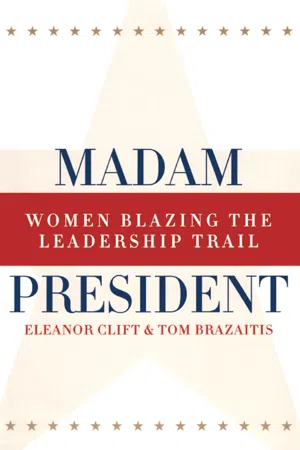
Madam President, Revised Edition
Women Blazing the Leadership Trail
- 366 pages
- English
- ePUB (mobile friendly)
- Available on iOS & Android
eBook - ePub
About this book
The first Madam President will be sworn in sooner than most people think. But the gender gap in politics is still shockingly broad, say two of America's most readable political commentators in this timely look at the nation's sputtering efforts to envision a woman in America's top job.(The Boston Globe ). Charting the transformation of women's power in American politics from the first female presidential candidate (Victoria Woodhull in 1872) to the shattered presidential hopes of Shirley Chisholm and Elizabeth Dole, Madam President presents tales of passion, determination, set-backs, and triumph from nearly all national women politicians and most leading state politicians in the pipeline. With insight garnered from years on the Washington political scene and candid interviews with leading politicians like Christine Todd Whitman and Kathleen Kennedy Townsend, Clift and Brazaitis explain why the barriers to women are still formidable: There are only 3 female governors (one of the best routes to the White House) and at the current rate it will take 250 years before there are as many women Senators and Representatives as men. A forward-looking, savvy analysis of women in politics, Madam President gives the first inside look at how America's female politicians got there, stayed there, and what it will take for them to make it to the presidency.
Information
One Getting Organized
DOI: 10.4324/9781315023540-1
On a warm September evening in 1983, four women sat down for dinner in the restaurant at Washington’s Watergate Hotel. All veterans of the feminist movement, they had come to plot strategy for the upcoming Democratic National Convention, which was ten months away. The women requested a comer table. They weren’t there to see or be seen, and they hadn’t come for the food or the atmosphere, neither of which was particularly notable. They had chosen the restaurant because of its convenience. The Watergate is an imposing complex of shops and high-rises on the banks of the Potomac near the heart of the city. One of the women had a small consulting firm and was renting an office in the Watergate tower. It was the same suite that the Democratic National Committee occupied at the time of the break-in that led to President Nixon’s resignation. Perhaps because of its infamous past, she’d gotten a break on the rent.
At every convention since 1976, women activists highlighted an issue to pick a fight about. One year it was abortion, another it was the Equal Rights Amendment. Press coverage would follow and the male politicians would cower. What was the unfinished business that would define the 1984 convention and capture press attention? There were mixed signals when it came to women and their political clout. The ERA had been defeated in June 1982 after a long and bitter struggle, leaving the women’s movement awash in recriminations over who was to blame. Yet there was oddly little left to accomplish within the Democratic party structure. The biggest fights had been won: The platform strongly supported abortion rights, and party rules mandated an equal number of women in each state delegation.
The best tool women had to command attention was growing evidence of a gender gap. In 1982, Democratic governors had won elections in New York, Michigan, and Texas on the strength of the women’s vote. The gender gap had been identified as a split between the sexes over issues, with women putting more emphasis than men on a candidate’s stand on health care, child care, education, and abortion rights. Pollsters started separating the genders in charting voter attitudes, and when an eight-point gap appeared in the election of Ronald Reagan in 1980, political analysts called it “the women’s voting bloc.” A staff aide preparing a chart at the National Organization for Women (NOW) couldn’t fit all those words, and jotted in “gender gap.” The phrase caught on and would inform political strategy for at least the next two decades.
Nobody remembers which of the four women proposed it first, but one of them said, “Let’s try a woman on the ticket.” Not any woman in particular, they agreed, but the idea of a woman. Even if it didn’t happen, getting people used to the idea would be a building block for the future. They talked excitedly about how they would “crack the ticket” for a woman. First, they felt it was time. Six decades had passed since women won the right to vote in 1920. The women’s movement had shattered the status quo and opportunities were opening for women everywhere. Second, beating Ronald Reagan would take a dramatic increase in turnout among women, where Reagan was weakest. Cutting back social programs, pouring more money into the arms race, scaling back environmental protections, and advocating a constitutional amendment to ban abortions had cost Reagan significant support among women. Putting a woman on the Democratic ticket could dramatize the differences between the two parties and generate the enthusiasm that would boost turnout enough to make the difference.
By the time the waiter brought the dessert menu, the women had settled on what role each would play in getting out the word that 1984 was the year for a woman. Kathy Bonk’s job was to get reporters to float the idea in the media. Bonk had come to Washington in the early seventies, right out of college, and brought a winning enthusiasm to whatever she tackled. As part of a communications class project at the University of Pittsburgh, she had challenged the licenses of Pittsburgh’s three television stations and gotten them to hire more women. Bonk had a number of friends in the media, and had no trouble persuading Jane O’Reilly at Time and Judy Mann at the Washington Post to write about the possibility of a woman on the ticket. Journalism being a pack profession, their articles spawned other stories until Bonk had a scrapbook bulging with clips from all the major media about how the gender gap was changing politics. What began as something of a lark over dinner soon gained enough momentum to force Vice President Walter Mondale, the presumptive Democratic nominee, to declare publicly that he would consider a woman as his vice presidential running mate.
At the time, Bonk was the communications director for NOW, the nerve center of the women’s movement. Eleanor Smeal, a past president of NOW, and Molly Yard, a grandmotherly figure who would later become president, were also at the dinner, along with Ann Lewis, then the political director for the Democratic National Committee. Lewis had been active in Democratic party politics for a long time, and it was her task to talk up the idea of a woman with the party establishment. Smeal’s job was to rally women. She had done her Ph.D. thesis in the early 1970s on women’s attitudes toward women candidates. She and another student had recruited fifty volunteers through NOW to help them interview a thousand women. Based on that research, Smeal challenged the prevailing dogma of the political science profession that women didn’t vote for other women, or on the basis of women’s issues, and were in fact their own worst enemy when they entered the voting booth. Smeal found that women favored women candidates, but by a small margin, only 10 percent in her research. She knew that a woman on the ticket would not automatically bring out the women’s vote, and that if the ticket lost badly, the whole venture could backfire.
Desperate to beat Reagan, they figured playing the women’s card was worth the risk. Smeal took out a full-page ad in the New York Times in June 1984 headlined “We Want a Woman!” Paid for with funds from the Women’s Trust Political Action Committee she had formed, the ad invited readers to join “The Gender Gap Action Campaign” by clipping a coupon and enclosing a contribution. Smeal estimates that the ad raised a quarter of a million dollars. Its placement in the Times had the intended effect of rallying East Coast opinion leaders and generating momentum that would prove unstoppable. What Times readers did not know is that the impulse for the ad originated with publishing heir Arthur O. Sulzburger, Jr., who had begun his ascent through the newsroom and was doing a stint in the Washington Bureau, where he had to show that he could sell advertising space. He called Bonk, who was a friend. “Do you know anyone who wants to buy an ad in the New York Times?” he wondered, eager to make a sale. Bonk conveyed the message to Smeal, who welcomed the opportunity. Sulzburger later sent Bonk a commemorative plaque of the ad, which she believes was the first he ever sold.
A woman on the ticket had become the mantra for women activists. “It was in the ether,” says Joanne Howes, then the executive director of the nonpartisan Women’s Vote Project and a member of “Team A,” seven Washington-wise women most instrumental in propelling Geraldine Ferraro onto the ticket. Howes had always been fascinated by politics, and remembers sitting on the couch as a ten year old with her uncle listening to the 1956 roll call for president. She’d worked for liberal Democrats like Ted Kennedy and Barbara Mikulski, and lobbied for Planned Parenthood. She found the election of Ronald Reagan in 1980 devastating to her political ideals, but was heartened by the attention it had drawn to the gender gap. She hoped a woman in the race could regain the White House for the Democrats. Looking back on what she now regards as naïveté, she says, “Assumptions got made. I’m not sure they were as valid as we wanted them, that women would make that big a difference. But we predicted that women would come out of the woodwork.”
There was little to disrupt the nominee-in-waiting aura that defined the former vice president. He and Jimmy Carter had lost in a landslide to Reagan, but many Democrats had convinced themselves that the aging actor was vulnerable, especially if the gender gap persisted. In 1982, a full two years before the next presidential election, Mondale’s numbers cruncher, Tom Donilon, had declared in a meeting, “You guys better start thinking about women on this ticket.” Donilon didn’t mention any names, but Mondale thought about it, talked about it, and worried a lot about the implications of Donilon’s words. Were there qualified women? Which woman would he select if that’s where the politics of winning took him? An earnest Minnesotan, Mondale took his role of presumptive nominee seriously. He viewed his time out of office as something of an interregnum, an opportunity for him as the president-in-waiting to study various aspects of governing. John Reilly, an old friend and political confidant, chuckles as he remembers Mondale striding confidently into his office in the summer of 1982 and proudly announcing, “I finally, finally understand the Federal Reserve.”
“But who can you tell?” Reilly prodded him, adding a gentle jab. “You’ve been the vice president. You’re supposed to understand the Federal Reserve.”
On Capitol Hill, no female member of Congress would initially agree to have her name floated as a potential vice presidential candidate for fear of upsetting the Mondale camp. Nobody wanted to risk a sideshow that might distract from the party’s goal of defeating Reagan. A coalition of women leaders met regularly in a tiny room behind the statues in Statuary Hall that had been set aside for use by the women members. New York representative Bella Abzug, a tart-tongued pioneer in the women’s movement, convened the sessions and was often the only elected official present. They were all the usual suspects, women attuned to politics, from NOW and other interest groups, plus a contingent of congressional aides who worked mostly for liberal Democrats. Some of the female members of Congress dropped by occasionally, but at best their reaction was tepid. The women quickly divided into two camps. One favored “the crusader position,” which meant advocating for a woman on the ticket but not backing any particular woman. The other camp didn’t see the point of pushing an abstraction, and supported “the candidate position” of recruiting and promoting a specific woman. Joan McLean, who worked on the House Banking Committee, sided with those who believed that once they sold the idea of a woman, they needed to be ready with the name of somebody who could fill the bill.
They methodically ran down the list of prospective candidates, and then imagined how each woman might fare in the initial news reports. Dianne Feinstein? “Married three times, Jewish, mayor of San Francisco” was the consensus media shorthand. “Although it wasn’t a problem for us, it’s a lot for the public to get through each of these circumstances,” says McLean. “You have to deal with the religion—is the country ready to have someone who’s Jewish? You have to deal with family values—one divorce, one died, one she’s married to now. To people sitting out there in mid-America, married three times seems pretty exotic.” Barbara Mikulski? “Four feet eleven, single, Catholic.” They loved the Baltimore congresswoman, but felt she was too unorthodox for mass consumption. Pat Schroeder? The independent-minded Denver Democrat had far and away the best credentials as a member of the House Armed Services Committee, but her reputation was that of a gadfly. A few years earlier, on a trip to China, she had donned an Easter bunny suit to entertain children at the American embassy, and the way the story was reported, her exuberance came across as juvenile behavior. “Flaky,” the women feared the media would label her. Gerry Ferraro? “Married, mother of three, part of the leadership, elected three times.” The women quickly zeroed in on Ferraro, a member of Congress from Queens, New York, serving her fourth term and regarded as a rising star in the House leadership.
Geraldine Anne Ferraro was the right age, forty-eight, with the right resume for the times. She was a liberal but not a limousine liberal, the kind the Republicans would mock. Her immigrant Italian father died of a heart attack when she was nine, and she had attended a Catholic college on a scholarship. After graduation, she taught school in Queens and studied law at night. She married the same year that she got her law degree, 1960, putting her career mostly on hold to raise three children, and dabbling in Democratic politics on the side. As her children grew older, she found more time for political activities, and in 1974, she was appointed as assistant district attorney. Assigned to a Special Victims Bureau that dealt with cases of rape, domestic violence, and child abuse, Ferraro says her views became more liberal as a result of what she saw. She left the agency in 1978 in part because, as a married woman, she was paid less than her male counterparts. It was common practice then for employers to exploit the widely held assumption that since men were the primary breadwinners, married women were not as deserving on the salary scale. When that same year the congressman representing her Queens district announced he was retiring, Ferraro saw a chance to make a bigger impact on the issues she cared about. Her years of networking and her Italian heritage made her an obvious successor. She won with 53 percent of the vote.
Women were not that welcome on Capitol Hill in the late seventies, but Democratic House Speaker Thomas “Tip” O’Neill took an instant liking to the scrappy Ferraro. He made sure she got on some important committees like Budget, where real decisions were made, and Public Works and Transportation, which funded projects that were the lifeblood of urban communities like the district she represented. She was effective and hardworking. Her ethnicity as a working-class Catholic appealed to O’Neill, a Boston Irishman, and he backed her in her first leadership election as secretary of the Democratic caucus in 1980, and again in 1982. Secretary didn’t sound like much, but it made Ferraro eligible to serve on the House Steering and Policy Committee, and she was widely regarded as a woman who’d made it as one of the boys. Yet she didn’t forget the issues having to do with women and children that had made her political in the first place. Her crusty male colleagues and her feminist friends agreed on one thing. This slip of a woman with the trademark swirl in her hair had a bright future.
Democrats were looking for a way to beat Reagan, and the women’s movement needed reenergizing. It was a marriage racing toward consummation. The women who called themselves Team A presented their case to Ferraro in November 1983 over take-out Chinese food in an efficiency apartment on Capitol Hill. They had concluded that the best way to advance the concept of a woman on the ticket was to rally around a plausible candidate. They argued that Mondale, a gray and cautious personality, needed something new to get people to take a second look at him. They told her that she would be good for the ticket, that it was time for women to command the national stage, and that she was the one who could pave the way. A fortune cookie specially ordered for the evening proclaimed, “You will win big in ’84.” Ferraro was pleased from the standpoint of her ego. But on leaving the dinner, she confided to an aide, “Those women are pretty crazy.”
Ferraro wasn’t eager to be the feminists’ stalking horse, but she didn’t say no either. She had accepted the dinner invitation, knowing in general what they had in mind. And by the end of the evening, she was at least willing to entertain strategic advice on what she should do to prepare herself. She thought she should press for a major role at the upcoming convention, perhaps chair the event. That would give her visibility, but probably too late to affect her chances to be named vice president. The women had a better idea. They wanted to see her named chairman of the Democratic Platform Committee, which writes the party’s agenda for the election. It was a more substantive showcase, and a good way to boost her name recognition. Platform Committee hearings are held around the country, and would guarantee her a series of regional forums in the months leading up to the convention. The women brought their collective clout to bear. As players in the Democratic party with ties to organized labor, prochoice activists, and various liberal interest groups, their voices were heard. Ferraro became the first woman ever to chair the Democratic Platform Committee. Her skill in bringing together warring factions within the party and crafting fragile coalitions got her noticed.
As a composite, Ferraro was the best woman available on the Democratic side. She had the enthusiastic backing of the influential and colorful Democratic Speaker, Tip O’Neill. She had leadership potential, as evidenced by her colleagues electing her to a spot in the House leadership, and she came from an important electoral state. She was a mother and a wife, and at the time of her selection, that was all still positive. “And she was attractive but not glamorous—all the stuff you wished didn’t matter,” says Joan McLean, and the Team A member whose Capitol Hill apartment provided the setting for the first tentative step in Ferraro’s historic odyssey. “She was attractive but not a raging beauty, so people could get by her looks and listen to her words.”
McLean teaches a course now on women and leadership at Ohio Wesleyan University, and agrees that it would have been better if the first woman had been a senator instead of a mere House member. But that option simply did not exist. It would be another two years before Maryland’s Barbara Mikulski would become the first Democratic woman senator elected in her own right. When the Mondale camp scrutinized Ferraro’s legislative record, they were surprised to discover how little there was. “We didn’t realize how parochial a congresswoman from Queens is,” a Mondale aide confessed. “When we vetted her on the substance side, there was almost nothing there, literally.” Once the decision was made to go with a woman, the paucity of Ferraro’s legislative achievements mattered less than her compelling personal story and novel persona as a woman in what had been a man’s role.
Mondale had hoped for an easy ride to the nomination, with ample time to consider vice presidential choices. But Senator Gary Hart of Colorado refused to drop out of the race, and the strength of his “new ideas” challenge forced Mondale to consider his arch-rival as his running mate. Mondale had developed a strong dislike for Hart, an aloof intellectual, and had no intention of naming him. So, in June 1984, having finally secured enough delegates to assure the nomination, Mondale created an elaborate smokescreen for picking a vice president, summoning a parade of possible contenders to his North Oaks, Minnesota, home, where he would interview them and divert attention from any claims Hart might make on the ticket. The media ridiculed the process, but there was no stopping Mondale. Among those making the trek were Los Angeles mayor Tom Bradley, an African American (“Age hurt him,” says a Mondale aide), and San Antonio mayor Henry Cisneros, a Hispanic (“A bright, bright star,” says the aide), who didn’t make the cut because he was thought too young. Texas senator Lloyd Bentsen was the only white male in the group.
A pall of political correctness hovered over the process, which strengthened the determination of those pushing Mondale to name a woman. On the weekend of July 4, with the convention two weeks away, Mondale met with a delegation of twenty-three women in the conference room of a motel near his home. The group was led by Carol Bellamy, a member of the New York City Council, and included both elected officials and leaders of women’s groups. Mondale and his aides braced for ultimatums and threats. They were pleasantly surprised when the women for the most part set aside their feminist rhetoric and calmly argued that it made political sense to put a woman on the ticket.
Ann Richards, then the Texas state treasurer, went so far as to bluntly announce that a woman was her second choice. “Really, I’m for Lloyd Bentsen,” she said in her honeyed Texas drawl. “But if you can’t have Lloyd, I’d take a woman.” Resigned to what they called “Annie’s Texas chauvinism,” the women let the moment pass. “She always did her Texas politics first,” says Carol Tucker Foreman, who coordinated women’s events for the Mondale campaign. That approach served Richards well. Six years later, in 1990, she became the first woman elected governor of Texas.
John Reilly was the note-taker. He remembers writing down Betty Friedan’s words: “Fritz, you’ve been talking about this all your political career—equal opportunity. You’re one of the few who has a chance to do something about it.” Friedan’s breakthrough book The Feminine Mystique, published in 1963, had launched the women’s movement with...
Table of contents
- Cover Page
- Half Title Page
- Title Page
- Copyright Page
- Contents
- 1 Getting Organized
- 2 Women Raising Money for Women: The Creation of Emily's List
- 3 Women Running and Winning: The Post-Ferraro Babies
- 4 Competing to Win Elective Office: The Obstacles Women Face
- 5 The 2000 Election: No Women Wanted
- 6 Senator Clinton
- 7 Go West, Young Woman
- 8 The Governor Gap
- 9 The Un-Kennedy
- 10 A Cautionary Tale
- 11 Careful and Cautious
- 12 Women in the House
- 13 Hurrying History
- CODA: A How-to for Women
- Source Notes
- Index
Trusted by 375,005 students
Access to over 1.5 million titles for a fair monthly price.
Study more efficiently using our study tools.
Frequently asked questions
Yes, you can cancel anytime from the Subscription tab in your account settings on the Perlego website. Your subscription will stay active until the end of your current billing period. Learn how to cancel your subscription
No, books cannot be downloaded as external files, such as PDFs, for use outside of Perlego. However, you can download books within the Perlego app for offline reading on mobile or tablet. Learn how to download books offline
Perlego offers two plans: Essential and Complete
- Essential is ideal for learners and professionals who enjoy exploring a wide range of subjects. Access the Essential Library with 800,000+ trusted titles and best-sellers across business, personal growth, and the humanities. Includes unlimited reading time and Standard Read Aloud voice.
- Complete: Perfect for advanced learners and researchers needing full, unrestricted access. Unlock 1.5M+ books across hundreds of subjects, including academic and specialized titles. The Complete Plan also includes advanced features like Premium Read Aloud and Research Assistant.
We are an online textbook subscription service, where you can get access to an entire online library for less than the price of a single book per month. With over 1.5 million books across 990+ topics, we’ve got you covered! Learn about our mission
Look out for the read-aloud symbol on your next book to see if you can listen to it. The read-aloud tool reads text aloud for you, highlighting the text as it is being read. You can pause it, speed it up and slow it down. Learn more about Read Aloud
Yes! You can use the Perlego app on both iOS and Android devices to read anytime, anywhere — even offline. Perfect for commutes or when you’re on the go.
Please note we cannot support devices running on iOS 13 and Android 7 or earlier. Learn more about using the app
Please note we cannot support devices running on iOS 13 and Android 7 or earlier. Learn more about using the app
Yes, you can access Madam President, Revised Edition by Eleanor Clift,Tom Brazaitis in PDF and/or ePUB format, as well as other popular books in Politics & International Relations & Political Campaigns & Elections. We have over 1.5 million books available in our catalogue for you to explore.