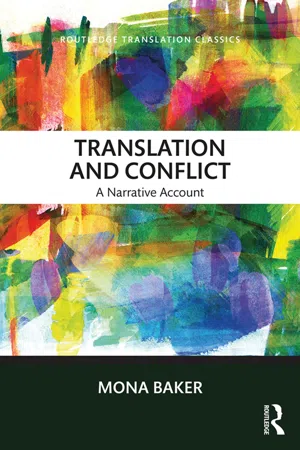
Translation and Conflict was the first book to demonstrate that translators and interpreters participate in circulating as well as resisting the narratives that create the intellectual and moral environment for violent conflict and social tensions. Drawing on narrative theory and with numerous examples from historical and current contexts of conflict, Mona Baker provides an original and coherent model of analysis that pays equal attention to the circulation of narratives in translation and to questions of dominance and resistance. With a new preface by Sue-Ann Harding, Translation and Conflict is more than ever the essential text for any student or researcher interested in the study of translation and social movements.
- 204 pages
- English
- ePUB (mobile friendly)
- Available on iOS & Android
eBook - ePub
About this book
Information
1
Introduction
Wherever we happen to be in the world and whatever type of activity or profession we may be involved in, we now live and function in a climate of conflict that cuts across national boundaries and constantly forces itself on our consciousness. In this conflict-ridden and globalized world, translation is central to the ability of all parties to legitimize their version of events, especially in view of the fact that political and other types of conflict today are played out in the international arena and can no longer be resolved by appealing to local constituencies alone. This book draws on narrative theory to examine the ways in which translation and interpreting function in this context and to explore how the discursive negotiation of conflictual and competing narratives is realized in and through acts of translation and interpreting.
1.1 Translation, power, conflict
Definitions of conflict inevitably draw on notions of power, and vice versa. Traditional scholarship assumed that power is something that some people have over others. Some theorists of power, such as Bachrach and Baratz (1962, 1970), further insisted that power is only present in situations of observable conflict, where one party forces another to act against its will or what it perceives to be its own interest. More robust definitions of power, however, acknowledge that the supreme exercise of power involves shaping and influencing another party’s desires and wants in such a way as to avert observable conflict, that ‘the most effective and insidious use of power is to prevent … conflict from arising in the first place’ (Lukes 1974: 23).1 Good (1989), Clegg (1993), Ehrenhaus (1993) and Philips (2001) provide excellent overviews of the relevant issues. The standard reference on power is Lukes (1974).
In its broadest meaning, conflict refers to a situation in which two or more parties seek to undermine each other because they have incompatible goals, competing interests, or fundamentally different values. In this sense, conflict is a natural part of everyday life rather than an exceptional circumstance. However, most people understand conflict in its political sense, as a state of hostility between groups of people, usually belonging to different races, religions or nation states. This book adopts the broader definition of conflict but draws extensively – though not exclusively – on examples of political, armed conflict in elaborating its theoretical premises. It also assumes that translation and interpreting are part of the institution of war and hence play a major role in the management of conflict – by all parties, from warmongers to peace activists.
Translation and interpreting participate in shaping the way in which conflict unfolds in a number of ways. First, as Chilton (1997: 175) reminds us, a declaration of war is, after all, ‘a linguistic act’. Clearly, this verbal declaration has to be communicated to other parties in their own languages; there is no point in the USA declaring war on Iraq without ensuring that the Iraqis and the rest of the world ‘hear’ that declaration. Second, once war is declared, the relevant military operations can only begin and continue through verbal activity (1997: 175). Much of modern warfare is based on coordinating several armies from different countries and linguistic communities; recent examples include the UN in Bosnia and the US command in Iraq. The very process of mobilizing military power then is heavily dependent on continuous acts of translation and interpreting, including – crucially – acts of translation and interpreting that allow military personnel to communicate with civilians living in the region. Propaganda leaflets dropped by US forces over Iraq in March 2003 communicated a variety of messages to Iraqi civilians and soldiers, such as ‘The Coalition does not wish to destroy your landmarks’ and ‘Coalition Air Power can strike at will. Any time. Any place’ (Moss 2003: 12–13). The legend underneath photographs of these leaflets in The Guardian read: ‘English translations of some of the propaganda leaflets dropped in Iraq by US planes and targeted at soldiers and civilians’ (1997: 175; emphasis added). More likely, the leaflets were first prepared in English and then translated and dropped in Iraq in Arabic, but the media often confuse these issues.
Third, it is not only the military but also ordinary people who have to be mobilized to initiate and support a war. Smith (1997: 200) reminds us that in the wake of the break-ups of the USSR and Yugoslavia successful political leaders were those who employed effective strategies for mobilizing ordinary people. Declaring and sustaining a war have to be discursively justified and legitimated; politicians have to pave the way for war to be accepted, for human sacrifice to be justified. Contemporary wars have to be sold to an international and not just domestic audiences, and translation is a major variable influencing the circulation and legitimation of the narratives that sustain these activities. And finally, once war is underway, attempts to broker and manage an end to the conflict typically take the form of meetings, conferences and public seminars, in addition to secret negotiations. All these require the mediation of translators and interpreters. Smith (1997: 210) recognizes that ‘if the meeting is conducted through language interpreters, the problems of translation, especially of emotionally charged terms, adds a further layer to the uncertainty generated by the incompatible discursive interpretations of the two conflict parties and the third party’.
More important perhaps than all the above, translation and interpreting are essential for circulating and resisting the narratives that create the intellectual and moral environment for violent conflict in the first place, even though the narratives in question may not directly depict conflict or war. Indeed, some of these narratives, as we will see, may be packaged as disinterested, abstract scientific theories, others as literary texts, cartoons, or innocent entertainment.
1.2 Why narrative?
Narratives ‘constitute crucial means of generating, sustaining, mediating, and representing conflict at all levels of social organization’ (Briggs 1996: 3). This book draws on the notion of narrative as elaborated in social and communication theory, rather than in narratology or linguistics, to explore the way in which translation and interpreting participate in these processes. Narratives, in the sense used here, are the everyday stories we live by, and indeed I will be using ‘narrative’ and ‘story’ interchangeably throughout the book. One of the attractions of narrative is that it is a highly transparent and intuitively satisfying concept that can easily be understood by anyone.
The notion of narrative used in this book overlaps to some extent with Foucault’s ‘discourse’ and Barthes’ ‘myths’, especially in its emphasis on the normalizing effect of publicly disseminated representations (see Chapter 2, ). But the concept of narrative is much more concrete and accessible, compared with the abstract notion of discourse as a vehicle for social and political processes and myth as an element in a second-order semiological system. Also, unlike myth, and much more so than discourse, the notion of narrative is not restricted to public representations but applies equally to individual stories (see Chapter 3, , on ontological narratives). Thus, as Whitebrook explains, one of the strengths of narrative theory is that it ‘make[s] the political agent concrete’:
A turn to narratives allows for the de-personalized persons of theory, the bearers of a representative or typified identity, to be understood as separate persons – characters – with singular sets of characteristics, including but not confined to their political context and/or group identity.
(2001: 15)
Narratives, as understood here, are dynamic entities; they change in subtle or radical ways as people experience and become exposed to new stories on a daily basis. This assumption has a number of consequences. First, narrative theory recognizes that people’s behaviour is ultimately guided by the stories they come to believe about the events in which they are embedded, rather than by their gender, race, colour of skin, or any other attribute.2 Second, because narratives are dynamic, they cannot be streamlined into a set of stable stories that people simply choose from. Narrative theory recognizes that at any moment in time we can be located within a variety of divergent, criss-crossing, often vacillating narratives, thus acknowledging the complexity and fluidity of our positioning in relation to other participants in interaction. Third, because narratives are continually open to change with our exposure to new experience and new stories, they have ‘significant subversive or transformative potential’ (Ewick and Silbey 1995: 199; see Chapter 2 on the political import of narrativity). Undermining regimes such as those of Nazi Germany or South Africa under apartheid, then, becomes – above all – a question of challenging the stories that sustain them (Hinchman and Hinchman 1997a: xxvii). This challenge, in turn, is articulated in the form of alternative stories.
Another strength of narrative theory is that unlike much of the existing scholarship in translation studies, it allows us to examine the way in which translation features in the elaboration of narratives that cut across time and texts. ‘The value of the concept narrative’, Ehrenhaus explains, is
its convenience as a shorthand notation for the multiplicity of interesting fragments that the critic circumscribes in constituting a working text – a story grounded in the social formations through which individuals, as members of an interpretive community, understand the world they inhabit and reproduce that world through their discursive participation and actions.
(1993: 80)
While narratology and linguistics tend to focus on one text at a time, the first mostly on literary text (and more recently cinema) and the second mostly on oral narratives, narrative theory as outlined here treats narratives – across all genres and modes – as diffuse, amorphous configurations rather than necessarily discrete, fully articulated local ‘stories’. It is simultaneously able to deal with the individual text and the broader set of narratives in which it is embedded, and it encourages us to look beyond the immediate, local narrative as elaborated in a given text or utterance to assess its contribution to elaborating wider narratives in society. Narrative theory further allows us to piece together and analyse a narrative that is not fully traceable to any specific stretch of text but has to be constructed from a range of sources, including non-verbal material. In so doing, it acknowledges the constructedness of narratives and encourages us to reflect critically on our own embeddedness in them.3
1.3 Overview of chapters
Chapter 2, ‘Introducting narrative’, offers a broad overview of narrativity as understood and applied in this book. It starts with a discussion of the status and effects of narrativity, including its relationship to genres, science, categories, fact and fiction, as well as the normalizing function of narratives. It then offers a definition of narrative that provides the basis for the model of analysis elaborated in the rest of the book. The chapter concludes with a discussion of the political import of narratives and the interplay of resistance and dominance evident in the way narratives are elaborated and received, stressing that narrative both reproduces existing power structures and provides a means of contesting them.
Drawing on Somers (1992, 1997) and Somers and Gibson (1994), Chapter 3 discusses four types of narrative and the way in which translators and interpreters mediate their circulation in society. Ontological narratives are personal stories that we tell ourselves about our place in the world and our own personal history; they are interpersonal and social in nature but remain focused on the self and its immediate world. Public narratives are stories elaborated by and circulating among social and institutional formations larger than the individual, such as the family, religious or educational institution, the media, and the nation. Individuals in any society either buy into dominant public narratives or dissent from them. Translators and interpreters play a crucial role in both disseminating and contesting public narratives within and across national boundaries. Conceptual, or disciplinary, narratives are the stories and explanations that scholars in any field elaborate for themselves and others about their object of inquiry. And finally, meta-narratives are public narratives ‘in which we are embedded as contemporary actors in history … Progress, Decadence, Industrialization, Enlightenment, etc.’ (Somers and Gibson 1994: 61), including ‘the epic dramas of our time: Capitalism vs. Communism, the Individual vs. Society, Barbarism/Nature vs. Civility’ (Somers 1992: 605).
Chapters 4 and 5 explain how narratives function in terms of how they construct the world for us. Chapter 4 focuses on the four core features of narrativity, namely temporality, relationality, causal emplotment and selective appropriation. Chapter 5 draws on Bruner (1991) to supplement these core features with another four: particularity, genericness, normativeness (including canonicity and breach), and narrative accrual. The eight features overlap and are highly interdependent. Temporal and spatial sequences participate in elaborating patterns of causal emplotment, and causal emplotment in turn is partly realized through selective appropriation, and so on. But discussing these features under separate headings allows me to clarify some of the complex ways in which narrativity mediates our experience of the world.
In Chapter 6, the notion of frame as elaborated in the work of Goffman and the literature on social movements is used to examine some of the many ways in which translators and interpreters – in collaboration with publishers, editors and other agents involved in the interaction – accentuate, undermine or modify aspects of the narrative(s) encoded in the source text or utterance, and in so doing participate in shaping social reality. Processes of (re)framing can draw on practically any linguistic or non-linguistic resource, from paralinguistic devices such as intonation and typography to visual resources such as colour and image, to numerous linguistic devices such as tense shifts, deixis, code switching, use of euphemisms, and many more. The chapter focuses on four key strategies for mediating the narrative(s) elaborated in a source text or utterance: temporal and spatial framing, framing through selective appropriation, framing by labelling (including rival place names and titles), and repositioning of participants.
Given that the version of narrative theory elaborated in this book stresses that narrative constitutes reality rather than merely representing it, and hence that none of us is in a position to stand outside any narrative in order to observe it ‘objectively’, we might conclude that there can be no criteria for assessing narratives and no sensible means for us to establish whether we should subscribe to or challenge any specific narrative. In Chapter 7, I argue that our embeddedness in narrative does not preclude our ability to reason about individual narratives. Walter Fisher’s influential narrative paradigm (1984, 1985, 1987, 1997) allows us to assess a narrative elaborated in a single text as well as diffuse narratives that have to be pieced together from a variety of sources and media. It can also be used to assess any narrative: ontological, public or conceptual, whether elaborated by an individual or an institution. I draw on Fishe...
Table of contents
- Cover
- Title
- Copyright
- Dedication
- Contents
- List of figures
- Acknowledgements
- Introduction to the classic edition
- 1 Introduction
- 2 Introducing narrative theory
- 3 A typology of narrative
- 4 Understanding how narratives work: features of narrativity I
- 5 Understanding how narratives work: features of narrativity II
- 6 Framing narratives in translation
- 7 Assessing narratives: the narrative paradigm
- Glossary
- Notes
- Bibliography
- Index
Trusted by 375,005 students
Access to over 1.5 million titles for a fair monthly price.
Study more efficiently using our study tools.
Frequently asked questions
Yes, you can cancel anytime from the Subscription tab in your account settings on the Perlego website. Your subscription will stay active until the end of your current billing period. Learn how to cancel your subscription
No, books cannot be downloaded as external files, such as PDFs, for use outside of Perlego. However, you can download books within the Perlego app for offline reading on mobile or tablet. Learn how to download books offline
Perlego offers two plans: Essential and Complete
- Essential is ideal for learners and professionals who enjoy exploring a wide range of subjects. Access the Essential Library with 800,000+ trusted titles and best-sellers across business, personal growth, and the humanities. Includes unlimited reading time and Standard Read Aloud voice.
- Complete: Perfect for advanced learners and researchers needing full, unrestricted access. Unlock 1.5M+ books across hundreds of subjects, including academic and specialized titles. The Complete Plan also includes advanced features like Premium Read Aloud and Research Assistant.
We are an online textbook subscription service, where you can get access to an entire online library for less than the price of a single book per month. With over 1.5 million books across 990+ topics, we’ve got you covered! Learn about our mission
Look out for the read-aloud symbol on your next book to see if you can listen to it. The read-aloud tool reads text aloud for you, highlighting the text as it is being read. You can pause it, speed it up and slow it down. Learn more about Read Aloud
Yes! You can use the Perlego app on both iOS and Android devices to read anytime, anywhere — even offline. Perfect for commutes or when you’re on the go.
Please note we cannot support devices running on iOS 13 and Android 7 or earlier. Learn more about using the app
Please note we cannot support devices running on iOS 13 and Android 7 or earlier. Learn more about using the app
Yes, you can access Translation and Conflict by Mona Baker in PDF and/or ePUB format, as well as other popular books in Languages & Linguistics & Linguistics. We have over 1.5 million books available in our catalogue for you to explore.