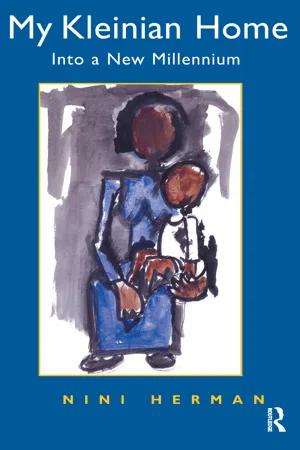
Fully revised, and including a new chapter, this is a welcome new edition of a psychoanalytic classic. The extraordinary autobiography of a woman who has had Jungian, Freudian and Kleinian analyses, My Kleinian Home depicts the author's life as an odyssey full of familial, historical and personal distress. She bravely and honestly discusses her experiences as a German Jew in the 1930s, the death of a child, and her constant search for the resolution of her childhood traumas, and brings an unusual clarity to the assumptions and experience of Kleinian psychoanalysis.
- 184 pages
- English
- ePUB (mobile friendly)
- Available on iOS & Android
eBook - ePub
About this book
Information
In the Beginning
All experience awaits recapture in the day to day of dreams, analysis and life. I remember being born. There was a splintering in the head, together with a bursting pain, a gurgling where there should have been breath, a feat of rescue and reprieve equally mysterious as that onslaught just before. This baffling sequence of events I have repeated all through life. Time and again, when all seemed lost, 1 somehow won through in the nick of time. When it was over there remained a blind necessity to sleep. To relegate this vast ordeal back to oblivion whence it made an illicit, brief escape. For everything has been inscribed in the computers of the mind from the beginning to the end.
‘You almost died when you were born. You had that string twice round your neck and looked quite blue. Well, almost black. Ugly, really terrible,’ my mother in due course confirmed this cataclysmic episode, during my analysis, one Sunday in her tidy flat.
Listening to her carefully I was unable to detect, fifty-three years afterwards, a trace of feeling in her voice, nor any hint that she had perhaps felt terror when her first-born did not cry in that impressive bedchamber of that villa in Berlin in which she too had grown up.
Since she had been accustomed to having all that money buys, which at the hour of my birth meant an obstetric galaxy, perhaps the possibility that something could go drastically wrong had not found its way into her mind. Or, if it had just flitted in, was simply bundled out again before the feeling had a chance to register its overtones. For Mother, now aged seventy-nine, got rid of fortunes in this way, habitually all her life, until very recently.
Until very recently, when my Kleinian analysis began to send a gentle rain, the deserts of this debris of feeling that she feared to own stretched between us, far and wide. Every time we were to meet I felt I was obliged to mount a full-scale expedition to traverse this blighted land. Yet, each time I set out again to visit, often fearing for my life, I slowly came to recognize that my growing sanity mobilized this enterprise and equipped it patiently to ensure I would survive several hours in this land which as I had once believed held no oasis anywhere. The only thing that I was no longer allowed to take, at that point, was an antidote to pain. I could no longer cast it out by being ‘naughty’, ‘wild’ or ‘bad’, all those awkward, stubborn things I had resorted to in the past, spilling, spoiling, injuring my belongings and myself with dreadful regularity.
‘Who is the mother? Who the child?’ my terror squealed continuously. ‘Look, you grown-ups everywhere, my mother simply cannot cope.’ This was the mother whom I loved so much, whom I worshipped and adored, and strove and struggled from the first to protect and to support, at the same time as I raged against her incapacity, until nothing but the rage remained. The love went hiding underground to be swept back in a dream.
I remember the rustle and papery starch of Nanny up against my cheek. And a swimming circle over me. Was it face or was it breast? Or the bottle in my Nanny’s hand when after several horrid days, Mother abandoned the struggle and put my life in Nanny’s charge. Was that the hovering shape above, to which I owe until this day a worship of great birds of prey that spread and circle overhead? Is it this that could explain Leonardo’s memory of the tail of a great bird beating him across the lips early in his infancy: the straight, hard nipple and the breast gently swinging overhead, which must be the baby’s view? What is the use of adult words? Before the tender age of three, I lost the Nanny of my life. All fell apart. Joy veered away, like the split atom navigates, shrieking down the lanes of death. For more than half a century I could bear nothing that was blue. And then, in my analysis, at last it swam before my eyes: her uniform had been blue. I had spent an aching life looking for my only love and the disappointment of every single glimpse of blue had made me hate the colour more.
But even before that disaster of my nanny’s disappearance struck, a previous catastrophe had all but cracked my world apart. I was taken by the hand and led down those daunting corridors which kept the wings of our great house so heartbreakingly far apart. At my parents’ bedroom door, flowering vistas greeted me. Extravaganzas of this kind meant that Father was at home. I saw my beautiful Mama like an angel, all in white, floating upon clouds of lace, among roses everywhere. I wanted, no, I insisted that I be picked up instantly and placed beside her on the bed, but was restrained and shown instead, by someone in the entourage, something that had now become the centre of the universe whose highlight I had been until then: a pink, a horrible pink worm. They say I cried out: ‘tiny eyes’, and did my best to poke them both out of the atrocious head of this pretender to the throne. But the deep reality was more sinister than that; a cataclysm which escaped detection for over fifty years.
It burst out of its well-built hiding place, by the purest accident, on a morning that I met a younger woman from abroad, also in treatment with my analyst, a ‘couch-sister’, as we say. We acted like two long-lost friends and soon dashed out to celebrate at a Brazilian restaurant because she wanted me to taste her traditional, native fare. From now on nothing in our lives would, I felt, remain unshared. But after lunch I grew depressed. My senses seemed to disappear. Thick layers of cotton wool were stuffed between me and the outer world. As the weekend dragged along I fought for reason, for my life. And yet there was no symptom that the Doctor-me could isolate: no temperature, no pain, no rash.
Then at last Monday crawled along. The analytic weekend plays a whole variety of tricks and Monday’s session as a rule restores a balanced frame of mind. But matters went from bad to worse. Now I could neither see nor hear as I was lying on the couch. As rats will leave a sinking ship my senses were deserting me. Here was the end of all my dreams. What use was this analysis? My hopes that it would lead me out of confusion, step by step, died down around me, once again. In the old and dreary way I resorted to retreat: ‘I am too serious a case. I am too old. I should have come, twenty, thirty years ago instead of wasting fifty years.’
Here was that bottomless, black hole which had dogged me all through life. I fled from the analysis during that Monday session in the blind, helter-skelter way that was my habit and my style. I felt I could no longer fight to save what I had once possessed in terms of mental clarity. As when a house is burning down, it was a case of salvaging - as it seemed to me that day - whatever swayed within my reach, except there was no longer an T, nor any ‘he’, or analyst. Only the gutted, charred remains of a former edifice, only rubble where there had grown the walls of a relationship. Where was a lifeline to that past? Words floated through the empty air. Yet when I tried to snatch at them, I could no longer link them up to make connections, rhyme or sense. Sense was dismantled, severed, stripped: the familiar categories deprived of every handle, grip or trust.
It took a week of patient analytic work to restore meaning, hope and love to these bombshell-like events. Meeting my younger ‘sister’ had triggered explosions in my mind of a previous baby’s birth, since the unconscious does not have any cognizance of time. Here was the pink worm back again. And with it all the rampant fears of absolute maternal loss had hurtled me a second time straight through the ‘autistic gate’. I was living for the second time through an autistic episode. It felt like having to undergo major surgery with no anaesthetist to hand.
As the analytic task grappled with the catastrophe during ensuing days and weeks, I realized that my analyst had suspected for some time that there must have been an autistic episode very early in my life. There had been dreams suggesting that the loss of the breast had hit so hard, once this brother hogged it all, that, inconsolable, I had replaced its warmth and comfort with anything and everything that could be stuffed into my mouth and sucked despairingly instead.
Now I had lived a second time through the fright of this eclipse that my brother’s birth had meant. But if that lightning had struck when I was twenty-five months old, how was it that I had escaped the fate of total mind arrest? Who had resuscitated me? To whom did I, in retrospect, owe this debt of gratitude?
‘Let us see,’ my mother said, when I questioned her again.
It was a Sunday, as before, and it was raining quietly. Not an afternoon for strolling round the tidy park that adjoins her block of flats. I had been careful to avoid the actual word ‘autism’. Had I been ‘poorly’, or ‘distressed’, soon after my brother’s birth?
‘Well, we shall look and see,’ my mother said.
She seemed a little interested and wanted above all things else to be helpful to her child. This has always been the case. How she struggled all her life with her cruel ineptitude, who grew up motherless herself from a very tender age! She got up from her leather chair with the slight difficulty that she has experienced ever since her hip replacement operation. I watched her as she slowly rose to her full majestic height and took some careful steps across to her fine six-foot-tall bookcase. There stand, carefully preserved, those remnants of her library which are most meaningful to her.
As she unlocked and opened it, I drew in the scent again, familiar from my childhood days, inseparable from old books when they are beautifully bound and have been lovingly preserved. Then they exhale in gratitude that musky, aromatic scent, and I inhaled it gratefully and felt extremely privileged. For it is not often that this polished glass case is unlocked when I am actually there - it is a sign of the growing trust there is between us nowadays. From the shelves my mother took a volume of the diaries that she had kept up day by day until, in 1938, she became a refugee. When the hour struck to flee, it was her diaries she had saved, when there was barely enough time to pack a nightdress and be gone.
She settled back into her chair and turned the pages that are bound in fine, red leather until she came to the first months of my life. There my weight from day to day stood registered and how much milk I had consumed, as Nanny had reported it.
‘You see, what interest I took?’ My mother’s voice is strong and proud as we confront this evidence of well-discharged maternity. ‘Aha,’ now warming to her theme, ‘a trip to Paris that we made. And here is Florence, where I went with your father, at the time. You were already six weeks old. Now, here we have your brother’s birth, and here, yes, good, he cried at once. Now, you again, Yes, “tiny eyes”, you said and tried to poke them out. You see, it’s all recorded here.’
Because it is all recorded in such detail, conscientiously, we slowly gravitate towards the kind of information that I am looking for. ‘Eleanore,’ my name at that time, ‘begins to run a temperature. The temperature goes on and on. Professor so-and-so is called.’
‘He was a great authority on every matter of that kind,’ my mother adds, consolingly, as if she needs to reassure a relentless enemy who never stops accusing her.
What is all this analysis? I very often feel her storm, antagonized and rather hurt. For does it not insinuate that she failed me in some way?
Those men, you know,’ she sometimes says, quoting her brother on the theme of analysts, ‘know when they’re onto something good. While the money lasts, of course.’
Mother and Uncle disapprove of people who are after other people’s money. For they have found the world to be greedy and grasping, they maintain.
She turns the pages slowly now. ‘Yes, we still have the temperature. And here, it says, you stayed in bed and only took a little soup: a spoon or two of consommé. Now here, the Herr Professor said that you might get up again, in the middle of the day. The temperature was coming down. He called it Bewegungs Temperatur.
I wondered what that word could mean, ‘movement temperature’. Was that what today we would call psychosomatic or emotional? Meanwhile there seems nothing more that I would want to hear about: behaviour changes, mood and sleep. Nothing that gives a tell-tale hint of regression, at this point. Maybe Nanny noticed it but could not put it into words for the day-to-day report? Perhaps intuitively she felt that anxieties should be withheld so soon after my brother’s birth, and meanwhile, very likely made all the right responsive moves to make those evil spirits pass before they took a lasting hold?
But since my mother had, it seemed, also found it difficult to recover from this second birth, the Professor suggested now that she should travel with my Nanny and me to the magical Engadine. Perhaps the Herr Professor was wiser than anybody knew. For it seemed that in St Moritz, the beneficial altitude and the healthy alpine sun made the mysterious fever yield.
Mother seems well satisfied. ‘There, you see, it went away. We did the right thing, obviously.’
‘Obviously you did,’ I smile, in my mother’s small, neat flat, where everything stays in its place, so unlike my London home.
Now I enjoy a deep relief. On behalf of that small girl I feel so grateful and at peace that in this crisis in her life, unable to protect herself except by overheating to produce the tell-tale temperature, she got her mother and her nurse absolutely to herself for several weeks on end, for the first time in her life, while that dreadful baby had been obliged to stay at home in the care of his own nurse.
Meanwhile Mother carries on, ‘Your father joined us. You refused to recognize him at first. Only the next day. Well, how strange.’
To me, it is not strange at all. For now ‘the enemy’ was back, who wanted Mother to himself. Now he would take her far away and I would lose her once again. Yes, I would have to yield her up without a word in my defence.
‘Your father took me to Copenhagen. And you went back then, to Berlin.’
She closes the red leather book. It is three-thirty, time for tea.
‘You see,’ she adds in her own defence, locking the glass bookcase door, ‘you always thought that I was not really, truly interested. Of course we travelled such a lot. People did in those days. Also, you must not forget, you had your Nanny, anyway.’
‘I wonder when she left?’ I asked.
‘When you were ready for the next, I would imagine,’ Mother smiled. ‘Next time we will look at that. Would you like Indian or China tea? Have what you like, child. You can choose.’
Choosing is something quite, quite new, belonging to my fifth decade. Consequently I am still a little heady and surprised every time I exercise this startling possibility. During those first years, in Berlin, it came full circle once a year. On the second day in April, Cook would come to the nursery to take luncheon orders from me: the best of all my birthday gifts. There she would stand, enormous, white, red-faced and slightly out of breath, pencil poised above her pad; and I would say with majesty: ‘spaghetti with tomato sauce’. I never wavered on my theme. Spaghetti was a solid link with the healing Engadine, the small pension run with the clockwork regularity the world was subject to in those days. My choice began and ended there, remaining the prerogative of kings and queens the other three hundred and sixty-four days of the submissive year; a tantalizing chink of light on which the darkness closed again when the empty dish went back to regions whence it had come.
The nursery had a padded door. Children frequently make noise. The handle of that towering door was too high for me to reach. It had its own perplexing laws in which my longings had no say. I could only moon around and watch that handle for a sign of life from the outer, happier world. If I watched it, long enough, I knew that it was bound to move. At bedtime, when they were not away in the four corners of the earth, parents came in evening dress, to wish us both a nice goodnight, briefly at each bed in turn, before Nanny showed them out. How beautiful the parents looked; they did not wear a uniform and smelled of flowers I had never seen. The others all wore uniform. The chauffeur’s was dark navy-blue, adorned with buttons made of gold. Successive nannies had one too, after that initial blue, with hooks and eyes and safety pins. Maids changed from pink, to mauve, to black through the hours of the day, as though in keeping with the sky. Caps of white perched on their heads, like frills on a crown of mutton roast. Cook was always swathed in white on the occasions when she rose from her kitchens way below.
Food, which made the handle move, had to come up in a lift. The lift was very, very far from the nursery, of course. Three or four times every day, trays came within sight and reach. They were carried by a maid. Upon them rested silver cupolas like those on a Byzantine church. The maid would leave the tray and glide to pull the heavy padded door shut behind her, carefully. I am not certain whether she spoke. Perhaps she said, Guten Morgen or Guten Apetit but I cannot be positive. I feared that people would be sacked for speaking unless spoken to. This term had swum into my consciousness when I eavesdropped on the maids, an activity which was my most important source of knowledge of the outer world. From it, I built an image of who was who and what was what, though it often proved bewildering. Being sacked meant being pushed into an enormous sack like the bad wolf possibly, then maybe drowned or eaten up. I took great trouble not to be the cause of such a dubious fate and consequently I would meet silence with silence to the best of my stunned ability. The food had to be eaten up. Its colours were greens-green, carrot-orange, prune-brown, and pudding-white. But memory here is very cold. And memory is shivery just like the start of a bad illness, when the fever has just dropped, briefly, before coming back.
Between that nursery and Berlin lay great flights of marble stairs, and all the rooms and anterooms and ballrooms of the floor below. The cunning scent of hot-house plants and cellophane-ensheathed cigars would animate long galleries where dark, imposing pictures hung and children rarely set a foot. Sometimes blueish wreaths of smoke danced together in the air unattended by a human shape. At other times, I caught a glimpse of ladies or of gentlemen who spoke in whispers as they gazed upon the pictures on the wall. Was it forbidden to speak loud - even where pictures were concerned? It made me feel very afraid of paintings locked into a frame for very many years to come.
The front door, once it had been reached, was like a drawbridge: difficult to master and negotiate. A porter in grey uniform operated this device, as part of his mysterious life, in a narrow little lodge where he spent his days and nights dedicated to that task. Every time we returned from the Grünewald or the Zoo he had to jump to it again. That was once or twice a day, depending on the weather and the delicacies of our health. In memory the weather is grey. Only rarely, if Mama or Pappi took us out, the weather had the colours of sun, wind and blue sky. But memories can also lie. Across their pearl-grey, pudding-white, I see the grown-ups shake their heads. ‘Nini, you are distorting everything again. Why do you never speak the truth?’ What do they mean, then, by ‘the truth’? Can it be something different from the hot and cold I feel, the thumping of my tick-tock heart, the queasy lurching in my soul? In the marrow of my bones and in the place where stomachs lie, I feel each time they scold me, that they are very very hurt, at their wits’ end over my wicked and ungrateful ways. That this time I am written off since I may never, never change and so am almost bound to be a burden to them all my life, because I keep inventing tales that no one in the whole wi...
Table of contents
- Cover
- Half Title
- Title Page
- Copyright Page
- Dedication Page
- Contents
- Introduction
- Cynthia
- In the Beginning
- My Jungian Mother
- Therapeutic Interlude
- My Freudian Father
- My Kleinian Home
- Postscript: Reflections after One Decade
- Road without an End
Trusted by 375,005 students
Access to over 1.5 million titles for a fair monthly price.
Study more efficiently using our study tools.
Frequently asked questions
Yes, you can cancel anytime from the Subscription tab in your account settings on the Perlego website. Your subscription will stay active until the end of your current billing period. Learn how to cancel your subscription
No, books cannot be downloaded as external files, such as PDFs, for use outside of Perlego. However, you can download books within the Perlego app for offline reading on mobile or tablet. Learn how to download books offline
We are an online textbook subscription service, where you can get access to an entire online library for less than the price of a single book per month. With over 1.5 million books across 990+ topics, we’ve got you covered! Learn about our mission
Look out for the read-aloud symbol on your next book to see if you can listen to it. The read-aloud tool reads text aloud for you, highlighting the text as it is being read. You can pause it, speed it up and slow it down. Learn more about Read Aloud
Yes! You can use the Perlego app on both iOS and Android devices to read anytime, anywhere — even offline. Perfect for commutes or when you’re on the go.
Please note we cannot support devices running on iOS 13 and Android 7 or earlier. Learn more about using the app
Please note we cannot support devices running on iOS 13 and Android 7 or earlier. Learn more about using the app
Yes, you can access My Kleinian Home by Nini Herman in PDF and/or ePUB format, as well as other popular books in Psychology & Social Science Biographies. We have over 1.5 million books available in our catalogue for you to explore.