eBook - ePub
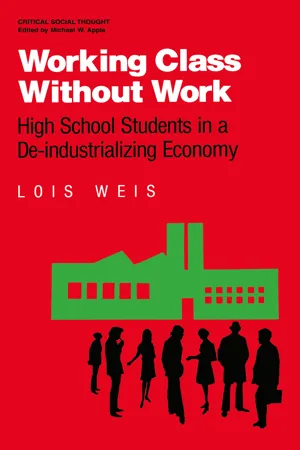
Working Class Without Work
High School Students in A De-Industrializing Economy
- 260 pages
- English
- ePUB (mobile friendly)
- Available on iOS & Android
eBook - ePub
About this book
The author wxplores issues of race, class, and gender among white working class youths, and she considers the roles of school and family in the production of the self. The book also examines the working class teens' attitudes toward and readiness for postfeminist thinking and the emerging American New Right. Presenting the first sustained ethnographic investigation of white working class youth in the context of deindustrializatin, Weis offers a complex portrait of how these young people produce themselves in a society vastly different from that of their parents and grandparents.
Information
1
Introduction
This book is an examination of the identity-formation process among white working-class youth in the context of the de-industrialization of the American economy. For present purposes, "identity" can be defined as a sense of self in relation to others. Identity formation refers, therefore, to the processes through which people, either individually or collectively, come to see themselves in relation to others in particular ways.1 In this volume I explore these processes among white working-class male and female high school students in Freeway—a city located in the northeastern "rust belt" of the United States.
In the 1970s I was greatly influenced by the literature on education and social and economic reproduction.2 The question here is how does the institution of schooling, which was once hailed as the great engine of democracy, in fact act to reproduce the relations of domination and subordination necessary to the maintenance of a capitalist economy? Whether one approaches this question from a largely structuralist point of view, such as that of Samuel Bowles and Herbert Gintis, or a largely culturalist one, such as that of Paul Willis, the basic premise is that schools serve largely to reproduce the existing social order—a social order marked by great disparities of wealth, power, and privilege.3 The question is, how?
Since the late 1970s, however, there have been radical changes in the economy which have rendered some of the assumptions and claims of the reproduction theorists (even those "revisionist" reproductionists such as Paul Willis) naive. The period from the end of World War II to the late 1970s represented the longest period of sustained economic growth in the history of world capitalism.4 Central to this period of relative stability and growth was what Allen Hunter and others have called the "capital-labor accord," which "represented, on the part of labor, the de facto acceptance of the logic of profitability and markets as the guiding principle of resource allocation . . . in return for an assurance that minimal living standards, trade union rights, and liberal democratic rights would be protected."5 It was logical, then, that scholars critical of the notion that schools were the great engine of democracy and distributor of opportunity would focus their attention on the role of schooling in the perpetuation of the class structure. Things did, after all, appear as if they were being reproduced. Given this apparent reproduction, it was deemed important to understand how it is that working-class youth, for example, obtain jobs similar to those of their parents despite the official ideology associated with schooling.
With the demise of the "capital-labor accord and the accompanying de-industrialization of the economy, it is important for scholars to reexamine the notion that schools prepare students to occupy positions in the industrial order similar to those of their parents.6 Although it is understandable how the reproduction framework took hold among academics in a period of relative stability, it is becoming increasingly clear that this framework will be unable to illuminate complex social processes currently unfolding. It is important, then, for scholars to break out of the reproduction framework and begin to explore alternative conceptions of society and the ways in which schools are linked to this society.7
In this book I use ethnographic data generated within one high school in a de-industrializing area to shed light on one such alternative understanding; that being that society is the material accomplishment of conflicting groups struggling for control of the field of historical cultural action.8 Specifically, I focus on the current struggle of white working-class youth as they produce themselves in a society vastly different from that of their parents and grandparents. I interpret the experiences and cultural praxis of youth in light of two general types of collective action that have occurred in the United States, that being the continuation of struggles related to social class and gender since the 1960s and 1970s. 1 also tie these struggles and the identity formation of white working-class youth to the emergence of the New Right in the United States and speculate as to the meaning of male and female identity formation in relation to this movement. As I will suggest later in this chapter, this perspective differs radically from that embedded in a social and economic reproduction framework.
The focus on social movements in this volume is important. Philip Wexler has argued persuasively that "liberal and critical work in American education [specifically work on social and economic reproduction] that was made possible by historical, collective social action now develops a mode of analysis that does not place collective action at its center."9 Wexler points to the irony of the lack of a movement or social-action perspective in the work which owes its very existence to the social action of the 1960s, in particular. The civil rights and women's movements encouraged academics to question the extent to which schools are the great engine of democracy. It is truly ironic, then, that social action was forgotten as the social-reproduction framework took hold in the academy.
In this volume I take the notion of social action seriously both in terms of my definition of society as constitutive of such action, as well as in the fact that I explore youth identity formation in light of broader social movements. This is the first full-scale ethnography, to my knowledge, in which this task is attempted.10 Ethnographies generally rest at the level of description or, when theorized, are couched in terms of some variant of reproduction theory.11 Here I bring in a social-action perspective by viewing student identity in relation to larger movements. I argue that youth exist in a dialectical relationship with such movements—they are both "created" by them and "create" them at one and the same time. I do not use the term "create" in a deterministic fashion, however. Youth are not passive recipients of social movements any more than they are passive recipients of any aspect of culture, whether dominant or otherwise.12 All of us exist in relation to social action, but not in any mechanistic sense.
This book does more than detail the formation of working-class youth identity in relation to social movements. I also focus on the way in which the school itself is related to the construction of identity. Specifically, I argue that youth identities form in relation to aspects of both school and teacher culture and that there is a dialectical quality to these relationships. Each is formed by, and at the same time forms, aspects of the other. The relational aspects of identity formation, both in terms of the school and larger social movements are, then, a key focus of this volume.
Philip Wexler has suggested that the school acts as a blockage to the path of collective identity formation.13 While this certainly may be the case, especially in terms of collective identity, he potentially simplifies what does go on within the site of the school. To assume that the school acts necessarily as a repressive apparatus and that it, therefore, blocks the path of collective identity formation ignores the fact that the school itself is the site of the very struggles that Wexler discusses. It also leads us back into the "black box" notion of schooling which the work of "new sociologists" of education has helped us move well beyond.
This is not to say that the school may not serve this function, but that the role of the school is itself a question for research. It is also possible that the school may serve to both block and further the identity-formation process, whether collective or not, at one and the same time, and that these contradictory pressures may reflect contradictory self-production processes in evidence among youth. My point here is that one has to look carefully at the site of the school to see what is, in fact, happening on a day-to-day basis rather than conclude, as Wexler does, that the school acts necessarily to block the path of identity formation.
My intent, then, is to capture the identity-formation process of white working-class youth in a de-industralizing economy and theorize this process in relation to both the school and broader social movements. I will also, at a later point, touch briefly on the role of parents in this process.14 These social movements, which lie at the heart of my analysis, must be seen in light of current economic trends. It is to the broader economic context that I now turn.
De-industrialization and the post-industrial society
At the end of World War II, American corporations dominated world markets. The American steel industry, for example, was virtually the only major producer in the world. By the 1960s, Germany, Japan, France, Italy, and Britain had rebuilt their steel industries, using the most advanced technology, and they became highly competitive with American industry. By the 1970s the American steel industry was in decline relative to that of other nations. For whatever reasons (and many have been offered), the industry continues in a decline and its effects are widely felt in the United States.
Factory closings are not restricted to the steel industry, and while more common to the northeastern United States, are not confined to this area. Gone are many of the jobs in heavy industry, automobiles, and manufacturing. The largest growth sector in the economy is now service, not production. Jobs in the service sector demand retraining, pay less, provide less security and fewer benefits, and often demand relocation. De-industrialization means a less secure, generally lower, standard of living for working-class Americans.
Barry Bluestone and Bennett Harrison, labor economists, note that "when the employment lost as a direct result of plant, store, and office shutdowns during the 1970s is added to the job loss associated with runaway shops, it appears that more than 32 million jobs were destroyed. Together, runaways, shutdowns, and permanent physical cutbacks short of complete closure may have cost the country as many as 38 million jobs."15
Pursuing Bluestone and Harrison's argument, Katherine Newman asks, "Why should American manufacturing sound its own death knell?" As she states,
Manufacturers have been pinched by a profit squeeze, whose origins lie both in increased foreign competition and in the victories of organized labor. Unionized workers have been able to bargain for higher wages, thus limiting the flexibility of management just as the competitive environment has become tough. From management's perspective, the most effective way to respond was to cut and run. And from a logistical standpoint, it had become much easier to run. Labor and transportation costs are low enough to make it more profitable to produce cars in Korea and ship them to the United States than to manufacture them in America's heartland.16
Many displaced workers remain unemployed today; others obtained jobs in the much lower paying service sector.17 De-industrialization, it must be stressed, is not a temporary phenomenon. It represents a radical shift in the nature of the American economy and the way in which American workers intersect with this economy. It is also the case that de-industrialization is now reaching beyond the "rust belt" industries. Newer industries (which represent the "high-tech solution"), such as microelectronics, are also exporting assembly jobs to Asian subsidiaries, thus eroding even further the employment base of the American working class.18
Capital is, in fact, more mobile than ever before. Investment is still taking place but in ways that signal a radical departure from previous decades. Basic production is, in fact, still occurring with the help of American finance, but American labor is being used less and less in this capacity. Jobs available in the United States are simply different from those available even a decade ago. Bluestone and Harrison are worth quoting in full here:
U.S. Steel has billions to spend, but instead of rebuilding steel capacity, it paid $6 million to acquire Marathon Oil of Ohio. General Electric is expanding its capital stock, but not in the United States. During the 1970s, GE expanded its worldwide payroll by 5,000 but did so by adding 30,000 foreign jobs and reducing its U.S. employment by 25,000. RCA Corporation followed the same strategy, cutting its U.S. employment by 14,000 and increasing its foreign work force by 19,000. It is the same in the depressed automobile industry. Ford Motor Company reports that more than 40 percent of its capital budget will be spent outside the United States, while General Motors has given up its plans to build a new multibillion-dollar plant in Kansas City, Missouri, and instead has shifted its capital spending to one of its facilities in Spain.19
The nature of the American economy has changed drastically within recent years, and the jobs upon which the white working class built their existence have been severely eroded. What is important for current purposes is that the landscape of the American economy has changed and that this represents a permanent shift which affects not only the Traditional Proletariat but all Americans.
Alain Touraine's points regarding the new social order—what he calls post-industrial society—must be taken seriously here. As Touraine suggests,
The characteristic feature of post-industrial society—which I have described more exactly as programmed society—is that the central investments are now made at the level of production management and not at that of work organization, as is the case in industrial society. Like all historical societies, industrial society, which should be defined rather in terms of production relations than of techniques, is based on the hold exerted by the masters of industry over salaried labor; this is why the place where class awareness and class conflict is situated is the factory, even the workshop or workplace, all of these being situations in which the boss-organizer imposes production rates and methods on workers. Whether the regime be capitalist or socialist, class domination in industrial society is always of the Taylorian type. By contrast, in programmed society class domination consists less in organizing work than in managing the production and data-processing apparatus; i.e., ensuring the often monopolistic control of the supply and processing of a certain type of data and hence of a way of organizing social life. This is the definition of the technocracy controlling the running of management apparatus. Resistance to this domination cannot be limited to a particular sphe...
Table of contents
- Cover
- Title
- Copyright
- Contents
- Series Editor's Introduction
- Acknowledgments
- Note to the Text
- Prologue
- 1 Introduction
- 2 Freeway Males
- 3 Freeway Females
- 4 Within the School
- 5 Freeway Teachers
- 6 Freeway Parents
- 7 Women and Men: A Social-Movement Perspective
- 8 Whither the Working Class?
- Appendix Open-ended Interview Questions—Students, Faculty, Parents
- Notes
- Index
Trusted by 375,005 students
Access to over 1.5 million titles for a fair monthly price.
Study more efficiently using our study tools.
Frequently asked questions
Yes, you can cancel anytime from the Subscription tab in your account settings on the Perlego website. Your subscription will stay active until the end of your current billing period. Learn how to cancel your subscription
No, books cannot be downloaded as external files, such as PDFs, for use outside of Perlego. However, you can download books within the Perlego app for offline reading on mobile or tablet. Learn how to download books offline
Perlego offers two plans: Essential and Complete
- Essential is ideal for learners and professionals who enjoy exploring a wide range of subjects. Access the Essential Library with 800,000+ trusted titles and best-sellers across business, personal growth, and the humanities. Includes unlimited reading time and Standard Read Aloud voice.
- Complete: Perfect for advanced learners and researchers needing full, unrestricted access. Unlock 1.5M+ books across hundreds of subjects, including academic and specialized titles. The Complete Plan also includes advanced features like Premium Read Aloud and Research Assistant.
We are an online textbook subscription service, where you can get access to an entire online library for less than the price of a single book per month. With over 1.5 million books across 990+ topics, we’ve got you covered! Learn about our mission
Look out for the read-aloud symbol on your next book to see if you can listen to it. The read-aloud tool reads text aloud for you, highlighting the text as it is being read. You can pause it, speed it up and slow it down. Learn more about Read Aloud
Yes! You can use the Perlego app on both iOS and Android devices to read anytime, anywhere — even offline. Perfect for commutes or when you’re on the go.
Please note we cannot support devices running on iOS 13 and Android 7 or earlier. Learn more about using the app
Please note we cannot support devices running on iOS 13 and Android 7 or earlier. Learn more about using the app
Yes, you can access Working Class Without Work by Lois Weis in PDF and/or ePUB format, as well as other popular books in Education & Education General. We have over 1.5 million books available in our catalogue for you to explore.