eBook - ePub
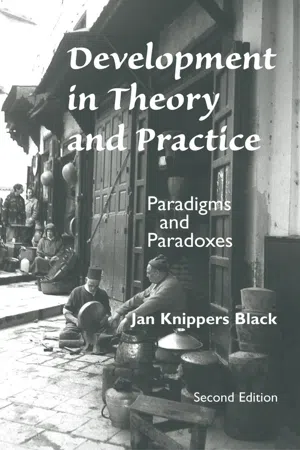
Development In Theory And Practice
Paradigms And Paradoxes, Second Edition
- 332 pages
- English
- ePUB (mobile friendly)
- Available on iOS & Android
eBook - ePub
About this book
As wealthy countries focus more attention on the ravages of poverty and maldistribution of the world's resources, the rationales for what is or is not done in the name of ?development? have become more elaborate and abstract. And as the literature has proliferated, communication among those who approach development from different perspectives, disciplines, and professions has become more strained. In this innovative text, Jan Black argues that what is missing is ?appropriate theory? that can help place the findings of social scientists and seasoned development practitioners at the service of those who would promote a more equitable and empowering approach to development.In the first section, the author presents the differing and even contradictory definitions of development and the various explanatory models and means of measurement associated with them. This is followed by an analysis of the evolution of development strategies and programs both of the First World?donor countries and organizations?and of Third World leaders, movements, and regional organizations. The author highlights key issues in the development debate of the 1990s, including ecology, refugees, debt, the informal sector, and gender roles. In a final section, she addresses the process of development and illustrates, through a number of vignettes and case studies, the sometimes illusory links between motives and consequences. The second edition includes more paradoxes and case studies and increased coverage of refugees and indigenous peoples. More information on the new states in post-Soviet East and Central Europe is also incorporated.At a time when theoreticians and practitioners appear to occupy different worlds and speak different languages, and when a large number of developing countries seem to be falling into an irreversible cycle of debt and dependency, this book is particularly welcome and compelling.
1 Introduction: In Pursuit of Appropriate Theory
Talleyrand, asked for a definition of nonintervention, said it was a term used in politics that meant intervention. The problem with using a term common in public affairs is that such terms are adopted and adapted in accordance with particular needs and may in fact be employed by different spokesmen or at different times to convey contradictory meanings.
Development is such a term. It has no precise meaning, no generally accepted definition. Metaphors aside, society is not an organism with a genetically programmed innate potential. We cannot say of a society, as a gardener might of a flower, that it has become what it should be.1 Like other terms that have acquired a positive connotation, development is user-friendly: It means whatever one wants or needs it to mean.
Why, then, should we bother to study it? For academics, the answer is simple. A term or concept in such common and yet multifarious use may be liberating. It gives us license to poach—to bring intellectual and scholarly traditions to bear on a broad range of issue and policy problem areas without becoming trapped by disciplinary, jurisdictional, cultural, or geographic boundaries.
There are more compelling reasons, however, for studying development. One is that, for better or worse, a lot of things are being done in its name that any well-informed person should know about. Another is that given the ambiguity and generally positive connotation attached to the term, useful things can be done in the name of development. Finally, the very open-endedness of the study of development gives us an incentive to elaborate our visions of what might be—a wagon to hitch to a star.
For the most part, however, it has not been the study of development and underdevelopment that has led to a mushrooming of official development assistance programs; rather, the latter has given rise to the former. In fact, the study of development has flourished in recent years, but its very currency has in some ways made the study of it more difficult. The more public attention in the wealthier countries has been focused on the ravages of poverty and the maldistribution of the world's bounty, the more elaborate, abstract, and jargonized have become our rationales for what we do or fail to do about it. And the more the literature has proliferated, the more strained has become communication among those who approach it from different perspectives, disciplines, and professions. Let us deal briefly with each of these obstacles.
Useful Fallacies
It should not be surprising that along with a wealth of insight and information, the flourishing of development studies has also brought forth misinformation, disinformation, and new conceptual vehicles for ethnocentricity and prejudice. In the first place, there has been a serious disjuncture among field practitioners, theoreticians, and policymakers. In the design of theories and policies, informational vacuums tend to be filled by prejudice. In the second place, policymakers routinely invoke widely shared moral ideals to justify the pursuit of cruder interests. And finally, nationalities and classes clearly favored by global inequality seek relief from impotence or guilt through the resolution of cognitive dissonance. That resolution is likely to take one or more of the following general forms: (1) there is no problem; (2) there is a problem, but it is not our problem; (3) there is a problem, but it is not our fault; (4) there is a problem, but we are solving it; or (5) there is no solution. These circumstances of ignorance, interest, and psychological need have nurtured a number of useful fallacies.
Assuming Progress
India's progress since independence in increasing life expectancy has been truly remarkable; the figure has risen from an average of twenty-seven years upon independence in 1947 to sixty-one years in 1994.2 Population has more than doubled during that period, with food production, overall, keeping pace—a consequence largely of the so-called green revolution. Food and other amenities, however, have not been efficiently distributed. In fact, there has been increasing inequality and pauperization in the rural areas. Whereas in 1947, 25 percent of the rural population was landless, by 1988 that proportion had risen to 40 percent. The landless were continually swelling the population of urban areas, placing severe strains on municipal governments. In Madras, slums or shantytowns accounted for 25 percent of the population in 1961, 33 percent in 1971, 40 percent in 1981, and 50 percent in 1988.3
For the developing countries as a whole, it is certainly clear that progress has been made in the period since World War II in some areas (e.g., life expectancy), but there has been slippage in others (e.g., self-sufficiency); and it is not clear that progress or development, by any definition, is inevitable. Immanuel Wallerstein, who has identified 75-to 100-year cycles of "expansion" and "contraction," or prosperity and depression, in the capitalist world economy over several centuries, has written that we are slipping into the downside of a cycle.4
At any rate, there does not appear to be any felicitous unidirectional locomotion, fueled by divinity or fate, that lets us off the hook. Nor is there convincing evidence that the thrust of policy to date on the part of rich countries and areas with respect to the less fortunate has been to the benefit of the latter. And while outcomes are not necessarily attributable to the intentions and efforts of policymakers and implementers, they are not wholly independent of them either.
Furthermore, although none would claim that there are easy ways for the "unpowerful" to influence policy, it remains true that "if enough people beat their heads against a brick wall, that wall will fall."5 In short, there is no legitimate rationale for escape—through either complacency or despair—from concern about the planet and its passengers.
Patenting Modernism
In one version of a perhaps apocryphal story, a visitor to India asked Gandhi what he thought of Western civilization. Gandhi replied, "It would be a good idea."
Contrary to the ethnocentric and tempocentric impression sometimes conveyed by development literature, modernism was not invented by the West, much less by the United States. Nor is there anything particularly new about the essence or the major components of international development. One should not need a stroll through Egypt's Valley of the Kings or through the Mayan temples of Mexico's Yucatan Peninsula or along China's Great Wall to be reminded that the contribution of "the West" to modernity and its diffusion is a thin veneer, most likely soon to fall beneath another Asian layer.
Technology transfer is probably as old as trade, certainly as old as empire. Economic planning was presumably in effect in Egypt when the Pharaoh reacted to Joseph's dream by storing grain from the years of abundant harvest for the anticipated seven lean years; and the planning and social-welfare systems of the Incas were apparently in many respects superior to those of their contemporary Andean counterparts. The ambitions of larger or richer states with respect to their neighbors have always been coated with the rhetoric of higher cause—spiritual or material uplift. And as for unsolicited advice, we need no carbon 14 dating to judge it timeless.
For the affluent of the First World, as well as for the Westernized elite of the Third, a major obstacle to understanding the challenges facing less-affluent peoples has been a tone pervading official pronouncements, and even much of the academic literature, of self-congratulation on the one hand, condescension on the other.
The dichotomous use of the terms modern and traditional is generally more pernicious than a mere lack of definition. It may mean that we have lumped together under a single derogatory heading all cultures other than our own. As the opposite of modernism, tradition is the essence of the national self-determination and cultural identity that is everywhere under assault. And the culture of which modernization, and now globalization, is a carrier is not necessarily a real culture—rooted either in popular or in elite tradition—from anywhere. It is now more likely to be a "virtual" culture, deriving from the needs and imaginations of advertisers and reflecting the capabilities of the communications revolution—a composite caricature of real culture that exacerbates the disjuncture between learning and experience.
Furthermore, while there can be little doubt that the past several decades have seen an unprecedented diffusion of some of the values and life-styles of some of the most highly industrialized Western states and the near suffocation of many less-aggressive cultures, there is some doubt as to whether that diffusion is unavoidable and much doubt as to whether it is desirable or universally desired.
Any assessment of the achievements of the "West" must surely weigh in the balance its failures and self-destructive tendencies as well. Anthropologist Johannes Wilbert has pointed out, for example, that observance of the loving care with which some of the so-called "primitive" peoples of the Amazon Basin attempt to protect their ecological systems makes us look quite primitive by comparison.
Blaming the Victim
A director of the U.S. Agency for International Development in northeast Brazil, justifying the agency's efforts in 1963-1964 to undermine Brazil's regional development agency for the severely depressed Northeast, said, "They didn't see their problems as clearly as we felt we did."6 All too often, U.S. officials in the post-World War II period have structured events in the Third World on the assumption that the problems in Africa, Asia, and Latin America lay in the quality of Africans, Asians, and Latin Americans. The blame for poverty and powerlessness has been placed squarely on the poor and powerless. It has followed, then, that the imposition of foreign models on their societies has been for their own good.
The tendency to blame the victim is by no means peculiar to the field of development. Means of explaining inequality so as to justify it were systematized in religion and philosophy long before such was undertaken by modern social science. Conservative Catholic thought, which has prevailed in Iberia and Latin America, at least until recently, and has enjoyed a revival in Eastern and Central Europe in the 1990s, held that the existing social hierarchy was an expression of divine will (rather than, say the outcome of a bloody conquest). Hindu rationalization was even more to the point: The higher castes were being rewarded in this life, as lower castes and outcastes were being punished, for their behavior in a previous incarnation.
The rationalization most common in the contemporary United States— an adaptation of the so-called Protestant Ethic—is even more devastatingly effective, more emboldening to the rich and demeaning and debilitating to the poor; it is that one's station is reflective of virtue or shame (e.g., of industriousness and thrift versus laziness and profligacy) in this life.
The business of explaining and promoting development probably has more than its share of the selfless and em pathetic. Even so, traces of this ethic are sprinkled among the terms that have come into common usage. A number of perfectly good words have been devalued as a consequence of their use as euphemisms. Ideology, for example, has been used to designate the pursuit of self-interest by "have-nots." The pursuit of self interest by "haves," on the other hand, has been labeled pragmatism.
Words like secularism and rationalism, used to distinguish modern societies from traditional ones, are often defined in circular fashion, thinly veiling the implication that they refer to the thought processes of clearheaded folks like us. Any attempt to define them in more precise terms runs the risk of making self-serving theories susceptible to empirical testing. Secularism in its most limited formulation connotes low receptivity to religious and ideological appeals, hardly a characteristic of the supposedly modern contemporary United States.
Rationalism is sometimes clarified by reference to such poles of Parsonian pattern variables as value instrumental action.7 In theory, instrumentality should be an operationalizable concept, but even psychiatrists and clinical psychologists are hard put to determine whether the behavior of their patients is instrumental. And yet, we presume to know enough about the values and options available to a few billion people to determine whose behavior is instrumental and whose is not.
While there is an obvious correlation between national levels of wealth and industrialization and levels of formal education and literacy, formal education is not the only kind of education and illiteracy is not the same as ignorance, much less irrationality Our assumption that non-Westernized folk are less rational than we are says more about our rationality problems than about theirs, and our assumption that the illiterate are ignorant is a projection of our own ignorance of them.
Certainly a glance at folklore challenges the view that the poor are ignorant of their own needs or of why they are not being met. The "Juan Bimbo" of Venezuelan rural folklore and the "roto" of Chilean shantytown humor are not subservient, grateful clients; they are shrewd operators who feign humility while trying to outsmart their patrons.
It may well be true, as Brazilian educator Paulo Freire has claimed, that "self-depreciation is a characteristic of the oppressed, which derives from their internalization of the opinion the oppressors hold of them."8 But there is a very important shade of difference between self-esteem and sense of efficacy. The "fatalistic" conviction so often noted among the Third World peasantry that efforts to organize in pursuit of class interests would be dangerous and probably futile is empirically well grounded. It might be that a sense of efficacy on the part of the severely and systematically repressed would be beneficial to the society as a whole in the long run, but, as John Maynard Keynes said, "In the long run we're all dead"; and in the short run it could be quite suicidal.
Limiting the Options
In the late 1980s, U.S.-born Jesuit economist Peter Marchetti, who had been among the intellectual pathfinders of the Nicaraguan revolution, hosted an informal gathering in Managua for students and young Sandinista activists. The group's discussion generally centered on means of dealing with the country's dire economic problems. One of the guests, a middle-aged foreigner, tended to dominate the conversation with suggestions of expensive, highly centralized, high-tech approaches that the young Nicaraguans viewed as absurdly inappropriate. After he left, the local guests asked Marchetti why he had invited "that American businessman." Marchetti replied that that was no American businessman; that was a Soviet technical adviser.9
A Third World perspective that virtually equates First and Second World approaches to development, that views those approaches not as alternative ones but as the same inappropriate one, becomes increasingly widespread as the world shrinks and as the failures of large-scale development programs mount. Such a perspective must be disconcerting to many development theorists, policymakers, and practitioners of the overdeveloped world. The Cold War worldview, which has supplied the overriding rationale for most major programs and disbursements of foreign assistance by major First World donors, particularly the United States, has held that Third World countries have two options, and only two—dog eat dog or all eat dog—for organizing their societies and their economies. Those who ...
Table of contents
- Cover
- Half Title
- Title
- Copyright
- Dedication
- Contents
- List of Illustrations
- Acknowledgments
- 1 Introduction: In Pursuit of Appropriate Theory
- Useful Fallacies
- Assuming Progress
- Patenting Modernism
- Blaming the Victim Limiting the Options
- Speaking in Tongues: The Communication Problem
- Appropriate Technology and Appropriate Theory
- Notes
- Part One Development in Theory: Meanings and Models
- 2 Defining Development and Its Nemesis
- Identifying the Problem
- What Price "Progress"?
- The Reckoning
- Empowerment and Sustainability: An Alternate Vision
- Notes
- Suggested Readings
- 3 Explaining Development: Theories and Models
- Assuming Harmonic Interests
- Liberal Internationalist School
- Development and Modernization Theorists
- Cultural Causation
- Interdependence
- Assuming Discordant Interests
- Marxism and Marxism-Leninism
- Dependency Theory
- The Center-Periphery Model and World Systems Theory
- International Political Economy
- The End of Debate
- The Neoliberal Monologue
- Dissidents, Heretics, and Outliers
- Notes
- Suggested Readings
- 4 Measurements and Findings
- Aggregate Data and the Law of the Instrument
- The Challenge of Intangibles
- Modernization
- Empowerment
- Notes
- Suggested Readings
- Part Two Development in Practice: Actors and Strategies
- 5 Donor Strategies and Programs
- U.S. Development and Foreign Assistance Policy
- Security and Economic Interests
- The Promising Ambivalence of Camelot
- Fewer Carrots, More Sticks
- "New Directions" for the 1970s
- A Post-Cold War Face-Lift
- U.S. Development Policy in Perspective
- Other Donor States and Institutions
- The Organization for Economic Cooperation and Development (OECD)
- The Council for Mutual Economic Assistance (CMEA)
- The Organization of Petroleum Exporting Countries (OPEC)
- Multilateral Financial Institutions
- Trade and Investment Regimes and Rules
- The United Nations and Its Affiliates
- Nongovernmental Organizations
- Notes
- Suggested Readings
- 6 Third World Strategies
- Import-Substitution Industrialization
- Export-Led Growth
- The East Asian Tigers and Cubs
- The Meltdown of 1997 and Its Lessons
- Implications for Export Promotion
- Economic Integration
- The Post-World War II Phase
- The Post-Cold War Phase
- Multilateral Bargaining
- The LDC Caucus
- NGO Networks
- Resource Management and Commodity Cartels
- The Organization of Petroleum Exporting Countries (OPEC)
- Other Producer Associations
- Harnessing Energy: The Latin American Experience
- Notes
- Suggested Readings
- 7 Political Counterparts and Consequences
- Revolutionary Strategies
- Strategy and Circumstance
- Making the Most of Motivation
- Cuba: The Last Holdout
- Options Closed, Lessons Learned
- Counterrevolutionary Strategies
- Political Demobilization
- Economic Restructuring
- Virtual Transition: The Chilean Model
- Democracy in the New Order: The Absence of Accountability
- Election to Office, Not to Power
- Democracy as Blame Sharing
- Notes
- Suggested Readings
- Part Three Development in Focus: Contemporary Issues and Themes
- 8 Development and the Gender Gap
- Getting the Price Wrong
- The Mixed Message of Modernization
- The Burden Shifting of Structural Adjustment
- Implications for Development
- Notes
- Suggested Readings
- 9 The Fragile Ecology of Mother Earth
- Exporting Garbage
- Sharing Hardships
- Questions of Equity and Responsibility
- Flunking the Millennial Review
- Rio Plus Five
- The Politics of Global Warming
- Notes
- Suggested Readings
- 10 Food Insecurity: Cocaine and Other Cash Crops
- Making War on a Cash Crop
- Trafficking in Food
- The Agroexport Advantage
- Notes
- Suggested Readings
- 11 The Homeless, the Stateless, and the Indigenous
- Refugees, Migrants, and Misfits
- The Plight of the Indigenous
- Cultural Diversity and Biodiversity
- Notes
- Suggested Readings
- 12 Macrodebt and Microcredit
- Debt Crisis and Debt Maintenance
- From Crisis to Treadmill
- The Payoff for Creditors
- The Catch-22 for Debtors
- The Informal Sector
- Microcredit and Microenterprise
- Notes
- Suggested Readings
- Part Four The Process and the Protagonists: Paradoxes of Development
- 13 The Process: Games Developers Play
- Paradox No. 1: In Public Affairs, No Matter How Bad Things Appear to Be, They're Actually Worse
- Paradox No. 2: Were It Not for Wrong Reasons, There Would Be No Right Things Done
- Paradox No. 3: To Every Solution There Is a Problem
- Paradox No. 4: Development Programs Are Given Impetus, Not by Underdevelopment, but by the Fear of Development That Is Not Programmed from Above
- Paradox No. 5: Credit Is Extended Mostly to Those Who Do Not Need It
- Paradox No. 6: Third World Governments Are Weakened by the Lack of Pressures
- Paradox No. 7: The Primary Beneficiaries of Rural Development Programs Are the Cities
- Paradox No. 8: The Most Reliable Guardians of Any Ecosystem Are Those Who Do Not Have the Option of Leaving
- Notes
- Suggested Readings
- 14 The Protagonists: Donors, Clients, and Field Agents
- Paradox No. 9: The Experts Are Always Wrong
- Paradox No. 10: Rural Development Is a Process Whereby Affluent Urban-Dwellers Teach Poor Peasants How to Survive in the Countryside Without Money
- Paradox No. 11: The More Important an Agency's Mission and the More Efficient Its Performance, the Sooner It Will Be Suppressed
- Paradox No. 12: Sophistication in the Development Process Is Acquired and Program Continuity Maintained Not by Donor Institutions but by Client Organizations and Individuals
- Paradox No. 13: In the Third World, There Is a Need for Technicians Who Are Less Well Trained
- Paradox No. 14: Distance Unites
- Paradox No. 15: In the Land of the Blind, the One-eyed Man Is a Subversive
- Notes
- Suggested Readings
- 15 On Motives and Consequences
- Paradox No. 16: There Is No Such Thing as a System That Doesn't Work. Every System Works for Somebody
- Paradox No. 17: The More Important the Decision, the Fewer and Less Well Informed Will Be Those Involved in Making It
- Paradox No. 18: Before a People Can Determine Its Own Future, It Must Take Back Its Past
- Paradox No. 19: Maintaining Stability at the Apex of a Sharply Graduated Social Pyramid Requires Perpetuating Instability at the Base
- Paradox No. 20: Treating the Symptoms May Prolong the Disorder
- Paradox No. 21: He Who Pays the Piper Does Not Necessarily Call the Tune
- Paradox No. 22: Any Program That Pretends to Promote Organization and Self-Help on the Part of the Have-Nots Runs the Risk of Being Successful.
- Notes
- Suggested Readings
- 16 Conclusion: Leaning on the Limits
- The Heist of the Peace Dividend
- The Specter of Globalization
- Obstacles into Assets
- Investing the Tribute
- Notes
- Appendix: Black's Laws of Public Affairs and Paradoxes of Development
- Index
Trusted by 375,005 students
Access to over 1.5 million titles for a fair monthly price.
Study more efficiently using our study tools.
Frequently asked questions
Yes, you can cancel anytime from the Subscription tab in your account settings on the Perlego website. Your subscription will stay active until the end of your current billing period. Learn how to cancel your subscription
No, books cannot be downloaded as external files, such as PDFs, for use outside of Perlego. However, you can download books within the Perlego app for offline reading on mobile or tablet. Learn how to download books offline
Perlego offers two plans: Essential and Complete
- Essential is ideal for learners and professionals who enjoy exploring a wide range of subjects. Access the Essential Library with 800,000+ trusted titles and best-sellers across business, personal growth, and the humanities. Includes unlimited reading time and Standard Read Aloud voice.
- Complete: Perfect for advanced learners and researchers needing full, unrestricted access. Unlock 1.5M+ books across hundreds of subjects, including academic and specialized titles. The Complete Plan also includes advanced features like Premium Read Aloud and Research Assistant.
We are an online textbook subscription service, where you can get access to an entire online library for less than the price of a single book per month. With over 1.5 million books across 990+ topics, we’ve got you covered! Learn about our mission
Look out for the read-aloud symbol on your next book to see if you can listen to it. The read-aloud tool reads text aloud for you, highlighting the text as it is being read. You can pause it, speed it up and slow it down. Learn more about Read Aloud
Yes! You can use the Perlego app on both iOS and Android devices to read anytime, anywhere — even offline. Perfect for commutes or when you’re on the go.
Please note we cannot support devices running on iOS 13 and Android 7 or earlier. Learn more about using the app
Please note we cannot support devices running on iOS 13 and Android 7 or earlier. Learn more about using the app
Yes, you can access Development In Theory And Practice by Jan Knippers Black in PDF and/or ePUB format, as well as other popular books in Economics & Development Economics. We have over 1.5 million books available in our catalogue for you to explore.