- 212 pages
- English
- ePUB (mobile friendly)
- Available on iOS & Android
eBook - ePub
About this book
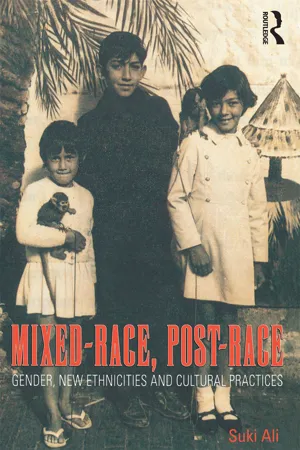
Social scientists claim that we now live in a post-race society, where race has been replaced by 'ethnicity'. Yet racism is endemic to British society and people often think in terms of black and white. With a marked rise in the number of children from mixed parentage, there is an urgent need to challenge simplistic understandings of 'race', nation and culture, and interrogate what it means to grow up in Britain and claim a 'mixed' identity. Focusing on mixed-race and inter-ethnic families, this book not only explores current understandings of 'race', but it shows, using innovative research techniques with children, how we come to read race. What influence do photographs and television have on childrens ideas about 'race'? How do children use memories and stories to talk about racial differences within their own families? How important is the home and domestic culture in achieving a sense of belonging? Ali also considers, through data gathered from teachers and parents, broader issues relating to the effectiveness of anti-racist and multicultural teaching in schools, and parental concerns over the social mobility and social acceptability of their children. Rigorously researched, this book is the first to combine childrens accounts on 'race' and identity with contemporary cultural theory. Using fascinating case studies, it fills a major gap in this area and provides an original approach to writing on race.
Information
—1—
'Where Do You Come From?'
[T]he question, and the theorisation of identity is a matter of considerable political significance, and it is only likely to be advanced when both the necessity and the 'impossibility' of identities, and the suturing of the psychic and the discursive in their constitution, are fully and unambiguously acknowledged.
S. Hall Questions of Cultural Identity
Introduction: 'Mixed-Race' Experiences
During the summer of 1998 I was in the middle of collecting the data which provides the material for this book. One day, while I was out shopping in the local supermarket, I bumped into Peggy. I knew Peggy quite well, although you could not characterise our relationship as a friendship. She was employed by my brother as a cleaner and I had lived at his house for a while. A white, workingclass Londoner, Peggy had lived in the same area her whole life. Her husband had died many years before leaving her to bring up a son and two daughters alone. She had had a hard life, and though her children were now grown, money was tight and she worked a variety of cleaning jobs to pay the bills. We stopped to chat and I asked how she was, as I no longer lived in the house and hadn't seen her for some months. She said that she was going through a particularly difficult time and explained why. Peggy's big news was that her beloved (white) son had 'taken up with a black girl' and, as a result of his mother's disapproval, had moved out and set up home with her. Peggy explained that although she knew that her boy had some black friends and had even had black girlfriends in the past, this was a serious relationship. Her biggest fear was that they would have children. I was so shocked by what she said next that I remembered the words exactly: 'I'm not racist but two cultures shouldn't mix. Some of those black people are all right, but the half-castes, well they're a breed apart'. (Peggy 56-year-old white, working-class Londoner, 1998).
Peggy had known me for several years (and my brother and sister longer), knew we were at least 'not-white', had met and spoken to our (white English) mother on more than one occasion.1 In numerous previous conversations, Peggy had alluded to community difficulties living in an area of London that has one of the highest ethnic diversities amongst the population. In particular, she talked about the difference between the 'blacks' or 'West Indians' and herself as a 'white' person. We agreed to disagree; when I challenged her she often said that she was not racist. On this occasion as on others, especially being 'half-caste' myself, I felt she was undoubtedly referring to me and to my family. I was so upset I was rendered speechless. The feeling was as acute as any other experience of racism I had ever encountered when a child. There is something especially bitter about resentments to my mixedness, deep and abiding, indescribably and incoherently wrong.It makes not only me invalid as a person, but worse still makes my mother wrong for all sorts of profound reasons. I said nothing, made an excuse and left.
After the encounter with Peggy I went home and wrote it down. It struck me how much that kind of conversation had the power to wound me, even though as an adult who studied in these areas I could rationalise it, analyse it, and to some extent explain it sufficiently for it make some kind of sense. None of those cognitive abilities made the emotion easier to bear. Nonetheless, analyse it I did as it spoke to the heart of the work I was (and still am) engaged with. The encounter reminded me that though we live in the increasingly post-race world - a world concerned with struggles for ethnic, national, religious and cultural meaning the irrational and corporeal ground of 'race' can still be a powerful force in social relations. It is a clear example of the tenacity of racialisation: 'a dialectical process by which meaning is attributed to particular biological features of human beings as a result of which individuals may be assigned to a general category of persons which reproduces itself biologically' (Miles 1989: 76).
Racialisation is a term which reinforces the psychosocially dynamic processes of 'racial positioning', and is often used in shorthand by talking about the way in which, for example, discourses themselves are 'raced' and often how this takes the form of 'racism'. Such a definition also implicitly underlines the role that 'family', real or imagined,informs this dis/identification with mixedness.
In Peggy's (and many others') terms, the language of 'Otherness' is now not only 'racial' but mobilises the 'cultural'. Peggy used the term 'culture' in place of 'race' to prove herself non-prejudiced and so she shows that 'post-race thinking' is filtering into everyday contexts. Post-race thinking is one of the central themes under investigation throughout the book; in this context it signifies a change from old essentialist views of biological races, and hence concepts of 'cultural mixing'. But Peggy also used 'half-caste', a term so outdated in academia that it is only used in historical context. This shows that although language or terms in common usage may change, meanings may well not. Whether Peggy uses the word 'race' or culture the meaning behind it is a 'racist' fear of the 'Other', of the black girl with her rampant sexuality trapping her son. This succinctly illustrates how discourses of 'race' are also hetero/sexualised and gendered. During one conversation when we talked about a white woman who lived near her, Peggy described her as 'Black man's woman' and asked me if I knew what that meant. I said I did not, and she decided not to enlighten me. I suspect it was a comment on this woman's sexual availability as well as her lack of good taste or judgement. These comments made me think of my mother who had also been a 'Black man's woman' and as a result suffered from abuse and discrimination, as had my father. That had been in the 1950s and 1960s, but for Peggy at least, the disapproval of interracial relationships is still tangible. She expresses a common concern that the children of these relationships are, at best, to be avoided, and, at worst, totally inhuman.
These are discourses that are 'out there' in common everyday usage; they construct and are constructed by a modern multiracial, multiethnic society in which some still believe in a form of white supremacy, fear of 'racial Others' and the contamination that they may bring through 'blood mixing'. Another important feature of this interaction was that the personal relationship between Peggy and myself was based on both a perceived 'race' and'class' difference. She conceptualised or identified herself as white, working class, and positioned me as 'coloured' and 'middle class'. This undoubtedly informed the way that she interacted with me at all times and shows how each part of our personal life histories informs the encounter.
Studying Mixedness
During the past decade I have read a large number of texts in order to try to understand my own position in relation to theoretical and political discourses of 'race' and racism.2 I found any meaningful engagement with mixedness almost entirely absent from mainstream literature on 'race', and that what material there was that centralised the issue was contextualised in ways that sometimes made translation to my own situation difficult. In this section I will introduce the key theoretical frameworks that inform the rest of the book. I start by looking at the empirical work into mixedness and then move on to consider the key issues about the encounter with Peggy in the light of post-race thinking.
Bad Blood
Foucault (1991) argues that genealogies require us to consider histories of the present, not in a search for an origin or linear trajectory leading us to the here and now but to provide us with details and surprises and possible truth effects from a range of sources. The historical antagonism to mixedness is well documented yet the central concerns within contemporary discussions often still hold echoes of colonial ideologies. Attitudes to interracial relationships and marriage and responses to fears of miscegenation have varied in different temporal and geographic locations (e.g. Martinez-Alier 1974; Ballhatchet 1980; Alibhai-Brown and Montague 1992; Tizard and Phoenix 1993; Breger and Hill 1998).3 Cultural and psychological differences categorised as borderline pathological were used to separate colonised 'natives' from the ruling British visitors in places such as West Africa and India (Ware 1992; C, Hall 1992; Balahatchet 1980; Opitz et al.1992). Conversely, in other areas such as South America, miscegenation was a strategy to control the indigenous natives by 'civilising' them through infusions of 'white' blood (see Stoler 2000; Labyani 2000). In Britain, mixed marriages took place as early as 1578, and fears of 'racial mixing' were often disguised by a stated concern for the sad products of this unnatural coupling. Stonequist's 'Marginal Man' thesis suggests that those of mixed heritage will suffer undue psychological harm as a result of possible rejection and lack of 'belonging' to a particular culture or 'race' (Stonequist 1937). Such ideas are tenacious. In 1998 a black woman was refused donor insemination from a London hospital as they only had white donors available. The reason given was for the 'sake of the children' (source Guardian Newspapers4). Jill Olumide argues: 'The problems and pathologies of mixed-race are framed in such a way as to indicate that these problems are somehow intrinsic to the group rather than dependent on social processes' (Olumide 2002: 47). Her work challenges this with its emphasis on the role of institutions (such as medical science) in the production of the problematic 'group' of mixed-race people and through in-depth analysis of 'the social construction of mixed-race' (ibid.). Olumide's account is another step towards the 'derecognition' of 'race' (ibid. 157). Her work is still for the most part set within the binary framework of black/white mixing, and again only deals with accounts from adults. It does, though, add more evidence to the argument for recognising how mixed identities force us to reconsider 'race' more generally.
Empirical work from around the world also supports a much more positive engagement with the possibilities of mixedness as an identity. In addition to the USA and British literatures, European perspectives on multiethnic positions are different again in their developing theories on 'racial' and cultural identities (e.g. Opitz et al.,Allund and Granquist 1995). There is a growing body of work by indigenous and migrant peoples in Australia and New Zealand that adds to the imperative for a more global perspective on 'racial mixing' (e.g. Ihihimaera 1998; Hartley 1995). In all these accounts, the experienceof mixedness is seen as potentially positive and counters the psychosocial censuring that is still in evidence in 'common sense' discourses of preferred 'monoraciality'.
It is clear from the above accounts and from demographic data that in spite of the historical and contemporary concerns with 'race mixing', increasing numbers of people are in mixed relationships (see Owen 2001). Even more importantly there is a significant and fast-increasing 'mixed-race population' of whom over 50 per cent are under the age of fifteen (see Phoenix and Owen 2000). In 1997 I attended the 'Rethinking "Mixed-Race"' conference where one of the key issues for discussion was the changes to the upcoming Census which was to include a new 'Mixed' category. Those present felt it to be an important development that needed extremely careful wording if it was to provide meaningful data. Although 'we' were happy finally to form a 'we' of sorts, we recognised the huge range of potential identifications that were excluded from most discussions of mixedness, focusing as they did on black/white binaries. At a later conference,5 the general feeling was that our concerns had been well-founded. It was agreed that the Census questions had been flawed as nation, ethnicity and 'race' were confused within the questions asked.6 Such problems reflect the difficulties in studying and theorisingmixedness.
David Parker and Miri Song (2001) argue that writing on 'mixed-race' takes three forms, the first of which incorporates diverse formulations that 'recognise "mixed-race" as a viable social category' (Parker and Song 2001: 6). They cite British empirical work by Tizard and Phoenix (1993), Benson (1981) and Wilson (1987) which looked at black/white mixes in support of this position. (I would add Olumide's.) I am not convinced that these authors necessarily argue for or support 'mixed-race' as a viable social categorythat needs no further discussion, any more than 'Black' does. What they do is provide valuable data in an under-researched area, and show that 'mixed-race' can be held as an identity. However, it is the inadequacyof 'mixed-race' as a single and coherent category that makes it so theoretically demanding. In a practical sense this is evidenced in the discussions over the problems with the British Census questions.
In the USA national identities are increasingly represented as multiracial or biracial (Parker and Song 2001), and this is reflected in the fact that 'mixed' categories have appeared on official forms for many years. Maria P.P. Root (1992, 1996) and Naomi Zack (1993, 1995) have been at the forefront of writing about mixedness in the USA and have put together collections of biracial and multiracial authors who also foreground their 'American' identities. What these (and other) collections show is the diversity of what can still be loosely termed gendered, mixed, American experience (Camper 1994; Fetherston 1994). Specifically, the authors cited above offer a direct response and challenge to the persistence of the idea that people who are multiracial will suffer more than those who are 'pure' in forging identities (see e.g. Cauce et aland Jacobs, both in Root 1992). It is, they argue, most often racism that is to blame for difficulties individuals have, rather than 'psychopathology' or 'dysfunctional families', and in this support the work in the British context by Olumide (2002). These collections include innovative work by individuals who claim heritage from Pacific Rim countries, South Asia, South America and Eastern Europe to name but a few. Despite the different national identitifications, cross-cultural endeavours focus on possibilities for change: '[multi/biracial/ised identity] provides us with a vehicle for examining ideologies surrounding race, race relations and the role of the social sciences in the deconstruction of race ... the answers are not to be found in a new system of classification, but in deconstruction, synthesis and evolution' (Root 1992: 10-11).
It is the latter part of Root's vision that fits best within the post-race framework - the need to deconstructand evolve.However, many of the authors featured in their books do not manage to do this as they draw together aspects of the 'comma-ed' or 'hyphenated' identities (Ang-Lygate 1995), that plague multiplicitous positions and hold to some kind of composite, constructed version of mixing previously singular 'racial' identities.
The problem lies not only with the ideaof 'race' itself but also within the languagethat constructs and maintains it. Jayne Ifekwunigwe (1997, 1999, 2000) interrogates terminologies and taxonomies of 'race' in her important work with adults of African and white heritage. Through her own experience, reading and the research of others she suggests that: 'Mixed-race people themselves as well as parents, carers, practitioners, educators, policy makers, academics and curious lay people are all hungry for a uniform but not essentialist term that creates a space for the naming of their specific experiences without necessarily re-inscribing and reifying "race"' (Ifekwunigwe 2000: 17). She remains convinced of 'the importance of trying to formulate an analytical scheme that can address multiracialised, biracialised and generational hierarchies of differences within the marginalised spaces of "mixed-race"' (ibid. 18). It is interesting that Ifwekunigwe uses this kind of (American) terminology, because, as Parker and Song note, 'the term multiracial grates on a British ear' (Parker and Song 2001: 8). The struggle to find appropriate names for collective identities whether forced or 'voluntary', coupled with a desire to preserve 'racial' or ethnic distinction, is a common feature of both British and USA literature.
A considerable amount of the work on multiracial identities does often draw upon a notion of multiple 'heritages' or family histories, and with it, unfortunately, the mixing or 'blending' of blood (Omi and Winant 1986; Spickard 1992). Both in Britain and the USA there has been a boom in auto/biographical writing, with literary life stories providing the detail of the experiences of mixedness (Spickard 2001). I am not in the least surprised that this kind of writing has become so popular, even with mainstream audiences (e.g. Smith 2000). In response to the ongoing singularity in hegemonic discourses of 'race', an...
Table of contents
- Cover
- Half Title
- Title
- Copyright
- Dedication
- Contents
- Acknowledgements
- 1 'Where Do You Come From?'
- 2 Researching the Unresearehable
- 3 Reading Popular Culture: Same Ideas, Different Bodies
- 4 Ambiguous Images: Relating 'Mixed-Race' Selves to Others
- 5 Creating Families Through Cultural Practices
- 6 Moving Homes: Gender, Diaspora, Ethnicity
- 7 Discourses of Race and Racism in Schools
- 8 'Mixed-Race' Futures
- Appendix
- Bibliography
- Index
Trusted by 375,005 students
Access to over 1.5 million titles for a fair monthly price.
Study more efficiently using our study tools.
Frequently asked questions
Yes, you can cancel anytime from the Subscription tab in your account settings on the Perlego website. Your subscription will stay active until the end of your current billing period. Learn how to cancel your subscription
No, books cannot be downloaded as external files, such as PDFs, for use outside of Perlego. However, you can download books within the Perlego app for offline reading on mobile or tablet. Learn how to download books offline
Perlego offers two plans: Essential and Complete
- Essential is ideal for learners and professionals who enjoy exploring a wide range of subjects. Access the Essential Library with 800,000+ trusted titles and best-sellers across business, personal growth, and the humanities. Includes unlimited reading time and Standard Read Aloud voice.
- Complete: Perfect for advanced learners and researchers needing full, unrestricted access. Unlock 1.5M+ books across hundreds of subjects, including academic and specialized titles. The Complete Plan also includes advanced features like Premium Read Aloud and Research Assistant.
We are an online textbook subscription service, where you can get access to an entire online library for less than the price of a single book per month. With over 1.5 million books across 990+ topics, we’ve got you covered! Learn about our mission
Look out for the read-aloud symbol on your next book to see if you can listen to it. The read-aloud tool reads text aloud for you, highlighting the text as it is being read. You can pause it, speed it up and slow it down. Learn more about Read Aloud
Yes! You can use the Perlego app on both iOS and Android devices to read anytime, anywhere — even offline. Perfect for commutes or when you’re on the go.
Please note we cannot support devices running on iOS 13 and Android 7 or earlier. Learn more about using the app
Please note we cannot support devices running on iOS 13 and Android 7 or earlier. Learn more about using the app
Yes, you can access Mixed-Race, Post-Race by Suki Ali in PDF and/or ePUB format, as well as other popular books in Social Sciences & Anthropology. We have over 1.5 million books available in our catalogue for you to explore.