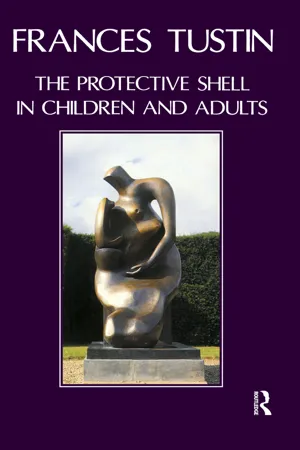
- 256 pages
- English
- ePUB (mobile friendly)
- Available on iOS & Android
eBook - ePub
The Protective Shell in Children and Adults
About this book
This book is by a professional for other professionals, but thoughtful people who are interested in the fundamental aspects of human nature will also find much to interest them. The papers which have been published in various journals or delivered to professional audiences since the appearance of Frances Tustin's previous book Autistic Barriers in Neurotic Patients are integrated with unpublished material written especially for this book, so that they can enrich and illuminate each other. A paper from the early days of her work with autistic children is the focus of this present work, since her awareness of encapsulation as being the major protective reaction associated with the autistic states of both psychotic and neurotic patients, has stemmed from that early paper.
Information
Chapter One
What autism is and what autism is not
Too often and for too long we have stood outside and regarded him [the autistic child] with increasing theoretical bewilderment as his behaviour continued to transgress the laws of orthodox psychopathology. Our only hope at present is to get inside him and look out at the world through his eyes.
[James Anthony, 'An experimental approach to the psychopathology of childhood autism', 1958, p. 211]
The 'theoretical bewilderment' to which James Anthony referred as long ago as 1958 still hampers precise diagnosis of autism. For example, as recently as 1986, the Polish professor of Psychiatry Andrzej Gardziel wrote:
Several diagnostic scales are in use . . . some children diagnosed as autistic according to one scale may be excluded by another. [Gardziel, 1986]
This confusion and uncertainty about diagnosis would seem to be due to the emphasis that psychiatric modes of classification place on external descriptive features. In my experience, the difficulty in diagnosis largely disappears when we get behind the external phenomena and study the underlying reactions that have given rise to the external features of the disorder. Becoming aware of these underlying reactions brings unifying order to the diverse and seemingly unrelated external characteristics of autistic psychopathology.
But before embarking on describing psychotherapeutic findings, let me gather together what has been written so far about the diagnosis of childhood autism from an external point of view.
Section I
External Descriptive Diagnostic Features
It would seem appropriate to begin with Leo Kanner's (1943) pioneering paper, in which he descriptively differentiated the syndrome he called early infantile autism from inherent mental defect. Here is his description of Paul, aged five years:
There was, on his side, no affective tie to people. He behaved as if people as such did not matter or even exist. It made no difference whether one spoke to him in a friendly or a harsh way. He never looked at people's faces. When he had any dealings with persons at all, he treated them, or rather parts of them, as if they were objects. [Ibid.]
He also writes:
Every one of the children, upon entering the office, immediately went after blocks, toys, or other objects, without paying the least attention to the persons present. It would be wrong to say that they were not aware of the presence of persons. But the people, so long as they left the child alone, figured in about the same manner as did the desk, the bookshelf, or the filing cabinet. Comings and goings, even of the mother, did not seem to register. [Ibid.]
At the time of its publication, and since then, Kanner's paper has aroused a great deal of interest. However, we have come to realize that the syndrome that Kanner described is very rare. One estimate is that its incidence is about 4 in every 10,000 children, its onset being before a child is 21/2 years old. But it is rarely diagnosed then. The parents of autistic children tell sad stories of going from one professional to another before the child's condition was recognized. Thus, it would seem to be important to alert health visitors and others who deal with mothers and young children to the danger signal of a mother and baby who do not seem to be in touch with each other.
This brings me to the most outstanding feature of autistic children, which is their lack of normal social relations. In his 1976 paper, Professor Rutter, who is a leading authority on the symptomatology of autism, described such children's absence of eye-to-eye gaze, and the way in which they did not assume the normal anticipatory gesture when picked up (body-moulding, as Margaret Mahler has called it). He described how they did not turn to their parents for comfort and how they approached strangers as readily as those whom they knew well. He described how they did not play co-operatively and appeared oblivious of the feelings and interests of others.
From humane experimental work with autistic children, Dr Peter Hobson (1986), a co-worker with Dr Rutter, has demonstrated such children's lack of empathy. Working in the same way as Dr Hobson, Uta Frith (1985) of the Medical Research Council has demonstated their lack of imagination. I have found these two findings very helpful for understanding clear-cut autistic children. They are specific to them.
Dr Rutter (1979) has described three symptoms as cardinal for the diagnosis of autistic children. The first is the failure to develop social relationships. The next is language retardation, some children being mute and others being echolalic, often with confusion in the use of personal pronouns such as 'I' and 'you'. The third symptom described by Rutter is their ritualistic and compulsive behaviour, associated with stereotyped movements and gestures.
Writing from the same behaviourist standpoint as Professor Rutter, Bernard Rimland (1964) has described in detail the external features of childhood autism and has, in addition, differentiated it from childhood schizophrenia.
Taking a wider perspective than either Rutter or Rimland, George Victor (1986) has also distingished childhood autism from childhood schizophrenia. He analysed a wide diversity of material from laboratory experiments with animals to parent's biographies of their autistic children. In chapter 2, he outlines the following symptoms:1
Rituals. These usually have the function of maintaining self-control and of keeping the environment from changing; autistic children's rituals are more bizarre than those of schizophrenic children and are clung to with greater tenacity.
Isolation. He describes autistic children's aloneness, their detachment and their withdrawal.
Sensation. Victor describes such children's peripheral vision, their seeming deafness and their oblivion to nearby events while tuning in to distant ones.
Sex. Autistic children's wild excitements resemble seizures or orgasms; these children are hypersexual and very sensual.
Movement. They may roll their heads, grind their teeth, and blink and grimace.
Sleep. Sleeping difficulties are common.
Miscellaneous symptoms. Victor describes autistic children's indifference to possessions and how they are upset by things that are broken or incomplete. He describes their panic after a slight change and their indifference to big changes.
Symptoms occurring in infancy. Victor also describes the way in which, both as infants and later on, autistic children are content to be left alone for hours.
Arising from his work as head of a day unit for psychotic children in the United States and writing as a psychotherapeutic psychiatrist, Dr Robert Olin (1975) distinguishes the autistic from the schizophrenic child and also from the organically retarded child. He particularly compares their feelings of identity. Of the autistic child he writes:
The autistic child's identity problem is one of feeling so small and insignificant that he hardly exists. So he defends against feelings of non-existence by using all his strength and ability to try to be a shell of indestructible power. [Olin, 1975]
Such a child may feel that he becomes a car, a light switch, a pavement or a record player. He becomes equated with such things instead of identifying with living human beings. Comparing the autistic with the schizophrenic child, Olin goes on to say:
A schizophrenic child, on the other hand, feels that his identity is very scattered and diffused—like mist in the air .. . . His personality is like a broken dish or a handful of sand that has been thrown into the wind. [Ibid.]
Olin continues:
He [the schizophrenic child] fragments and confuses in the most ingenious manners. For example, his words frequently make no sense to the observer. Suddenly, however, the observer discovers that there is a sort of secret message in what is being said and done. [Ibid.]
By comparison, the undoubted autistic child is mute or echolalic.
Olin comments on another difference between the two types of psychopathology, in that hallucinations are usually a feature of the schizophrenic child, but not of the autistic child, although they may occur in treatment when the autistic child is recovering.
Olin illustrates the difficulties in differentiating between autistic and schizophrenic children when external descriptive features alone are used, when he writes:
Like the autistic child, the schizophrenic child may not be cuddly. He resists learning. He has difficulty in mixing with other children. [Ibid.]
In the same vein, Olin continues:
Some schizophrenic children have histories which are similar to those of autistic children. [Ibid.]
Later he says:
Early in life, some children appear autistic. Later, they appear schizophrenic. Or, some children develop, initially, a schizophrenia which later becomes autism. [Ibid.]
Other writers have commented on this fluctuation in some psychotic children between autism and schizophrenia, which I have also noticed. A recent paper dealing with symptom development in childhood schizophrenia asks important questions about this fluctuation.2 In that paper, John Watkins, Robert Asarnow, and Peter Tanguay (1988) present their findings from a study of 18 children who met DSM-III criteria for schizophrenia with onset before 10 years of age. They found that symptoms of childhood autism were present in 39% of their sample, and that the onset of schizophrenia occurred at an earlier age for children with a history of autistic symptoms during infancy than for other children in the sample.
The writers then asked the important question: 'Does the finding that over one third of our sample of schizophrenic children had earlier histories of autistic symptoms imply a continuity between autism and schizophrenia?' In attempting to answer this question they suggested that, rather than supporting an argument for continuity, their results point to a need to rethink the way in which these disorders are defined. In relation to this, the authors have come to think that in much previous work, important developmental issues had been obscured by too great a reliance on age of onset as a diagnostic criterion. They concluded that their results brought into sharp focus the developmental nature of schizophrenia in children. This fits in with my own psychotherapeutic observations, which have made me suspect that, in some cases, autism has developed as a protection against the disintegration characteristic of schizophrenia. Thus when and if the autism breaks down, the latent schizophrenia manifests itself. Both autistic encapsulation and schizophrenic entanglement arise as protective reactions against the 'black hole' type of depression. Later in this chapter I hope to show that going behind the external symptoms enables us to take a deeper view of the developmental issues that differentiate the protections of childhood autism from those of childhood schizophrenia.
But before embarking on this, I need to correct certain common misapprehensions about autistic children.
Corrections to misconceptions
The mistaken idea that all autistic children have been unloved as infants has led to an over-emphasis on environmental causes, as well as to over-indulgent attempts to remedy their autistic condition. This notion that the autistic child had not been loved as an infant was first promulgated by Leo Kanner, who wrote of the mothers of such children as being 'cold' and 'intellectual'. Also, Dibs, the autistic child described by Virginia Axline (1966, 1971) was obviously unloved and unwanted. But this has not been the case with all autistic children. For example, all the autistic children I have worked with had had mothers who were depressed when the child was a young baby, but they had wanted the baby and had not been unloving, although their attention probably left much to be desired because of their depression.
Apropos the notion of the mothers of autistic children being unloving, Helen Baker, a child psychologist in a Child and Adolescent Unit in Australia, writes as follows:
As a Child Psychologist, who has worked with autistic children and their parents over a period of twelve years, I have found absolutely no relationship between the existence of the condition and the lack of love shown by the parents. In fact, some of the most caring parents I have met are those who happen to have autistic children. [Letter, 6 April 1988]
It seems to me that a variety of nature–nurture interactions can lead to autism. It has also seemed to me that, in some cases, genetic factors need to be given more weight than environmental ones. Obviously, much more work needs to be done concerning the assessment and sorting out of these children.
For myself, I have always found Colin Trevarthen's hypothesis about autism, which was derived from his observation of babies, to be in keeping with my own, which has arisen from clinical work with children. Victoria Hamilton, who met and heard Trevarthen lecture in Los Angeles, sent me a summary of his views. This gives them in such a succint way that I propose to quote it here. She wrote:
Trevarthen accepts Kanner's descriptive diagnosis, but rejects the refrigerator mother hypothesis. He thinks that autism is a dysfunction or disturbance in the emotional exchanges between mother and baby which regulate their contract. . . . Basically, I think his view is that babies are born with this very complex emotional set-up, the function of which is to communicate and regulate contact with other human beings. This set-up is very complex and delicate and fairly easy to disrupt.
I found this very sympathetic to my own point of view. It has seemed to me that most theories about autism do not put sufficient emphasis on inbuilt proclivities. Much too 'reasonable' explanations are offered for these children's aversion to human contact, such as that they have felt rejected by their mother, whereas it fits the clinical facts much better to see their behaviour as completely unreasoning, being reactive in terms of certain biological predispositions that are common to all human animals. Obviously, the balance between environmental and genetic influences will be different in each case, but inherent psychobiological predispositions that are common to all human beings will play the vital role.
Another popular misconception that it seems important for me to correct is that all autistic children are brain-damaged. As with their being unloved, just because some of these children are brain-damaged, it does not mean that all of them are.
Brain damage
Professor Adriano Giannotti and Dr Giulianna de Astis, who work in the research and psychotherapy unit of the Institute of Childhood Neuropsychiatry of Rome University and whose young autistic patients are all initially investigated in the well-equipped metabolic and organic unit of that institute, have written as follows:
The fact that some of these features of autism are occasionally accompanied by minimal cerebral lesions makes it necessary to investigate an important problem. Many of the cases we have observed and treated with some success had been diagnosed as mental retardation, or even cerebropathy, with the consequence that any possibility for normal psychic development had been ruled out. Our experience in this matter has shown that electroencephalographically revealed cerebral alterations tend to disappear with psychotherapeutic treatment; thus we do not believe that these lesions should be given excessive importance for psychotherapeutic purposes. Cases in which the autistic condition is related to serious cerebropathic alterations . . . have been excluded from our experience. [Giannotti & De Astis, 1978]
The trouble is that, to the superficial observer, the type of autism that mainly originates from psychological disturbances can look virtually the same as that which originates from gross organic damage. Obviously, careful and deep investigation is necessary. In...
Table of contents
- Cover
- Half Title
- Title
- Copyright
- Contents
- Acknowledgements
- Preface
- CHAPTER ONE What autism is and what autism is not
- CHAPTER TWO To be or not to be
- CHAPTER THREE Psychotherapy as a treatment for autistic children
- CHAPTER FOUR Confirmations of findings from psychotherapy with autistic children
- CHAPTER FIVE Psychotherapy with children who cannot play
- CHAPTER SIX The child who taught me about autistic encapsulation
- CHAPTER SEVEN The autistic capsule in neurotic adult patients
- CHAPTER EIGHT Other workers’ applications of findings, from autistic children to neurotic adult patients
- CHAPTER NINE Being born from the autistic shell: becoming part of a group
- CHAPTER TEN Autism in an adult patient
- CHAPTER ELEVEN Closing remarks
- CHAPTER TWELVE A statement
- References
- Index
Trusted by 375,005 students
Access to over 1.5 million titles for a fair monthly price.
Study more efficiently using our study tools.
Frequently asked questions
Yes, you can cancel anytime from the Subscription tab in your account settings on the Perlego website. Your subscription will stay active until the end of your current billing period. Learn how to cancel your subscription
No, books cannot be downloaded as external files, such as PDFs, for use outside of Perlego. However, you can download books within the Perlego app for offline reading on mobile or tablet. Learn how to download books offline
Perlego offers two plans: Essential and Complete
- Essential is ideal for learners and professionals who enjoy exploring a wide range of subjects. Access the Essential Library with 800,000+ trusted titles and best-sellers across business, personal growth, and the humanities. Includes unlimited reading time and Standard Read Aloud voice.
- Complete: Perfect for advanced learners and researchers needing full, unrestricted access. Unlock 1.5M+ books across hundreds of subjects, including academic and specialized titles. The Complete Plan also includes advanced features like Premium Read Aloud and Research Assistant.
We are an online textbook subscription service, where you can get access to an entire online library for less than the price of a single book per month. With over 1.5 million books across 990+ topics, we’ve got you covered! Learn about our mission
Look out for the read-aloud symbol on your next book to see if you can listen to it. The read-aloud tool reads text aloud for you, highlighting the text as it is being read. You can pause it, speed it up and slow it down. Learn more about Read Aloud
Yes! You can use the Perlego app on both iOS and Android devices to read anytime, anywhere — even offline. Perfect for commutes or when you’re on the go.
Please note we cannot support devices running on iOS 13 and Android 7 or earlier. Learn more about using the app
Please note we cannot support devices running on iOS 13 and Android 7 or earlier. Learn more about using the app
Yes, you can access The Protective Shell in Children and Adults by Frances Tustin in PDF and/or ePUB format, as well as other popular books in Psychology & Autism Spectrum Disorders. We have over 1.5 million books available in our catalogue for you to explore.