- 192 pages
- English
- ePUB (mobile friendly)
- Available on iOS & Android
eBook - ePub
About this book
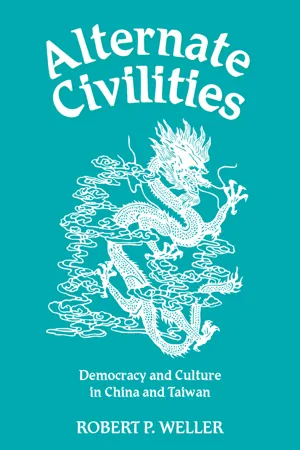
Alternate Civilities is an anthropologist's answer to the argument that China's cultural tradition renders it incapable of achieving an open political system. Robert Weller draws on his knowledge of both China and Taiwan to show how such sweeping claims fail to take account of potential democratic stimuli among local-level associations such as business organizations, religious groups, environmental movements, and women's networks. These groups were pivotal in Taiwan's democratic transition, and they are thriving in the new free space that has opened up in China. They do not promise a clone of Western civil society, but they do show the possibility of an alternate civility.
Information
1
Culture, Economy, and the Roots of Civil Change
China's political future concerns policymakers around the world almost as much as it does 1.2 billion Chinese citizens. Chinese societies have tried a panoply of different political systems in the course of the twentieth century. They began the century holding on to the dying remnant of the old imperial system with its emperor, magistrates, runners, and Confucian examination system. Taiwan and Hong Kong at the time were classic colonies with virtually no indigenous political power. The next few decades brought warlords, chaos in a few places, and most importantly the Republican government—economically modernizing (at least in intention), corrupt, politically authoritarian, and sometimes brutal. The Communist victory in 1949 finally brought peace, but not political stability, as the country lurched between following general Soviet policy and charging ahead into an egalitarian communism that left the Soviets panting angrily in the dust during the Great Leap Forward and then the Cultural Revolution. The really stunning recent political change has been Taiwan's move from authoritarian control to true democracy beginning in the late 1980s.
China's economic transformation as it has rediscovered markets during the same period has also brought some political loosening, but nothing like the dramatic changes in Taiwan. Yet the breadth of the recent social changes in China and the modern history of drastic political upheaval lead many, both in China and abroad, to wonder what the most appropriate and likely political structure for China will be. Two main schools and a few variants currently dominate the debates: One sees China as the latest success for an Asian-style authoritarianism that has no need or desire for Western liberal values, and another sees the triumph of market capitalism and the end of communism almost everywhere else in the world as the harbinger of a basically universal liberal social, economic, and political order.
Some sort of Asian authoritarianism seems to be the direction of choice for China's current rulers. It has considerable popular appeal as well. I was bumping along an arid and very peripheral corner of China a few years ago, sharing a Jeep with a senior professor and a young graduate student of his. The professor had suffered terribly during the Cultural Revolution, constantly humiliated and then forced to do years of bitter labor in one of the harshest and poorest environments in China. The student had grown up with the reforms. Somehow the conversation turned to Mao Zedong. The old professor, in spite of all he had been through, saw many positive contributions from the Great Helmsman, especially his vision of a new kind of China. The student disagreed at every turn, speaking with the bitterness one would have expected from someone who had actually lived through some of the worst periods. The student's idea of an attractive leader was instead Singapore's Lee Kuan Yew, one of the foremost champions of an Asian authoritarianism that rejects liberal values as Western ethnocentrism at best and neocolonialism at worst. Such a leader, he argued, could bring China wealth and stability without giving in to Western ideologies. This student was far from unusual—he was sympathetic with the "democracy" movement of 1989, concerned about the environment, and eager to study abroad. He was also eager for a China that could be strong and respected in the world by its own standards.
This image of an economic superpower morally opposed to the West has been very upsetting to a range of outsiders, from human rights groups opposed to political arrests, to U.S. congress members trying to slow trade with China.1 It is not hard to imagine a virulent combination of economic strength (based on simple projections of recent growth rates), political reaction (as in the powerful clampdown after 1989 and continuing calls for renewed Party control and education in socialist values), and nationalism (seen now in occasional outbursts like some sporting events, the conflict over the Nansha/Spratley Islands, and books like the influential China Can Say No).2 It is no accident that two recent influential American books on foreign policy close with purely imaginary wars between the United States and China.3
The major alternative people discuss is China's move more fully into a global modernity based on liberal market economics and democratic politics. The transformation of Eastern Europe and the ex-Soviet Union and the new wave of democratization in parts of Latin America and Africa imply for some the inevitable demise of socialist politics like China's. This would be, in Fulcuyama's famous phrase, the "end of history."4 Taiwan is the most relevant example here. By the mid-1950s, when both Taiwan and the mainland had recovered from their long wars, they had very similar cultural traditions, single-party states constructed on Leninist models, and powerful authoritarian control over daily life. They differed, of course, in the path of economic development they would pursue in the coming decades. Taiwan's thriving market economy ultimately helped push the island to full democracy. China's bullish new economy is headed in the same direction, making for plausible speculation that the political system could change in the same way.
While many in the West, and some in China, deeply desire such a change, it too contains an ugly variation—that the end of authoritarian central control would bring chaos and corruption, democracy to the point of anarchy. Severe social problems in much of Eastern Europe and the bloody collapse of Yugoslavia make this scenario quite plausible to many in China. Talk of Tibetan or Taiwanese independence, and even inklings of Cantonese chauvinism or other revivals of strongly local sentiment, only add to the fear of a general breakdown of central authority. Unified political power in China, after all, has collapsed many times in the past, sometimes for centuries at a time.
Culture and Economy
Understanding the dynamics behind these possibilities is central to the welfare of everyone in China and Taiwan, and also to formulating effective policies toward China. Does one promote a human rights agenda, for example, by encouraging trade to foster independent business interests, or by punitively limiting trade to send a message to the government? Can there be an Asian civil society, or even an Asian modernity, that retains values fundamentally different from those that developed in Enlightenment Europe?
Most of the reasoning behind various expectations for China's future has relied on two major factors: Chinese (or Asian) culture as a push to authoritarian politics and the market as a motor of change toward values of individualism and civil liberties. At heart this is an argument between two opposed views of how culture relates to economic change. In the "ancient curse" theory of culture, some remote ancestor becomes burdened with a worldview (usually called Confucianism in this case), after which it is inexorably passed down from generation to generation.5 Changing economics are largely irrelevant, and politics is a product of the cultural past. The "Etch-A-Sketch" theory of culture is the opposite. Here, as with the toy, you can draw any culture you want. When your interests require a new one, you just give a little shake and start over. Markets thus drive changing values in this view, and historical legacies do not count for much. I simplify sometimes complex arguments here, of course, and it is worth taking a closer look at the cases that have been made for both sides.
A Culture of Authority?
The argument that Chinese societies are unlikely to produce an open political system largely for cultural reasons comes in both Asian and Western forms. The Asian form was championed initially by Lee Kuan Yew, currently Singapore's senior minister, and Mohamad Mahatir, prime minister of Malaysia. It has become quite influential in China, and internationally is one of the most important voices opposing universalist values of civil liberties. The argument, at least in its Chinese form, rests on the idea that "Confucian culture" provides an alternative to Western ideas of human rights. Here the family metaphors of paternal benevolence and filial respect are extended to the nation as a whole, in a move that recalls both the European corporatist ideologies of Franco or Salazar (always the champions of the family) and Confucius himself.
In Singapore, this has evolved out of a largely unsuccessful Confucian education campaign into an ideology of shared values that allegedly unite the island's Chinese, Malay and Indian populations: nation before community and society above self, the family as the basic social unit, consensus over contention as a way of resolving issues, community support and respect for the individual, and harmony among racial and religious groups.6 The roots of this lie partly in an authoritarian reading of Confucianism, with the central government as caring father to a family of obedient children-citizens. This is hardly the only possible reading of Confucius, but it is consistent with the philosophy's use by two millennia of imperial Chinese governments.
This attempt to foster new Asian values also partly reacts against a rather occidentalized reading of "Western" morality, which is said to privilege individual over community and nation, dissolve family and religious morality into self-serving careerism, and solve problems through adversarial competition alone. The state's goal is to avoid the moral degeneration and social chaos for which politicians like Lee Kuan Yew constantly lambaste the United States and democratic Asian governments like Taiwan. Even the token recognition of the individual in this system is contextualized in a broader community. These were the ideas championed by Singapore, Malaysia, Indonesia, Iran, and China at the UN World Conference on Human Rights in 1993 as an alternative to Western concepts of human rights based on civil liberties.
Such values claim to be naturally independent from the global market economy, which advocates of Asian values typically embrace wholeheartedly. Campaigns for stepped-up "spiritual civilization" in the Peopie's Republic of China (PRC) similarly assume that the nation can develop a market economy without taking the "spiritually corrupt" Western values that historically grew up with that economy. This is a singularly un-Marxist point of view, of course, where culture has a life fully independent from the economy Yet it has been important in the People's Republic all along—the theoretical underpinning of the Cultural Revolution was also the idea that culture could remain stubbornly feudal or bourgeois even when the economic systems underlying those cultures had been utterly destroyed. This was an ancient curse indeed.
The Western, mostly scholarly, version of a determining Chinese authoritarian culture points to many of these same values. Instead of embracing them as a normative alternative, however, Western scholars generally regret how such values make a democratic China impossible. One of the pioneers in studies of Chinese political culture, Lucian Pye, identified a number of key characteristics that have been continuous through imperial and modern history. These include the centrality of hierarchy, a pervasive concern with morality over bureaucratic machinery (and thus of rule of men over rule of law), an imperative of conformity, and an antipathy toward the individual.7 Pye does not share Lee Kuan Yew's enthusiasm for any of this, but instead sees it as a key explanation of Chinese factionalism and periodic crises of authority. Like the "Asian values" enthusiasts, though, Pye has a very robust version of culture, in his case based in socialization practices, which has lasted China through the ages and shows little sign of any fundamental change.8
A related argument stresses the lack of institutional guarantees of trust in China. The Chinese skill at using interpersonal relations and forging personal networks of connections, according to this argument, evolved largely as a response to the absence of larger social or political mechanisms that could create the trust needed to do business. Such networks have turned out to be very useful in fostering dynamic family businesses in modern economies. Yet seeing this as an inherent feature of all Chinese societies makes it very difficult to imagine China building a democracy when the only available social resources are particularistic personal ties and the authoritarian state.9
Political scientists outside the China field have also discovered culture, and nearly always prefer the ancient curse version, Robert Putnam's important study of political variation in Italy also looks at social trust as an explanation for the relatively democratic society of the north and the relatively autocratic one of the south. Already six hundred years ago, he argues, northern Italy was characterized by horizontal ties of trust and mutual assistance, while the south emphasized vertical ties of hierarchy.10 The situation has been self-perpetuating ever since, leading to current political differences. Samuel Huntington has recently taken an even stronger culturalist position, chopping the world into seven or eight "civilizations," defined culturally with a strong emphasis on religion. Nearly all of these have existed for a millennium or more, apparently unchanged in their fundamentals. With the end of the Cold War, he predicts, the world will return to its older lines of unbreachable difference, and the potentials for major conflict lie along his civilizational fault lines. Possible conflict between the "West" and the "Sinic" world play a large role in this analysis.
His version of the "Confucian ethos" stresses "the values of authority, hierarchy, the subordination of individual rights and interests, the importance of consensus, the avoidance of confrontation, 'saving face,' and, in general, the supremacy of the state over society and of society over the individual."11 If this sounds rather like Singapore's version of things, it is because Huntington, more than nearly any other important Western observer, is sympathetic to their "ambitious and enlightened" effort to create a regional cultural identity.12 He is less cynical than others about this ideology being a convenient rationalization by an authoritarian government, largely because he agrees that such things are natural for the Sinic civilization, and because he sees no real possibility for fundamental change.
These strong cultural analyses tend to look past the case of a truly thriving Chinese democracy that already exists—Taiwan. The Kuomintang (KMT) government that took over Taiwan in 1945 learned its political organization hand-in-hand with the Communist Party As on the mainland today the government would not tolerate any institutionalization of pu...
Table of contents
- Cover
- Half Title
- Title
- Copyright
- Dedication
- Contents
- List of Figures
- Preface
- Acknowledgments
- 1 Culture, Economy, and the Roots of Civil Change
- 2 Legacies
- 3 The Limits to Authority
- 4 Business and the Limits to Civil Association
- 5 Religion: Local Association and Split Market Cultures
- 6 Forms of Association and Social Action
- 7 Alternate Civilities and Political Change
- Appendix
- Bibliography
- Index
Trusted by 375,005 students
Access to over 1.5 million titles for a fair monthly price.
Study more efficiently using our study tools.
Frequently asked questions
Yes, you can cancel anytime from the Subscription tab in your account settings on the Perlego website. Your subscription will stay active until the end of your current billing period. Learn how to cancel your subscription
No, books cannot be downloaded as external files, such as PDFs, for use outside of Perlego. However, you can download books within the Perlego app for offline reading on mobile or tablet. Learn how to download books offline
Perlego offers two plans: Essential and Complete
- Essential is ideal for learners and professionals who enjoy exploring a wide range of subjects. Access the Essential Library with 800,000+ trusted titles and best-sellers across business, personal growth, and the humanities. Includes unlimited reading time and Standard Read Aloud voice.
- Complete: Perfect for advanced learners and researchers needing full, unrestricted access. Unlock 1.5M+ books across hundreds of subjects, including academic and specialized titles. The Complete Plan also includes advanced features like Premium Read Aloud and Research Assistant.
We are an online textbook subscription service, where you can get access to an entire online library for less than the price of a single book per month. With over 1.5 million books across 990+ topics, we’ve got you covered! Learn about our mission
Look out for the read-aloud symbol on your next book to see if you can listen to it. The read-aloud tool reads text aloud for you, highlighting the text as it is being read. You can pause it, speed it up and slow it down. Learn more about Read Aloud
Yes! You can use the Perlego app on both iOS and Android devices to read anytime, anywhere — even offline. Perfect for commutes or when you’re on the go.
Please note we cannot support devices running on iOS 13 and Android 7 or earlier. Learn more about using the app
Please note we cannot support devices running on iOS 13 and Android 7 or earlier. Learn more about using the app
Yes, you can access Alternate Civilities by Robert Paul Weller in PDF and/or ePUB format, as well as other popular books in Politics & International Relations & Asian Politics. We have over 1.5 million books available in our catalogue for you to explore.