eBook - ePub
American Artists On Art
From 1940 To 1980
- 292 pages
- English
- ePUB (mobile friendly)
- Available on iOS & Android
eBook - ePub
About this book
From the Preface: The fact that so much of modern art has devoted itself to the exploration and assertion of its own identity is reflected in, but does not explain, the increasing amount of writing and talking on the part of contemporary artists. Rather, the whole history of the changing role of art and artists in a democratic, industrial, and technological society stands behind the spate of artists' words and the public's hunger for them--even some of the general public out there beyond art's little circle. Statements by artists appeal somewhat the way drawings do: they bring us, or at least they hold the promise of bringing us, closer to the artist's thoughts and feelings and to an understanding of his or her modus operandi; they hold the keys to a mysterious realm. And sometimes they offer us the sheer pleasure of good reading. Such is the primary raison d'etre of this book.Its other motivation is educational, and stems from the frustrating lack, in teaching contemporary art, of any single compilation of statements by American artists from 1940 to the present.... This anthology differs in several respects from those others that do include documents of American art since 1940.... The selection I have made is devoted exclusively to statements of artists; it is limited to the last four decades; it presents in a single volume a representative and fairly comprehensive coverage of major developments in American art beginning with Abstract Expressionism; and, whenever possible, it cities the first, or among the very earliest, documents signalizing a shift in the definition, intent, or direction of art."
Information
1
Abstract Expressionism
With the emergence, during World War II, of Abstract Expressionist painting (also known as Action Painting and the New York School), the United States began to play a major role in world art. The presence of several important European artists, especially Mondrian and the Surrealists—actually living right there, in the same place, during those years—was a profoundly liberating force to our artists, as Pollock acknowledges.
Jackson Pollock (1912-1956)
Jackson Pollock, Response to questionnaire, Arts and Architecture (February 1944)
This early statement by the artist who is universally identified with the American breakthrough in the 1940s was effectively titled simply by Pollock’s signature, with no interviewer named. Francis O’Connor ascertained from the artist’s widow, Lee Krasner, that the questionnaire was “formulated by Pollock with the assistance of Howard Putzel.”* Putzel was associated with the Art of This Century Gallery, where, during the war years, the expatriate Peggy Guggenheim showed the work of the European Surrealists whom she had brought here, as well as that of several of the Americans who later became known as Abstract Expressionists.
* * *
Where were you born?
J.P.: Cody, Wyoming, in January, 1912. My ancestors were Scotch and Irish.
Have you traveled any?
J.P.: I’ve knocked around some in California, some in Arizona. Never been to Europe.
Would you like to go abroad?
J.P.: No. I don’t see why the problems of modern painting can’t be solved as well here as elsewhere.
Where did you study?
J.P.: At the Art Student’s League, here in New York. I began when I was seventeen. Studied with Benton, at the League, for two years.
How did your study with Thomas Benton affect your work, which differs so radically from his?
J.P.: My work with Benton was important as something against which to react very strongly, later on; in this, it was better to have worked with him than with a less resistant personality who would have provided a much less strong opposition. At the same time, Benton introduced me to Renaissance art.
Why do you prefer living here in New York to your native West?
J.P.: Living is keener, more demanding, more intense and expansive in New York than in the West; the stimulating influences are more numerous and rewarding. At the same time, I have a definite feeling for the West: the vast horizontality of the land, for instance; here only the Atlantic Ocean gives you that.
Has being a Westerner affected your work?
J.P.: I have always been very impressed with the plastic qualities of American Indian art. The Indians have the true painter’s approach in their capacity to get hold of appropriate images, and in their understanding of what constitutes painterly subject matter. Their color is essentially Western, their vision has the basic universality of all real art. Some people find references to American Indian art and calligraphy in parts of my pictures. That wasn’t intentional; probably was the result of early memories and enthusiasms.
Do you consider technique to be important in art?
J.P.: Yes and no. Craftsmanship is essential to the artist. He needs it just as he needs brushes, pigments, and a surface to paint on.
Do you find it important that many famous modern European artists are living in this country?
J.P.: Yes. I accept the fact that the important painting of the last hundred years was done in France. American painters have generally missed the point of modern painting from beginning to end. (The only American master who interests me is Ryder.) Thus the fact that good European moderns are now here is very important, for they bring with them an understanding of the problems of modern painting. I am particularly impressed with their concept of the source of art being the unconscious. This idea interests me more than these specific painters do, for the two artists I admire most, Picasso and Miró, are still abroad.
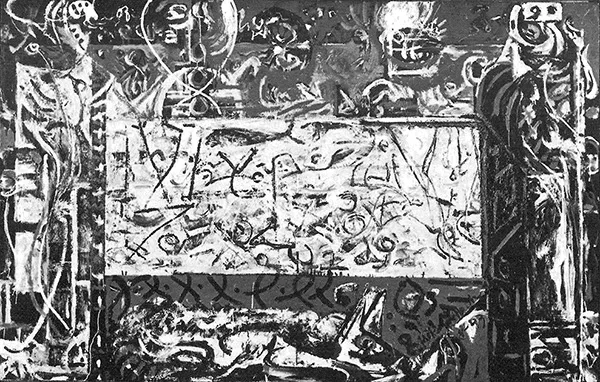
1. Jackson Pollock, Guardians of the Secret, 1943. Oil on canvas, 48¾ × 75 in. San Francisco Museum of Modern Art, Albert M. Bender Bequest Fund Purchase.
Do you think there can be a purely American art?
J.P.: The idea of an isolated American painting, so popular in this country during the thirties, seems absurd to me, just as the idea of creating a purely American mathematics or physics would seem absurd…. And in another sense, the problem doesn’t exist at all; or, if it did, would solve itself: An American is an American and his painting would naturally be qualified by that fact, whether he wills it or not. But the basic problems of contemporary painting are independent of any one country.
Jackson Pollock, “My Painting,” Possibilities I (Winter 1947-48)
This brief document, which included six illustrations of Pollock’s paintings, appeared in the first and only issue of Possibilities, published by Wittenborn, Schultz, Inc., and edited by Robert Motherwell, art; Harold Rosenberg, writing; Pierre Chareau, architecture; and John Cage, music. Pollock’s recorded statements are even more scant than Picasso’s—and nearly as influential. ‘On the floor I am more at ease. I feel nearer, more a part of the painting, since this way I can walk around, work from the four sides and literally be in the painting” is as familiar to the student of contemporary art now as Picasso’s “When a form is realized it is there to live its own life” was thirty or forty years ago.
* * *
My painting does not come from the easel. I hardly ever stretch my canvas before painting. I prefer to tack the unstretched canvas to the hard wall or the floor. I need the resistance of a hard surface. On the floor I am more at ease. I feel nearer, more a part of the painting, since this way I can walk around it, work from the four sides and literally be in the painting. This is akin to the method of the Indian sand painters of the West.
I continue to get further away from the usual painter’s tools such as easel, palette, brushes, etc. I prefer sticks, trowels, knives and dripping fluid paint or a heavy impasto with sand, broken glass and other foreign matter added.
When I am in my painting, I’m not aware of what I’m doing. It is only after a sort of “get acquainted” period that I see what I have been about. I have no fears about making changes, destroying the image, etc., because the painting has a life of its own. I try to let it come through. It is only when I lose contact with the painting that the result is a mess. Otherwise there is pure harmony, an easy give and take, and the painting comes out well.
Excerpted from William Wright, “An Interview with Jackson Pollock,” 1950, quoted in Francis V. O’Connor, Jackson Pollock, New York, Museum of Modern Art, 1967.
Taped for the Sag Harbor radio station but not broadcast, this interview dates from the same year as Hans Namuth’s extraordinarily illuminating film of Pollock at work, in which the artist voices some of the ideas expressed in these three documents.
* * *
W.W.: Mr. Pollock, in your opinion, what is the meaning of modern art?
J.P.: Modern art to me is nothing more than the expression of contemporary aims of the age that we’re living in.
W.W.: Did the classical artists have any means of expressing their age?
J.P.: Yes, they did it very well. All cultures have had means and techniques of expressing their immediate aims—the Chinese, the Renaissance, all cultures. The thing that interests me is that today painters do not have to go to a subject matter outside of themselves. Most modern painters work from a different source. They work from within.
W.W.: Would you say that the modern artist has more or less isolated the quality which made the classical works of art valuable, that he’s isolated it and uses it in a purer form?
J.P.: Ah—the good ones have, yes.
W.W.: Mr. Pollock, there’s been a good deal of controversy and a great many comments have been made regarding your method of painting. Is there something you’d like to tell us about that?
J.P.: My opinion is that new needs need new techniques. And the modern artists have found new ways and new means of making their statements. It seems to me that the modern painter cannot express this age, the airplane, the atom bomb, the radio, in the old forms of the Renaissance or of any other past culture. Each age finds its own technique.
W.W.: Which would also mean that the layman and the critic would have to develop their ability to interpret the new techniques.
J.P.: Yes—that always somehow follows. I mean, the strangeness will wear off and I think we will discover the deeper meanings in modern art.
W.W.: I suppose every time you are approached by a layman they ask you how they should look at a Pollock painting, or any other modern painting—what they look for—how do they learn to appreciate modern art?
J.P.: I think they should not look for, but look passively—and try to receive what the painting has to offer and not bring a subject matter or preconceived idea of what they are to be looking for.
W.W.: Would it be true to say that the artist is painting from the unconscious, and the—canvas must act as the unconscious of the person who views it?
J.P.: The unconscious is a very important side of modern art and I think the unconscious drives do mean a lot in looking at paintings.
W.W.: Then deliberately looking for any known meaning or object in an abstract painting would distract you immediately from ever appreciating it as you should?
J.P.: I think it should be enjoyed just as music is enjoyed—after a while you may like it or you may not. But—it doesn’t seem to be too serious. I like some flowers and other flowers I don’t like. I think at least … give it a chance.
W.W.: ... A person would have to subject himself to it [modern painting] over a period of time in order to be able to appreciate it.
J.P.: I think that might help, certainly.
W.W.: Mr. Pollock, the classical artists had a world to express and they did so by representing the objects in that world. Why doesn’t the modern artist do the same thing?
J.P.: H’m—the modern artist is living in a mechanical age and we have a mechanical means of representing objects in nature such as the camera and photograph. The modern artist, it seems to me, is working and expressing an inner world—in other words—expressing the energy, the motion, and other inner forces.
W.W.: Would it be possible to say that the classical artist expressed his world by representing the objects, whereas the modern artist expresses his world by representing the effects the objects have upon him?
J.P.: Yes, the modern artist is working with space and time, and expressing his feelings rather than illustrating.
W.W.: … Can you tell us how modern art came into being?
J.P.: It didn’t drop out of the blue; it’s a part of a long tradition dating back with Cézanne, up through the Cubists, the Post-Cubists, to the painting being done today.
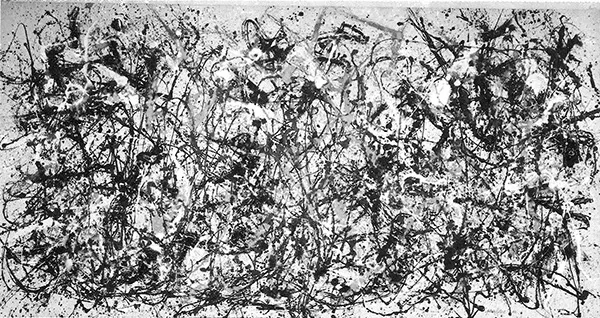
2. Jackson Pollock, Autumn Rhythm, 1950. Oil on canvas, 105 × 207 in. The Metropolitan Museum of Art, George A. Hearn Fund, 1957.
W.W.: Then, it’s definitely a product of evolution?
J.P.: Yes.
W.W.: … Can you tell us how you developed your method of painting, and why you paint as you do?
J.P.: Well, method is, it seems to me, a natural growth out of a need, and from a need the modern artist has found new ways of expressing the world about him. I happen to find ways that are different from the usual techniques of painting, which seems a little strange at the moment, but I don’t think there’s anything very different about it. I paint on the floor and this isn’t unusual—the Orientals did that.
W.W.: How do you go about getting the paint on the canvas? …
J.P.: Most of the paint I use is a liquid, flowing kind of paint. The brushes I use are used more as sticks rather than brushes—the brush doesn’t touch the surface of the canvas, it’s just above.
W.W.: Would it be possible for you to explain the advantage of using a stick with liquid paint rather than a brush on canvas?
J.P.: Well, I’m able to be more free and to have a greater freedom and move about the canvas, with greater ease.
W.W.: … Isn’t it more difficult to control than a brush? …
J.P.: No, I don’t think so … with experience—it seems to be possible to control the flow of the paint, to a great extent, and... I don’t use the accident—’cause I deny the accident.
W.W.: I believe it was Freud who said there’s no such thing as an accident. Is that what you mean?
J.P.: I suppose that’s generally what I mean.
W.W.: Then, you don’t actually have a preconceived image of a canvas in your mind?
J.P.: Well, not exactly—no—because it hasn’t be...
Table of contents
- Cover Page
- Half title
- Title Page
- Copyright Page
- Contents
- Acknowledgments
- Preface
- 1: Abstract Expressionism
- 2: Other Art of the Forties and Fifties
- 3: Color Field Painting
- 4: Happenings and Other Pre-Pop Art
- 5: Pop Art
- 6: Minimal Art
- 7: Systemic and Conceptual Art
- 8: Photo-Realist Painting and Super-Realist Sculpture
- 9: Earth and Process Art
- 10: Site and Architectural Sculpture
- 11: Performance Art, Film, and Video
- 12: Decorative, Narrative, and Popular Image Painting and Installations
- Illustrations
- Index
Trusted by 375,005 students
Access to over 1.5 million titles for a fair monthly price.
Study more efficiently using our study tools.
Frequently asked questions
Yes, you can cancel anytime from the Subscription tab in your account settings on the Perlego website. Your subscription will stay active until the end of your current billing period. Learn how to cancel your subscription
No, books cannot be downloaded as external files, such as PDFs, for use outside of Perlego. However, you can download books within the Perlego app for offline reading on mobile or tablet. Learn how to download books offline
Perlego offers two plans: Essential and Complete
- Essential is ideal for learners and professionals who enjoy exploring a wide range of subjects. Access the Essential Library with 800,000+ trusted titles and best-sellers across business, personal growth, and the humanities. Includes unlimited reading time and Standard Read Aloud voice.
- Complete: Perfect for advanced learners and researchers needing full, unrestricted access. Unlock 1.5M+ books across hundreds of subjects, including academic and specialized titles. The Complete Plan also includes advanced features like Premium Read Aloud and Research Assistant.
We are an online textbook subscription service, where you can get access to an entire online library for less than the price of a single book per month. With over 1.5 million books across 990+ topics, we’ve got you covered! Learn about our mission
Look out for the read-aloud symbol on your next book to see if you can listen to it. The read-aloud tool reads text aloud for you, highlighting the text as it is being read. You can pause it, speed it up and slow it down. Learn more about Read Aloud
Yes! You can use the Perlego app on both iOS and Android devices to read anytime, anywhere — even offline. Perfect for commutes or when you’re on the go.
Please note we cannot support devices running on iOS 13 and Android 7 or earlier. Learn more about using the app
Please note we cannot support devices running on iOS 13 and Android 7 or earlier. Learn more about using the app
Yes, you can access American Artists On Art by Ellen H. Johnson, Ellen H. Johnson,Ellen Johnson in PDF and/or ePUB format, as well as other popular books in Art & Art General. We have over 1.5 million books available in our catalogue for you to explore.