- 144 pages
- English
- ePUB (mobile friendly)
- Available on iOS & Android
eBook - ePub
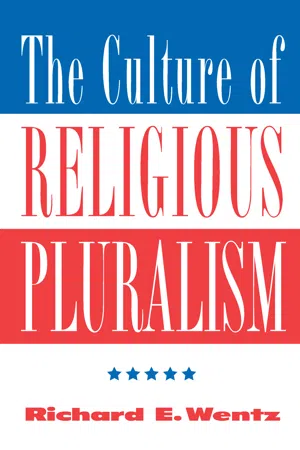
The Culture Of Religious Pluralism
About this book
Providing a historical context, this book examines the challenges that pluralism presents to denominationalism and civil religion and considers the contributions secularism and the New Age movement have made to the culture of religious pluralism.
Information
1
Diversity and Pluralism: An Introduction
A culture can be defined as an identifiable and regularized behavior that is attributable to a particular people and that is expressed through certain images, symbols, rituals, myths, and other kinds of stories. Art, music, literature, celebrations, and other distinctive creations and behaviors are all cultural forms; they give expression to the manner in which a certain people in their time and place live out their days. Cultures do not die; they undergo constant transformation. A culture that is believed to be “dead” usually lives on among a people who have memories of a mythic and legendary past. Even the “dead” language of a culture may live in words, symbols, and stories that continue to be important. It was long thought that the pre-Columbian cultures of Mexico and Central and South America were extinct. However, we are increasingly aware of the fact that the Incan and Aztec cultures live on among peoples whose present circumstances still reflect their cultural ancestry.
Culture is a difficult subject for academic study; it is inventive, changing, and elusive. Cultural study becomes a kind of mural painting, an affair of constantly identifying new elements and extending the tapestry. Therefore, cultural study is an interesting, even a fascinating intellectual enterprise. As Franklin Gamwell reminds us: “[The word] ‘religion’ is frequently used, at least in the first instance, to identify a form of culture.”1 This would imply, of course, that religion and culture are virtually indistinguishable terms. It would mean that what we call “religions” are those identifiable cultural forms associated with distinctive ways of living. Although religion and culture are finally indistinguishable, it is useful to understand that religion represents a particular reading of culture. Religion concerns itself with the manner in which cultural forms express a certain sense of the ultimate order and meaning of existence. The study of religion is therefore never satisfied with the definitions and proscriptions provided by official councils and their doctrines. It must take an academic reading of the entire culture. As Sam Gill puts it in his study of the religions of nonliterate peoples:
We are faced with great opportunities and challenges in the study of nonliterate peoples. The opportunities rest upon extending our knowledge of religious belief and practice in the cultural domains where religion is lived by all the people of a culture, a dimension to which in nonliterate cultures we are nearly confined. This cultural dimension exists in religions everywhere, but it has been largely ignored by religion scholars because of a preference to study religion in terms of its written documents. We are presented with the challenge to learn how to read and to understand the religious significance of elements of expression that are not written, such things as art, architecture, oral traditions, and ritual.2
The culture of America is measured to a great extent by its diversity. American art, architecture, music, and oral traditions have been shaped by diversity and by the need to accommodate the desire for unity to the necessity of accepting “manynessThe mutual encounters of Europeans, Native Americans, and Africans have fashioned a culture in which the religious need to give expression to ultimate order and meaning must take constant account of diversity. In America there are not only many religions; there is a religiousness that arises from the circumstances of that manyness. In other words, even if Americans live within their own religious particularities, when they accept manyness they acknowledge some perception of order and meaning not confined to their traditional religious loyalties.
The culture of religious pluralism is ever changing as new religious and ethnic groups arrive upon the scene, and also as our religiousness breaks out of its existing forms and joins in the many struggles for order and meaning in the midst of chaos. European religious consciousness in the North American context emerged out of the cultural revolution known as the Reformation of the sixteenth century. This was a chaotic struggle among diverse claims to authentic Christianity. Even the colonialism that accompanied the Reformation was more than a matter of economic or political manipulation. Geographic and demographic horizons were being radically shifted, and the questions of ultimate truth and salvation were directed toward mastering those who threatened existing perceptions of reality. The diversity generated in the sixteenth century, and exported to the New World almost immediately, has been a constant factor in American religious and cultural life.
The story of America is the story of this diversity and the hope of transcending its fragmentary effects. The thesis of this book is that the transformation of diversity into pluralism is a religious phenomenon that serves as a prevailing factor in the development of American culture. Pluralism denotes the acceptance of diversity; and this acceptance, we have observed, always works within some perception of ultimate order and meaning not confined to traditional religions.3
This, I take it, is what Sidney Mead means when, in the two essays cited on the dedication page of this book, he points to pluralism as a state of mind supportive of diversity and to his own quest to discern “the religion of the pluralistic culture in which [he has] lived and moved and had [his] being.”4 The usual academic distinction between the descriptive and the normative does not hold as we contemplate Mead’s ideas and the thesis I have set forth. Certainly this enterprise will reveal the depth of my commitment to the descriptive mode. I wish to set clearly before the reader the contours of American religious diversity and the manner in which each stage of American history has revealed the religious need to find a pluralistic posture of acceptance. But the attempt to understand the process of transformation cannot be only a matter of description. For, as Mead has pointed out: “[The] study of the history of the religion of one’s culture is perhaps the most direct and efficacious route to self-understanding, and that insofar as the historian is immersed in his culture (as I am in mine) his history of the religion of his culture is his ‘internal’ history and his approach will be ‘autobiographical.’”5 For Mead, the task of interpreting traditional or particular religions will likely be biographical rather than autobiographical. There is a certain sense of “outsiderness” that one accepts by admitting that one cannot live the lives of all people being studied. One becomes an empathetic biographer. However, all are common residents in a diverse culture where autobiographical assumptions are at work; it is not easy to separate oneself from the larger culture, and therefore the pursuit of understanding the religious dimension of pluralistic America is to some extent an exercise in self-understanding. “The American experience,” says Mead, “. . . has undermined real belief in the ultimacy of sectarian possibilities.”6 It has done so by reminding the devotees of each tradition that they are not God. That reminder is an essential element in the religious mind that learns to transform the particularisms of diversity into pluralism. To discover the truth of this statement is to move beyond mere functional description. It is a mode of selfunderstanding fashioned in the autobiographical necessities of a culture in which I am not an outsider.
I cannot escape those questions that are concerned with living together meaningfully in a common culture, even though I commit myself to the description of what I observe in the history of American religion and culture. Traditional societies, whether Native American, European Christian, or African, developed their cultures on the assumption that social order depended upon commonly shared rituals, symbols, and myths.7 These societies also assumed that their traditions had to be maintained by responsible and continuous leadership (e.g., by priests, storytellers, or medicine men, all of whom have their counterparts in modern societies). The natural diversity of human societies was disrupted by the emergence of modern ideas and technologies, beginning in the sixteenth century. Modern diversity (which is the only kind that the United States has known) is characterized by rapid and dramatic encounters that thrust people together in sacred spaces that had traditionally been occupied only by people with common worldviews. In the modern era, which encompasses America’s history from colonial times to the present, religious and cultural diversity could not exist either in parallel or shared sacred space. Diversity tended to exist within a broadly shared geographical area. As a result, the people occupying American space found it difficult to agree on shared rituals, symbols, and myths, and even more difficult to establish any appropriate leadership or authority for the maintenance of a common tradition.
The Meaning of Pluralism
Before launching into a discussion of the many forms of America’s religious and cultural diversity, I wish to explore some theoretical implications of the concept of pluralism. Because this is American history we are trying to understand, the American reader will have more than an academic interest in the subject. Diversity becomes pluralism because Americans all belong to their nation together, some as members of traditions or with commitments to specific religions, others without such relationships. Some Americans may not even feel any particular attachment to the nation itself. But the fact remains that, unless Americans wish to force their individual sentiments and motivations on the rest of society, they must all think together about the meaning of their country’s diversity.
Sooner or later, someone will challenge our ideas and loyalties. We may begin to wonder whether our loyalties are “true.” The question of the “truth” of what we think probably only arises when we become aware of “others” who think and act differently. They may ask us why we think and act as we do; or we may suddenly begin asking these questions of ourselves. The question of truth is a question of the reliability of our ideas and assumptions. Can I rely on what I think in the face of those who apparently think differently? Is what I think true? Does it measure up to the size of the world we occupy? The question of truth asks: How far outward does what I think extend? How far do my convictions go and how do they stack up against other ideas, of which I am only beginning to be aware?
Of course, our question is also important because our loyalties have to do with power. Sometimes we are told that power is a bad thing. However, power is an enabler. It is the resource that makes it possible for human beings to contribute to and maintain their own well-being and the well-being of those who belong to their circle of responsibility and concern. We need power to exist meaningfully and without undue dependence upon others who may threaten our well-being. Power is important, and the use of power is a delicate enterprise. Our loyalties empower us; they set conditions and provide resources for the conduct of our lives. In a world where there is but one form of loyalty, there are likely to be few limitations on the use of the power generated by that loyalty. As different loyalties increase in number, however, the people who represent each set of loyalties will experience various adjustments and curtailments of power.
Diversity within commonly shared political and economic space raises questions of more than loyalty and power. One of the most difficult of the issues before us is the matter of identity. Who am I? Who are we? I may assume that my identity is bound up with religious assumptions (including atheism and secularism) that are ethnic, ecclesiastical, or intellectual. That is to say, I may find it meaningful to identify myself as Polish Catholic, Orthodox Jewish, Irish Catholic, Swedish Lutheran, or Southern Baptist. However, it is difficult to nurture that identity in a space that is shared with others whose identity is different. That is why so many of our cherished commitments remain private; why, indeed, we consider discussion of religion and politics to be taboo in social settings. I am an American, and I live among people whose very presence challenges the public validity of my identity. How can I reconcile being Navajo and American at the same time? How can I be Jewish and American, Roman Catholic and American? Does one identity cancel another out?
These issues of power, loyalty, and identity are religious because they have to do with ultimate order and meaning. These are the issues that begin to fashion “the religion of the pluralistic culture” of which Mead speaks; they create pluralism because they affirm a set of values beyond our traditional allegiances. Diversity becomes pluralism, creating symbols, ideas, rituals, and myths that maintain the worth of plurality. Pluralism becomes a religious phenomenon, and a study of the culture of religious pluralism becomes more than an enterprise in the social sciences. American culture is based upon the religious assumptions of pluralism and encompasses the relationship of traditional religions to the religion of pluralism.
The Study of Religion
Religious studies is a relatively new academic discipline, and the communities of higher education are still surprisingly ignorant of the nature of the enterprise. One of the characteristics of the modern world has been the differentiation of the fullness of human activity into separate and compartmentalized units that are thought of as distinct and readily definable. Scholars who live in this kind of compartmentalized world assume that they can satisfactorily define these separate activities. One problem that emerges from such an assumption is that the scholar tends to believe that these limited definitions are objectively real. Accordingly, anthropologists, sociologists, and psychologists may define religion conveniently in keeping with their own compartmentalized notions and not realize the superficiality of their work.
Religious studies scholars attempt to gain as comprehensive a view of human thought and action as possible. These scholars are not satisfied with examining only what the social sciences call “religion.” Instead, they find religiousness expressed in almost all human endeavor. They move behind, before, and beyond, as well as into, the compartments called “religion” in order to encounter those ideas, images, and actions that express the ultimate order and meaning of existence for a people in a certain time and place. Accordingly, we can understand how and why the rest of the academic world may have no notion of what the discipline of religious studies is. Many may inexcusably assume that the enterprise is a specifically religious (in the sense of “pious” or “devout”) field of study. Yet what are called “religious commitments” or “experiences” are neither here nor there in the opinions of religious studies scholars; they are simply part of what is to be examined.
Scholars are concerned with religious ideas, images, and actions regardless of the context in which they may occur—whether that be religion or politics. They examine religious beliefs, commitments, and devotion as part of a comprehensive enterprise of trying to understand how humans express notions of ultimate order and meaning.
There are three modes in which religiousness is expressed: the verbal, the practical, and the social or communal.8 The verbal expression of religiousness has to do with the work of intelligence, the mind, and the use of words (hence verbal). We must remember, of course, that human intelligence is to some extent dependent upon the time and circumstances under consideration. An inhabitant of a remote Amazon wilderness is possessed of an intelligence that is different from that of twentieth-century Americans, but it is not to be considered inferior. The verbal expression of our religiousness has to do with ideas, images, intuitions, and convictions discerned by our minds as we respond to our status as human beings in an existence that seems greater than the sum of its parts. We derive ideas of gods or God, of first cause or primal force. Our minds formulate theories like Henri Bergson’s elan vital that provide a sense of ultimate order and meaning, helping us to understand life. The people of the Hopi mesas of north central Arizona speak of kachinas as spirit beings inhabiting the San Francisco peaks and visiting the mesas to animate the seasons and the cycles of fertility and growth. These too are ideas and images, relying upon language (words) that is shared by people to express the ultimate order and meaning of things. Whether we speak of beliefs, convietions, ideas, doctrines, or revelations, we allude to the propensity of the mind to discern, to think, and to communicate that which is necessary for an ordered and meaningful life.
The mind works with symbols and images that are formed by our social intelligence and imagination. They are part of the verbal mode of religiousness. The practical expression of these symbols has to do with actions and practices, with things done. We must not make the mistake of thinking that the practical mode follows or acts out what is first thought or believed. I recently came across this erroneous assumption in a book by Rollo May, the distinguished psychotherapist. In The Cry for Myth, May tells us that rituals act out and dramatize myths.9 This may or may not be the case. But the point is that human beings often ritualize their response to what it means to be human without first fashioning a story or a set of ideas or beliefs about their world. Contemplation, storytelling, or the development of doctrine may come after performative response to existence has been established.
Imagine, for example, the ancient peoples who lived in or near the deserts and other arid regions of the world. When the rains came, these people were like the birds who danced and chirped. They danced like the raindrops, laughing and crying at the same time, chattering and mimicking the rain and the birds.
Soon they remembered what they had done, and whenever the rains came they performed in the same way. But at first they remembered by doing, not by thinking. The thinking came later; and in this thinking there was a close association between the coming of the rains and their own spontaneous response...
Table of contents
- Cover
- Half Title
- Title Page
- Copyright Page
- For Cynthia
- Contents
- Preface
- 1 Diversity and Pluralism: An Introduction
- 2 Conquest and Conversion: Models of Response to Diversity
- 3 The Denominational Model: From Dissent to Commonality
- 4 Diversity and the Public Order: The Way of Civil Religion
- 5 Race, Gender, and Ethnicity
- 6 Secularity and Diversity
- 7 The New Age as a Festival of Diversity
- 8 The Mandate of Pluralism
- About the Book and Author
- Index
Trusted by 375,005 students
Access to over 1.5 million titles for a fair monthly price.
Study more efficiently using our study tools.
Frequently asked questions
Yes, you can cancel anytime from the Subscription tab in your account settings on the Perlego website. Your subscription will stay active until the end of your current billing period. Learn how to cancel your subscription
No, books cannot be downloaded as external files, such as PDFs, for use outside of Perlego. However, you can download books within the Perlego app for offline reading on mobile or tablet. Learn how to download books offline
Perlego offers two plans: Essential and Complete
- Essential is ideal for learners and professionals who enjoy exploring a wide range of subjects. Access the Essential Library with 800,000+ trusted titles and best-sellers across business, personal growth, and the humanities. Includes unlimited reading time and Standard Read Aloud voice.
- Complete: Perfect for advanced learners and researchers needing full, unrestricted access. Unlock 1.5M+ books across hundreds of subjects, including academic and specialized titles. The Complete Plan also includes advanced features like Premium Read Aloud and Research Assistant.
We are an online textbook subscription service, where you can get access to an entire online library for less than the price of a single book per month. With over 1.5 million books across 990+ topics, we’ve got you covered! Learn about our mission
Look out for the read-aloud symbol on your next book to see if you can listen to it. The read-aloud tool reads text aloud for you, highlighting the text as it is being read. You can pause it, speed it up and slow it down. Learn more about Read Aloud
Yes! You can use the Perlego app on both iOS and Android devices to read anytime, anywhere — even offline. Perfect for commutes or when you’re on the go.
Please note we cannot support devices running on iOS 13 and Android 7 or earlier. Learn more about using the app
Please note we cannot support devices running on iOS 13 and Android 7 or earlier. Learn more about using the app
Yes, you can access The Culture Of Religious Pluralism by Richard Wentz in PDF and/or ePUB format, as well as other popular books in Théologie et religion & Religion, politique et État. We have over 1.5 million books available in our catalogue for you to explore.