eBook - ePub
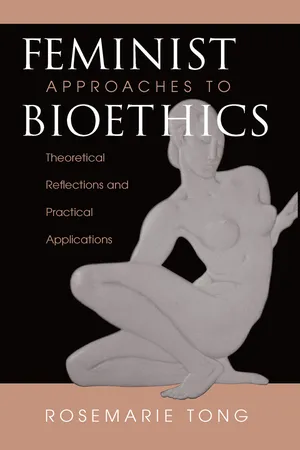
Feminist Approaches To Bioethics
Theoretical Reflections And Practical Applications
- 288 pages
- English
- ePUB (mobile friendly)
- Available on iOS & Android
eBook - ePub
Feminist Approaches To Bioethics
Theoretical Reflections And Practical Applications
About this book
No other cluster of medical issues affects the genders as differently as those related to procreation—contraception, sterilization, abortion, artificial insemination, in-vitro fertilization, surrogate motherhood, and genetic screening. Yet the moral diversity among feminists has led to political fragmentation, foiling efforts to create policies that are likely to serve the interests of the largest possible number of women. In this remarkable book, Rosemarie Tong offers an approach to feminist bioethics that serves as a catalyst, bringing together varied perspectives on choice, control, and connection. Emphasizing the complexity of feminist debates, she guides feminists toward consensus in thought, cooperation in action, and a world that would have no room for domination and subordination. Tong fairly and comprehensively presents the traditions of both feminist and nonfeminist ethics and bioethics. Although feminist approaches to bioethics derive many insights from nonfeminist ethics and bioethics, Tong shows that their primary source of inspiration is feminist ethics, leading feminist bioethicists to ask the so-called woman question in order to raise women's consciousness about the systems, structures, and relationships that oppress them. Feminist bioethicists are, naturally, committed to acting locally in the worlds of medicine and science. But their different feminist voices must also be raised at the policy table in order to make gender equity a present reality rather than a mere future possibility. Inability to define a plan that guarantees liberation for all women must not prevent feminists from offering a plan that promises to improve the welfare of many women. Otherwise, a perspective less appealing to women may fill the gap.
Information
Part One
Theoretical Overview
1
Nonfeminist Approaches to Ethics
In order to appreciate what distinguishes feminist from nonfeminist approaches to bioethics, we must first understand what distinguishes feminist from nonfeminist approaches to ethics. Although this is not a simple task, it is a necessary one. Tracing the similarities and differences between feminist and nonfeminist approaches to ethics will ultimately enable us to identify what feminist approaches to bioethics do and don't have in common with nonfeminist approaches to bioethics. It will also help us to formulate moral critiques of actions, practices, and institutions in the realm of biomedicine that reinforce women’s subordination; to develop morally justifiable methods of countering such actions, practices, and institutions; and to imagine morally ideal ways to restructure the realm of biomedicine in a women-liberating and women-affirming fashion.
Nonfeminist Approaches to Ethics: Some Dominant Perspectives
Western philosophers generally define ethics as a rational effort to systematize the rules, principles, and ideals to which we appeal in justifying our actions as right and our moral characters as good.1 For the most part, these norms arrange themselves in several familiar dyads: justice/benevolence, rights/responsibilities, individual freedom/group well-being, and so forth. Minimally, most of us wish to pursue our own goals without being harmed by other individuals; maximally, most of us also desire to live and work with other individuals who regard our goals as good ones for all human beings. Supposedly, ethics provides us with a number of analytic tools and action-guides with which to pursue our individual and collective goals “rightly”—whether these goals be minimalistic ones such as personal survival or maximalistic ones such as universal love. At the low end of the moral spectrum, ethics tells us what we must not do to other individuals: Do not kill, cheat, lie, steal, inflict unnecessary pain or suffering, and so on. And at the high end of the moral spectrum, ethics advises us as to how we can benefit other persons by contributing to their happiness or to the process of their perfection.
As I noted in the Prologue, the most widely recognized and therefore dominant systems of Western ethics include classical virtue-centered ethics (Aristotle), utility-oriented ethics (Jeremy Bentham and John Stuart Mill), duty-focused ethics (Immanuel Kant and W. D. Ross), sentiment-motivated ethics (David Hume), law-based ethics (for our purposes discussed as the Doctrine of Natural Law), and contract-grounded ethics (John Rawls). By briefly examining each of these systems of moral philosophy, we can identify some of the weaknesses as well as the strengths of nonfeminist approaches to ethics. The better we understand traditional Western ethics, the more we will be able to appreciate feminists' quarrels with it.
Classical Virtue-Centered Ethics
The Greek philosopher Aristotle (384-322 b.c.) was one of the earliest proponents of virtue ethics. He claimed that the ultimate goal of human action is personal happiness (eudaemonia), explained as “an active life in accord with excellence, or if there are more forms of excellence than one, in accord with the best and completest of them”2—that is, reason. Depending on our physical and psychological constitutions, we might obtain satisfaction from any number of human activities—for example, from parenting, teaching, or healing. What distinguishes these undertakings from, say, eating an ice-cream sundae, is that each is not only a satisfying activity but also one that makes use of our rational powers. In order to be truly happy persons, we have to use what Aristotle called the virtue of “practical wisdom” to prioritize and coordinate our human activities, organizing them in ways that serve the good of society as well as our own personal good.
In the course of describing the virtue of practical wisdom, Aristotle claimed that it has two indispensable functions. First, it enables us to identify which ends (i.e., aims, goals, or purposes) are really worthy of human desire and to pursue them only. Second, it helps us attain not only the specific goods internal to any worthy practice (e.g., medicine, law, business) but also the general good toward which all worthy practices tend— namely, the good of flourishing as an individual in a community. Unless we are practically wise, we will exhibit not virtue but either its excess or its defect. So, for example, the practically-unwise woman will act not courageously but either recklessly or in a cowardly way. Likewise, the practically-unwise man will act not generously but in either a stingy or ostentatious manner.
Practically-wise individuals are moral geniuses because they consistently strike at the mean between the excesses and defects that frame each virtue. This, too, is no easy task. It requires a person to coordinate reason with emotion in much the same way that a jockey becomes comfortable with a racehorse. As soon as the rider feels at one with the horse, she or he can compel it forward or rein it in without incurring any rebellion. For Aristotle, then, reason is like a jockey who uses the emotions to help individuals become experts in ethics, consistently running well in the race of life by making morally appropriate decisions. Commented Aristotle: “It is the expert, not just anybody, who finds the center of the circle. In the same way, having a fit of temper is easy for anyone; so is giving money and spending it. But this is not so when it comes to questions of ‘for whom?’ ‘how much?’ ‘when?’ ‘why?’and ‘how?’This is why goodness is rare. ‘3 But critics of Aristotle’s approach to ethics have objected that it errs by relying too heavily on practical wisdom, a virtue that requires consensus about what is truly valuable. Since individuals in a heterogeneous society such as ours do not typically agree on the moral worth of various ends (aims, goals, or purposes), it is highly unlikely that they will all strive to do the same “right thing.” On the contrary, insist the critics: The more heterogeneous a society is, the more necessary it is to create an ethics of rules that provides clear guidance about how far any one individual can go in the pursuit of her or his own unique good. Unless everyone’s rights, general responsibilities, and specific duties are precisely delineated, too much will be left to individual judgment, and no society set on surviving can afford to trust its members with their own moral governance.
Conceding that the critics' objection is a serious one, Aristotle’s defenders nonetheless insist that it is not a devastating one. They point out that although ancient Greece was a relatively homogeneous society, there was considerable disagreement as to what constituted the good life. Some thought it was material prosperity; others, power or prestige; yet others, the life of the mind. Still, Aristotle’s “great-souled man,” whom we might instead term a “right-minded person,” managed to settle moral disputes wisely, serving as an example for the majority of his contemporaries.
If Aristotle’s defenders are correct, ideals as well as rules play a crucial role in our moral development. The power of an ideal, however, is quite different from the force of a rule. Whereas rules tell us what is forbidden, permitted, or required and threaten us with punishments for noncompliance, ideals encourage us to put our best foot forward even when we are not required to do so. This is not to suggest that ideals, compared to punishment-backed laws, are a weak means of behavior control. On the contrary, by requiring ourselves to live up to a set of self-imposed moral ideals, we might become the human analogues not of tiny bonsai trees but of giant redwoods. For the Aristotelian, ethics is fundamentally the struggle to become one’s best self.
Given the fact that ideals have guided the practice of healing through the ages, Aristotelian ethics should appeal to health-care practitioners. According to such classical texts as the Hippocratic Oath and the Prayer of Maimonides, as well as to such contemporary documents as the Principles of Medical Ethics statement of the American Medical Association (AMA), medicine’s moral foundation depends on the cultivation, by physicians in particular, of a certain set of virtues. Among these essential virtues are respect for human dignity, compassion, and respect for human life.4 Displaying what seems to be these virtues may result in great professional success, esteem, and even patient satisfaction; but in the Aristotelian system, pretending to be good is a far cry from actually being good. The appearance of moral conduct is not an acceptable substitute for the reality of moral conduct. Physicians must really care about their patients; faking concern is an unacceptable substitute.
Utility-Oriented Ethics
Like Aristotelians, utilitarians believe that happiness is a fundamental human goal; however, they link happiness not with the achievement of personal perfection but with the attainment of the most good for the most people. Because utilitarians are committed to performing whichever action is most likely to net the most good (happiness minus unhappiness, benefit minus cost, pleasure minus pain) for the most people, they consider both the utility-producing and the disutility-producing consequences of each of several alternative actions before deciding on one. For example, a woman choosing between aborting or not aborting her fetus must decide whether she will produce more overall utility by terminating or not terminating her pregnancy. Let us assume that this woman’s parents and friends are opposed to abortion and that her husband wants a child more than anything else in life. Let us also assume that this woman’s chances of achieving her career goals will be severely limited if she has a child at this time. If more unhappiness will accrue to her parents, friends, and husband if she has the abortion than will accrue to her if she does not have the abortion, utilitarian tenets require her to continue the pregnancy. What ultimately matters is not an individual’s happiness or rights but what is best for everyone on the whole.
Some critics of utilitarianism object that individuals are not necessarily morally required to prefer the group’s interest over their own interests. They find utilitarianism’s emphasis on “self-sacrifice” unsettling. They reason that if ethics grants rights to individuals, then it is flagrantly wrong to disregard these rights simply because the majority’s pleasure or happiness is served by doing so. Other critics of utilitarianism object that it is impossible to construct a moral scale so finely calibrated that it can objectively weigh, for example, a woman’s career goals against her husband’s “paternal instincts.” In particular, they ridicule Jeremy Bentham’s (1748-1832) “hedonic calculus,” which he designed to enable people to measure the utility of their actions in terms of duration, intensity, certainty, propinquity, fecundity, purity, and extent.5 Few—if any—people were able to use Bentham’s calculus successfully, having apparently proved unable to “quantify” their various and sundry happinesses and unhappinesses.
Bentham’s failure provoked his successor, John Stuart Mill (1806-1873) to distinguish between quantity and quality of goods.6 Mill’s followers would advise the woman in our previous example to determine not only the amount of happiness that the fulfillment of her career goals would bring her but also the relative human worth of such an achievement. Since no reasonable person ever deliberately chooses an inferior good over a superior good, she or he would also advise the woman to use as her criterion for action the judgments of reasonable women who have had to make similar judgments under comparable circumstances in the past. If reasonable women who have experienced both childbearing (to make their husbands happy) and career-pursuing (to make themselves happy) rate the latter happiness as much better than the former, then the woman in our example should have the abortion she wants.
Mill’s critics, however, are not confident that anyone, including the woman in our example, should use Mill’s experienced judges as moral guides. In their view, there are no criteria for membership in this select group other than to be “reasonable.” Thus, they caution that Mill’s experienced judges are not reasonable judges but, instead, partisan judges, intent on affirming their particular values as universally right and good.
To avoid the problem of relying on partisan judges, twentieth-century preference utilitarians suggest that the most democratic way to make intersubjective comparisons of utility is to construct a scale on which all people can rank their pleasure preferences from highest to lowest. Yet as appealing as this suggestion seems, it is doubtful either that such a scale can be devised or that most people would truthfully rank their actual preferences on it. When people are polled about their preferences, they tend to distinguish between their ideal and actual preferences, often reporting the former rather than the latter to pollsters. For example, knowing that for ideological reasons feminists ought to prefer Ms. magazine to Harlequin romances, a feminist might reveal her ideal preference (Ms.) rather than her actual preference (Harlequin) to pollsters. After all, it would probably be too embarrassing for her to admit publicly that she enjoys reading novels that portray women as “sex kittens” more than reading journals that highlight women’s professional accomplishments.
Yet, even if preference utilitarians were able to construct a perfect preference scale on which persons would rank only their actual preferences, they, like all utilitarians, would still need to prove that individuals should sacrifice their own good to that of the group if doing so would produce more total good. It is this assumption, more than any other, that threatens the moral credibility of utilitarianism in its critics' estimation. Consider, for example, the hypothetical case of Sally, a dying patient, whose bodily organs could be used to save the lives of five other patients. Let us assume that Sally is unemployed and that she is without family and friends, whereas the other five patients are powerful persons with large families and many friends. Let us also assume that only Sally can provide the needed organs, since alternative organ sources are unavailable. Finally, let us assume that Sally has only a few more weeks to live, but that the other five patients will die within hours unless Sally’s organs are immediately transplanted in them, in which case they will live for several years. Under such circumstances, so-called act utilitarians (who directly apply the principle of utility to each and every case as it arises) would defy the ordinary moral judgment according to which Sally should not be killed even if it means that five “worthier” people will die. They would seek to justify killing Sally by viewing her and the five other patients who need her organs as some sort of collective superperson whose aggregate utility demands to be maximized. Individual rights, even Sally’s right not to be killed, must give way to the group’s interest in life.
In contrast to act utilitarians, so-called rule utilitarians would probably not view killing Sally as a morally appropriate action. Rule utilitarians directly apply the principle of utility to general rules of action rather than to specific actions. For this reason, they would most likely argue that even if the specific act of violating Sally’s right to life produces overall utility in the immediate circumstances, a general rule permitting—let alone requiring—such a violation would not produce more overall good in the long run. On the contrary, it would lead to radical social instability, to a fear that the abuses initially inflicted on the Sallys of this world might one day be inflicted on one’s own family, friends, or self.
In its emphasis on rules, rule utilitarianism rep...
Table of contents
- Cover
- Half Title
- Title
- Copyright
- Contents
- Acknowledgments
- Prologue
- Part One Theoretical Overview
- Part Two Practical Applications
- Epilogue
- Notes
- About the Book and Author
- Index
Trusted by 375,005 students
Access to over 1.5 million titles for a fair monthly price.
Study more efficiently using our study tools.
Frequently asked questions
Yes, you can cancel anytime from the Subscription tab in your account settings on the Perlego website. Your subscription will stay active until the end of your current billing period. Learn how to cancel your subscription
No, books cannot be downloaded as external files, such as PDFs, for use outside of Perlego. However, you can download books within the Perlego app for offline reading on mobile or tablet. Learn how to download books offline
Perlego offers two plans: Essential and Complete
- Essential is ideal for learners and professionals who enjoy exploring a wide range of subjects. Access the Essential Library with 800,000+ trusted titles and best-sellers across business, personal growth, and the humanities. Includes unlimited reading time and Standard Read Aloud voice.
- Complete: Perfect for advanced learners and researchers needing full, unrestricted access. Unlock 1.5M+ books across hundreds of subjects, including academic and specialized titles. The Complete Plan also includes advanced features like Premium Read Aloud and Research Assistant.
We are an online textbook subscription service, where you can get access to an entire online library for less than the price of a single book per month. With over 1.5 million books across 990+ topics, we’ve got you covered! Learn about our mission
Look out for the read-aloud symbol on your next book to see if you can listen to it. The read-aloud tool reads text aloud for you, highlighting the text as it is being read. You can pause it, speed it up and slow it down. Learn more about Read Aloud
Yes! You can use the Perlego app on both iOS and Android devices to read anytime, anywhere — even offline. Perfect for commutes or when you’re on the go.
Please note we cannot support devices running on iOS 13 and Android 7 or earlier. Learn more about using the app
Please note we cannot support devices running on iOS 13 and Android 7 or earlier. Learn more about using the app
Yes, you can access Feminist Approaches To Bioethics by Rosemarie Putnam Tong in PDF and/or ePUB format, as well as other popular books in Philosophy & Ethics in Medicine. We have over 1.5 million books available in our catalogue for you to explore.